Disclaimer: This article is for educational and informational purposes only. It does not constitute financial or investment advice. Trading forex and CFDs carries significant risk of loss. Past performance of any strategy — including backtests — does not guarantee future results. Never trade with money you cannot afford to lose.
What Is This Strategy?
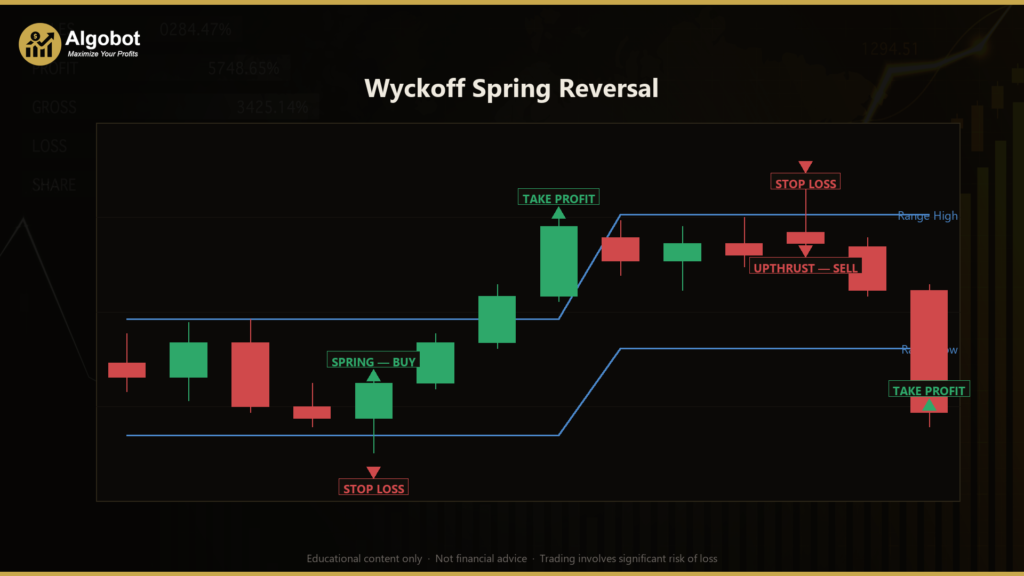
The Wyckoff Spring Reversal is a pure price-action reversal strategy built on the classic Wyckoff method — a framework for reading supply and demand inside a trading range. Rather than relying on lagging indicators like moving averages or oscillators, this Expert Advisor (EA) reads the raw structure of price itself, hunting for failed liquidity sweeps at the edges of a recently established range. The two patterns it looks for are the "Spring" (a failed downside break) and the "Upthrust" (a failed upside break).
The strategy is designed for range-bound or consolidating markets — periods where price oscillates between a definable high and low rather than trending strongly in one direction. In these conditions, the boundaries of the range tend to attract stop orders. When price briefly pierces a boundary and then snaps back inside, it often signals that the breakout failed and that the dominant side (buyers or sellers) has been absorbed. The Wyckoff Spring Reversal aims to capture the rotation that may follow such a failure.
As a learning tool, this EA is well suited to traders who want to study mean-reversion and liquidity concepts without the noise of additional indicators. Because every entry maps to a clear, visual pattern on the chart, it is a useful way to understand how Wyckoff range mechanics translate into mechanical, rule-based logic. It is framed here as a strategy analysis — a way to study a method — not as a profit opportunity.
How It Works
The strategy evaluates one freshly completed bar at a time (no look-ahead bias) and only considers a new trade when no position is already open. Here is the logic in plain English:
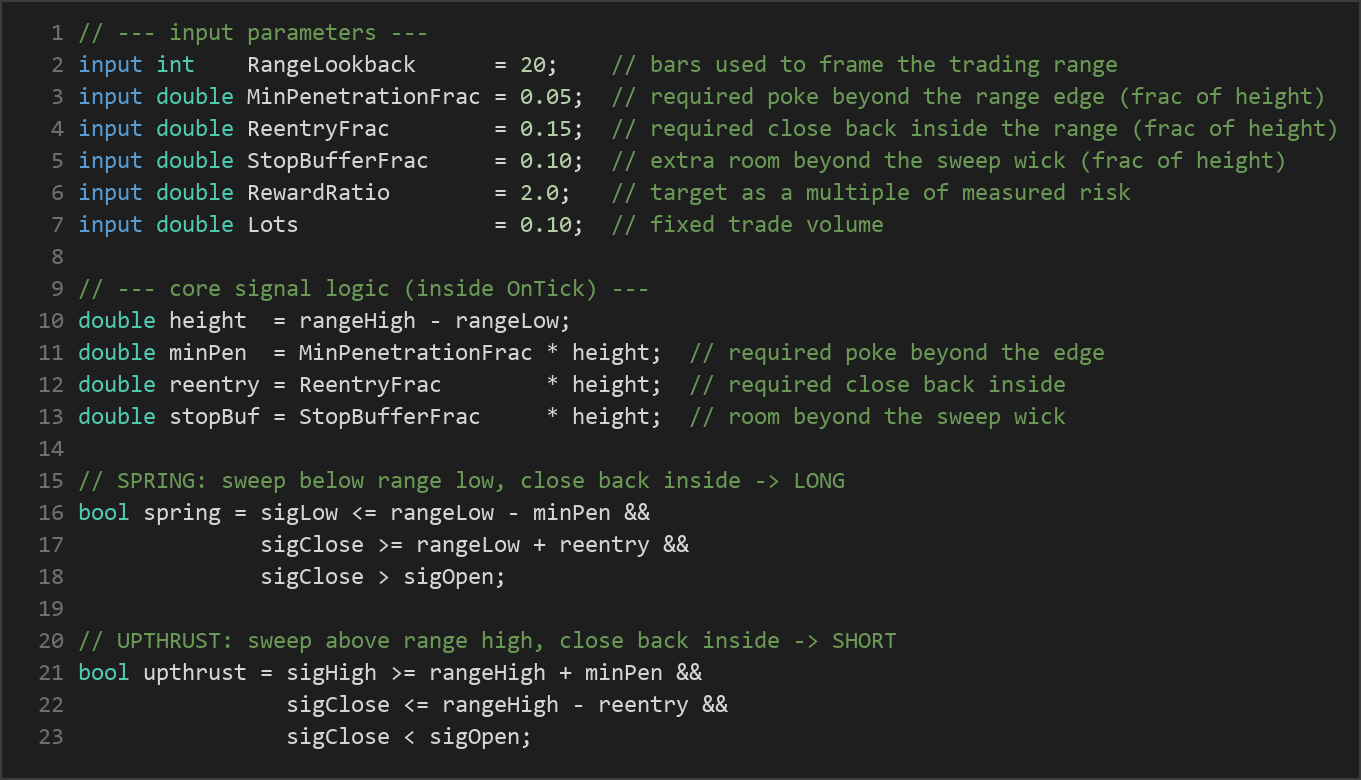
- Framing the range: The EA scans a lookback window of recent bars behind the signal bar to find the highest high (the range high) and the lowest low (the range low). The distance between them is the range "height," which scales every other threshold in the strategy.
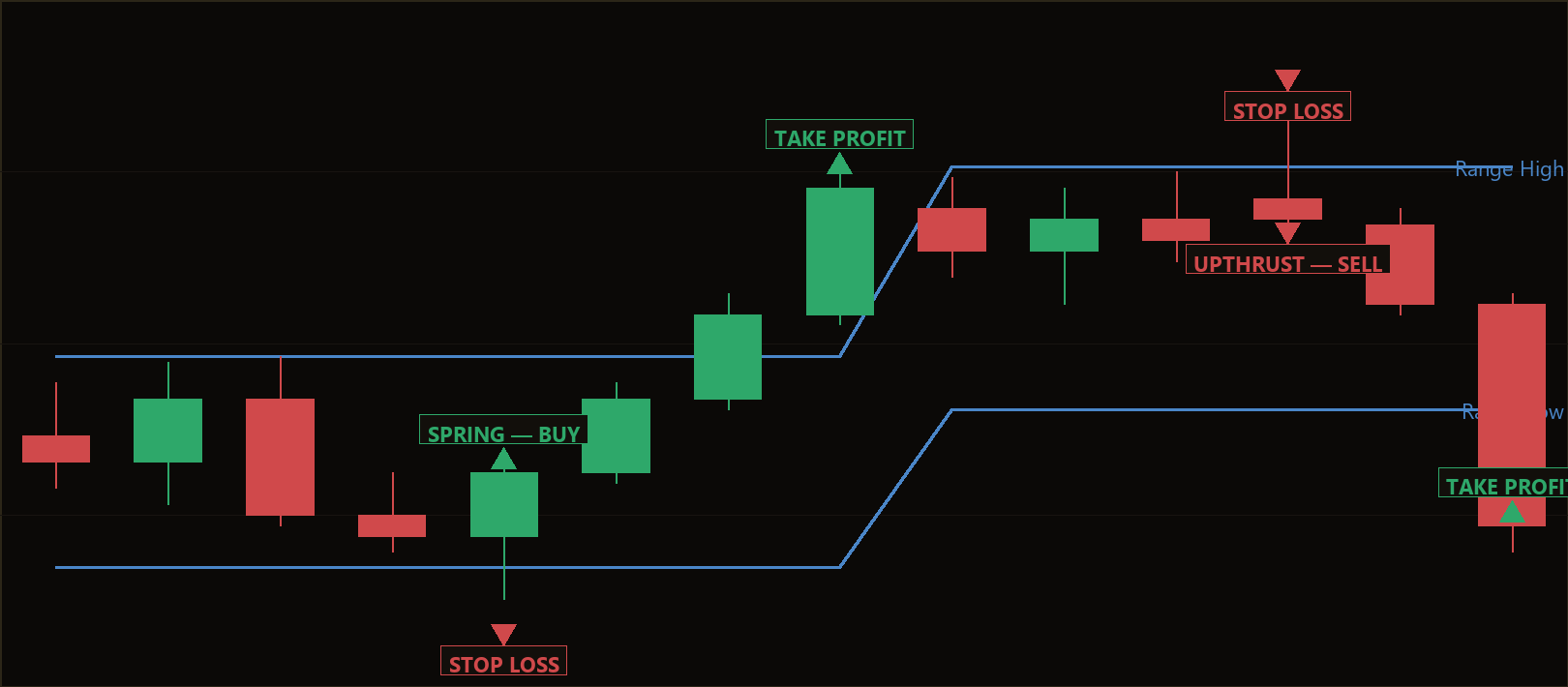
- Spring entry (long): The strategy signals a long when the signal bar's low pokes below the range low by at least the minimum penetration amount (sweeping sell-side liquidity / stops), but the bar closes back inside the range by at least the re-entry amount, and closes higher than it opened. The interpretation: the breakdown failed, supply was absorbed, and price may rotate upward.
- Upthrust entry (short): The strategy signals a short when the signal bar's high pokes above the range high by at least the minimum penetration amount (sweeping buy-side liquidity), but the bar closes back inside the range by at least the re-entry amount, and closes lower than it opened. The interpretation: the breakout failed, demand was absorbed, and price may rotate downward.
- Stop-loss logic: The stop is placed just beyond the sweep wick — below the signal bar's low for a Spring, above the signal bar's high for an Upthrust — plus a small buffer. This is the point where the reversal idea is invalidated: if price returns to make a new extreme, the failed-sweep premise no longer holds.
- Take-profit logic: The target is a fixed multiple of the measured risk (the distance from entry to stop). With the default reward ratio of 2.0, the EA seeks two units of reward for every one unit risked. There are no trailing stops or partial exits; each trade resolves at either its stop or its target.
Every threshold — penetration depth, re-entry depth, and stop buffer — is expressed as a fraction of the range height rather than a fixed pip value. This lets the same settings adapt proportionally to wide and narrow ranges.
Strategy Parameters
| Parameter | Default | Min | Max | Description |
|---|---|---|---|---|
| RangeLookback | 20 | 10 | 60 | Number of bars used to frame the trading range (the highest high and lowest low behind the signal bar). |
| MinPenetrationFrac | 0.05 | 0.0 | 0.40 | Required poke beyond the range edge, as a fraction of range height, before a sweep counts. |
| ReentryFrac | 0.15 | 0.0 | 0.50 | Required close back inside the range, as a fraction of height, confirming the sweep failed. |
| StopBufferFrac | 0.10 | 0.0 | 0.50 | Extra room placed beyond the sweep wick for the stop-loss, as a fraction of height. |
| RewardRatio | 2.0 | 1.0 | 4.0 | Take-profit target expressed as a multiple of the measured risk (entry-to-stop distance). |
| Lots | 0.10 | 0.01 | 1.0 | Fixed trade volume in lots for each position. |
Recommended Chart Settings
The Wyckoff Spring Reversal was designed as a single-position, swing-style reversal EA and tends to be studied on higher intraday timeframes such as the H1 (1-hour) or H4 (4-hour) charts, where ranges are cleaner and individual sweep bars carry more weight. It can be applied to liquid instruments — major forex pairs, indices, or gold — where defined ranges form regularly.
Because the strategy is built for consolidating conditions, it will behave very differently in a strong trend, where range boundaries are repeatedly broken rather than respected. Results will vary across different symbols, timeframes, and market conditions, and any setting that looks favorable on one instrument may not transfer to another. Always test the EA on a demo account across multiple market environments before drawing conclusions.
How to Install on MetaTrader 5
- Download the .ex5 file from the link below
- Copy it to your MT5
MQL5\Expertsfolder - Restart MetaTrader 5 or refresh the Navigator panel
- Drag the EA onto a chart matching the recommended symbol and timeframe
- Configure the input parameters and enable Algo Trading
What to Consider Before Using This EA
Strengths of the approach. The Wyckoff Spring Reversal is conceptually clean: it uses no indicators, makes one decision per closed bar, and ties every entry to a visible, well-documented price pattern. Its stops sit at a logical invalidation point — just beyond the failed sweep — and its risk-to-reward is defined in advance, which makes the logic transparent and easy to study. Scaling thresholds to range height means the same parameters adapt across volatile and quiet periods.
Known limitations. Failed-sweep reversal patterns are powerful but not infallible. A "Spring" can precede a genuine breakdown just as easily as a rotation, especially around high-impact news. Because the EA trades one position at a time with a fixed lot size and no trailing logic, it does not pyramid winners or reduce risk dynamically. The fixed reward-ratio target may also leave gains on the table in strong rotations or, conversely, sit too far away in choppy conditions.
Where it may underperform. Trending markets are the natural enemy of a range-reversal system: when price genuinely breaks out, what looks like a sweep is actually the start of a move, and the strategy may be repeatedly stopped out fighting the trend. Very low-volatility ranges can also produce tiny heights, making the penetration and re-entry thresholds so small that ordinary noise triggers signals. Treat this EA as a study of a specific market condition, not an all-weather system.
Risk Management Tips
Sound risk management matters far more than any single entry signal. As you study this strategy, keep these general principles in mind:
- Risk a small, fixed percentage per trade — many educators suggest no more than 1–2% of account equity on any single position. The default fixed
Lotsvalue does not scale to your account size, so adjust volume to match your own risk tolerance. - Understand drawdown. Even a sound strategy will experience losing streaks. Knowing the largest peak-to-trough decline you can tolerate — emotionally and financially — helps you size positions sensibly.
- Always start on a demo account. Run the EA in a risk-free simulated environment first to understand how it behaves across different sessions and market conditions before considering real capital.
- Mind costs and slippage. Spreads, commissions, and execution slippage all erode results, particularly around the volatile bars this strategy is built to detect.
- Never trade money you cannot afford to lose, and consider how a single strategy fits into your broader plan rather than relying on it in isolation.
Risk Warning
Trading foreign exchange, CFDs, and other leveraged financial instruments involves substantial risk of loss and is not suitable for all investors. The strategies and tools discussed on this page are provided for educational purposes only and do not constitute financial advice, investment recommendations, or solicitation to trade. Always consult a qualified financial adviser before making trading decisions. Past backtest performance is not indicative of future results.
Downloads
- Expert Advisor: WyckoffSpringReversal.ex5 (56 downloads)
- Source Code: WyckoffSpringReversal.mq5 (60 downloads)
- Documentation: WyckoffSpringReversal.pdf (62 downloads)