
Disclaimer: This article is for educational and informational purposes only. It does not constitute financial or investment advice. Trading forex and CFDs carries significant risk of loss. Past performance of any strategy — including backtests — does not guarantee future results. Never trade with money you cannot afford to lose.
What Is This Strategy?
The Wick Asymmetry Trend Rider is a trend-following MetaTrader 5 expert advisor built around a custom wick-asymmetry oscillator — a volume-free reading of the "rejection tails" that every candlestick leaves behind. Rather than watching where a candle closes, this strategy studies the shadows above and below the body: the upper wick (a push higher that was sold back) and the lower wick (a dip that was bought back). By summing those tails across a rolling window, the strategy builds a picture of who keeps quietly defending their side of the market.
The core idea is that a single hammer or shooting-star candle is noise, but a persistent imbalance of rejection tails is a footprint. When dips are repeatedly bought back bar after bar, the aggregate lower wick dominates and the oscillator drifts toward +1 — a sign of quiet accumulation. When every rally gets faded, upper wicks dominate and the reading drifts toward −1, hinting at quiet distribution. This is deliberately different from Close-Location or Balance-of-Power indicators, which read where the close settles inside the bar. The Wick Asymmetry Trend Rider ignores the body entirely and listens only to the rejected extremes.
This strategy is designed as a learning tool for traders who want to study how candlestick anatomy, momentum thresholds, and trend filters can be combined into a systematic, rules-based approach. It is best suited to those exploring trend-following concepts and price-action footprints rather than anyone seeking a shortcut. It works on a single timeframe — whatever chart you attach it to — and trades both long and short symmetrically.
How It Works
The strategy computes a Wick Asymmetry Index (WAI) each time a new bar completes. WAI is the sum of lower wicks minus the sum of upper wicks over the rolling window, divided by their total, producing a bounded oscillator between −1 and +1. Every decision below is made once per closed bar, using the last completed candle rather than the still-forming one.
Trend gate (the direction filter):
- The strategy calculates an EMA (Exponential Moving Average — a moving average that weights recent prices more heavily) baseline of closing prices.
- For a long setup, the EMA baseline must be rising and price must sit above it — confirming an uptrend.
- For a short setup, the EMA baseline must be falling and price must sit below it — confirming a downtrend.
- Trades are only taken in the direction of this underlying drift.
Entry conditions:
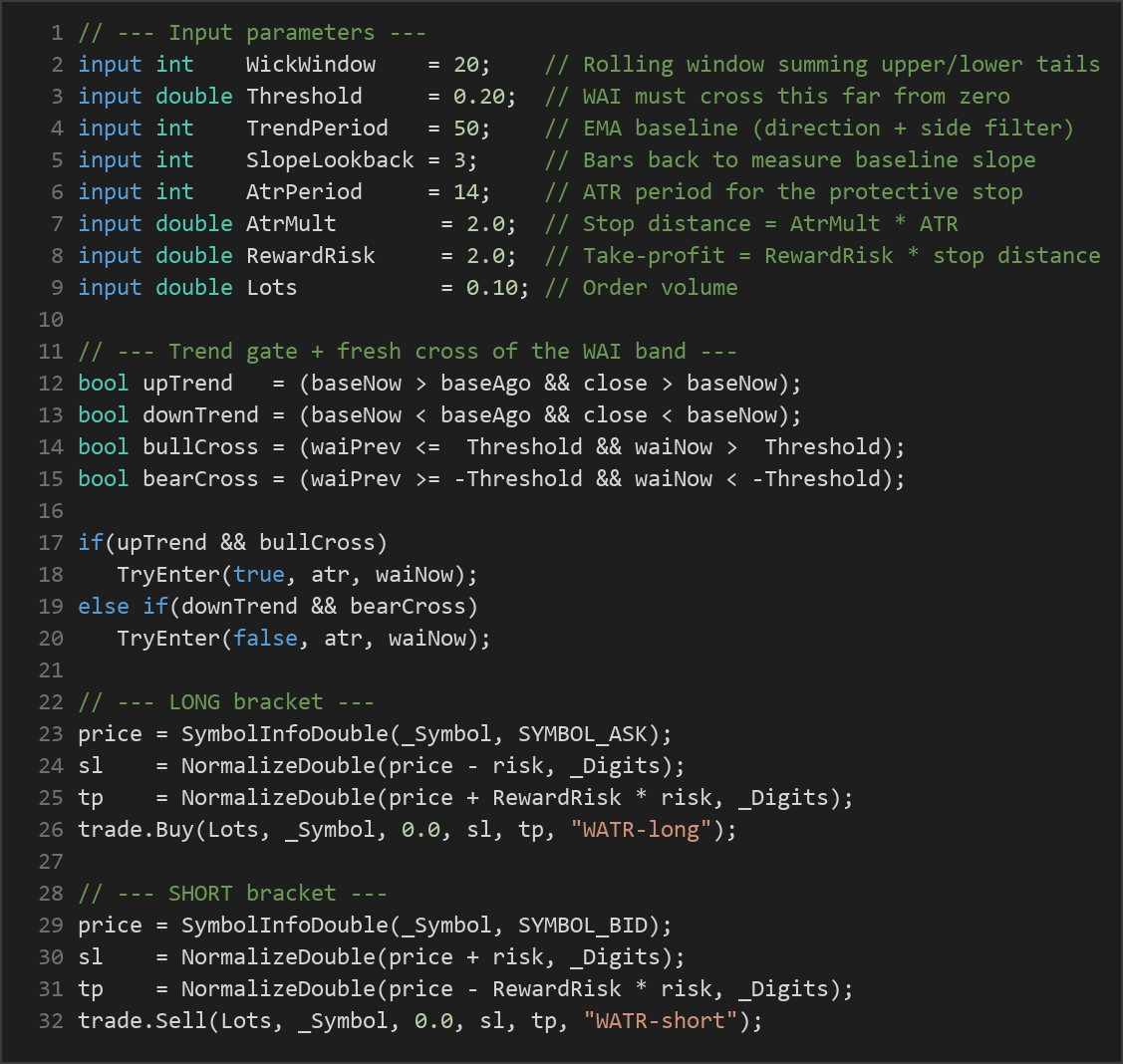
- The strategy signals a long when WAI crosses up through the positive Threshold on the current bar while the baseline is rising. This marks the moment hidden rejection pressure tips decisively bullish.
- The strategy signals a short when WAI crosses down through the negative Threshold while the baseline is falling.
- Only a fresh cross qualifies — a sustained reading already above the threshold does not trigger a new entry. This is intended to avoid late entries into moves that may already be exhausted.
Exit conditions:
- Active momentum-fade: the strategy closes a long the moment WAI slips back below zero (the tails have stopped favouring buyers), and closes a short once WAI rises back above zero.
- ATR bracket backstop: every position is opened with a hard stop-loss and take-profit. The stop distance is
AtrMult × ATR, and the take-profit isRewardRisk × stop distance. ATR (Average True Range) measures recent volatility, so the protective levels adapt to how much the market is currently moving.
Position handling:
- Only one position per magic number is held at a time.
- The strategy never enters and exits on the same bar, avoiding conflicting actions.

Strategy Parameters
| Parameter | Default | Min | Max | Description |
|---|---|---|---|---|
| WickWindow | 20 | 5 | 60 | Number of bars over which the upper and lower wicks are summed to compute the Wick Asymmetry Index. |
| Threshold | 0.20 | 0.0 | 0.60 | How far WAI must cross from zero to count as a decisive tip into the trend. |
| TrendPeriod | 50 | 10 | 150 | EMA length of the trend baseline used for direction and the side filter. |
| SlopeLookback | 3 | 1 | 10 | Number of bars back used to measure the baseline's slope. |
| AtrPeriod | 14 | 5 | 30 | Lookback period for the ATR used to size the protective stop. |
| AtrMult | 2.0 | 1.0 | 4.0 | Stop-loss distance expressed as a multiple of ATR. |
| RewardRisk | 2.0 | 1.0 | 4.0 | Take-profit distance as a reward-to-risk multiple of the stop distance. |
| Lots | 0.10 | 0.01 | 1.0 | Order volume (trade size) in lots. |
Recommended Chart Settings
The Wick Asymmetry Trend Rider is timeframe-agnostic — every calculation uses the timeframe of the chart it is attached to, so you can test it on anything from the M15 to the H4 or Daily. As a starting point for study, a liquid major forex pair such as EUR/USD on the H1 timeframe offers clean candle structure and enough bars for the rolling window to fill quickly.
Because wick behaviour depends heavily on liquidity and session activity, results will vary considerably across symbols, timeframes, and market conditions. Treat any single configuration as one data point, not a universal setting. Always run your own tests before drawing conclusions.
How to Install on MetaTrader 5
- Download the .ex5 file from the link below
- Copy it to your MT5
MQL5\Expertsfolder - Restart MetaTrader 5 or refresh the Navigator panel
- Drag the EA onto a chart matching the recommended symbol and timeframe
- Configure the input parameters and enable Algo Trading
What to Consider Before Using This EA
Strengths of this approach. The Wick Asymmetry Trend Rider looks at a genuinely different dimension of price than most indicators. By reading rejected extremes instead of closing prices, it can register hidden pressure that body-based tools miss — a candle can close dead-centre yet still carry a huge defended tail. The double filter of a trend gate plus a fresh-cross trigger is designed to keep the strategy on the right side of the drift and out of chop. The volatility-scaled ATR stop means protective levels expand and contract with the market automatically.
Known limitations. Wick-based measures are sensitive to spreads, spikes, and thin liquidity. During news events or illiquid sessions, exaggerated wicks can distort the oscillator and produce signals that historically would not have appeared under normal conditions. Like all trend-following systems, this strategy may indicate entries that get chopped up in ranging or sideways markets, where the EMA slope flip-flops and the momentum-fade exit closes trades quickly for small losses. The fresh-cross requirement helps timing but can also cause the strategy to miss strong moves where WAI was already elevated.
Where it may underperform. Expect more difficulty in low-volatility drift, during major economic releases, and on symbols with wide or variable spreads. No single indicator captures every market regime, and the wick footprint is no exception. Study its behaviour across several conditions before forming any view.
Risk Management Tips
Sound risk management matters far more than any single entry signal. Consider these general principles as you study this strategy:
- Position sizing: Keep trade size proportional to your account. Many educational sources suggest risking no more than 1–2% of account equity per trade so a losing streak cannot do outsized damage.
- Use a demo account first: Test the EA on a demo or a strategy tester before ever considering live capital. This lets you observe behaviour without financial exposure.
- Understand drawdown: Every strategy experiences losing runs. Know the maximum drawdown you are willing to tolerate and how it feels before it happens live.
- Respect the stop: The ATR bracket exists for a reason — resist the urge to widen or remove stops on losing trades.
- Diversify your study: Do not rely on a single strategy or symbol. Treat this EA as one component of a broader learning process.
Risk Warning
Trading foreign exchange, CFDs, and other leveraged financial instruments involves substantial risk of loss and is not suitable for all investors. The strategies and tools discussed on this page are provided for educational purposes only and do not constitute financial advice, investment recommendations, or solicitation to trade. Always consult a qualified financial adviser before making trading decisions. Past backtest performance is not indicative of future results.
Downloads
- Expert Advisor: WickAsymmetryTrendRider.ex5 (35 downloads)
- Source Code: WickAsymmetryTrendRider.mq5 (30 downloads)
- Documentation: WickAsymmetryTrendRider.pdf (37 downloads)