Disclaimer: This article is for educational and informational purposes only. It does not constitute financial or investment advice. Trading forex and CFDs carries significant risk of loss. Past performance of any strategy — including backtests — does not guarantee future results. Never trade with money you cannot afford to lose.
What Is This Strategy?
The Vwap Pullback Engulfing strategy is an intraday trend-continuation system built around a single core indicator — the session-anchored VWAP (Volume Weighted Average Price) — combined with one of the most widely studied candlestick patterns, the engulfing bar. VWAP is the average price a market has traded at over the session, weighted by volume, and it resets at the start of each trading day. Many institutional desks benchmark their fills against VWAP, which is why it often behaves as a meaningful intraday reference line. This strategy uses no moving averages, no RSI, and no ATR — just VWAP and raw candle geometry.
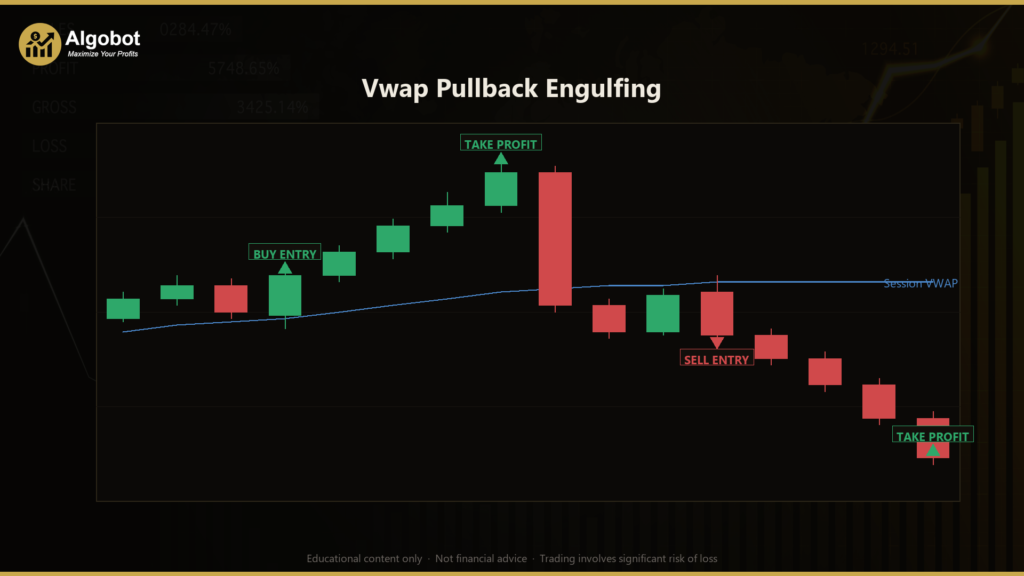
The approach is designed for trending intraday markets rather than choppy, directionless ranges. When price is trading above VWAP, the strategy treats the line as dynamic support and looks for pullbacks that get bought back up. When price is below VWAP, it treats the line as dynamic resistance and looks for rallies that get sold back down. The defining idea is that the strategy does not try to predict a turn — it waits for price to actually pull back to VWAP and for an engulfing candle to confirm that participants have re-engaged in the prevailing trend direction.
As a learning tool, Vwap Pullback Engulfing is well suited to traders who want to study how VWAP interacts with price action and how candlestick confirmation can be combined with a volume-based reference. It is a clean, transparent example of a rules-based system, making it useful for understanding entry confirmation, structural stop placement, and fixed reward-to-risk targeting — not a shortcut to any particular outcome.
How It Works
The strategy evaluates conditions once per freshly closed bar on your chosen timeframe. It continuously rebuilds the session VWAP from the day's opening bar, weighting each bar's typical price (High + Low + Close) / 3 by its tick volume. Here is how the logic flows:
- VWAP warm-up: The strategy waits until a minimum number of bars have formed since the session open (
MinSessionBars) before it trusts VWAP and considers any trades. This avoids acting on a VWAP that is still highly sensitive to just a handful of bars. - Trend context check: It looks back a configurable number of bars (
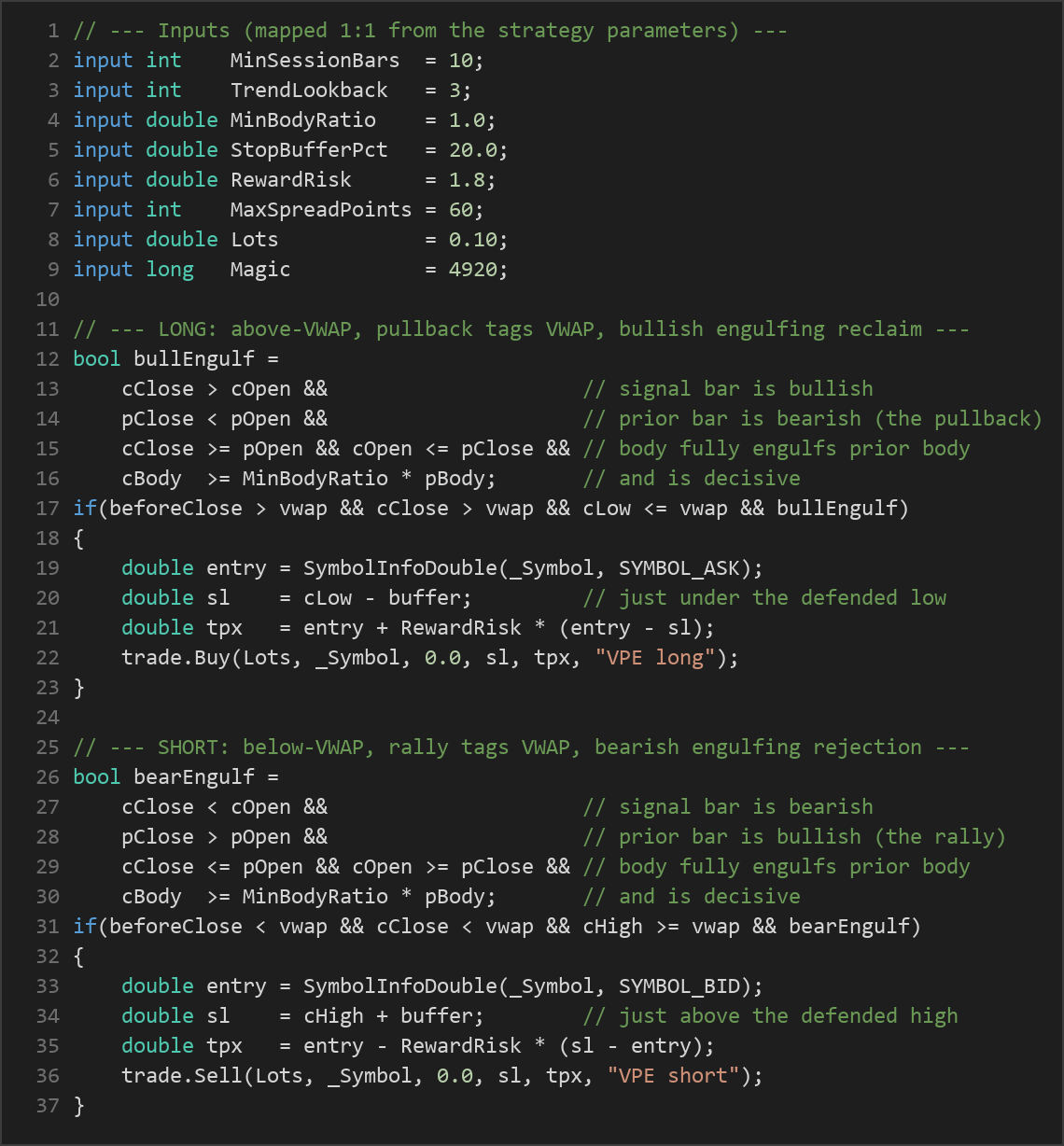
TrendLookback) to confirm that price was already on the correct side of VWAP before the pullback. This helps distinguish a genuine pullback within a trend from a fresh reversal crossing the line. - The long signal: The strategy signals a potential buy when (1) the reference bar from
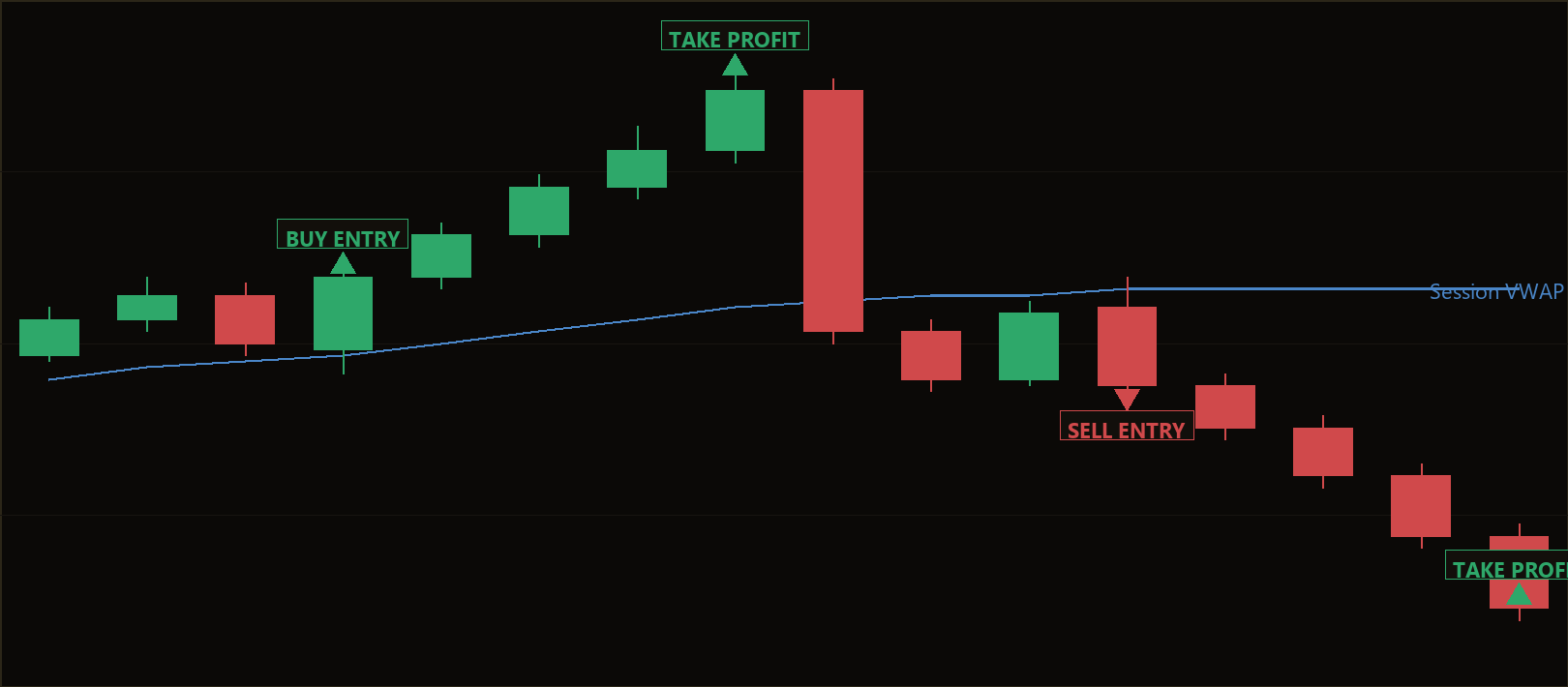
TrendLookbackago closed above VWAP, establishing an above-VWAP regime; (2) the just-closed bar dipped its low into or through VWAP and then closed back above it, meaning VWAP held as support; and (3) that same bar is a bullish engulfing candle — the prior bar was bearish, and the current bar's body fully engulfs it and is decisive (its body is at leastMinBodyRatiotimes the prior bar's body). - The short signal: This is the exact mirror. The strategy signals a potential sell when the regime is below VWAP, the just-closed bar rallied up to tag VWAP from below and then closed back beneath it (VWAP held as resistance), and the bar is a decisive bearish engulfing candle.
- Stop-loss logic: Stops are structural and indicator-free. For a long, the stop is placed just below the signal bar's low; for a short, just above the signal bar's high. A buffer — a percentage of the signal bar's range set by
StopBufferPct— is added beyond that extreme so the stop sits a little past the level VWAP just defended. - Take-profit logic: The target is a fixed reward-to-risk projection. The strategy measures the distance from entry to stop (the risk) and projects the take-profit a
RewardRiskmultiple of that distance in the trade direction. - Trade filters: Only one position per magic number is held at a time, so the bracket (stop and target) manages every exit. New entries are also skipped when the current spread exceeds
MaxSpreadPoints, helping avoid entries during unusually wide or illiquid conditions.
Because every exit is defined the moment the trade is placed, the system is fully bracketed — there is no discretionary management once a position is open.
Strategy Parameters
| Parameter | Default | Min | Max | Description |
|---|---|---|---|---|
| MinSessionBars | 10 | 3 | 60 | Number of bars that must elapse after the session open before VWAP is trusted and trades are allowed. |
| TrendLookback | 3 | 1 | 20 | How many bars back the close must already be on the trend side of VWAP, confirming a pullback within a trend rather than a fresh reversal cross. |
| MinBodyRatio | 1.0 | 0.5 | 3.0 | Engulfing strength filter — the signal bar's body must be at least this multiple of the engulfed (prior) bar's body. |
| StopBufferPct | 20.0 | 0.0 | 100.0 | Stop buffer placed beyond the defended candle extreme, expressed as a percentage of the signal bar's range. |
| RewardRisk | 1.8 | 0.5 | 5.0 | Take-profit distance as a multiple of the structural stop distance. |
| MaxSpreadPoints | 60 | 5 | 300 | Maximum spread (in points) allowed for a new entry; wider spreads are skipped. |
| Lots | 0.10 | 0.01 | 1.0 | Trade volume in lots. |
| Magic | 4920 | 0 | 9,999,999 | Unique identifier so the EA only manages its own positions. |
Recommended Chart Settings
Vwap Pullback Engulfing was designed with liquid FX majors or indices in mind — for example EURUSD, US500, or XAUUSD — traded on an intraday M5–M15 chart. These markets tend to produce the cleanest intraday trends and the most meaningful VWAP interactions, since VWAP is most relevant within a single trading session. That said, the underlying code is timeframe-agnostic and will run on whatever primary timeframe you select.
Keep in mind that results will vary considerably across different symbols, sessions, and market conditions. A setting that suits a trending index session may behave very differently on a range-bound currency pair. Always study the strategy's behavior on your specific instrument and timeframe before drawing any conclusions.
How to Install on MetaTrader 5
- Download the
.ex5file from the link below. - Copy it to your MT5
MQL5\Expertsfolder. - Restart MetaTrader 5 or refresh the Navigator panel.
- Drag the EA onto a chart matching the recommended symbol and timeframe.
- Configure the input parameters and enable Algo Trading.
What to Consider Before Using This EA
The main strength of this approach is its clarity. By using only VWAP and a well-defined candlestick pattern, the logic is easy to understand, audit, and study. Anchoring to a volume-weighted reference that institutions actually watch gives the entries a logical basis, and requiring both a trend context and an engulfing confirmation filters out many low-conviction signals. The fully structural stop and fixed reward-to-risk target also make the system disciplined and consistent in how it defines risk.
There are also important limitations to understand. Engulfing patterns are common, and not every engulfing bar at VWAP marks a durable continuation — false signals occur, particularly when the broader trend is weak. VWAP itself is a session tool, so its usefulness depends heavily on there being a coherent intraday trend; in choppy, sideways markets, price can cross and re-cross VWAP repeatedly, generating signals that whipsaw. The strategy may also underperform during major news events, thin liquidity periods, or sessions where price never establishes a clear side of VWAP. Because it holds only one position at a time and relies on a fixed reward-to-risk target, it does not adapt its exits to changing volatility. Treat it as an educational framework to study and test, not a finished system to deploy blindly.
Risk Management Tips
Sound risk management matters far more than any single entry signal. Consider these general principles as part of your education:
- Risk a small, fixed fraction per trade. Many educational resources suggest risking no more than 1–2% of account equity on any single position, so that a string of losses does not threaten the account.
- Size positions to your stop, not the other way around. Let your structural stop distance and your per-trade risk budget determine your lot size, rather than picking a lot size first.
- Test on a demo account first. Run the strategy on a demo or simulated environment to understand how it behaves across different sessions before considering any live capital.
- Understand drawdown. Every strategy experiences losing streaks. Study the historical drawdown behavior so you know what a normal rough patch looks like and can avoid emotional decisions.
- Account for costs. Spread, slippage, and commissions all affect outcomes, especially on lower timeframes where trades are more frequent. The
MaxSpreadPointsfilter helps, but real-world execution still differs from idealized conditions.
Risk Warning
Trading foreign exchange, CFDs, and other leveraged financial instruments involves substantial risk of loss and is not suitable for all investors. The strategies and tools discussed on this page are provided for educational purposes only and do not constitute financial advice, investment recommendations, or solicitation to trade. Always consult a qualified financial adviser before making trading decisions. Past backtest performance is not indicative of future results.
Downloads
- Expert Advisor: VwapPullbackEngulfing.ex5 (55 downloads)
- Source Code: VwapPullbackEngulfing.mq5 (52 downloads)
- Documentation: VwapPullbackEngulfing.pdf (67 downloads)