
Disclaimer: This article is for educational and informational purposes only. It does not constitute financial or investment advice. Trading forex and CFDs carries significant risk of loss. Past performance of any strategy — including backtests — does not guarantee future results. Never trade with money you cannot afford to lose.
What Is This Strategy?
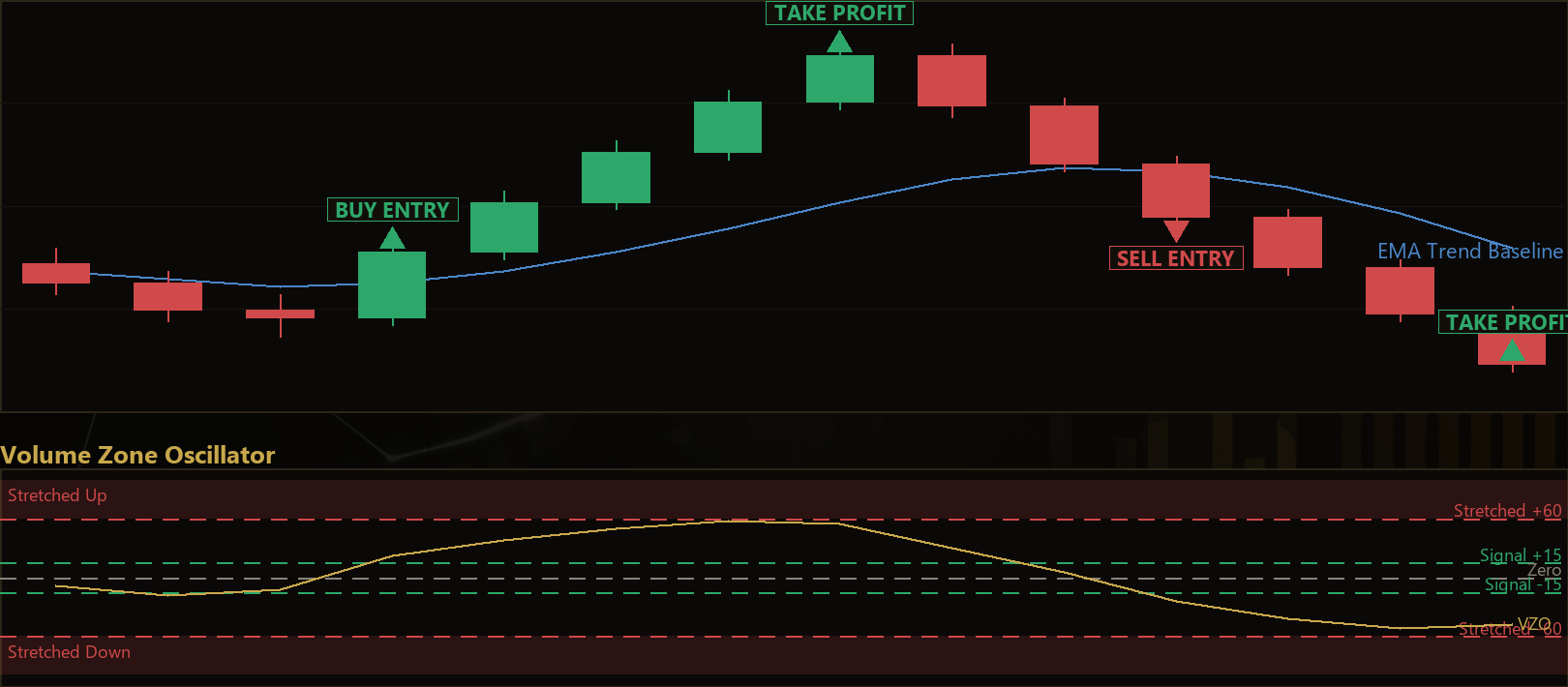
The Volume Zone Trend Rider is a volume-momentum, trend-following strategy for MetaTrader 5 built around the Volume Zone Oscillator (VZO) — a named indicator developed by Waleed Khalil and Ali Steckler in 2011. Unlike price-only trend systems, the VZO measures how one-sided the "tape" (the flow of buying versus selling volume) has become. It does this by comparing a smoothed reading of signed volume against a smoothed reading of total volume, producing an oscillator that swings roughly between −100 and +100. When buyers dominate, the VZO climbs into positive territory; when sellers take over, it sinks negative.
The core idea behind this strategy is to ride trends that are confirmed by volume, not by price movement alone. Price can drift higher on thin, unconvincing activity — a move that often fails. By requiring the VZO to cross a positive threshold at the same time price is trending above a rising moving-average baseline, the strategy aims to enter only when fresh volume appears to be backing the direction of the move. A mirror set of rules applies to short trades in downtrends.
This strategy is best understood as a learning tool for traders who want to study how volume-based oscillators can act as a confirmation filter on top of a classic trend regime. It is designed for trending market conditions on liquid instruments and is not intended for quiet, range-bound periods where volume signals tend to whipsaw. If you are exploring how order flow proxies, regime filters, and volatility-based risk framing fit together in a single automated system, the Volume Zone Trend Rider offers a clear, self-contained example.
How It Works
The strategy evaluates its rules once per newly closed bar, so signals are only acted on after a candle has completed. It combines a volume oscillator, a trend regime filter, and an Average True Range (ATR) volatility measure. ATR is a common indicator that estimates how much an instrument typically moves per bar, and here it frames the stop-loss and take-profit distances.
The Volume Zone Oscillator is calculated as:
- Assign each bar a direction: +1 if it closed up, −1 if it closed down, 0 if flat.
- Multiply that direction by the bar's tick volume to get signed volume.
- Smooth the signed volume with an exponential moving average (EMA) over the VZO period.
- Smooth the total (unsigned) volume with an EMA over the same period.
- VZO = 100 × (smoothed signed volume ÷ smoothed total volume).
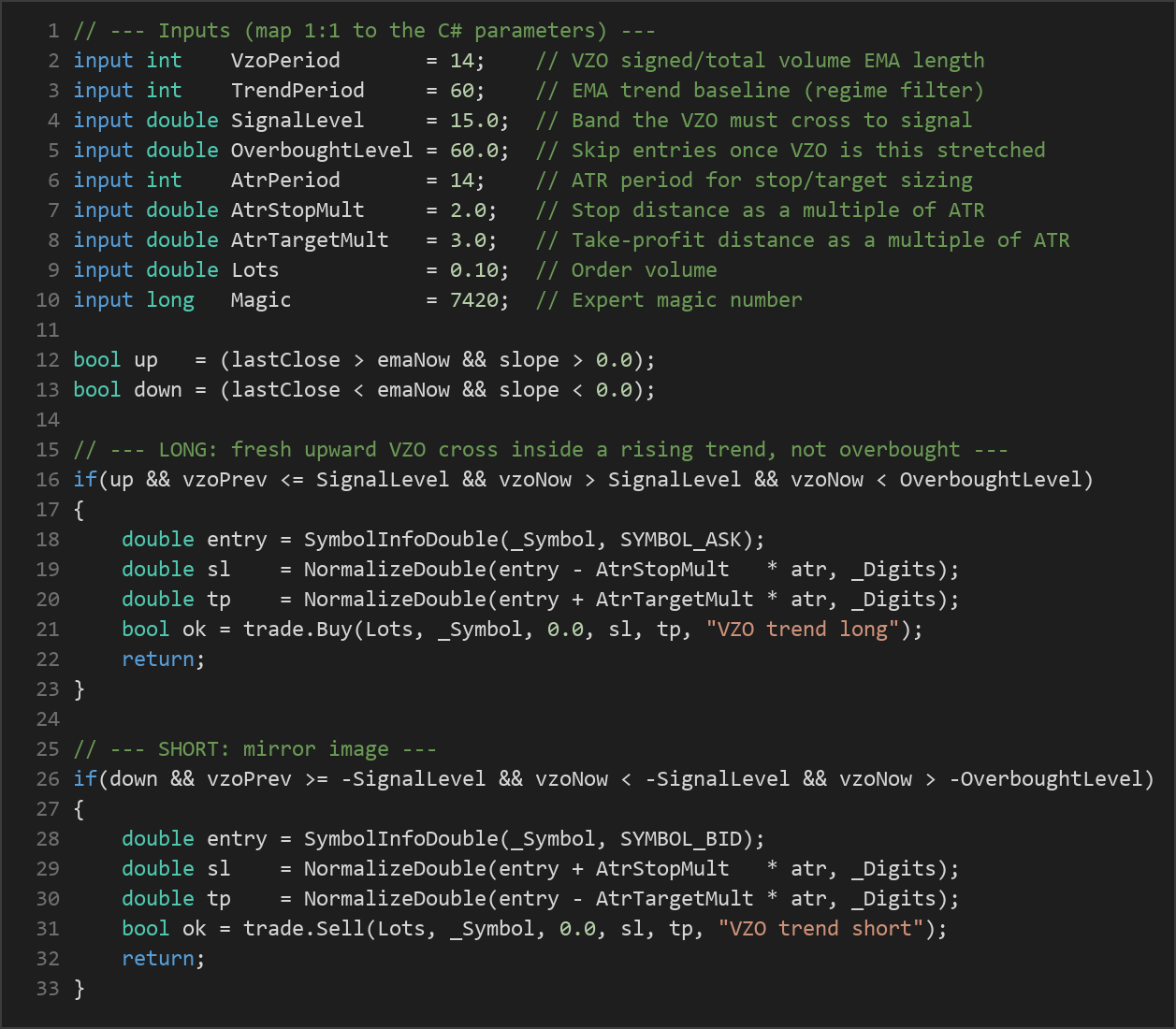
A long trade signals when all of the following are true:
- The last close is above its EMA trend baseline, and that baseline is rising (measured over the last three bars). This confirms an uptrend regime.
- The VZO crosses up through the positive Signal Level, meaning it was at or below that level on the prior bar and is above it now — a sign that fresh buying volume has just taken a side.
- The VZO is not already stretched past the Overbought Level, so the strategy avoids chasing an exhausted volume blow-off.
A short trade signals as the exact mirror image:
- The last close is below a falling EMA baseline (a downtrend regime).
- The VZO crosses down through the negative Signal Level.
- The VZO is not already stretched beyond the negative Overbought Level.
Exit and risk logic:
- Every trade is framed with an ATR-based stop-loss, placed a multiple of ATR away from entry.
- A take-profit is set a larger multiple of ATR away, giving a defined reward-to-risk shape.
- As a protective early exit, if the VZO flips all the way to the opposite band (for example, a long position while the VZO drops below the negative Signal Level), the volume thesis is considered broken and the position is closed.
- The strategy holds only one position per magic number at a time — it never stacks multiple entries.
Strategy Parameters
| Parameter | Default | Min | Max | Description |
|---|---|---|---|---|
| VzoPeriod | 14 | 5 | 40 | Smoothing length of the VZO signed- and total-volume EMAs. Lower values react faster; higher values smooth out noise. |
| TrendPeriod | 60 | 20 | 200 | EMA length of the price trend baseline used as the regime filter. Longer settings define a slower, more established trend. |
| SignalLevel | 15.0 | 5.0 | 40.0 | The positive/negative zero-band level the VZO must cross to signal that volume has taken a side. |
| OverboughtLevel | 60.0 | 40.0 | 95.0 | Entries are skipped once the VZO is already stretched beyond this level, to avoid chasing volume blow-offs. |
| AtrPeriod | 14 | 5 | 40 | ATR period used for stop-loss and take-profit sizing. |
| AtrStopMult | 2.0 | 0.5 | 6.0 | Stop-loss distance expressed as a multiple of ATR. |
| AtrTargetMult | 3.0 | 0.5 | 10.0 | Take-profit distance expressed as a multiple of ATR. |
| Lots | 0.10 | 0.01 | 1.0 | Order volume (position size) in lots. |
Recommended Chart Settings
The Volume Zone Trend Rider is designed to run on any liquid symbol and on whatever single primary timeframe you select at backtest or deployment time. Because it relies on tick volume as a proxy for real traded volume, it tends to be most meaningful on actively traded instruments — major forex pairs, popular indices, or liquid commodities — where the tick-volume stream is dense and representative.
Many traders studying volume-oscillator systems begin with intraday timeframes such as the M15, M30, or H1 charts, where trend regimes are frequent enough to generate a reasonable number of signals but slow enough to filter out much of the tick-level noise. Whichever timeframe you choose, remember that results will vary significantly across different market conditions, instruments, and broker data feeds. Always test the settings on your own data before drawing conclusions.
How to Install on MetaTrader 5
- Download the
.ex5file from the link below. - Copy it to your MT5
MQL5\Expertsfolder. - Restart MetaTrader 5 or refresh the Navigator panel.
- Drag the EA onto a chart matching the recommended symbol and timeframe.
- Configure the input parameters and enable Algo Trading.
What to Consider Before Using This EA
Strengths of this approach. The Volume Zone Trend Rider layers three independent checks — a trend regime filter, a volume-confirmation cross, and a volatility-scaled risk frame — before committing to a trade. This multi-condition design historically helps avoid entering trends that price alone might suggest but that volume does not support. The overbought filter is a thoughtful touch: by refusing to enter when the VZO is already extreme, the strategy tries to avoid buying into the tail end of a volume surge. The ATR-based stops and the volume-reversal early exit give each trade a clearly defined risk structure.
Known limitations. The strategy depends on tick volume, which is a proxy for actual traded volume rather than a true measure of it. Tick volume can differ from broker to broker and does not perfectly reflect institutional order flow, so signals may behave differently across data feeds. Like all trend-following systems, it is vulnerable to choppy, range-bound markets, where the price repeatedly crosses its baseline and the VZO oscillates without a durable trend — producing whipsaw entries that get stopped out. Trend followers also typically endure long stretches of small losses while waiting for the occasional sustained move, which can be psychologically demanding.
Where it may underperform. Expect weaker behavior during low-liquidity sessions, around major news releases where volatility spikes can trigger stops, and in sideways consolidations. The fixed lot size means position risk is not automatically scaled to account equity, which is something to review before any live use. Treat this EA as a framework to study and adapt, not as a finished, hands-off system.
Risk Management Tips
Sound risk management matters more than any single indicator setting. Consider these general principles as you study the strategy:
- Risk only a small fraction per trade. Many educational sources suggest risking no more than 1–2% of account equity on any single position. Adjust the lot size and ATR stop multiple so that a stop-out stays within that limit.
- Use position sizing, not just fixed lots. Rather than always trading the same volume, size each position relative to your account balance and the current ATR-based stop distance.
- Start on a demo account. Run the strategy on a demo or paper account first so you can observe how it behaves across different market conditions without financial exposure.
- Understand drawdown. Every strategy experiences losing streaks. Study the maximum drawdown in your own testing and confirm you could tolerate it emotionally and financially before considering live deployment.
- Diversify and avoid overexposure. Running the same logic across many correlated instruments can concentrate risk rather than spread it.
Risk management is the part of trading you can actually control — treat it as the foundation of any experiment with this or any other EA.
Risk Warning
Trading foreign exchange, CFDs, and other leveraged financial instruments involves substantial risk of loss and is not suitable for all investors. The strategies and tools discussed on this page are provided for educational purposes only and do not constitute financial advice, investment recommendations, or solicitation to trade. Always consult a qualified financial adviser before making trading decisions. Past backtest performance is not indicative of future results.
Downloads
- Expert Advisor: VolumeZoneTrendRider.ex5 (44 downloads)
- Source Code: VolumeZoneTrendRider.mq5 (44 downloads)
- Documentation: VolumeZoneTrendRider.pdf (52 downloads)