Disclaimer: This article is for educational and informational purposes only. It does not constitute financial or investment advice. Trading forex and CFDs carries significant risk of loss. Past performance of any strategy — including backtests — does not guarantee future results. Never trade with money you cannot afford to lose.
What Is This Strategy?
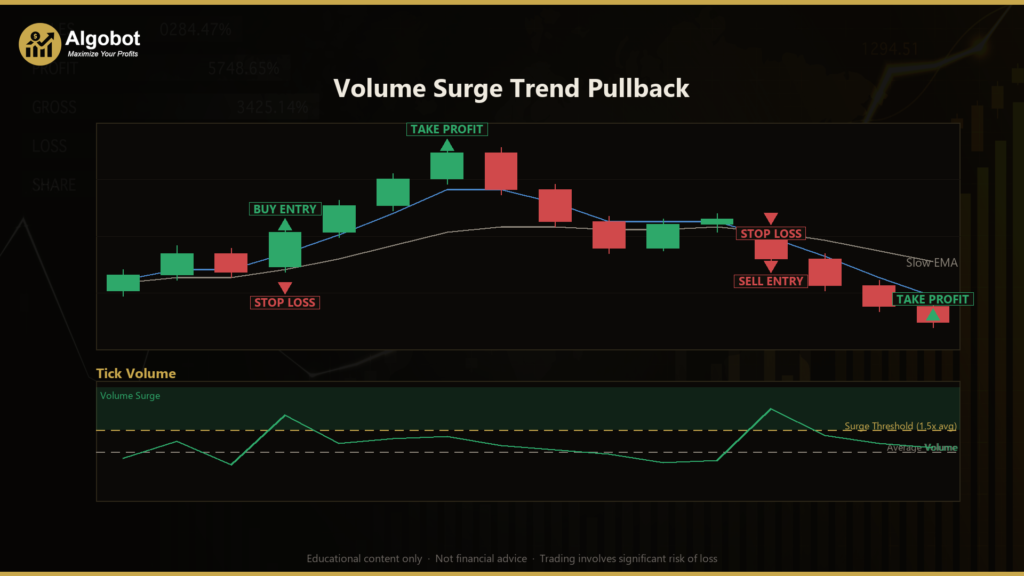
The Volume Surge Trend Pullback is a trend-following, pullback-continuation strategy for MetaTrader 5 that combines exponential moving averages (EMAs — averages that weight recent prices more heavily) with a tick-volume confirmation filter. Rather than trying to predict tops and bottoms, it waits for an established trend, lets price retrace, and then looks for a burst of trading activity to confirm that the trend is resuming. The goal of the design is to study how participation — measured through volume — can be used to separate genuine trend continuations from weak, low-conviction bounces.
The strategy is built for trending market conditions on liquid instruments. When a market is drifting sideways, moving averages tend to whipsaw and volume spikes lose their meaning, so this system is deliberately structured to stand aside unless a directional bias is clearly present. It only considers long trades when a fast EMA sits above a slow EMA and the slow EMA is rising, and only considers short trades in the mirror-image case. This regime filter is what keeps it from fighting the dominant direction of the market.
As a learning tool, the Volume Surge Trend Pullback is well suited to traders who want to understand multi-condition confirmation logic — how stacking a trend filter, a pullback-and-reclaim trigger, a momentum candle, and a volume surge together can reduce false signals. It is best treated as a framework for studying trend-continuation mechanics on a demo account, not as a shortcut to results. Every rule below is a filter designed to make the strategy more selective, not more frequent.
How It Works
The strategy runs entirely on closed bars only — it detects each new bar and reads finished candles, so its signals never repaint (change after the fact). All entries require several conditions to line up on the same trigger candle.
Entry — the strategy signals a long trade when all of the following are true:
- Trend regime is up: the fast EMA is above the slow EMA, and the slow EMA is higher than it was
SlopeLookbackbars ago (confirming an upward slope). - Pullback and reclaim: the previous bar closed below the fast EMA, and the current bar closed back above it — price dipped and then reclaimed the trend line.
- Momentum candle: the trigger candle closes higher than it opened and closes above the previous bar's high, breaking prior structure.
- Volume surge: the trigger bar's tick volume is greater than
VolMultipliertimes the average volume of the precedingVolPeriodbars. (If volume data is unavailable, this check passes so the strategy can still function.) - RSI filter: the Relative Strength Index (a 0–100 momentum gauge) is below the upper threshold, so the strategy avoids buying into an already overextended move.
Short trades use the exact mirror image: a downtrend, a failed rally that closes back below the fast EMA, a bearish momentum candle breaking the prior low, the same volume surge, and RSI above the lower threshold.
Exit and risk logic:
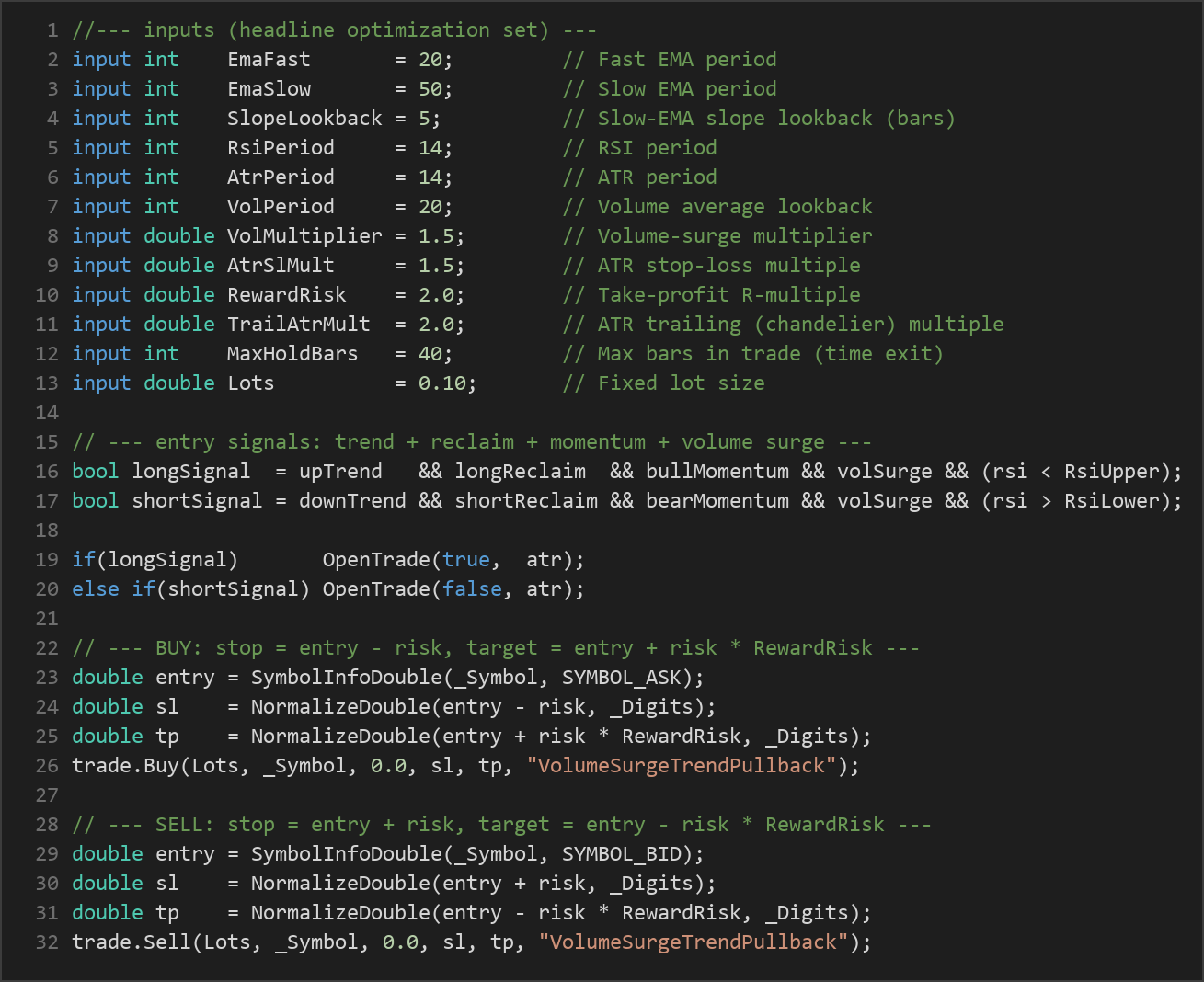
- Stop-loss: placed at a distance of
AtrSlMult× ATR (Average True Range — a volatility measure) from entry, so the stop adapts to current market conditions. - Take-profit: set at the stop distance multiplied by
RewardRisk. With defaults, this targets roughly twice the risk per trade. - ATR chandelier trailing stop: once in profit, the stop ratchets in the trade's favour by
TrailAtrMult× ATR and never loosens, helping lock in open gains as a trend extends. - Time-based exit: if a position is held for
MaxHoldBarsbars without resolving, it is closed to free up capital from stagnant trades. - Single-position exposure control: only one position is open at a time — no pyramiding — which acts as a simple money-management guardrail.
Strategy Parameters
| Parameter | Default | Min | Max | Description |
|---|---|---|---|---|
| EmaFast | 20 | 10 | 40 | Period of the fast EMA used to define the near-term trend and the reclaim line. |
| EmaSlow | 50 | 30 | 120 | Period of the slow EMA used as the primary trend-direction filter. |
| SlopeLookback | 5 | 2 | 15 | How many bars back the slow EMA is compared against to confirm its slope. |
| RsiPeriod | 14 | 7 | 21 | Lookback period for the RSI momentum filter. |
| AtrPeriod | 14 | 7 | 28 | Lookback period for ATR, used to size stops, targets, and the trailing stop. |
| VolPeriod | 20 | 10 | 50 | Number of prior bars used to compute the average volume baseline. |
| VolMultiplier | 1.5 | 1.0 | 3.0 | How far above average volume the trigger bar must be to count as a surge. |
| AtrSlMult | 1.5 | 0.8 | 3.0 | ATR multiple that sets the initial stop-loss distance. |
| RewardRisk | 2.0 | 1.0 | 4.0 | Take-profit distance as a multiple of the stop-loss (reward-to-risk ratio). |
| TrailAtrMult | 2.0 | 1.0 | 4.0 | ATR multiple for the chandelier trailing stop distance. |
| MaxHoldBars | 40 | 10 | 150 | Maximum bars a trade may stay open before the time-based exit closes it. |
| Lots | 0.10 | 0.01 | 1.0 | Fixed position size, in lots, for each trade. |
Secondary tunables also exist in the code (RSI upper/lower blocking levels, an optional spread filter, and the magic number) but are kept out of the headline set to keep optimization lean.
Recommended Chart Settings
The Volume Surge Trend Pullback was designed with major forex pairs (such as EUR/USD or GBP/USD) and liquid index or metal CFDs in mind, where tick-volume readings are meaningful and trends develop cleanly. A timeframe of H1 (1-hour) or H4 (4-hour) is a sensible starting point for study: these balance signal frequency against noise, and the closed-bar logic behaves predictably on them.
Because the strategy leans on volume, it is best avoided on thin or illiquid symbols where tick-volume data is sparse. Keep in mind that behaviour will vary considerably across different symbols, timeframes, and market conditions — a setting that looks reasonable on one instrument may perform very differently on another. Always test any configuration on historical data and a demo account before drawing conclusions.
How to Install on MetaTrader 5
- Download the .ex5 file from the link below.
- Copy it to your MT5
MQL5\Expertsfolder. - Restart MetaTrader 5 or refresh the Navigator panel.
- Drag the EA onto a chart matching the recommended symbol and timeframe.
- Configure the input parameters and enable Algo Trading.
What to Consider Before Using This EA
Strengths. The design's main strength is selectivity. By requiring four independent conditions — trend, reclaim, momentum, and volume — to agree before entering, it filters out many of the weak fake reclaims that plague simpler pullback systems. The ATR-based stops and trailing logic mean risk automatically scales with volatility rather than using fixed pip distances, and the closed-bar approach avoids repainting, so what you see in the tester reflects the live logic.
Limitations. No confirmation stack is free. The same filters that reduce false signals also reduce the number of signals, so the strategy can go long stretches without trading — which requires patience and can be psychologically difficult. Trend-following systems historically suffer during choppy, range-bound periods, where pullbacks reclaim the EMA repeatedly without follow-through, producing a series of small losses. Tick volume in forex is a proxy for real volume (it counts price updates, not contracts), so the "surge" filter is an approximation, not a true order-flow reading. The fixed lot size also means position sizing does not adapt to account equity unless you change it manually.
Where it may underperform. Expect weaker behaviour in low-volatility consolidations, around major news spikes that gap through stops, and on illiquid symbols with unreliable volume. It is a tool for studying trend-continuation logic, not a solution for all market environments.
Risk Management Tips
Sound risk management matters more than any single entry rule. Consider these general principles as you study the strategy:
- Risk a small, fixed fraction per trade. Many educational sources suggest risking no more than 1–2% of account equity on any single position. Adjust the lot size so that the ATR-based stop distance corresponds to that fraction, rather than using a fixed lot blindly.
- Always start on a demo account. Run the strategy in simulation until you understand how often it trades and how it behaves through both trending and ranging periods.
- Understand drawdown. Every strategy experiences losing streaks. Know the largest peak-to-trough decline you could tolerate emotionally and financially before committing real capital.
- Do not over-optimize. Tuning parameters until they fit historical data perfectly ("curve-fitting") tends to produce settings that fail on new data. Prefer robust ranges over precise magic numbers.
- Mind costs. Spreads, commissions, and slippage all erode edge — factor them into any evaluation and consider the optional spread filter on wider-spread instruments.
Risk Warning
Trading foreign exchange, CFDs, and other leveraged financial instruments involves substantial risk of loss and is not suitable for all investors. The strategies and tools discussed on this page are provided for educational purposes only and do not constitute financial advice, investment recommendations, or solicitation to trade. Always consult a qualified financial adviser before making trading decisions. Past backtest performance is not indicative of future results.
Downloads
- Expert Advisor: VolumeSurgeTrendPullback.ex5 (46 downloads)
- Source Code: VolumeSurgeTrendPullback.mq5 (45 downloads)
- Documentation: VolumeSurgeTrendPullback.pdf (49 downloads)