Disclaimer: This article is for educational and informational purposes only. It does not constitute financial or investment advice. Trading forex and CFDs carries significant risk of loss. Past performance of any strategy — including backtests — does not guarantee future results. Never trade with money you cannot afford to lose.
What Is This Strategy?
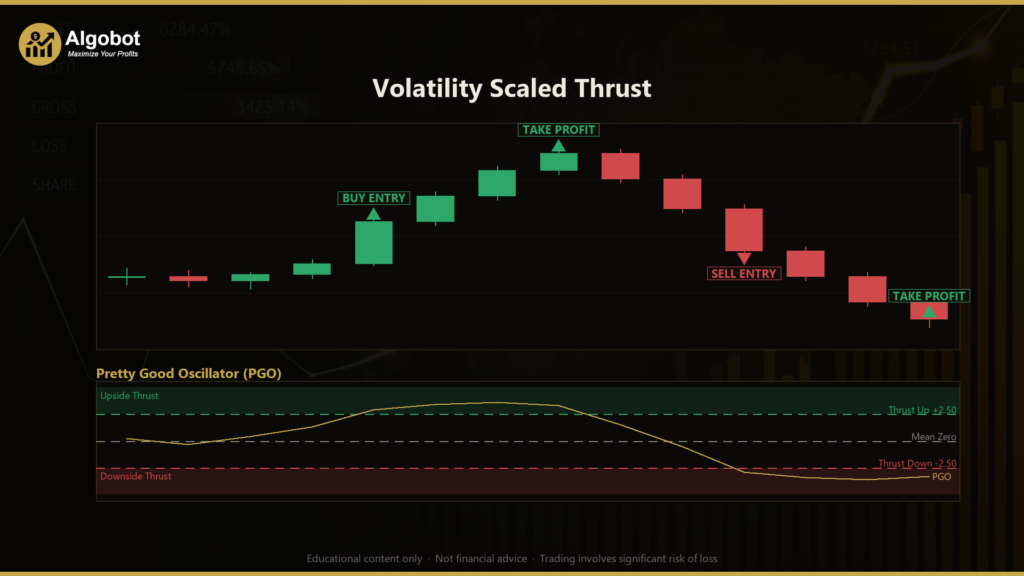
Volatility Scaled Thrust is a momentum-ignition breakout strategy built on the Pretty Good Oscillator (PGO), a directional indicator that measures how far price has stretched away from its own average — expressed in volatility units rather than raw price. It is a trend-initiation approach: instead of waiting for a moving-average crossover or a channel break, it tries to detect the exact bar on which a fresh burst of momentum "ignites" and pushes price decisively out of its recent equilibrium.
The Pretty Good Oscillator is calculated with a compact formula: PGO = (Close − SMA) / ATR. The SMA (Simple Moving Average) defines the mean, or centre of gravity, that price is measured against. The ATR (Average True Range, a standard measure of typical bar-to-bar volatility) then divides that displacement so the reading is scaled to how much the market normally moves. Because the distance is normalised by volatility, a PGO reading of "+2.5" carries the same meaning on a quiet, slow-moving day as it does on a fast, wide-ranging one. That self-normalising quality is the whole point: a single threshold can travel across different symbols and market regimes without constant re-tuning.
This strategy is best understood as a learning tool for studying volatility-normalised momentum and breakout timing. It suits traders who want to explore how displacement-from-mean can be standardised into a comparable oscillator, and who are curious about the difference between chasing an already-stretched market versus catching the bar where a move first breaks free. It is designed for trending or impulsive conditions, and — like all breakout systems — it is likely to struggle in choppy, range-bound markets. Treat what follows as a technical analysis of the mechanics, not a profit opportunity.
How It Works
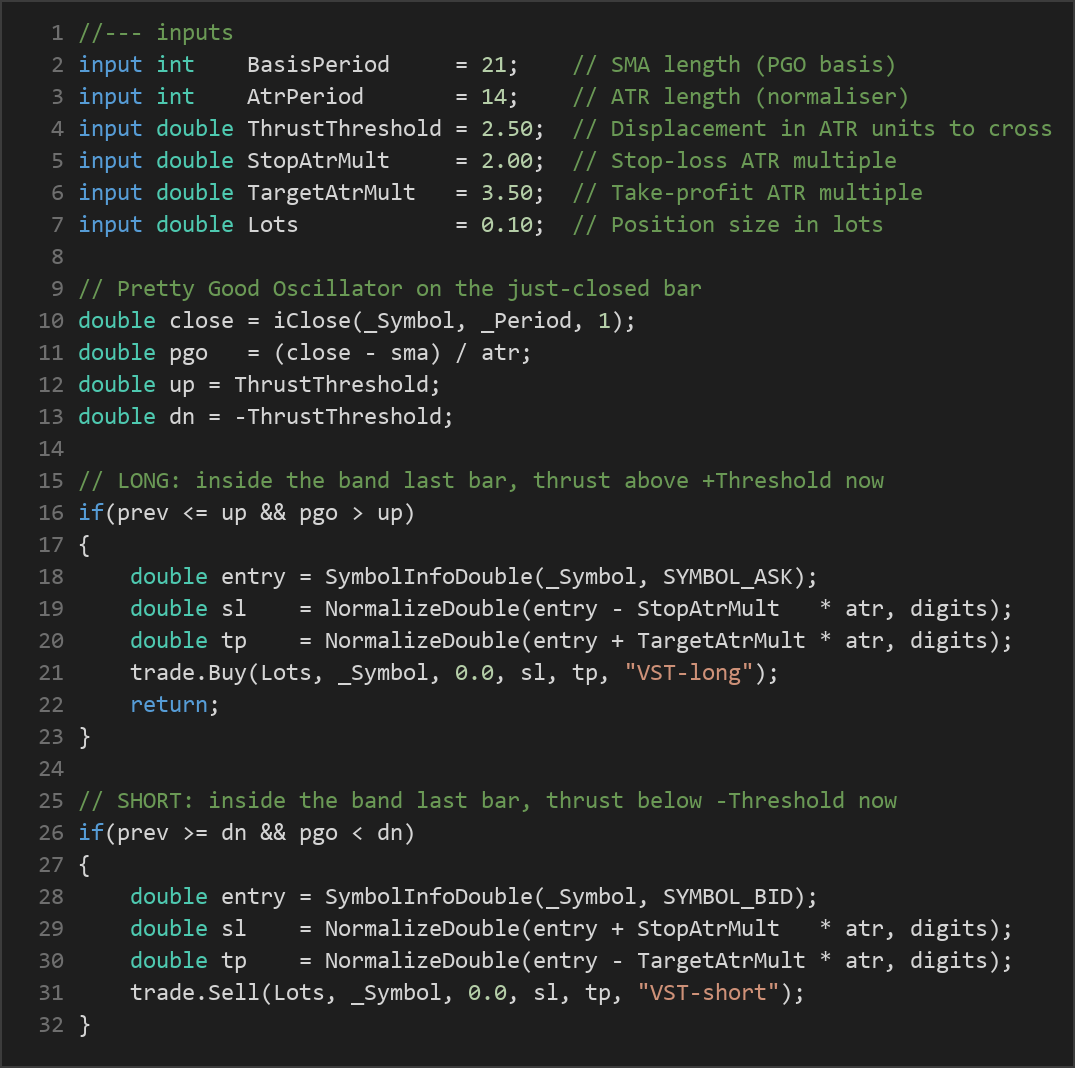
Volatility Scaled Thrust evaluates only fully-closed bars — it acts once per new bar, reading the bar that has just closed, so signals are based on confirmed, non-repainting data. On each closed bar it recomputes the PGO and compares it to the previous bar's reading to detect a genuine cross rather than a static condition.
Entry conditions:
- The strategy signals a long entry when the PGO crosses up through the positive threshold (
+ThrustThreshold) — meaning it was at or inside the band on the previous bar and has thrust above it on this bar. This is read as a fresh burst of upside displacement. - The strategy signals a short entry when the PGO crosses down through the negative threshold (
−ThrustThreshold) — inside the band last bar, below it now. This is read as a fresh burst of downside displacement. - The cross requirement is deliberate. Requiring price to move from inside the band to outside it on a single bar filters out slow drift and prevents entering a market that is already fully stretched, which is a common weakness of simple threshold systems.
Exit conditions:
The strategy uses three independent exits, whichever triggers first:
- ATR-based stop-loss: The protective stop is placed at a multiple of ATR away from the entry price (
StopAtrMult × ATR). Sizing the stop by volatility keeps risk proportionate to current market conditions rather than fixed in pips. - ATR-based take-profit: The target is placed at a larger ATR multiple (
TargetAtrMult × ATR) on the profit side, giving the trade a defined reward relative to its risk. - Momentum-exhaustion (zero-cross) early exit: A long position is closed when the PGO falls back through zero, and a short is closed when the PGO climbs back through zero. A zero reading means price has returned to its mean — the impulse that triggered the trade is considered spent. This exit lets winners ride while the thrust persists but cuts trades whose momentum quietly dies before the stop or target is reached.
The strategy also enforces a simple discipline rule: while a position is open, it manages that position only and will not stack a new entry on top of it within the same bar.

Strategy Parameters
| Parameter | Default | Min | Max | Description |
|---|---|---|---|---|
| BasisPeriod | 21 | 8 | 60 | Length of the Simple Moving Average that defines the "mean" the close is measured against — the basis of the PGO. |
| AtrPeriod | 14 | 7 | 40 | Length of the Average True Range used to normalise the displacement into volatility units. |
| ThrustThreshold | 2.50 | 1.00 | 5.00 | The volatility-scaled displacement (in ATR units) that a thrust must cross to trigger an entry. Higher values demand a stronger move. |
| StopAtrMult | 2.00 | 0.50 | 5.00 | Stop-loss distance as a multiple of ATR. |
| TargetAtrMult | 3.50 | 1.00 | 8.00 | Take-profit distance as a multiple of ATR. |
| Lots | 0.10 | 0.01 | 1.00 | Position size in lots per trade. |
Recommended Chart Settings
Volatility Scaled Thrust operates on a single primary timeframe and makes no assumptions about a specific instrument, because the PGO's ATR normalisation is designed to travel across symbols. As a starting point for study, many momentum-breakout approaches like this are examined on major forex pairs (for example EUR/USD or GBP/USD) on an intraday-to-swing timeframe such as H1 or H4, where trends have room to develop and volatility is stable enough for ATR to behave predictably.
These are starting points for observation, not recommendations. Because the strategy responds to volatility-normalised displacement, its behaviour will vary meaningfully across different instruments, sessions, and market conditions. Always study how it behaves on your chosen symbol and timeframe in a testing environment before drawing any conclusions.
How to Install on MetaTrader 5
- Download the
VolatilityScaledThrust.ex5file from the link below. - Copy it to your MT5
MQL5\Expertsfolder. - Restart MetaTrader 5 or refresh the Navigator panel.
- Drag the EA onto a chart matching the recommended symbol and timeframe.
- Configure the input parameters and enable Algo Trading.
What to Consider Before Using This EA
Strengths of the approach. The chief advantage of Volatility Scaled Thrust is its self-normalising signal. By dividing displacement by ATR, the PGO puts fast and slow markets on the same scale, so a threshold that works reasonably on one regime does not immediately break on another. The cross-based entry adds discipline by insisting on a fresh ignition rather than a stale, already-extended reading, and the zero-cross exhaustion exit is a thoughtful attempt to release trades whose momentum has faded — a nuance that pure stop-and-target systems lack.
Known limitations. Momentum-ignition breakouts are, by nature, vulnerable to whipsaws. In sideways or choppy conditions, the PGO can thrust across the threshold, trigger an entry, and then reverse straight back through zero — producing a quick exhaustion exit for a small loss. A cluster of these false starts is the most common way this style of system bleeds. The strategy also depends on the ATR remaining representative; during sudden volatility spikes or gaps, the normalisation can lag, temporarily distorting the reading.
Where it may underperform. Expect this approach to be tested hardest in low-volatility ranges, during major news events that cause gaps beyond the ATR-scaled stop, and in markets that grind slowly rather than thrust. The zero-cross exit that protects capital in choppy conditions can also cut a genuine trend short if price briefly pulls back to its mean before continuing. No single parameter set will suit every market, so understanding why a signal fired matters more than the signal itself.
Risk Management Tips
Regardless of the strategy, sound risk management is what keeps a trading account intact long enough to learn:
- Position sizing: Size each trade so that a stop-loss hit costs only a small, predefined fraction of your account. A widely taught guideline is to risk no more than 1–2% of account equity per trade.
- Test on a demo account first: Run the EA on a demo account and study its behaviour across many trades and different market conditions before considering any live capital.
- Understand drawdown: Every strategy experiences losing streaks. Know the maximum peak-to-trough decline you are prepared to tolerate, and recognise that historical drawdown may be exceeded in the future.
- Respect leverage: Leverage amplifies losses as readily as gains. Use conservative leverage while you are still learning how a strategy behaves.
- Keep a trading journal: Recording why each trade was taken and how it resolved turns raw results into genuine understanding.
Risk Warning
Trading foreign exchange, CFDs, and other leveraged financial instruments involves substantial risk of loss and is not suitable for all investors. The strategies and tools discussed on this page are provided for educational purposes only and do not constitute financial advice, investment recommendations, or solicitation to trade. Always consult a qualified financial adviser before making trading decisions. Past backtest performance is not indicative of future results.
Downloads
- Expert Advisor: VolatilityScaledThrust.ex5 (17 downloads)
- Source Code: VolatilityScaledThrust.mq5 (19 downloads)
- Documentation: VolatilityScaledThrust.pdf (25 downloads)