Disclaimer: This article is for educational and informational purposes only. It does not constitute financial or investment advice. Trading forex and CFDs carries significant risk of loss. Past performance of any strategy — including backtests — does not guarantee future results. Never trade with money you cannot afford to lose.
What Is This Strategy?
The Volatility Quality Trend Shift strategy is a price-only, trend-following expert advisor for MetaTrader 5 built around the Volatility Quality Index (VQI) — a cumulative accumulator that scores every closed candle by how clean its directional move was and by how large that move was. Instead of counting raw price direction like a simple moving-average system, the VQI measures the quality of the volatility behind each move, so it distinguishes a decisive, one-directional candle from a wide but indecisive one.
The core idea is that healthy trends are built from clean, high-conviction bars, while chop and noise produce candles with small bodies stuffed inside large ranges. The VQI line rises only when genuinely high-quality directional flow is present. This strategy then watches for regime shifts in that quality flow — moments when the VQI crosses its own smoothing line — and takes trades in the direction of the prevailing trend. Because it uses only price (no volume) and reads only closed bars, it is designed to be robust to spikes, does not repaint, and is intended to keep drawdown tight.
As a learning tool, this strategy is well suited to traders who want to understand how a volatility-quality filter differs from ordinary momentum indicators, and how a cross-based signal can be combined with a trend gate and a confirmation filter to reduce false entries. It is designed for trending conditions on liquid instruments and is best studied as a piece of strategy analysis rather than as a shortcut to any particular outcome.
How It Works
The strategy computes a per-bar "quality" score, accumulates it into the VQI line, and then trades shifts in that line. Here is the logic in plain English.
Building the Volatility Quality Index:
- For each newly closed bar, the strategy measures the range (High − Low) and the true range (the largest of the range or the gap to the previous close).
- It calculates a body fraction — where the candle closed within its own range — and a gap fraction — the net displacement versus true range. Averaging these gives a directional cleanliness score of roughly −1 to +1, where +1 is a decisive, clean up-bar.
- This quality score is then weighted by the size of the move (
quality × |Close − prevClose|) and added to the running VQI total. A big, clean candle moves the VQI a lot; a wide indecisive candle or a tiny noise bar barely moves it at all.
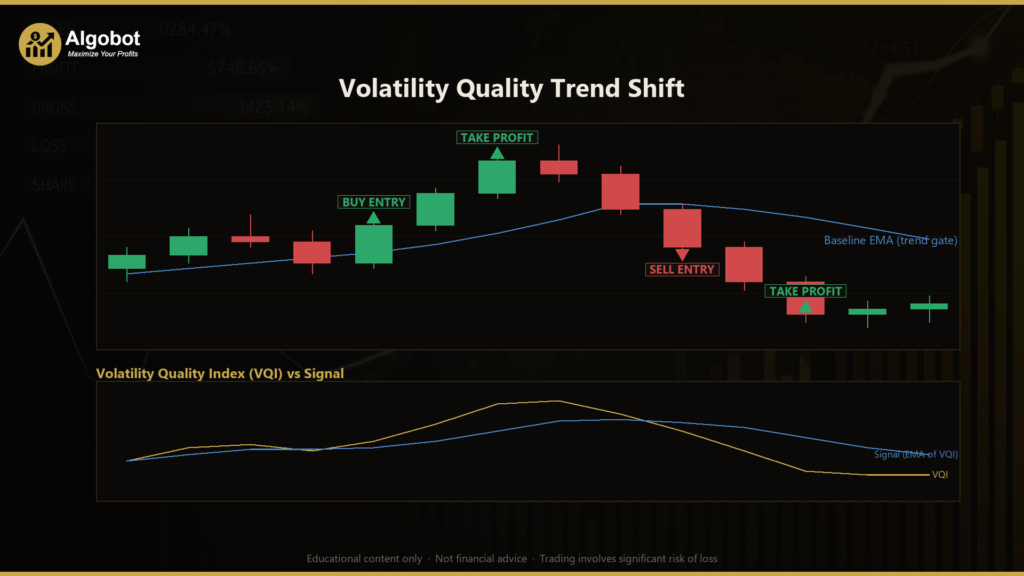
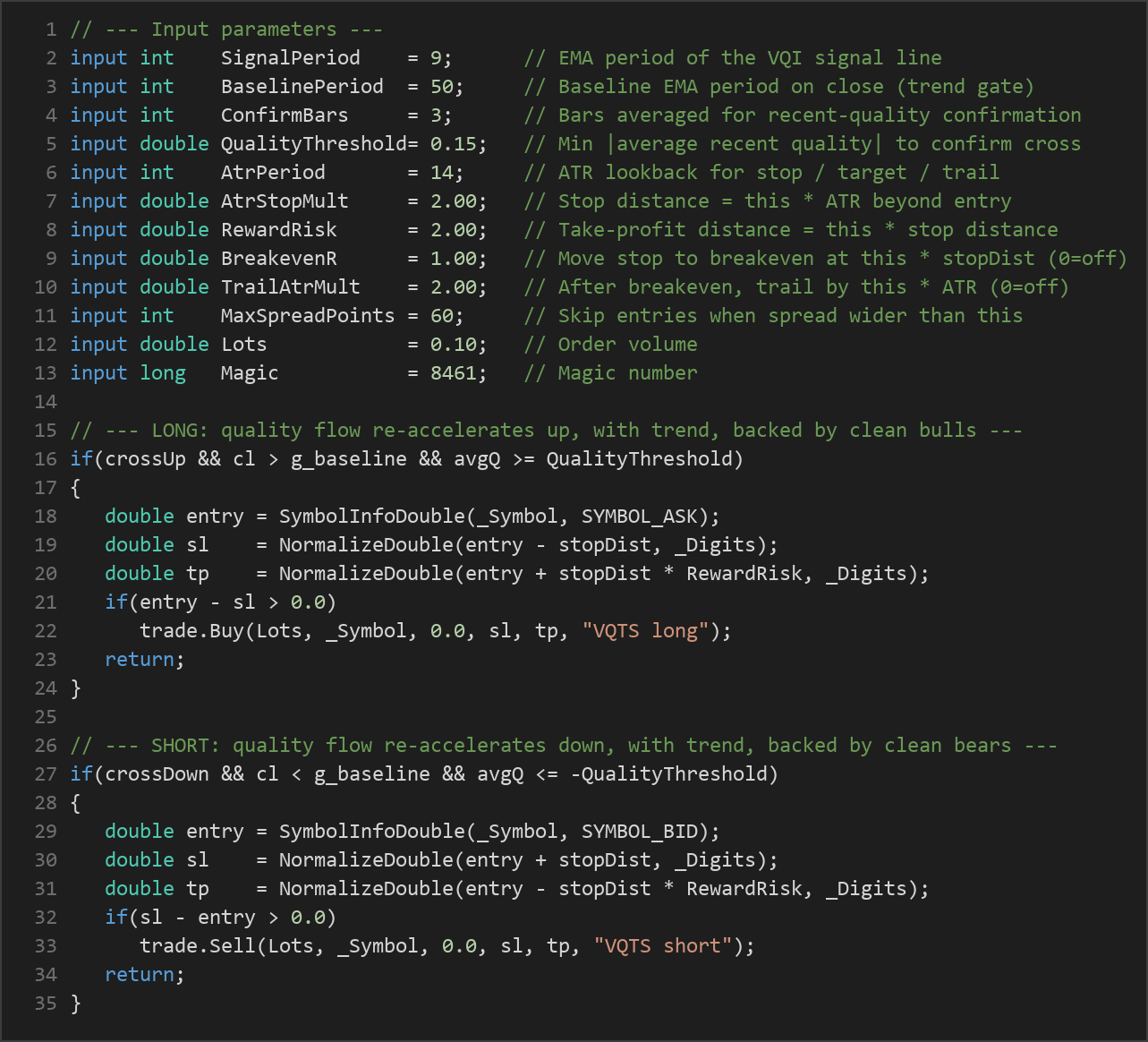
Entry conditions — the strategy signals a LONG when all three align:
- The VQI line crosses above its EMA signal line (quality flow re-accelerates upward).
- Price closes above the baseline EMA, confirming the move is with the prevailing trend.
- The average bar-quality over the last
ConfirmBarsbars is at or above+QualityThreshold, confirming the cross is backed by genuinely clean bullish candles.
A SHORT is signalled under the mirror-image conditions: the VQI crosses below its signal line, price closes below the baseline EMA, and average recent quality is at or below −QualityThreshold.
Because the VQI naturally dips below its signal during a corrective pullback and re-crosses on resumption, the cross tends to time continuation entries — "the clean dip" or "the clean rip" — rather than chasing an already-extended move.
Exit and stop-loss logic:
- The protective stop-loss is placed a distance of
AtrStopMult × ATRbeyond the entry, so it scales with current volatility. - The take-profit target is set at
RewardRisk ×that stop distance. - Once price runs
BreakevenR ×the stop distance in your favour, the stop is pulled to breakeven so a winning trade can generally only scratch rather than lose. - After breakeven, the stop trails by
TrailAtrMult × ATRto lock in open profit as the move extends. - An opposite VQI/signal cross closes the position early, before the hard stop is reached, if the quality regime flips against the trade.
The EA holds only one position per magic number at a time, and every calculation uses closed bars on a single timeframe.

Strategy Parameters
| Parameter | Default | Min | Max | Description |
|---|---|---|---|---|
| SignalPeriod | 9 | 3 | 40 | EMA period of the VQI signal line whose cross with the VQI marks a quality-regime shift. |
| BaselinePeriod | 50 | 10 | 200 | Baseline EMA period on close — the prevailing-trend gate that price must be on the correct side of. |
| ConfirmBars | 3 | 1 | 10 | Number of recent bars averaged for the bar-quality confirmation of the cross. |
| QualityThreshold | 0.15 | 0.00 | 0.60 | Minimum absolute average recent quality required to confirm a cross (filters weak signals). |
| AtrPeriod | 14 | 5 | 40 | ATR lookback used for stop, target, and trail sizing. |
| AtrStopMult | 2.00 | 0.50 | 5.00 | Protective stop distance as a multiple of ATR beyond entry. |
| RewardRisk | 2.00 | 0.50 | 6.00 | Take-profit distance as a multiple of the stop distance (reward-to-risk ratio). |
| BreakevenR | 1.00 | 0.00 | 3.00 | Move the stop to breakeven once price runs this multiple of the stop distance in favour (0 = off). |
| TrailAtrMult | 2.00 | 0.00 | 6.00 | After breakeven, trail the stop by this multiple of ATR (0 = off). |
| MaxSpreadPoints | 60 | 5 | 300 | Skip new entries when the current spread (in points) is wider than this. |
| Lots | 0.10 | 0.01 | 1.00 | Order volume in lots. |
| Magic | 8461 | 0 | 9,999,999 | Magic number used to identify and manage this EA's positions. |
Recommended Chart Settings
The Volatility Quality Trend Shift strategy is designed to run on a single timeframe and reads whatever chart it is attached to. Natural homes are liquid instruments — a major forex pair, a metal such as gold, or a stock index — on the M15 to H4 timeframes, where clean directional candles and readable trends are more common. Lower timeframes tend to be dominated by noise that the quality filter is specifically built to reject, while very high timeframes produce fewer signals.
Because every strategy behaves differently across instruments and market phases, treat any single configuration as a starting point for your own study. Results will vary across different symbols, spreads, and market conditions, and the parameter ranges above exist precisely so you can explore how the strategy adapts.
How to Install on MetaTrader 5
- Download the
.ex5file from the link below. - Copy it to your MT5
MQL5\Expertsfolder. - Restart MetaTrader 5 or refresh the Navigator panel.
- Drag the EA onto a chart matching the recommended symbol and timeframe.
- Configure the input parameters and enable Algo Trading.
What to Consider Before Using This EA
Every approach has strengths and limitations, and a fair assessment helps you learn where a tool fits.
Strengths of this approach:
- The magnitude-weighted quality score gives the VQI natural robustness to spikes and choppy, indecisive candles — a design intended to keep drawdown tight.
- Combining a cross signal with a trend gate and a recent-quality confirmation creates a triple filter that historically helps screen out weak, one-off crosses.
- The volatility-scaled stop, breakeven lock, and ATR trail form a disciplined risk framework that adapts to changing volatility rather than using fixed distances.
Known limitations:
- Like all trend-following systems, it can struggle in range-bound or sideways markets, where the VQI may cross its signal repeatedly without a sustained move, producing whipsaw entries that the trend gate cannot always avoid.
- The cumulative nature of the VQI means the line drifts over long periods; the cross matters, not the absolute level, but a prolonged flat market can still generate low-quality signals.
- Because it acts only on closed bars, entries occur after a candle completes, which introduces a natural lag compared with intrabar systems.
- Sudden news-driven gaps can move price beyond the ATR-based stop before it is honoured, as with any stop-based strategy.
The strategy may underperform during low-volatility consolidations, during erratic news events, or on illiquid instruments with wide spreads — which is exactly why the MaxSpreadPoints filter exists. Study it as an educational example of volatility-quality filtering, not as a guarantee of any behaviour.
Risk Management Tips
Sound risk management matters far more than any single indicator. Consider these general principles as you study this or any strategy:
- Position sizing: Keep your lot size proportional to your account. A common educational guideline is to risk no more than 1–2% of account equity per trade, so a string of losses does not materially damage your capital.
- Use a demo account first: Test the strategy on a demo or simulated environment until you understand how it behaves across different market conditions before considering any live use.
- Understand drawdown: Even a well-designed strategy will experience losing streaks. Know the maximum drawdown you are prepared to tolerate and how it affects you psychologically.
- Respect the stop: The ATR-based stop and breakeven logic exist to define your risk on every trade. Overriding them manually undermines the entire framework.
- Diversify your study: Do not rely on a single strategy or instrument. Understanding several approaches builds better judgement than optimising one to fit past data.
Risk Warning
Trading foreign exchange, CFDs, and other leveraged financial instruments involves substantial risk of loss and is not suitable for all investors. The strategies and tools discussed on this page are provided for educational purposes only and do not constitute financial advice, investment recommendations, or solicitation to trade. Always consult a qualified financial adviser before making trading decisions. Past backtest performance is not indicative of future results.
Downloads
- Expert Advisor: VolatilityQualityTrendShift.ex5 (21 downloads)
- Source Code: VolatilityQualityTrendShift.mq5 (20 downloads)
- Documentation: VolatilityQualityTrendShift.pdf (27 downloads)