
Disclaimer: This article is for educational and informational purposes only. It does not constitute financial or investment advice. Trading forex and CFDs carries significant risk of loss. Past performance of any strategy — including backtests — does not guarantee future results. Never trade with money you cannot afford to lose.
What Is This Strategy?
The Volatility Lull Reclaim strategy is a trend-continuation system that combines an Exponential Moving Average (EMA) trend filter, the Average True Range (ATR) volatility measure, and candlestick expansion analysis. An EMA is a moving average that gives more weight to recent prices, while ATR measures how much an instrument typically moves per bar. Together these tools let the strategy read one very specific market moment: the quiet pause inside a healthy trend, followed by a decisive push that restarts it.
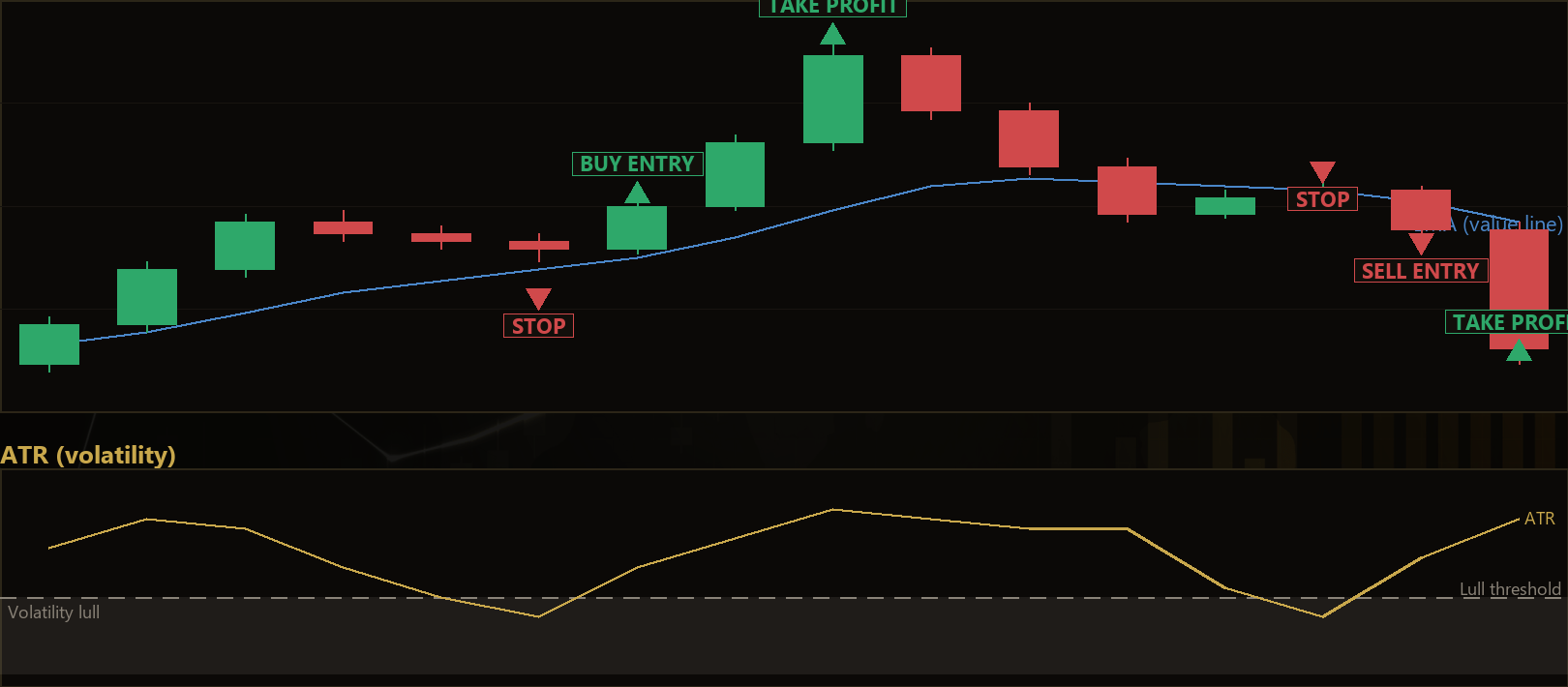
The core idea is that trends do not travel in a straight line — they "breathe." After each advance, price pauses and pulls back toward the moving-average "value" line while the bar ranges shrink. This contraction is the volatility lull: the market catching its breath. The Volatility Lull Reclaim strategy waits for that lull to form, then looks for a single strong expansion candle that reclaims the mean in the trend direction. Only when all three ingredients — an established trend, a genuine lull, and an expansion reclaim — line up does the strategy signal an entry.
As a learning tool, this approach is well suited to traders who want to study how volatility contraction and expansion interact with trend structure. It is a mechanical, rule-based system, so it is useful for understanding how objective filters can be layered to isolate a repeatable pattern rather than trading on discretion. It is designed for trending markets and will deliberately stay flat when price is directionless or when volatility never dries up.
How It Works
The strategy evaluates its rules once per completed bar and manages any open position on every tick. Entries require a three-part "fingerprint" to be present at the same time.
Entry conditions (long example — short is the exact mirror):
- Trend filter: The EMA's slope is measured over a lookback window and then divided by ATR to make it scale-free. If this ATR-normalized slope is at or above
MinSlopeAtr, the strategy considers the trend to be up; at or below the negative of that value, the trend is down. Normalizing by ATR keeps the trend test consistent across different symbols and timeframes. - Lull filter: Across the pullback window (
LullBarsbars just before the trigger bar), the strategy averages each bar's High–Low range. This average must be at or belowLullFactor × ATR, confirming that volatility has contracted. At the same time, the pullback extreme must sit withinZoneAtr × ATRof the EMA, confirming price has returned to the value zone. - Reclaim trigger: The just-closed bar must be a strong expansion candle. Its body must be at least
ExpandFactor × ATR, it must close back across the EMA, and it must close beyond the prior bar's close. This bar signals that the lull is over and the trend may be re-igniting.
Stop-loss logic:
- The stop is placed just beyond the quiet pullback extreme, padded by
StopBufferAtr × ATR. Because entry comes right off a tight, low-volatility pullback, the resulting stop distance tends to be small. - If the calculated risk (entry to stop distance) exceeds
MaxRiskAtr × ATR, the trade is skipped entirely, so no single position can risk an outsized amount.
Take-profit and trade management:
- The take-profit is set at
RewardRisk × risk, giving a fixed reward-to-risk target. - Once price moves
BreakevenRrisk-multiples in your favor, the stop is pulled to break-even and then trailed byTrailAtrMult × ATR. The stop is only ever tightened, never loosened. - The strategy holds one position at a time, tagged with the
Magicidentifier.
Strategy Parameters
| Parameter | Default | Min | Max | Description |
|---|---|---|---|---|
| TrendPeriod | 40 | 15 | 200 | Number of bars used in the EMA that defines the trend line. |
| SlopeLookback | 8 | 3 | 40 | How many bars back the EMA slope is measured over. |
| MinSlopeAtr | 0.15 | 0.0 | 1.50 | Minimum ATR-normalized EMA slope required to confirm a trend. |
| AtrPeriod | 14 | 5 | 40 | Number of bars used to calculate the ATR volatility measure. |
| LullBars | 5 | 2 | 15 | Length of the pullback / lull window before the trigger bar. |
| LullFactor | 0.80 | 0.30 | 1.30 | Average bar range must be at or below this multiple of ATR. |
| ZoneAtr | 0.75 | 0.0 | 3.0 | Pullback extreme must be within this multiple of ATR from the EMA. |
| ExpandFactor | 0.60 | 0.10 | 2.0 | Expansion-candle body must be at least this multiple of ATR. |
| StopBufferAtr | 0.40 | 0.0 | 2.0 | Extra ATR-based padding placed beyond the pullback extreme for the stop. |
| MaxRiskAtr | 3.0 | 1.0 | 8.0 | Trades whose risk exceeds this multiple of ATR are skipped. |
| RewardRisk | 2.0 | 1.0 | 5.0 | Take-profit distance as a multiple of the trade's risk. |
| BreakevenR | 0.9 | 0.3 | 2.0 | Profit (in risk-multiples) required before the stop moves to break-even. |
| TrailAtrMult | 1.5 | 0.5 | 4.0 | Trailing-stop distance in ATRs after break-even is reached. |
| Lots | 0.05 | 0.01 | 1.0 | Fixed trade volume in lots. |

Recommended Chart Settings
The Volatility Lull Reclaim strategy is written to run on a single timeframe and is not hardcoded to any specific symbol or period — every calculation uses the chart's primary timeframe. This makes it flexible, but it also means you should test it deliberately rather than assuming a universal setting.
A practical starting point is a liquid major forex pair such as EUR/USD on an intraday timeframe like the H1 (1-hour) chart, where trend-pause-continuation structure is common and spreads are typically tight. Because the trend and lull tests are ATR-normalized, the same defaults can be evaluated across other pairs and timeframes without rescaling. Keep in mind that results will vary considerably across different instruments and market conditions, and any settings that appear favorable in one period may behave differently in another.
How to Install on MetaTrader 5
- Download the .ex5 file from the link below
- Copy it to your MT5
MQL5\Expertsfolder - Restart MetaTrader 5 or refresh the Navigator panel
- Drag the EA onto a chart matching the recommended symbol and timeframe
- Configure the input parameters and enable Algo Trading
What to Consider Before Using This EA
Strengths of this approach. The strategy's main advantage is its selectivity. By requiring an established trend, a genuine volatility contraction, and an expansion reclaim all at once, it filters out much of the noise that traps simpler pullback systems. Entering right after volatility collapses into the mean allows a naturally tight stop, and the MaxRiskAtr cap prevents any single trade from carrying excessive risk. The break-even and ATR-trailing logic is designed to protect gains once a move develops, which historically supports a lower peak-to-trough drawdown profile.
Known limitations. Trend-continuation systems depend on trends actually continuing. In choppy, range-bound, or sharply mean-reverting markets, the strategy may take entries that immediately reverse, producing a string of small losses. The expansion-candle requirement can also cause you to enter after a large bar, occasionally near a short-term exhaustion point. Because the system trades only when a fairly precise pattern appears, signal frequency can be low, and long quiet periods with no trades are normal.
Where it may underperform. Expect weaker behavior during low-volatility drift where the lull never resolves into a real expansion, during news-driven whipsaws that violate the tight structural stop, and in strongly ranging conditions where the ATR-normalized slope oscillates around the MinSlopeAtr threshold. As with any single indicator combination, no filter set anticipates every regime, and the strategy should be viewed as one lens on the market rather than a complete system.
Risk Management Tips
Sound risk management matters more than any single entry signal. Consider these general principles as part of your learning process:
- Position sizing: Size each trade so that a loss at the stop represents only a small, predetermined fraction of your account. A widely taught guideline is to risk no more than 1–2% of account equity on any single trade.
- Respect the stop: The structural stop is central to this strategy's design. Avoid widening or removing it, since doing so undermines the tight-risk logic that the whole approach depends on.
- Test on demo first: Run the EA on a demo account across varied market conditions before considering any live use. This lets you observe how often it trades and how it behaves during trends, ranges, and volatile events without financial exposure.
- Understand drawdown: Even a well-constructed strategy will experience losing streaks. Study the depth and duration of drawdown so your expectations are realistic, and never deploy capital you cannot afford to lose.
- Keep records: Logging your parameter choices and observations helps you learn what the strategy is actually doing rather than relying on assumptions.
Risk Warning
Trading foreign exchange, CFDs, and other leveraged financial instruments involves substantial risk of loss and is not suitable for all investors. The strategies and tools discussed on this page are provided for educational purposes only and do not constitute financial advice, investment recommendations, or solicitation to trade. Always consult a qualified financial adviser before making trading decisions. Past backtest performance is not indicative of future results.
Downloads
- Expert Advisor: VolatilityLullReclaim.ex5 (42 downloads)
- Source Code: VolatilityLullReclaim.mq5 (43 downloads)
- Documentation: VolatilityLullReclaim.pdf (53 downloads)