Disclaimer: This article is for educational and informational purposes only. It does not constitute financial or investment advice. Trading forex and CFDs carries significant risk of loss. Past performance of any strategy — including backtests — does not guarantee future results. Never trade with money you cannot afford to lose.
What Is This Strategy?
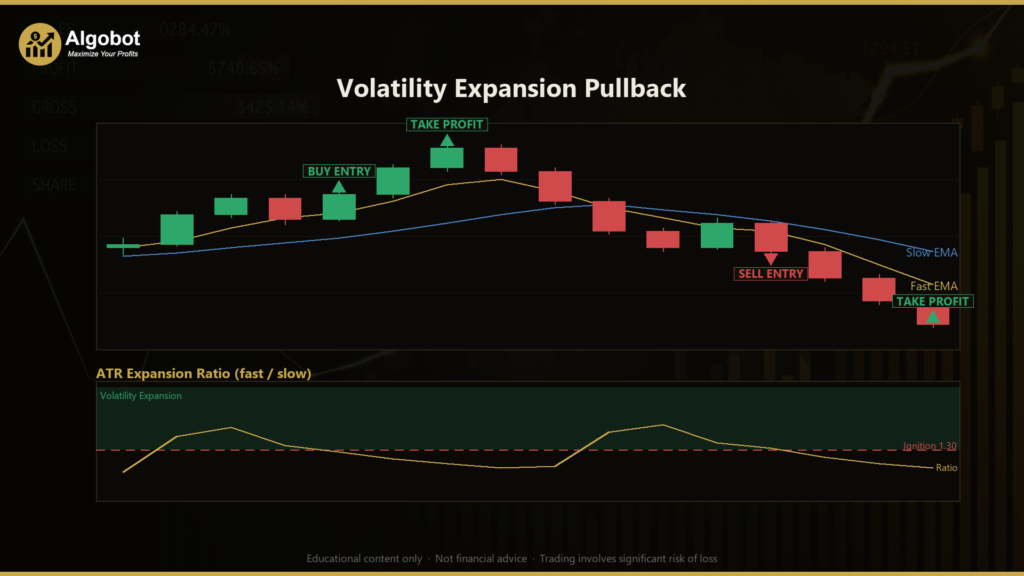
The Volatility Expansion Pullback strategy is a trend-following continuation system built around a dual-ATR "volatility ignition" gate paired with an EMA (Exponential Moving Average) pullback entry. ATR, or Average True Range, is a classic indicator that measures how much price typically moves over a set number of bars — in other words, how volatile the market is right now. This strategy compares a short-window ATR against a longer-window ATR to detect the exact moment a quiet market suddenly springs to life.
The core idea it explores is that sustained directional moves are often born out of a sudden expansion of volatility off a quiet base. When short-horizon range swells relative to its own longer-horizon baseline, it can signal that one side of the order book has grabbed control. Most breakout systems chase that first expansion bar directly, which historically means the worst fill and the widest stop. The Volatility Expansion Pullback does the opposite: it treats the expansion only as a trigger to watch, notes the direction of the impulse from a slow trend EMA, then waits patiently for the first shallow pullback into a fast EMA and enters on the reclaim.
As a learning tool, this strategy is well suited to traders who want to study how volatility regime changes, trend filters, and pullback timing can be combined into a single rules-based system. It is designed for liquid, trending environments — a classic example being a major forex pair — and it deliberately sits on its hands during flat, low-volatility conditions where no ignition ever arms a setup. It is not a "signal in every bar" system; it is a patient, condition-driven approach.
How It Works
The strategy operates entirely on closed bars, taking at most one action per completed bar on the primary timeframe. Its logic can be broken into an ignition phase, an arming phase, and an entry phase.
- The ignition gauge: The strategy continuously computes a ratio of
ATR(AtrFast) / ATR(AtrSlow). This ratio rises when short-term volatility expands faster than the longer-term baseline. - Ignition trigger: The strategy signals ignition when this ratio crosses up through the
BurstThreshold. This upward cross — not simply a high reading — is what marks a fresh volatility swell. - Arming a direction: On ignition, the strategy checks the trend context using two EMAs.
- If price closed above the slow EMA and the fast EMA is above the slow EMA, it arms a long setup.
- If price closed below the slow EMA and the fast EMA is below the slow EMA, it arms a short setup.
- If the direction is ambiguous, nothing is armed.
- Waiting window: Once armed, a setup stays valid for up to
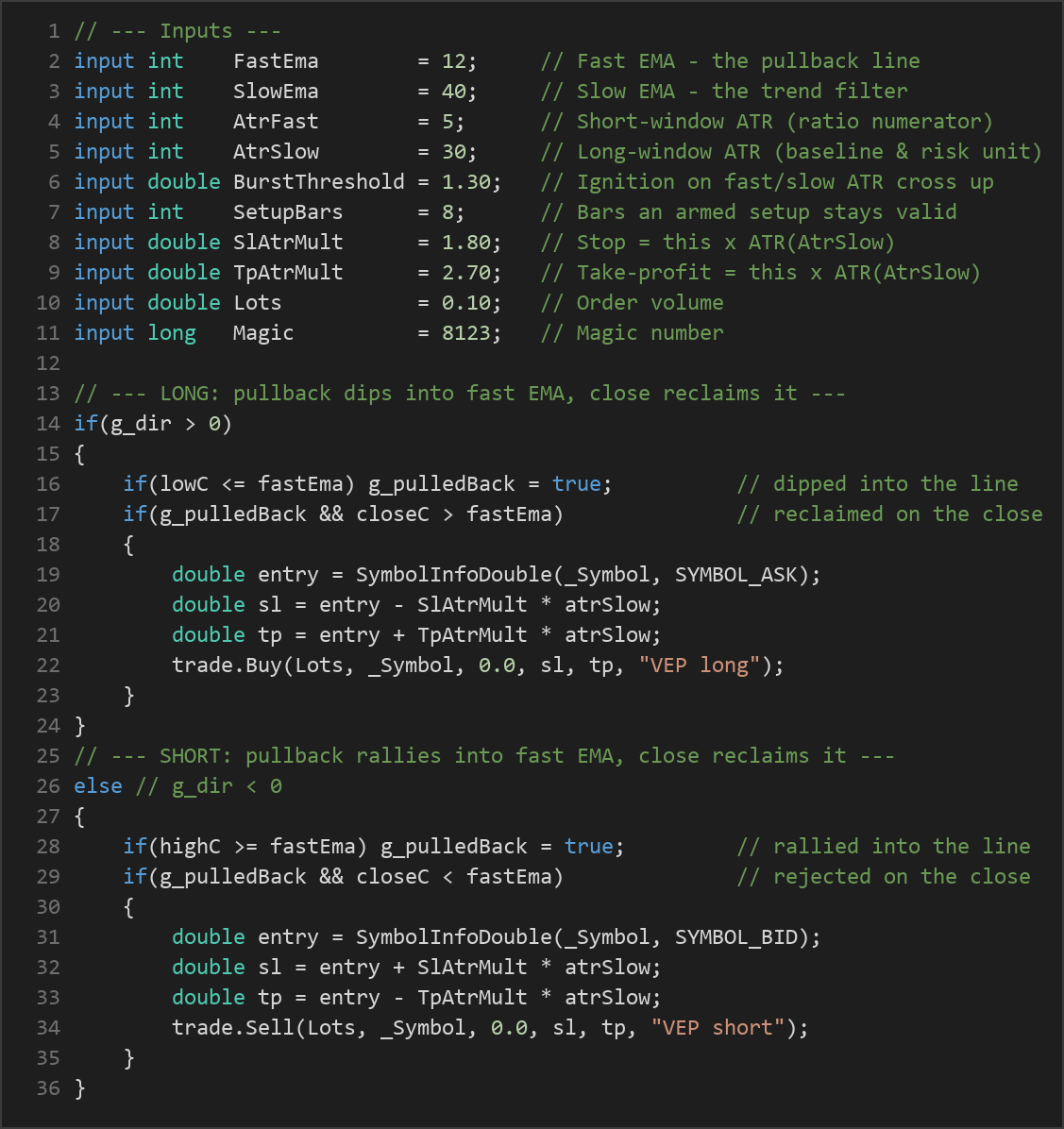
SetupBarsbars. The setup is invalidated early if price crosses back through the slow EMA against the intended direction — a sign the impulse may have been a false start. - Pullback: While armed, the strategy watches for the first shallow pullback into the fast EMA. For a long, this means a bar's low dips to or below the fast EMA; for a short, a bar's high rallies to or above it.
- Entry (the reclaim): After a pullback has occurred, the strategy signals an entry when a bar closes back on the trend side of the fast EMA — above it for longs, below it for shorts. Because a single rejection bar can both dip into the line and reclaim it, an entry can occur on the same bar as the pullback.
For exits, risk is scaled by volatility using the stable slow ATR as the unit:
- Stop-loss: placed
SlAtrMult × ATR(AtrSlow)away from the entry price. - Take-profit: placed
TpAtrMult × ATR(AtrSlow)away from the entry price. - One position at a time: trades are tagged by a Magic number, and only a single position is held. The ATR-based stop and target manage the exit — there is no discretionary intervention.
Strategy Parameters
| Parameter | Default | Min | Max | Description |
|---|---|---|---|---|
| FastEma | 12 | 5 | 40 | Period of the fast EMA — the pullback line that entries must reclaim. |
| SlowEma | 40 | 20 | 150 | Period of the slow EMA — the trend and direction filter. |
| AtrFast | 5 | 2 | 20 | Short-window ATR period; the numerator of the ignition ratio. |
| AtrSlow | 30 | 15 | 100 | Long-window ATR period; the volatility baseline and the risk unit. |
| BurstThreshold | 1.30 | 1.05 | 2.50 | Ignition fires when the fast/slow ATR ratio crosses up through this value. |
| SetupBars | 8 | 2 | 25 | How many bars an armed setup stays valid while waiting for its pullback. |
| SlAtrMult | 1.80 | 0.50 | 5.00 | Stop-loss distance as a multiple of ATR(AtrSlow). |
| TpAtrMult | 2.70 | 0.50 | 8.00 | Take-profit distance as a multiple of ATR(AtrSlow). |
| Lots | 0.10 | 0.01 | 1.00 | Order volume in lots. |
| Magic | 8123 | 0 | 9,999,999 | Magic number used to tag and identify this EA's positions. |
Recommended Chart Settings
The Volatility Expansion Pullback was designed with liquid forex majors in mind — a typical example being EURUSD — on intraday timeframes such as M15 to H1. These conditions tend to offer the blend of clean trends and periodic volatility contractions that the ignition gauge is built to detect.
That said, every market behaves differently, and results will vary considerably across symbols, timeframes, and changing market conditions. A pair or timeframe that trends smoothly in one period may chop sideways in another. Before relying on any settings, study how the strategy behaves on your chosen instrument across many different market regimes, and treat the defaults as a starting point for research rather than a finished configuration.
How to Install on MetaTrader 5
- Download the
.ex5file from the link below. - Copy it to your MT5
MQL5\Expertsfolder. - Restart MetaTrader 5 or refresh the Navigator panel.
- Drag the EA onto a chart matching the recommended symbol and timeframe.
- Configure the input parameters and enable Algo Trading.
What to Consider Before Using This EA
Like every mechanical system, the Volatility Expansion Pullback has clear strengths and equally clear limitations, and understanding both is the point of studying it.
Strengths of the approach. By entering on a pullback reclaim rather than chasing the first expansion bar, the strategy historically aims for a better price and a tighter, more logical stop than a raw breakout entry. The dual EMA filter means it only arms trades that are aligned with the prevailing trend, and the ATR-scaled stop and target automatically adapt position risk to current volatility rather than using fixed pip distances. The requirement that a setup expire after SetupBars bars, or invalidate on a slow-EMA break, helps keep the system from acting on stale signals.
Known limitations. This is a trend-continuation model, so it may struggle in choppy, range-bound, or sharply mean-reverting markets. Whipsaws around the fast and slow EMAs can arm setups that fail quickly, and a volatility expansion does not always resolve into a clean directional leg — sometimes it simply marks a spike that fades. Because the entry depends on a specific pullback-then-reclaim sequence within a limited window, valid trends can be missed entirely if price never offers the shallow dip the rules require. Frequent volatility bursts in a directionless market can also produce a series of small losses.
The most productive way to use this EA is as a transparent, well-documented example of how volatility filtering and pullback timing fit together — not as a finished, hands-off solution. Test it thoroughly, understand why it enters and exits, and observe the market conditions where it underperforms.
Risk Management Tips
Sound risk management matters far more than any single entry signal. As you study this strategy, keep these general principles in mind:
- Risk a small, fixed fraction per trade. Many educational sources suggest risking no more than 1–2% of account equity on any single position, so that a losing streak cannot do outsized damage.
- Size positions deliberately. The
Lotsinput is fixed, so calculate whether that volume is appropriate for your account size and the ATR-based stop distance before going live. - Always start on a demo account. Run the EA in a risk-free simulated environment first to understand its behavior, trade frequency, and drawdown profile.
- Understand drawdown. Every strategy experiences losing periods. Know the depth and duration of drawdown you are willing to tolerate before you begin, not during a losing streak.
- Review regularly. Markets evolve. Periodically re-examine whether the parameters and the instrument still suit current conditions.
Risk Warning
Trading foreign exchange, CFDs, and other leveraged financial instruments involves substantial risk of loss and is not suitable for all investors. The strategies and tools discussed on this page are provided for educational purposes only and do not constitute financial advice, investment recommendations, or solicitation to trade. Always consult a qualified financial adviser before making trading decisions. Past backtest performance is not indicative of future results.
Downloads
- Expert Advisor: VolatilityExpansionPullback.ex5 (49 downloads)
- Source Code: VolatilityExpansionPullback.mq5 (50 downloads)
- Documentation: VolatilityExpansionPullback.pdf (68 downloads)