Disclaimer: This article is for educational and informational purposes only. It does not constitute financial or investment advice. Trading forex and CFDs carries significant risk of loss. Past performance of any strategy — including backtests — does not guarantee future results. Never trade with money you cannot afford to lose.
What Is This Strategy?
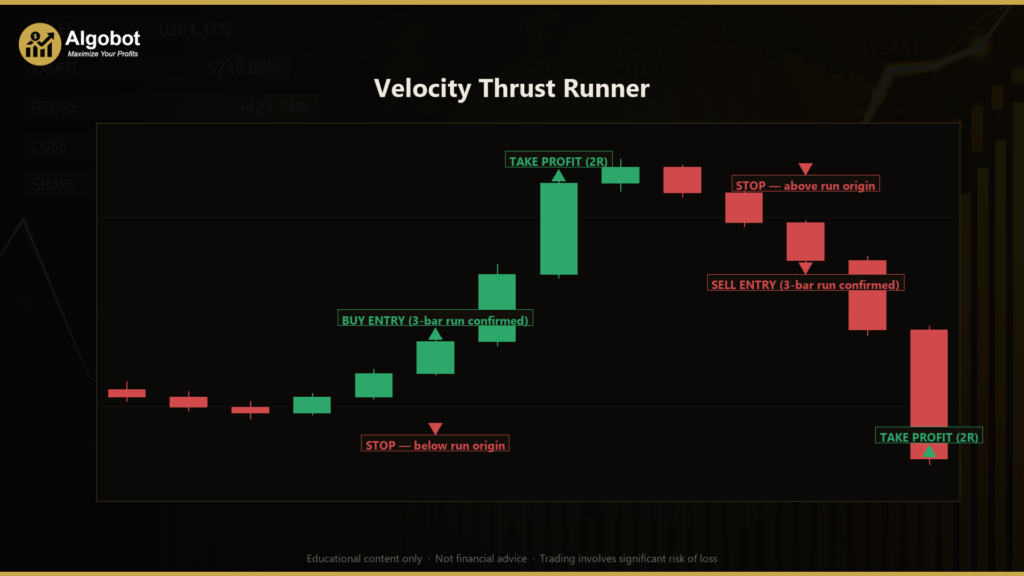
The Velocity Thrust Runner is a pure price-action momentum strategy for MetaTrader 5 that uses no indicators of any kind — no moving average, no RSI, no ATR, nothing derived from a formula. Instead, it reads raw candlestick data (the open, high, low, and close of each bar) to measure one thing: genuine velocity, meaning sustained directional travel across several consecutive bars that is still accelerating. In trading, "momentum" is often misread as a single large candle, but the Velocity Thrust Runner treats momentum as a run — a sequence of bars all pushing the same direction with conviction rather than chopping back and forth.
The strategy is designed for trending, impulsive market conditions — the moments when price breaks out of a quiet range and begins to travel decisively. It deliberately ignores slow, grinding moves and sideways noise. The logic combines three raw-OHLC facts: a run of same-direction bars, a velocity check (how far the run traveled relative to the recent quiet baseline), and an acceleration check (whether the most recent bar is still expanding). Only when all three align does the strategy signal an entry.
As a learning tool, the Velocity Thrust Runner is well suited to traders who want to understand momentum and breakout behavior without relying on lagging indicators. Because every condition is built from candle geometry, it is transparent and easy to study bar by bar. This article frames the strategy as an analytical exercise — a way to learn how price velocity can be quantified — not as a profit opportunity.
How It Works
The Velocity Thrust Runner evaluates the market once per newly-closed bar. It never acts on the bar that is still forming, which avoids reacting to incomplete information. When a fresh bar closes, the strategy walks through a strict checklist before it will signal a trade. Here is the logic in plain English:
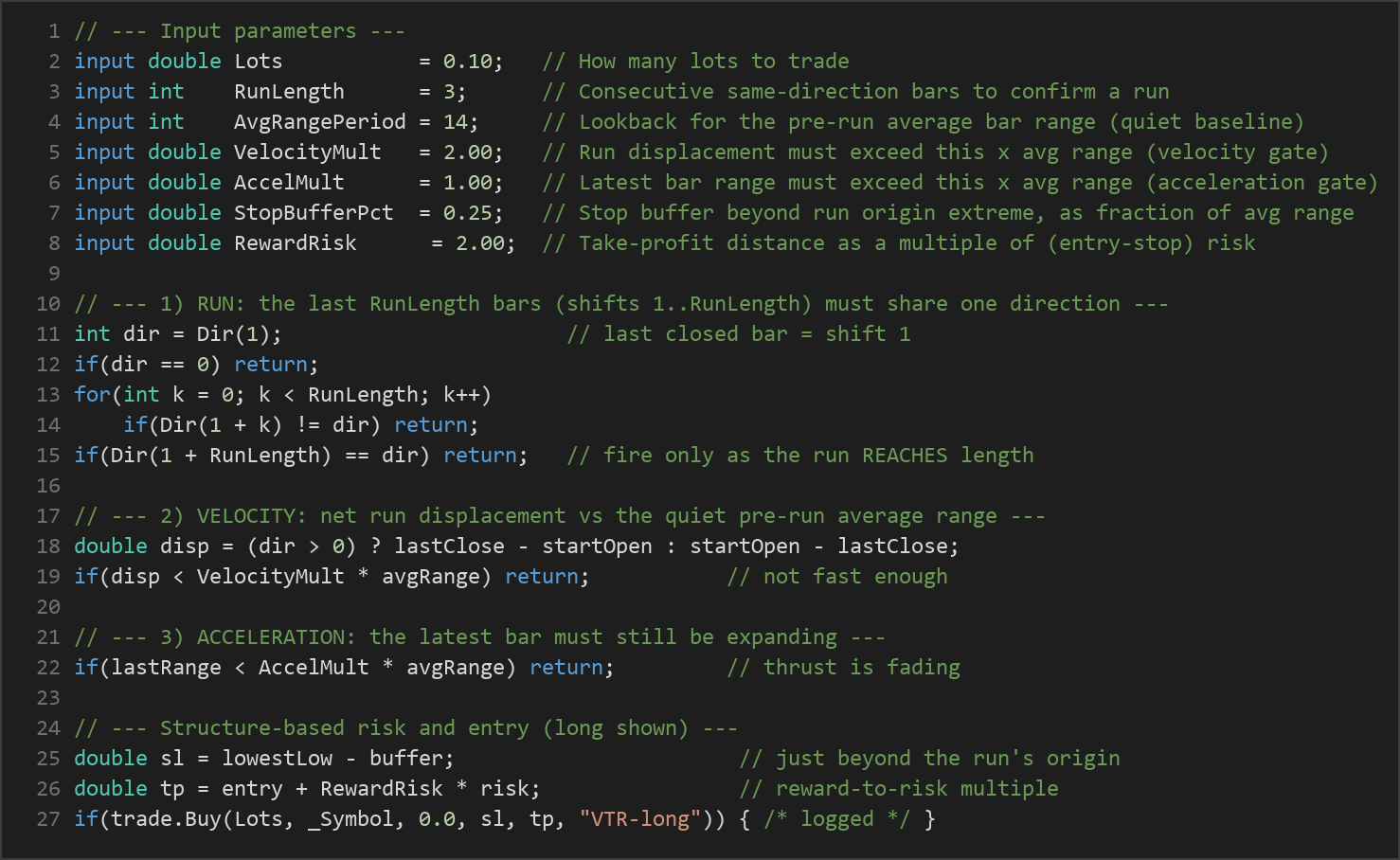
- The run condition (persistence). The strategy counts the body direction of recent bars — bullish if the close is above the open, bearish if below. It requires the last RunLength bars (default 3) to all share the same direction. This confirms price is moving with persistence, not chopping.
- Fire only when the run is first confirmed. The strategy checks the bar immediately before the run. If that bar is the same direction, the run was already longer and a signal would have fired earlier — so it skips. This ensures each run is traded once, at the exact moment momentum is confirmed, never chased late.
- The velocity gate (speed). It measures displacement — the net distance from the open of the run's first bar to the close of its last bar. That displacement must exceed VelocityMult (default 2.00) times the average bar range of the quiet bars before the run. In short: the thrust must be fast relative to the calm that preceded it.
- The acceleration gate (thrust still alive). The most recent bar's high-to-low range must exceed AccelMult (default 1.00) times that same pre-run average range. If the latest bar is shrinking, the momentum may be exhausting, and the strategy stands aside.
- Entry. When all conditions pass, the strategy signals a market order in the run's direction — a buy at the ask for bullish runs, a sell at the bid for bearish runs.
- Stop-loss (structure-based). The stop is placed just beyond the run's origin extreme: below the lowest low of the run for longs, or above the highest high for shorts, plus a small buffer set by StopBufferPct of the average range. Risk is defined by structure, not a fixed pip count.
- Take-profit (fixed reward-to-risk). The target sits at a multiple of the stop distance, controlled by RewardRisk (default 2.00). If the stop is 20 pips away, a 2.0 setting places the target 40 pips away.
- One trade at a time. While a position is open for this strategy's magic number, no new trade is taken. The stop-loss or take-profit must resolve the open risk first.
Strategy Parameters
| Parameter | Default | Min | Max | Description |
|---|---|---|---|---|
| Lots | 0.10 | 0.01 | 1.00 | Trade size in lots. Set this to match your account size and risk tolerance. |
| RunLength | 3 | 2 | 8 | Number of consecutive same-direction bars required to confirm a momentum run. |
| AvgRangePeriod | 14 | 5 | 40 | Lookback used to measure the quiet pre-run average bar range — the baseline the thrust must beat. |
| VelocityMult | 2.00 | 0.50 | 6.00 | Run displacement must exceed this multiple of the average range (the velocity gate). Higher = stricter. |
| AccelMult | 1.00 | 0.50 | 2.50 | The latest bar's range must exceed this multiple of the average range (the acceleration gate). |
| StopBufferPct | 0.25 | 0.00 | 1.00 | Extra stop distance beyond the run's origin extreme, as a fraction of the average range. |
| RewardRisk | 2.00 | 1.00 | 5.00 | Take-profit distance as a multiple of the entry-to-stop risk. |
Recommended Chart Settings
The Velocity Thrust Runner is a momentum-and-breakout concept, so it tends to express most clearly on intraday timeframes such as the M15, M30, or H1 charts, where impulsive runs are frequent enough to study but not buried in tick noise. It can be applied to liquid instruments — major forex pairs such as EUR/USD or GBP/USD, or index CFDs — where directional thrusts are common.
Because the strategy measures velocity relative to each instrument's own recent range, it adapts naturally to different volatility profiles. That said, results will vary considerably across symbols, sessions, and market conditions. A setting that captures clean runs on one pair during a trending session may signal far less often during quiet, range-bound periods. Always test any configuration on historical data and a demo account for your specific symbol and timeframe before drawing conclusions.
How to Install on MetaTrader 5
- Download the
VelocityThrustRunner.ex5file from the link below. - Copy it to your MT5
MQL5\Expertsfolder. - Restart MetaTrader 5 or refresh the Navigator panel.
- Drag the EA onto a chart matching the recommended symbol and timeframe.
- Configure the input parameters and enable Algo Trading.
What to Consider Before Using This EA
Every strategy has strengths and trade-offs, and the Velocity Thrust Runner is no exception.
Strengths. Its biggest advantage is transparency: because it uses only raw OHLC data, there is no indicator lag and no hidden smoothing. The "fire once when the run is first confirmed" rule is a thoughtful touch — it avoids chasing a move that is already extended. Risk is also defined by market structure rather than an arbitrary fixed distance, which keeps the stop logically tied to where the thrust began.
Known limitations. Momentum strategies, by their nature, depend on follow-through. In choppy or mean-reverting conditions, a confirmed run can stall or reverse immediately after entry, leading to a cluster of small losses. The strategy enters at market after a run is confirmed, so part of the move has already occurred before the position opens; the take-profit relies on continued travel. Whipsaw around news releases and low-liquidity sessions can also trigger qualifying ranges that fail to persist.
Where it may underperform. Tight, range-bound markets are the natural enemy of this approach — runs form, trip the gates, then fade. Be realistic: no parameter set will perform equally across all regimes, and historically momentum systems experience streaks of losses during non-trending phases. Treat the defaults as a starting point for study, not a finished solution.
Risk Management Tips
Sound risk management matters more than any single entry rule. Consider these general principles as you study the strategy:
- Risk a small, fixed fraction per trade. Many educational resources suggest risking no more than 1–2% of account equity on any single position. Size your
Lotsso the distance to the structure-based stop stays within that limit. - Understand drawdown. Even a well-designed momentum system will have losing streaks. Know the maximum historical drawdown of any configuration before committing real capital, and ask whether you could tolerate it emotionally.
- Start on a demo account. Run the EA on a demo or paper account first to observe how often it signals and how it behaves across different sessions and volatility regimes.
- Use a reward-to-risk that suits you. The
RewardRiskparameter directly shapes your win-rate-to-payoff balance. A higher multiple needs fewer winners to break even but produces fewer full targets. - Never over-leverage. Leverage amplifies both gains and losses. Keep position sizes conservative, especially while learning.
Risk Warning
Trading foreign exchange, CFDs, and other leveraged financial instruments involves substantial risk of loss and is not suitable for all investors. The strategies and tools discussed on this page are provided for educational purposes only and do not constitute financial advice, investment recommendations, or solicitation to trade. Always consult a qualified financial adviser before making trading decisions. Past backtest performance is not indicative of future results.
Downloads
- Expert Advisor: VelocityThrustRunner.ex5 (69 downloads)
- Source Code: VelocityThrustRunner.mq5 (62 downloads)
- Documentation: VelocityThrustRunner.pdf (66 downloads)