Disclaimer: This article is for educational and informational purposes only. It does not constitute financial or investment advice. Trading forex and CFDs carries significant risk of loss. Past performance of any strategy — including backtests — does not guarantee future results. Never trade with money you cannot afford to lose.
What Is This Strategy?
The Value Migration Trend Rider is a market-profile trend-pullback strategy built around a concept called the Point of Control (POC) — the single price level where a market has spent the most time over a recent window of bars. In classic market-profile analysis, the POC acts as a "value magnet": price is repeatedly drawn back toward the level that traders have collectively accepted as fair. Rather than relying on a moving average or a volume spike, this strategy measures where time-at-price actually concentrates and treats that level as its reference line.
What makes this approach distinct is its focus on value migration. Instead of asking "where is fair value right now?", the strategy asks "which direction is fair value drifting?" When the developing POC steadily climbs bar after bar, the market is accepting higher and higher prices as fair — a signature of a healthy uptrend. When the POC sinks, value is being redistributed lower, a downtrend footprint. A market stuck in chop leaves the POC roughly stationary and produces no trade. The strategy then waits for price to dip back into that migrating value zone before committing, aiming to enter on a pullback rather than chasing a breakout.
This strategy is best suited to traders who want to learn how market-profile and time-at-price concepts can be automated. It combines three familiar ideas — a rolling price profile, a drift/trend filter, and Average True Range (ATR, a standard volatility measure) for risk sizing — into one testable system. It is designed as a study tool for understanding trend-pullback logic, not as a shortcut to results. Traders comfortable with backtesting and demo-account experimentation will get the most educational value from it.
How It Works
The strategy processes one signal per newly closed bar. Each bar it rebuilds a time-at-price profile, locates the POC, measures how far that POC has migrated, and then checks for a pullback entry. Here is the logic in plain English:
- Building the profile: For the last
ProfileWindowclosed bars, the strategy takes each bar's typical price — the average of its High, Low, and Close — and drops it into one ofProfileBinsequal-width price buckets spanning the window's high-to-low range. The bucket that collected the most bars is the modal (most-visited) bucket, and its centre becomes the POC. Because the buckets are sized from the data itself, the profile adapts automatically to any symbol or timeframe without needing a fixed point size.
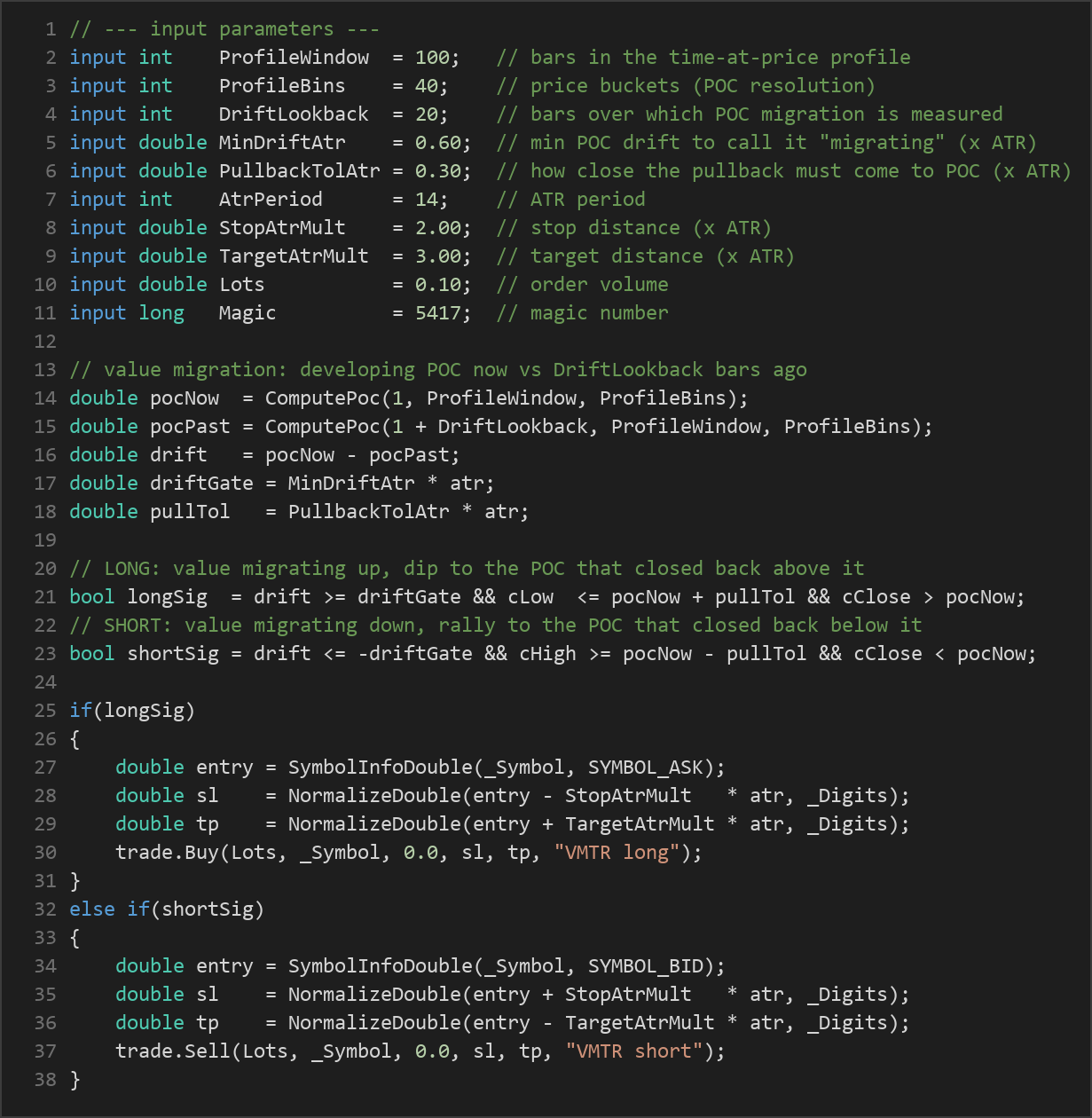
- Measuring migration (the drift): The strategy stores the POC on every bar and compares the current POC to the POC from
DriftLookbackbars ago. The difference is the drift. A large positive drift means value has been marching upward; a large negative drift means it has been sinking.
- The trend gate: Drift alone is not enough — it must be significant relative to volatility. The strategy multiplies ATR by
MinDriftAtrto create a drift gate. Only when the POC has moved by at least that much does the market qualify as "migrating."
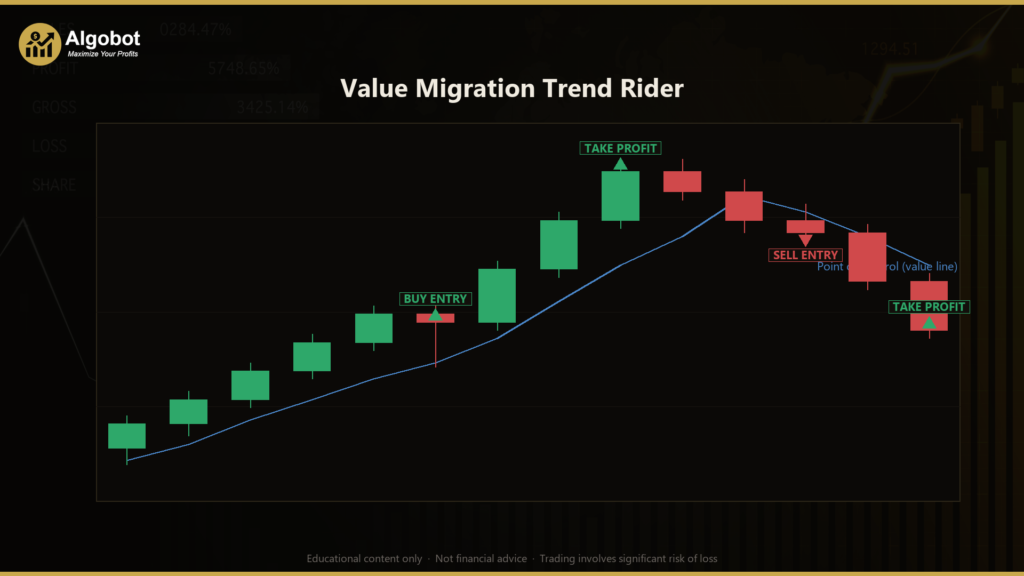
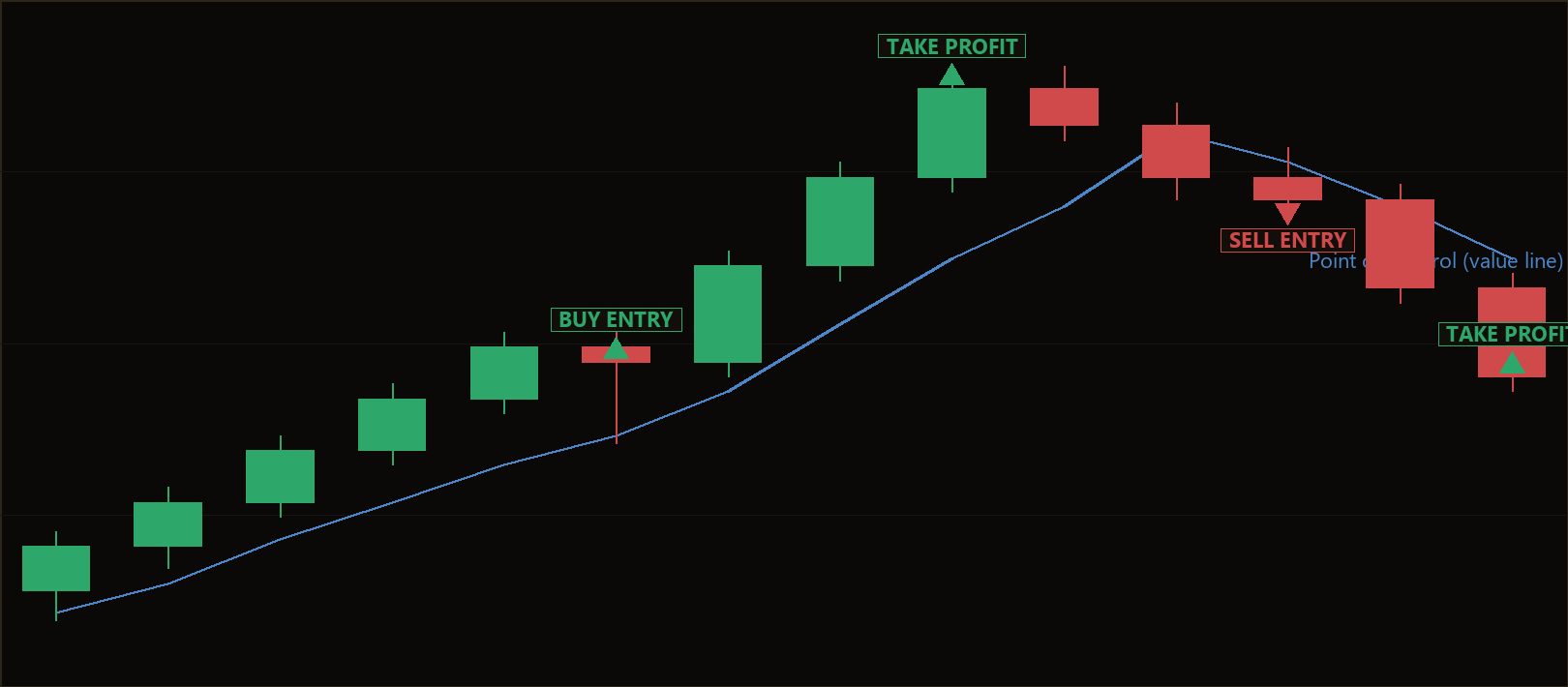
- Long entry signal: The strategy signals a long when three conditions align: (1) the POC has migrated up by at least the drift gate, (2) the just-closed bar dipped back down to the POC — its Low came within
PullbackTolAtr× ATR of the POC — and (3) that same bar closed back above the POC. In effect, price pulled into rising value and was accepted there.
- Short entry signal: The mirror image. The strategy signals a short when the POC has migrated down by at least the drift gate, the just-closed bar rallied up to the POC (its High reached within tolerance), and the bar closed back below the POC — a rip into sinking value that was rejected.
- Stop-loss logic: On entry, the stop is placed
StopAtrMult× ATR away from the fill price — below entry for longs, above for shorts. Because it scales with ATR, the stop widens in volatile conditions and tightens in calm ones.
- Take-profit logic: The target is placed
TargetAtrMult× ATR in the direction of the trade. With the defaults (2.0 stop, 3.0 target), this produces a roughly 1.5-to-1 reward-to-risk framing, though both are fully adjustable.
- Position management: Only one position per Magic number is allowed at a time. Once a trade is open, the ATR-based stop and target manage the exit entirely — there is no separate trailing or scaling logic.
Strategy Parameters
| Parameter | Default | Min | Max | Description |
|---|---|---|---|---|
| ProfileWindow | 100 | 40 | 200 | Number of closed bars in the rolling time-at-price profile. Larger values smooth the POC and slow its response. |
| ProfileBins | 40 | 15 | 80 | How many price buckets the profile is split into. Higher values give a finer, more precise POC resolution. |
| DriftLookback | 20 | 5 | 60 | Number of bars over which the POC's migration (drift) is measured. Shorter values detect faster trend shifts. |
| MinDriftAtr | 0.60 | 0.10 | 2.00 | Minimum POC drift, as a multiple of ATR, required to call the profile "migrating." Higher values demand a stronger trend. |
| PullbackTolAtr | 0.30 | 0.00 | 1.00 | How close the pullback bar must come to the POC, as a multiple of ATR. Larger values accept looser pullbacks. |
| AtrPeriod | 14 | 7 | 30 | Averaging period for the ATR volatility measure used in the gate, stop, and target calculations. |
| StopAtrMult | 2.00 | 1.00 | 5.00 | Stop-loss distance as a multiple of ATR. |
| TargetAtrMult | 3.00 | 1.00 | 8.00 | Take-profit distance as a multiple of ATR. |
| Lots | 0.10 | 0.01 | 1.00 | Order volume (position size) in lots. |
| Magic | 5417 | 0 | 9,999,999 | Unique magic number so the EA can identify and manage only its own trades. |
Recommended Chart Settings
The Value Migration Trend Rider was designed with a single-timeframe H1 (1-hour) chart in mind, applied to trending FX majors or metals such as EURUSD or XAUUSD (gold). These instruments tend to produce the sustained directional value migration that the strategy is built to detect, and the H1 timeframe balances signal frequency against noise.
That said, because the profile bins and all risk distances are sized from ATR and the data itself, the logic is portable to other symbols and timeframes. Behaviour will vary considerably across different instruments and market conditions — a setting that produces frequent signals on one symbol may rarely trigger on another. Always test any symbol/timeframe combination thoroughly on historical data and a demo account before drawing conclusions.
How to Install on MetaTrader 5
- Download the .ex5 file from the link below.
- Copy it to your MT5
MQL5\Expertsfolder. - Restart MetaTrader 5 or refresh the Navigator panel.
- Drag the EA onto a chart matching the recommended symbol and timeframe.
- Configure the input parameters and enable Algo Trading.
What to Consider Before Using This EA
Like every strategy, this one has clear strengths and equally clear limitations, and understanding both is the point of studying it.
Strengths. The market-profile POC is a genuinely different reference line from the moving averages most retail systems rely on, because it is built from time-at-price rather than a simple average of closes. This can make the POC more robust to brief spikes and wicks that would drag a moving average around. The value-migration filter also enforces trade discipline: it will simply produce no signal when the POC is flat, keeping the strategy out of directionless chop. And because every threshold and risk distance is expressed in ATR units, the logic self-scales across instruments and volatility regimes rather than depending on hard-coded price distances.
Limitations. The POC is inherently a lagging construct — it describes where value has already accumulated, so by the time migration is confirmed, part of the move may be behind you. The strategy is a trend-follower at heart and, like all trend systems, it can struggle in ranging or whipsawing markets, where a POC may drift just enough to trip the gate and then reverse. The pullback requirement helps but does not eliminate false starts. Bin resolution matters too: too few bins produce a coarse, jumpy POC, while too many can fragment the profile so no single bucket dominates cleanly. Finally, the fixed ATR stop and target mean the strategy cannot let a strong trend run beyond its target or cut a losing pullback early — the exit framework is deliberately simple.
Conditions where it may underperform. Expect weaker behaviour during low-volatility consolidations, news-driven volatility spikes that blow through ATR stops, and sharp V-shaped reversals where value migrates in one direction and then abruptly flips before a pullback can form.
Risk Management Tips
Sound risk management matters more than any single entry signal. As you study this strategy, keep these general principles in mind:
- Risk only a small fraction per trade. A common educational guideline is to risk no more than 1–2% of account equity on any single position. Use the ATR-based stop distance together with your account size to work backward to an appropriate lot size, rather than trading a fixed lot blindly.
- Understand your drawdown tolerance. Even a well-behaved trend strategy will have losing streaks. Know in advance how many consecutive losses you could absorb and still stick to the plan.
- Start on a demo account. Run the EA in simulation first to observe how often it trades, how it behaves in different regimes, and how the parameters interact — before any real capital is involved.
- Test across varied market conditions. Backtest and forward-test over trending, ranging, and volatile periods so you understand where the strategy is comfortable and where it is not.
- Size positions deliberately. Position sizing, not prediction, is the primary lever most traders actually control. Keep it conservative while you are still learning the strategy's behaviour.
Risk Warning
Trading foreign exchange, CFDs, and other leveraged financial instruments involves substantial risk of loss and is not suitable for all investors. The strategies and tools discussed on this page are provided for educational purposes only and do not constitute financial advice, investment recommendations, or solicitation to trade. Always consult a qualified financial adviser before making trading decisions. Past backtest performance is not indicative of future results.
Downloads
- Expert Advisor: ValueMigrationTrendRider.ex5 (61 downloads)
- Source Code: ValueMigrationTrendRider.mq5 (61 downloads)
- Documentation: ValueMigrationTrendRider.pdf (62 downloads)