Disclaimer: This article is for educational and informational purposes only. It does not constitute financial or investment advice. Trading forex and CFDs carries significant risk of loss. Past performance of any strategy — including backtests — does not guarantee future results. Never trade with money you cannot afford to lose.
What Is This Strategy?
The Ultimate Smoother Trend Cross is a trend-following crossover strategy built around John Ehlers' Ultimate Smoother, a modern (2024) digital filter designed to strip market "chop" out of price with almost no lag. A traditional moving-average crossover reads two smoothed lines and treats "fast line above slow line" as an uptrend. That reading is intuitive, but both moving averages lag price, so the signal arrives late. The Ultimate Smoother replaces those averages with a recursive two-pole filter that subtracts a matched high-pass component from raw price — the practical effect is that noise is removed while the underlying trend amplitude is left largely untouched, so the smoothed line hugs price far more closely.
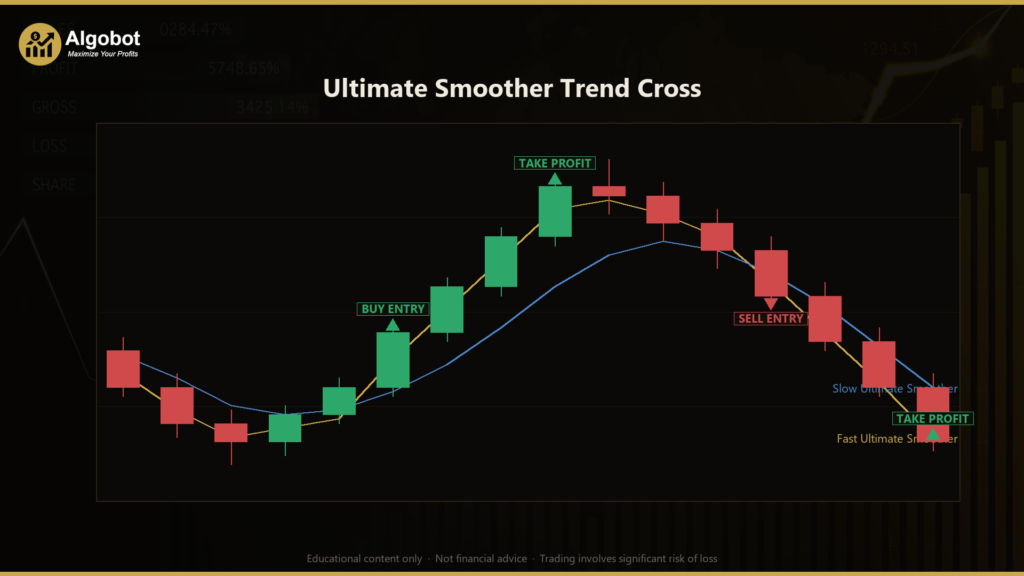
This strategy runs two Ultimate Smoothers at once: a fast one that tracks price responsively, and a slow one that acts as the trend baseline. When the fast line crosses the slow line, the strategy interprets that as a potential change in trend direction — but only if a set of confirmation filters agree. Because the filter has very little lag, the crossover fires closer to the actual turning point than a conventional moving-average cross, which is the core idea the strategy is exploring.
As a learning tool, the Ultimate Smoother Trend Cross is best suited to traders who already understand moving-average crossovers and want to study how a lower-lag filter changes their timing and whipsaw behaviour. It is designed for trending market conditions and, like all trend-following approaches, is expected to struggle in flat, ranging markets — one reason a slope-based regime filter is included. Treat it as a framework for understanding filter design and trend confirmation, not as a shortcut.
How It Works
The strategy evaluates its logic once per bar, acting only on the candle that has just completed (never on the still-forming candle). This avoids reacting to intrabar noise that may vanish before the bar closes.
Indicator calculations on each completed bar:
- Two Ultimate Smoother lines are updated recursively — a fast line (length =
FastPeriod) and a slow line (length =SlowPeriod). - An Average True Range (ATR) value is calculated over
AtrPeriodbars. ATR measures recent volatility and is used to size the stop-loss and take-profit distances.
The strategy signals a LONG entry when all of the following are true:
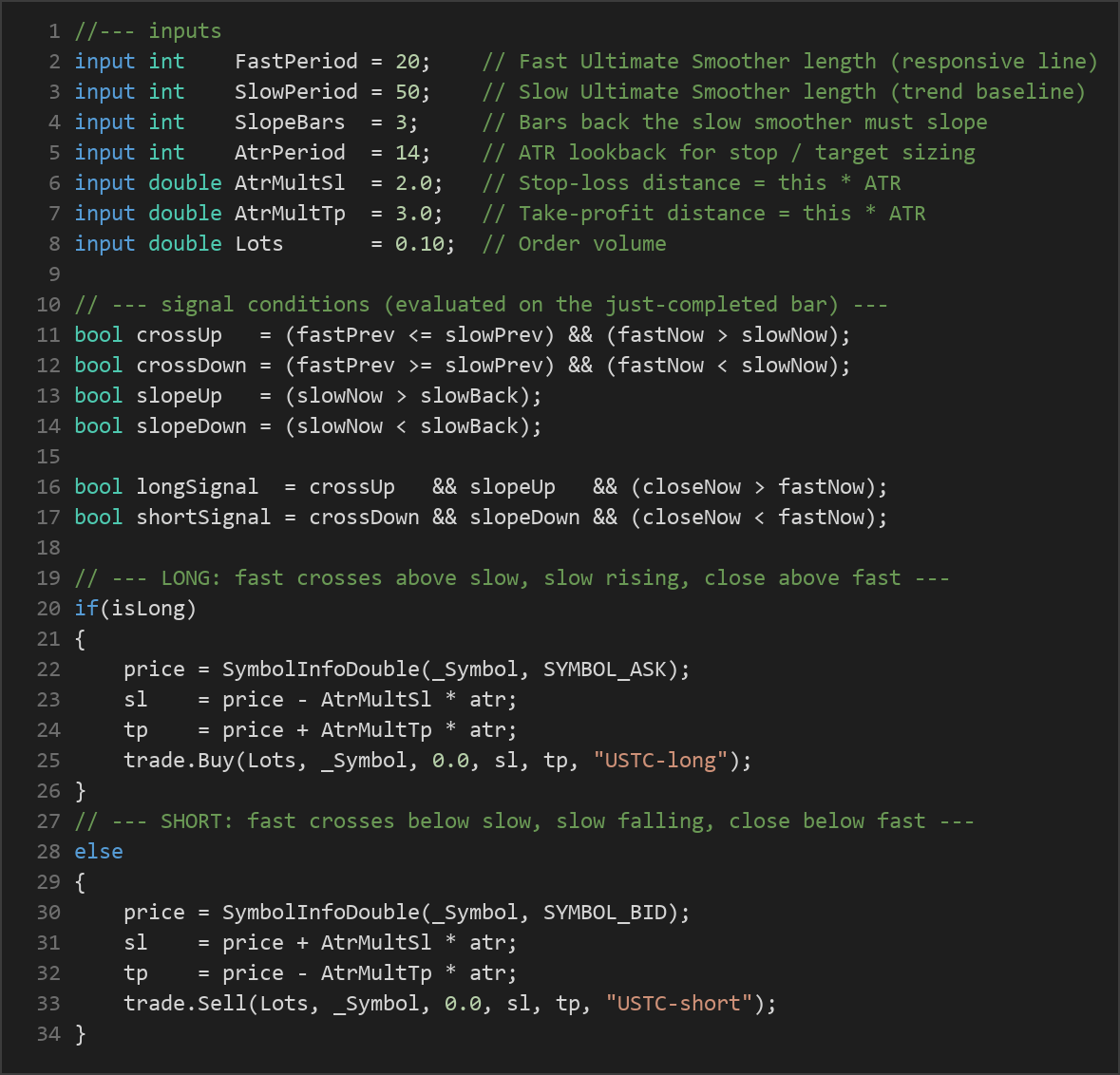
- The fast Ultimate Smoother crosses above the slow Ultimate Smoother (a fresh bullish crossover, not a line that was already above).
- The slow Ultimate Smoother is rising over the last
SlopeBarsbars — a regime filter that helps screen out crossovers happening in a flat market. - The latest close sits above the fast smoother, so current price confirms the crossover.
The strategy signals a SHORT entry when the mirror-image conditions are true:
- The fast smoother crosses below the slow smoother.
- The slow smoother is falling over the last
SlopeBarsbars. - The latest close sits below the fast smoother.
Position management, stops, and targets:
- Reversal logic: If an opposite signal appears while a position is open, the strategy closes the existing trade and opens a new one in the new direction. If a signal points in the same direction as the open position, no new trade is added.
- Stop-loss: For a long, the stop is placed
AtrMultSl × ATRbelow the entry price; for a short, the same distance above it. Wider volatility automatically produces a wider stop. - Take-profit: For a long, the target is
AtrMultTp × ATRabove entry; for a short, the same distance below. With the defaults (2.0 × ATR stop, 3.0 × ATR target), the strategy aims for a reward-to-risk ratio of roughly 1.5:1 on each trade. - Warmup: The recursive filters need history to settle, so the strategy waits until enough completed bars exist before generating any signals.
Because every calculation uses the chart's primary timeframe, the strategy adapts to whatever timeframe you attach it to.

Strategy Parameters
| Parameter | Default | Min | Max | Description |
|---|---|---|---|---|
| FastPeriod | 20 | 8 | 50 | Length of the fast Ultimate Smoother — the responsive line that reacts quickly to price. |
| SlowPeriod | 50 | 25 | 150 | Length of the slow Ultimate Smoother — the trend baseline the fast line crosses. |
| SlopeBars | 3 | 1 | 12 | Number of bars back over which the slow smoother must be sloping in the trade direction (regime filter). |
| AtrPeriod | 14 | 7 | 30 | ATR lookback used to measure volatility for stop and target sizing. |
| AtrMultSl | 2.0 | 1.0 | 4.0 | Stop-loss distance as a multiple of ATR. |
| AtrMultTp | 3.0 | 1.0 | 6.0 | Take-profit distance as a multiple of ATR. |
| Lots | 0.10 | 0.01 | 1.0 | Order volume (position size) in lots. |
Recommended Chart Settings
This strategy is single-timeframe and can technically run on any chart, because all of its calculations use whichever timeframe you select. As a starting point for study, trend-following crossover systems like this one are commonly examined on the H1 (1-hour) or H4 (4-hour) timeframes of major forex pairs such as EUR/USD, where trends tend to be cleaner and spreads are typically low.
Lower timeframes (M5, M15) generate more crossovers but also more noise and whipsaws, while higher timeframes produce fewer, slower signals. The default parameters (fast 20 / slow 50) are a balanced middle-ground; if you shorten them the strategy trades more often, and if you lengthen them it becomes more selective. Remember that results will vary considerably across different symbols, timeframes, and market conditions — always test on your chosen instrument before drawing conclusions.
How to Install on MetaTrader 5
- Download the .ex5 file from the link below
- Copy it to your MT5
MQL5\Expertsfolder - Restart MetaTrader 5 or refresh the Navigator panel
- Drag the EA onto a chart matching the recommended symbol and timeframe
- Configure the input parameters and enable Algo Trading
What to Consider Before Using This EA
Strengths of this approach. The main appeal of the Ultimate Smoother is its low lag: compared with a standard moving-average crossover, the smoother lines follow price more tightly, so crossovers can register nearer to the actual turn. The strategy also stacks three independent conditions before entering — a fresh crossover, a sloping trend baseline, and price confirmation — which historically helps filter out some of the low-quality signals that a bare crossover would take. The ATR-based stops and targets adapt to volatility rather than using fixed pip distances, so the risk framework scales with market conditions.
Known limitations. Like every trend-following crossover, this strategy is vulnerable to ranging, sideways markets, where the fast and slow lines repeatedly cross with no follow-through. The slope filter reduces but does not eliminate these whipsaws. Lower lag is a double-edged sword: reacting faster also means reacting to more false starts. Because the strategy reverses on opposite signals, a choppy period can produce a string of back-to-back losing trades as it flips direction. The fixed reward-to-risk targets also mean the strategy may exit a strong trend early, or hold through a pullback that eventually stops it out.
Where it may underperform. Expect degraded behaviour during low-volatility consolidation, around major news releases that cause sharp spikes, and on instruments with wide spreads relative to the ATR. No single parameter set is optimal across all markets, so treat the defaults as a baseline to study rather than a finished configuration.
Risk Management Tips
Sound risk management matters more than any single indicator setting. Consider these general principles as you study this strategy:
- Risk a small, fixed fraction per trade. A widely taught guideline is to risk no more than 1–2% of your account on any single position. Choose your lot size so that the distance to the stop-loss represents that small fraction — not the other way around.
- Understand drawdown. Even a well-designed trend system endures losing streaks. Know the largest peak-to-trough decline you are willing to tolerate before you begin, and size positions accordingly.
- Start on a demo account. Run the EA on a demo or paper account first to observe how it behaves in live conditions, how often it trades, and how it handles ranging markets — without financial risk.
- Test across conditions. Backtest and forward-test over multiple market regimes (trending, ranging, volatile, quiet) so you understand the strategy's weaknesses, not just its best-case behaviour.
- Never over-leverage. Leverage magnifies both gains and losses. Keep your total exposure conservative, and never trade with money you cannot afford to lose.
- Keep expectations realistic. No strategy wins every trade. The goal of studying a system like this is to understand its logic and risk profile, not to chase a specific outcome.
Risk Warning
Trading foreign exchange, CFDs, and other leveraged financial instruments involves substantial risk of loss and is not suitable for all investors. The strategies and tools discussed on this page are provided for educational purposes only and do not constitute financial advice, investment recommendations, or solicitation to trade. Always consult a qualified financial adviser before making trading decisions. Past backtest performance is not indicative of future results.
Downloads
- Expert Advisor: UltimateSmootherTrendCross.ex5 (51 downloads)
- Source Code: UltimateSmootherTrendCross.mq5 (52 downloads)
- Documentation: UltimateSmootherTrendCross.pdf (64 downloads)