Disclaimer: This article is for educational and informational purposes only. It does not constitute financial or investment advice. Trading forex and CFDs carries significant risk of loss. Past performance of any strategy — including backtests — does not guarantee future results. Never trade with money you cannot afford to lose.
What Is This Strategy?
The Turtle Soup Reversal is a price-action reversal strategy built entirely around the ICT "Turtle Soup" liquidity-raid pattern and order-block structure — it uses no indicators at all. Instead of moving averages or oscillators, it reads raw candle behavior around recent swing highs and swing lows to identify a failed breakout: a moment when price spikes past an obvious level, trips a cluster of resting stop orders, and then snaps back into the prior range. The trading style here is counter-trend (mean-reversion) intraday/swing reversal trading, fading the breakout rather than chasing it.
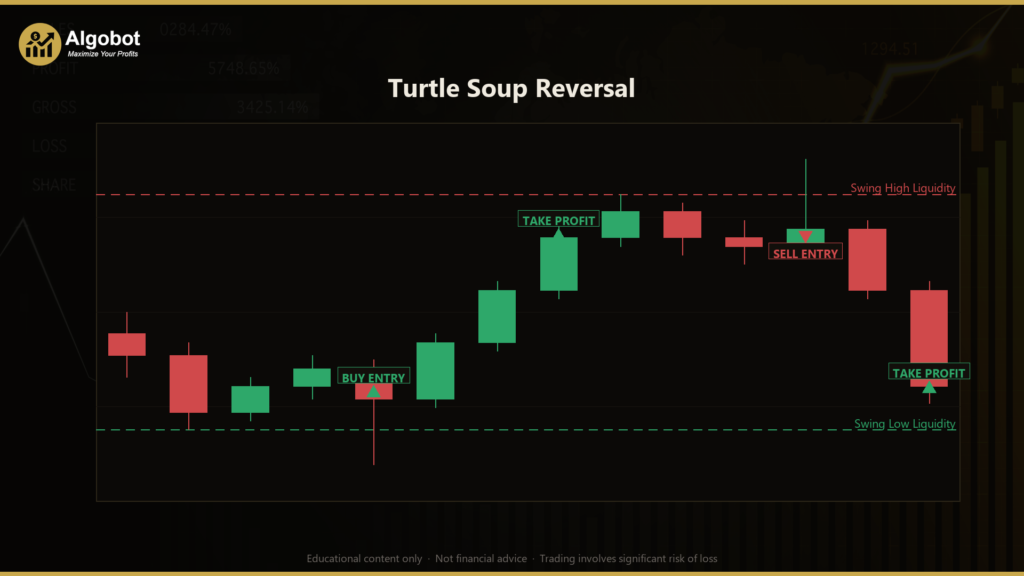
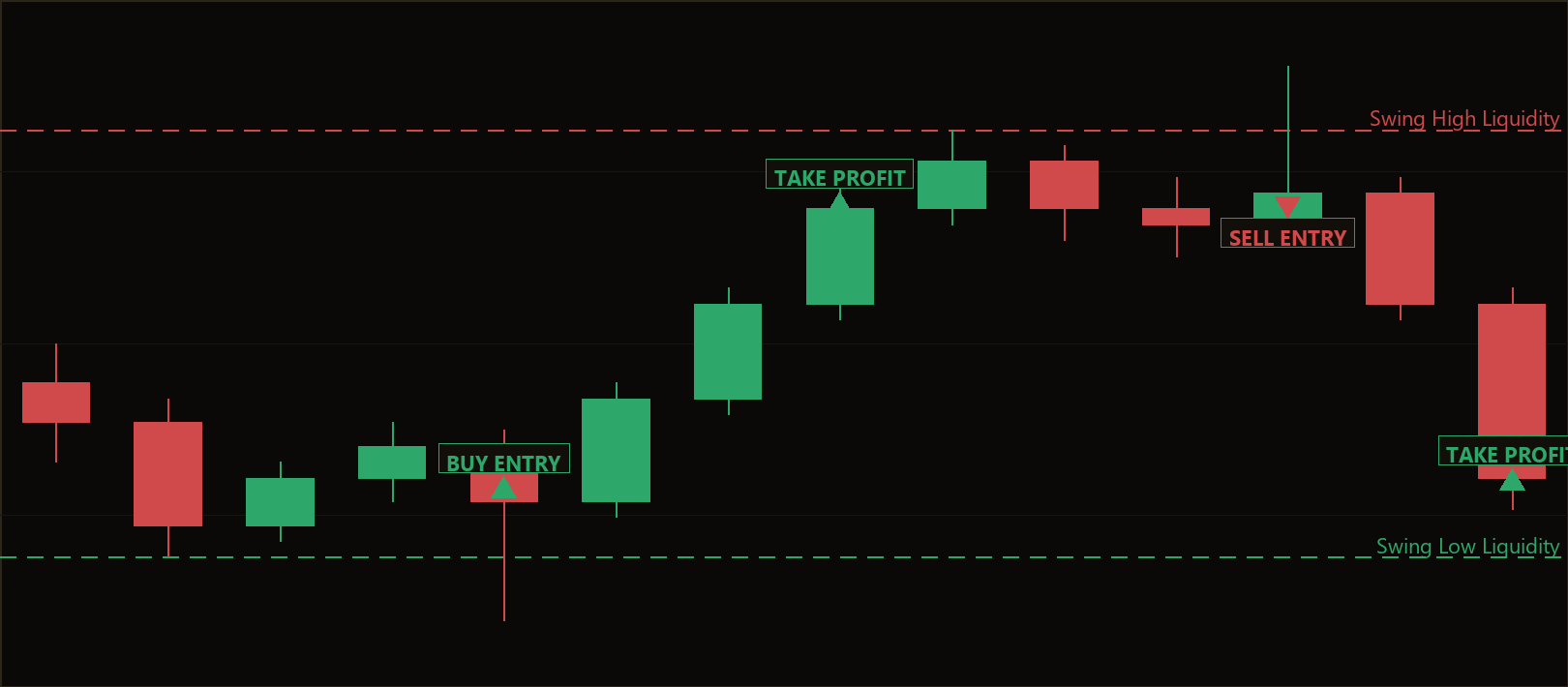
The core idea comes from the way stop orders pool just beyond visible swing points. Many traders place breakout entries and protective stops a few pips above a recent high or below a recent low. That cluster of orders is what ICT-style analysis calls "liquidity." When price briefly pierces the level and then rejects, the strategy interprets that spike as a deliberate stop raid — liquidity was swept, the breakout failed, and the candle that did the sweeping becomes a potential reversal order block (a zone where larger orders were absorbed). The strategy then enters in the opposite direction of the raid.
As a learning tool, the Turtle Soup Reversal is well suited to traders who want to understand market-structure concepts: swing detection, liquidity pools, failed breakouts, and fixed reward-to-risk planning. It is a focused, rules-based study of how a reversal setup can be defined objectively in code — not a shortcut to results. Treat it as a framework for studying price behavior around key levels.
How It Works
The strategy evaluates the market once per newly closed candle and holds only one position at a time, letting the stop-loss and take-profit manage the exit. Here is what the strategy signals on each closed bar:
- Find resting liquidity. It scans back through a configurable window for the most recent confirmed swing high (a fractal pivot with a set number of lower highs on each side) and the most recent confirmed swing low. These swing extremes mark where stop orders are likely resting.
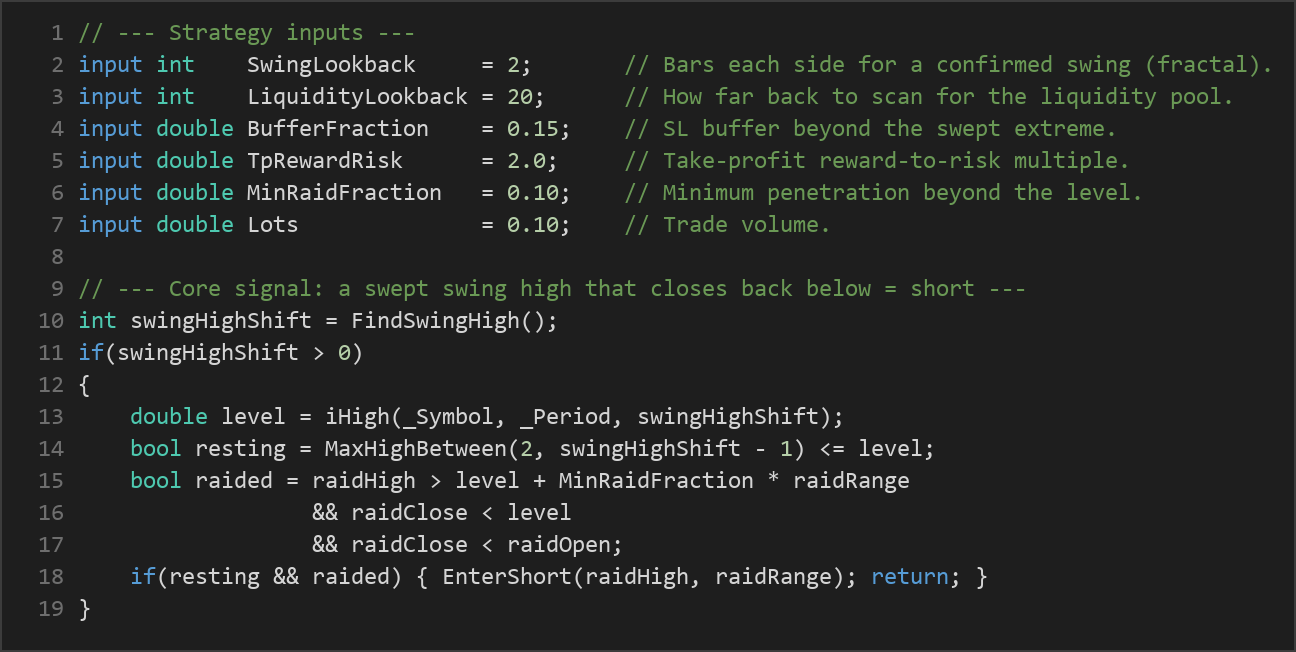
- Confirm the liquidity is untouched. The level only qualifies if no candle between the swing and the current candle has already traded through it. If the pool was already taken, the setup is skipped.
- Detect a genuine raid (short side). For a bearish reversal, the just-closed candle must (1) pierce above the swing high by at least a minimum fraction of its own range, (2) close back below that level, and (3) close below its own open. This combination — penetrate, reject, close red — defines a failed bullish breakout.
- Detect a genuine raid (long side). For a bullish reversal, the just-closed candle must pierce below the swing low by the minimum fraction, close back above the level, and close above its own open — a failed bearish breakout.
- Filter out noise. The minimum-penetration rule means a candle that barely grazes the level with a tiny wick does not count as a real stop raid, reducing low-conviction signals.
Entry logic. When a valid short raid is detected, the strategy sells at the current bid; when a valid long raid is detected, it buys at the current ask. Only one trade per magic number is open at any time.
Stop-loss logic. The stop is placed just beyond the swept extreme — above the raid candle's high for shorts, below its low for longs — plus a buffer expressed as a fraction of the raid candle's range. This keeps the stop on the far side of the level that was raided, where the setup would be invalidated.
Take-profit logic. The target is set at a fixed reward-to-risk multiple of the measured stop distance. If the trade risks one unit to the stop, the take-profit sits at the configured multiple of that distance in the favorable direction. This enforces a consistent, pre-defined payoff structure on every trade.
Strategy Parameters
| Parameter | Default | Min | Max | Description |
|---|---|---|---|---|
| SwingLookback | 2 | 1 | 6 | Number of bars required on each side of a candle for it to qualify as a confirmed swing (fractal pivot). Higher values demand more pronounced swings. |
| LiquidityLookback | 20 | 8 | 60 | How far back (in bars) to scan for the liquidity pool — the swing high or low that may be raided. |
| BufferFraction | 0.15 | 0.0 | 1.0 | Stop-loss buffer placed beyond the swept extreme, expressed as a fraction of the raid candle's range. |
| TpRewardRisk | 2.0 | 1.0 | 5.0 | Take-profit reward-to-risk multiple. A value of 2.0 targets twice the stop distance. |
| MinRaidFraction | 0.10 | 0.0 | 0.8 | Minimum penetration beyond the level, as a fraction of the raid candle's range, so a barely-touching wick does not count as a genuine stop raid. |
| Lots | 0.10 | 0.01 | 1.0 | Trade volume in lots for each position. |
Recommended Chart Settings
The Turtle Soup Reversal is designed to read clean market structure, so it tends to be studied on liquid instruments where swing points and liquidity sweeps are well defined — for example major forex pairs such as EUR/USD or GBP/USD, or an index/metal with similar liquidity. Intraday timeframes such as the 5-minute (M5), 15-minute (M15), or 1-hour (H1) charts are common starting points for observing the raid-and-reject pattern, since these timeframes produce frequent swing points without excessive noise.
Keep in mind that the optimal symbol and timeframe vary with market conditions. A configuration that produces clear signals during one volatility regime may behave very differently in another. Always test the strategy on the specific symbol and timeframe you intend to study before drawing any conclusions, and re-evaluate as conditions change.
How to Install on MetaTrader 5
- Download the .ex5 file from the link below
- Copy it to your MT5
MQL5\Expertsfolder - Restart MetaTrader 5 or refresh the Navigator panel
- Drag the EA onto a chart matching the recommended symbol and timeframe
- Configure the input parameters and enable Algo Trading
What to Consider Before Using This EA
The strengths of the Turtle Soup Reversal lie in its objectivity and discipline. Every component — swing confirmation, untouched liquidity, minimum penetration, close-back rejection — is defined numerically, removing much of the subjectivity that plagues discretionary reversal trading. Because it uses a fixed stop beyond the raided extreme and a fixed reward-to-risk target, the trade structure is consistent and easy to study. The absence of indicators also means there is no lag from smoothing or repainting.
There are real limitations to understand. Reversal strategies trade against the immediate move, so during strong, persistent trends a "failed breakout" can simply be the start of a genuine breakout — the level breaks, price keeps going, and the stop is hit. The strategy may also underperform in choppy, low-volatility ranges where false signals cluster, or around major news events when spreads widen and candle ranges distort the raid and buffer calculations. Because it acts only on closed bars and allows one position at a time, it can miss fast moves or sit idle for long stretches when no clean raid forms. Slippage and spread can meaningfully affect entries placed at the bid/ask, especially on lower timeframes.
This EA is best viewed as a structured study of liquidity-raid mechanics, not a finished system. Parameter choices interact: a tighter MinRaidFraction produces more signals of lower conviction, while a larger BufferFraction widens stops and lowers the effective reward-to-risk. Understanding these trade-offs is the educational value.
Risk Management Tips
Sound risk management matters more than any single setup. Consider these general principles as you study this strategy:
- Risk a small, fixed percentage per trade — many educational sources suggest no more than 1–2% of account equity on any single position — and size your
Lotsaccordingly rather than using a default blindly. - Test on a demo account first. Run the strategy in a risk-free simulated environment until you understand how it behaves across different sessions and market conditions.
- Understand drawdown. Even a well-defined reversal approach will experience losing streaks; know the maximum drawdown you can tolerate before committing any capital.
- Account for costs. Factor in spread, commission, and potential slippage, which can erode the fixed reward-to-risk math, particularly on shorter timeframes.
- Keep a trading journal. Recording why each signal triggered and how it resolved turns the EA into a genuine learning instrument.
- Never trade money you cannot afford to lose, and treat all historical or simulated behavior as illustrative only.
Risk Warning
Trading foreign exchange, CFDs, and other leveraged financial instruments involves substantial risk of loss and is not suitable for all investors. The strategies and tools discussed on this page are provided for educational purposes only and do not constitute financial advice, investment recommendations, or solicitation to trade. Always consult a qualified financial adviser before making trading decisions. Past backtest performance is not indicative of future results.
Downloads
- Expert Advisor: TurtleSoupReversal.ex5 (48 downloads)
- Source Code: TurtleSoupReversal.mq5 (51 downloads)
- Documentation: TurtleSoupReversal.pdf (47 downloads)