Disclaimer: This article is for educational and informational purposes only. It does not constitute financial or investment advice. Trading forex and CFDs carries significant risk of loss. Past performance of any strategy — including backtests — does not guarantee future results. Never trade with money you cannot afford to lose.
What Is This Strategy?
The Triple Smoothed Momentum Shift strategy is a trend-following, momentum-based system built around the TRIX indicator — the rate-of-change of a triple-smoothed exponential moving average (EMA) of price. Where a raw momentum oscillator reacts to every small wiggle in price, TRIX runs the closing price through three cascaded EMAs before measuring its slope. That triple smoothing strips out short-cycle noise and single-bar spikes, so what is left behind is a cleaner read on the underlying momentum of the trend rather than the surface chatter.
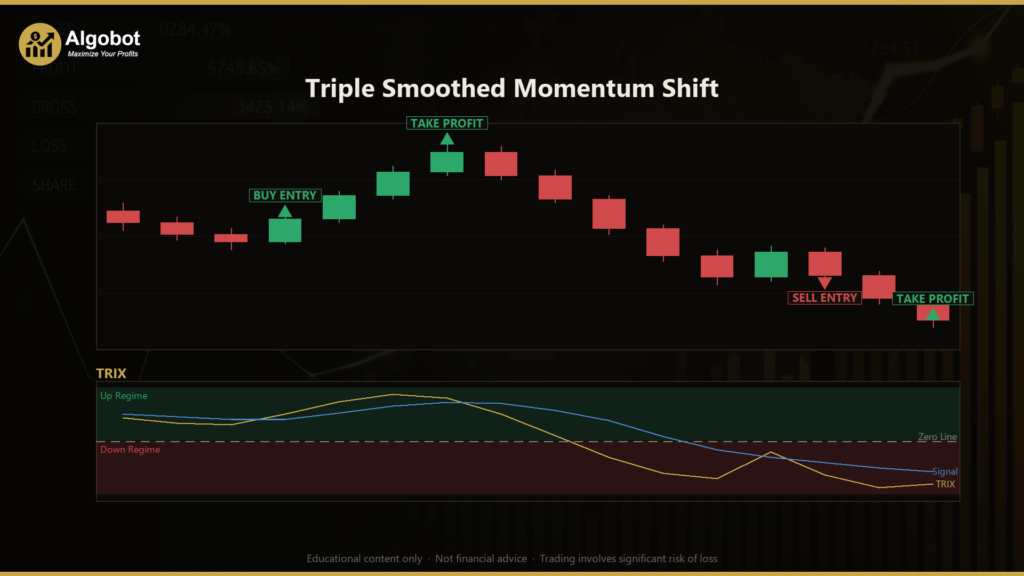
In plain terms, TRIX is the one-bar percentage change of that thrice-smoothed line. It reads positive while smoothed momentum is accelerating upward and negative while it is accelerating downward. The strategy watches how TRIX interacts with two references: its own signal line (an EMA of TRIX, used as the trigger) and the zero line (used as a regime gate). A trade is only considered when a fresh signal-line cross happens on the correct side of zero — an approach designed to filter out the counter-trend crosses that tend to fire in choppy, directionless conditions.
This system is best understood as a learning tool for traders who want to study how momentum smoothing and regime filtering work together. It is designed for liquid, trending instruments and is indicator-only with distinct long and short rules. It is not a shortcut of any kind — it is a structured example of a momentum/trend-following approach that you can study, backtest, and dissect to deepen your understanding of oscillator-based systems.
How It Works
The strategy acts once per newly-closed bar, feeding each closed price through the EMA cascade and then checking its entry and exit logic. Here is how the pieces fit together:
Entry conditions:
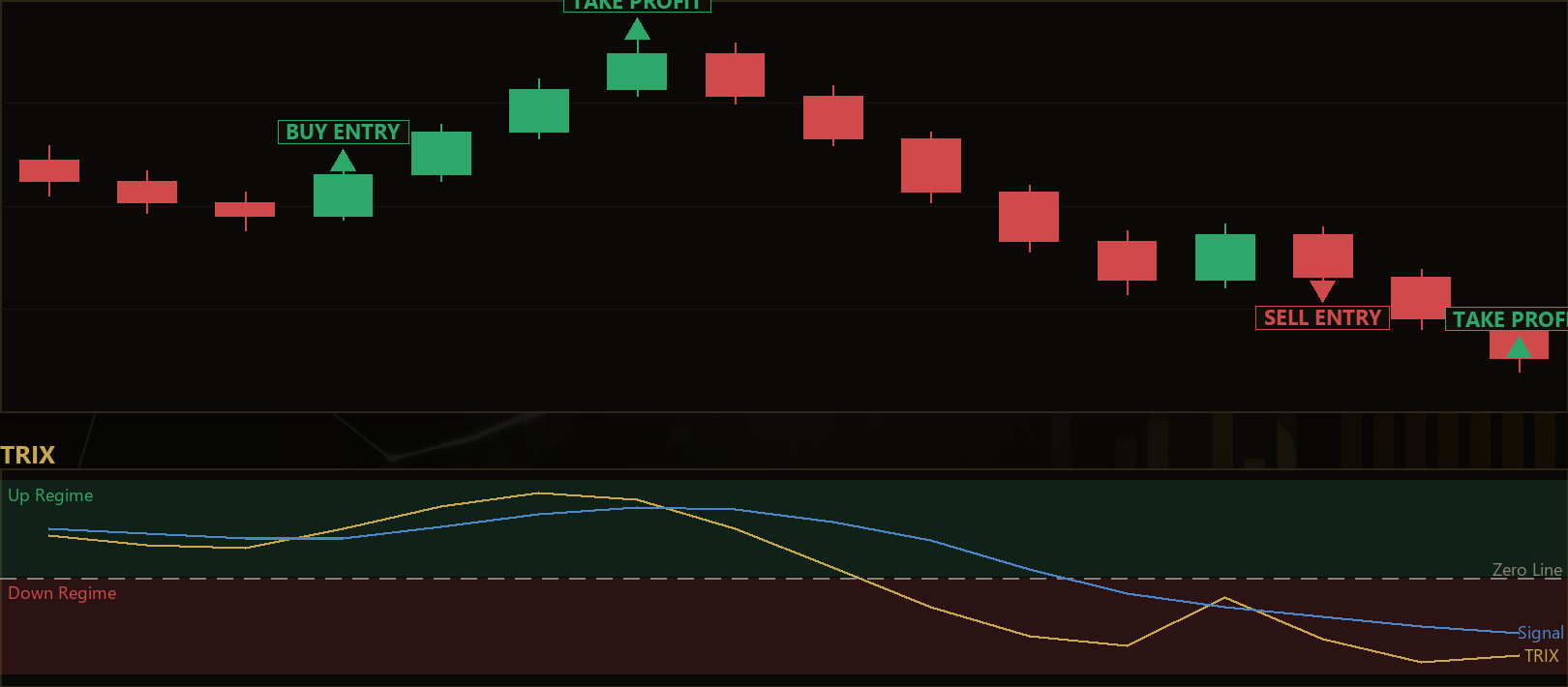
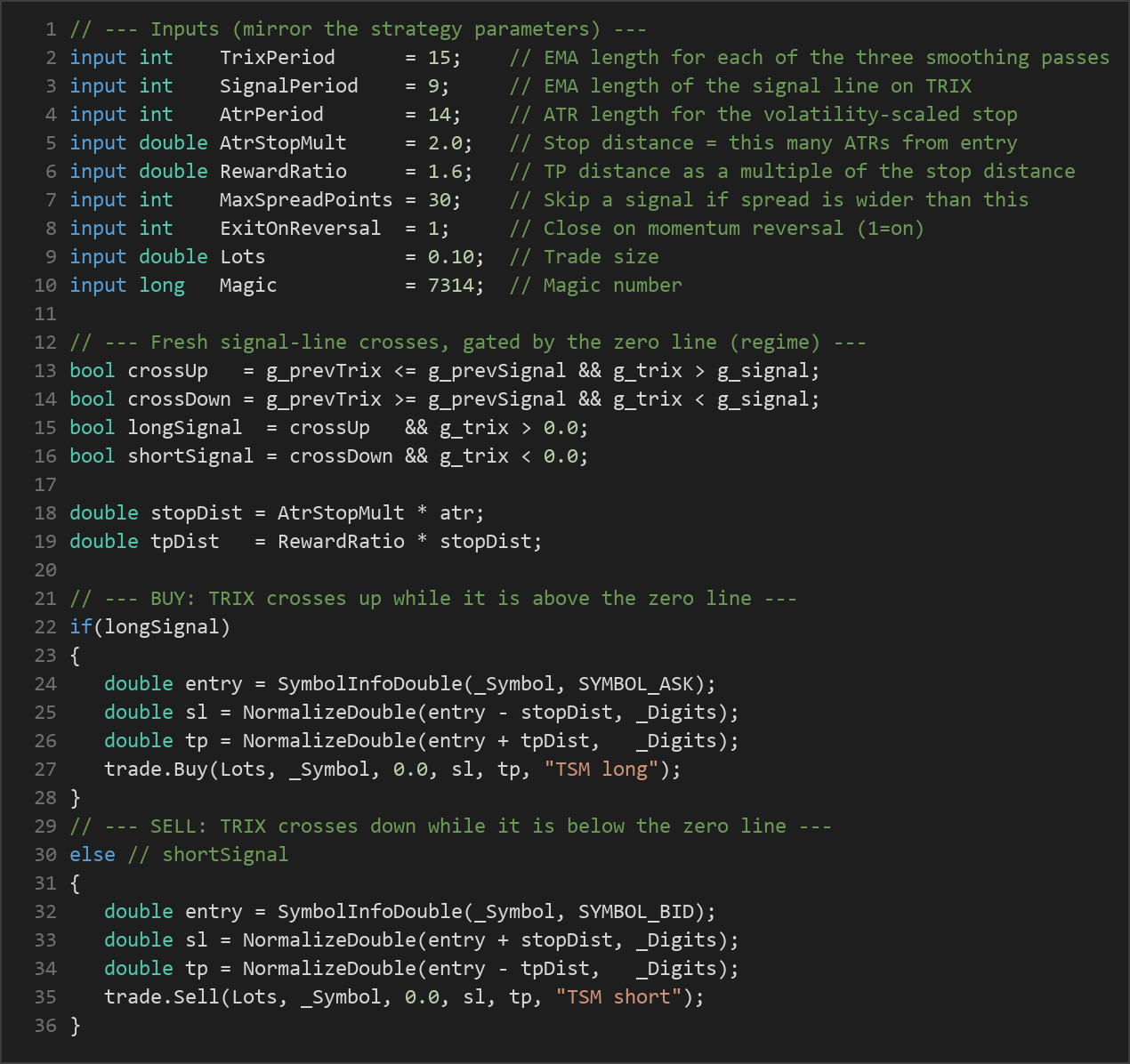
- The strategy signals a long when TRIX crosses above its signal line while TRIX is already above zero. This represents momentum turning up inside an established up-regime.
- The strategy signals a short when TRIX crosses below its signal line while TRIX is already below zero. This is the mirror image inside a down-regime.
- Requiring the cross to occur on the correct side of the zero line is the core idea of the system. It is intended to discard the many counter-trend crosses that occur in the chop around the midline, which historically helps keep trade count and drawdown lower.
- Before any trade is placed, a spread gate checks the current spread. If the spread (in points) is wider than the configured maximum, the signal is skipped to avoid entering under poor execution conditions.
Stop-loss logic:
- The stop-loss is volatility-scaled using the Average True Range (ATR), a measure of how much price typically moves per bar. The stop distance is set to a configurable number of ATRs from the entry price.
- Because the stop is measured in ATRs rather than fixed pips, it automatically widens in volatile markets and tightens in calm ones, so it travels with the market.
Take-profit logic:
- The take-profit is measured as a reward multiple of the stop distance. For example, with a reward ratio of 1.6, the profit target sits 1.6 times as far from entry as the stop. This keeps the reward-to-risk relationship consistent regardless of current volatility.
Exit conditions:
The strategy uses three layers of exit:
- A fixed ATR stop-loss (described above).
- A reward-multiple take-profit (described above).
- An early momentum-reversal exit: when the
ExitOnReversaloption is enabled, an open long is closed the moment TRIX crosses back below its signal line (and a short is closed when TRIX crosses back above). This is intended to release a stalled trade before it round-trips, rather than waiting for the full stop to be hit.
Only one position per magic number is held at a time, so the strategy manages a single open trade before looking for the next signal.
Strategy Parameters
| Parameter | Default | Min | Max | Description |
|---|---|---|---|---|
| TrixPeriod | 15 | 5 | 40 | EMA length used for each of the three smoothing passes that build TRIX. Larger values smooth more and react slower. |
| SignalPeriod | 9 | 3 | 20 | EMA length of the signal line drawn on TRIX — the crossover trigger. |
| AtrPeriod | 14 | 5 | 30 | ATR length used for the volatility-scaled stop. |
| AtrStopMult | 2.0 | 0.5 | 5.0 | Stop distance expressed as this many ATRs from entry. |
| RewardRatio | 1.6 | 0.8 | 4.0 | Take-profit distance as a multiple of the stop distance (reward : risk). |
| MaxSpreadPoints | 30 | 1 | 200 | Skip a signal if the current spread (in points) is wider than this. |
| ExitOnReversal | 1 | 0 | 1 | Close a live trade when momentum crosses back through its signal line (1 = on, 0 = off). |
| Lots | 0.10 | 0.01 | 1.0 | Trade size (position-sizing lever). |
| Magic | 7314 | 0 | 9,999,999 | Magic number used to identify this strategy's positions. |
Recommended Chart Settings
The Triple Smoothed Momentum Shift strategy was designed for liquid, trending instruments such as EURUSD, GBPUSD, or XAUUSD (gold), running on the H1 (1-hour) timeframe. These markets tend to produce the sustained directional moves that a momentum/trend-following system is built to capture, and the H1 timeframe offers a balance between signal frequency and noise.
Because the strategy reads the primary timeframe dynamically, the same logic will run on whatever timeframe you attach it to — but the default behavior and parameter ranges were tuned with H1 in mind. Keep in mind that results will vary significantly across different symbols, timeframes, and market conditions. A momentum system that behaves well in a trending environment may behave very differently during range-bound or highly volatile periods. Always test any configuration on historical data and a demo account before drawing conclusions.
How to Install on MetaTrader 5
- Download the
TripleSmoothedMomentumShift.ex5file from the link below. - Copy it to your MT5
MQL5\Expertsfolder. - Restart MetaTrader 5 or refresh the Navigator panel.
- Drag the EA onto a chart matching the recommended symbol and timeframe.
- Configure the input parameters and enable Algo Trading.
What to Consider Before Using This EA
Like every technical approach, the Triple Smoothed Momentum Shift strategy has clear strengths and equally clear limitations. Understanding both is essential before you rely on it for any decision-making.
Strengths of this approach:
- Noise reduction. The triple-smoothed TRIX line filters out much of the short-term noise that causes single-EMA momentum systems to whipsaw, which can lead to steadier, more interpretable signals.
- Regime gating. By demanding that a fresh signal cross occur on the correct side of zero, the strategy avoids many low-quality counter-trend signals. This is intended to reduce trade count and curb curve-fitting to noise.
- Volatility-aware risk. The ATR-based stop adapts to current market conditions instead of using a rigid fixed distance, so the same settings behave more consistently across calm and volatile periods.
Known limitations:
- Lag. Triple smoothing is a double-edged sword: the same filtering that removes noise also introduces lag. In fast reversals, TRIX may confirm a shift later than a faster oscillator would, and some of the early move can be missed.
- Range-bound underperformance. Momentum and trend-following systems generally struggle when price chops sideways. Even with the zero-line gate, extended range-bound conditions can produce a series of small losing trades.
- Parameter sensitivity. Changing the TRIX and signal periods can meaningfully alter behavior. Over-optimizing these values on past data may indicate a fit to history rather than a robust edge going forward.
- Single position at a time. The strategy holds only one trade per magic number, which keeps risk contained but also means it will not pyramid or scale into strong trends.
This strategy is a structured, transparent example of a momentum system — not a finished solution. Treat it as a starting point for your own study and testing.
Risk Management Tips
Sound risk management matters more than any single indicator setting. Whatever strategy you study, these general principles apply:
- Size positions responsibly. As a common educational guideline, many traders limit risk to no more than 1–2% of account equity per trade. The
Lotsand stop parameters together determine your risk per position, so review them carefully. - Understand drawdown. Every strategy experiences losing streaks. Before committing capital, study how deep and how long the historical drawdowns can run so you are mentally and financially prepared for them.
- Start on a demo account. Test the strategy in a risk-free demo environment first to understand its behavior, signal frequency, and how it reacts to different market conditions before considering any live use.
- Diversify and avoid over-leverage. Concentrating risk in a single instrument or using excessive leverage can amplify losses quickly. Leverage magnifies both directions.
- Keep records. Journaling your tests and observations helps you learn what the strategy does well and where it struggles — which is the entire point of studying a system like this.
Risk Warning
Trading foreign exchange, CFDs, and other leveraged financial instruments involves substantial risk of loss and is not suitable for all investors. The strategies and tools discussed on this page are provided for educational purposes only and do not constitute financial advice, investment recommendations, or solicitation to trade. Always consult a qualified financial adviser before making trading decisions. Past backtest performance is not indicative of future results.
Downloads
- Expert Advisor: TripleSmoothedMomentumShift.ex5 (45 downloads)
- Source Code: TripleSmoothedMomentumShift.mq5 (38 downloads)
- Documentation: TripleSmoothedMomentumShift.pdf (44 downloads)