Disclaimer: This article is for educational and informational purposes only. It does not constitute financial or investment advice. Trading forex and CFDs carries significant risk of loss. Past performance of any strategy — including backtests — does not guarantee future results. Never trade with money you cannot afford to lose.
What Is This Strategy?
The Triple Pivot Reversal is a pure price-action expert advisor built around the classic "1-2-3" swing reversal pattern and symmetric fractal pivot points. It uses no oscillators and no moving-average crossovers. Instead, it reads market structure directly from swing highs and swing lows — the raw skeleton of price movement that discretionary traders learn to spot by eye. In this system, that structure is mechanised so a machine can identify it consistently and act on it without hesitation or bias.
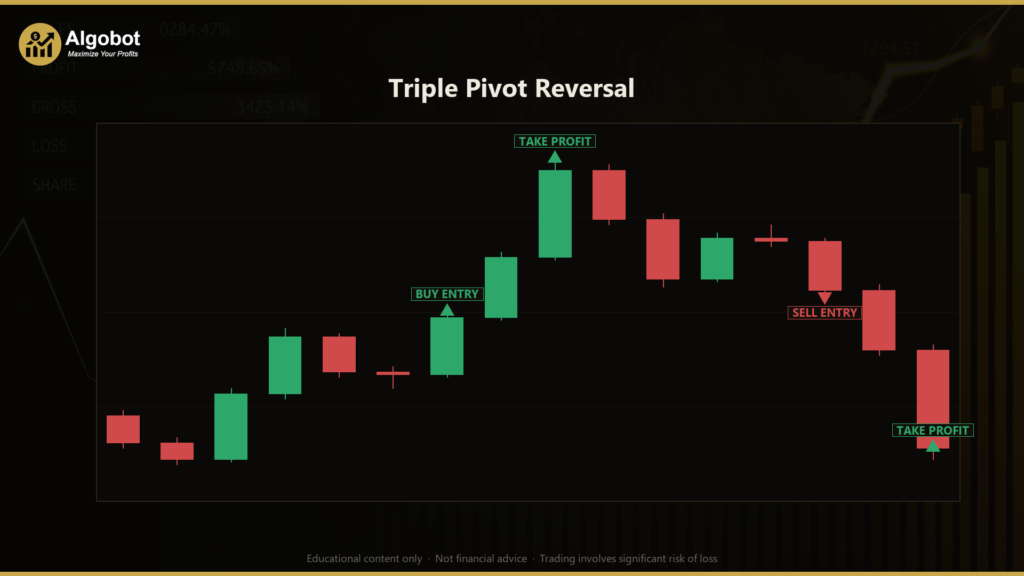
The 1-2-3 pattern describes a well-known turning point. Imagine a market that has been falling. It carves out a low (point 1), rallies to a high (point 2), then pulls back to a higher low (point 3) that refuses to break the previous bottom. When price finally trades back through point 2, the down-swing is considered broken and a new up-swing is confirmed. The mirror image — a high, a low, then a lower high — marks a potential top. The Triple Pivot Reversal encodes exactly this structure and adds several quality filters so it acts only on well-formed, meaningful patterns rather than every minor wiggle.
As a learning tool, this strategy is well suited to traders who want to understand swing structure, market reversals, and the anatomy of a trend change. Because it is designed to react to shifts in direction rather than to ride an established trend, it is best studied in markets that oscillate between swings rather than grind endlessly in one direction. It is not a "set and forget" money machine — it is a transparent, rules-based model of a timeless chart pattern that you can inspect, backtest, and learn from.
How It Works
The strategy continuously maps price into a sequence of alternating swing pivots and then watches for a valid three-point reversal to complete and break out.
- Locating pivots: A swing point is confirmed using a symmetric fractal pivot — a bar whose high (or low) is the strict extreme compared with
PivotStrengthbars on each side. This means a pivot is only recognised once enough bars have formed to its right to prove it was a genuine turning point. - Keeping structure clean: Pivots are stored in a strictly alternating Low-High-Low or High-Low-High sequence. If two same-type pivots appear in a row, only the more extreme one is kept, so the pattern always reflects real swing structure.
- The bullish setup signals when: a swing Low (1), swing High (2), and swing Low (3) form in order, and point 3 is a higher low than point 1. Entry is armed for a close above point 2.
- The bearish setup signals when: a swing High (1), swing Low (2), and swing High (3) form in order, and point 3 is a lower high than point 1. Entry is armed for a close below point 2.
Before a pattern is accepted, three quality gates must pass:
- Impulse size: The leg from point 1 to point 2 must be at least
MinLegAtr× ATR (Average True Range — a measure of typical bar-to-bar volatility). This filters out micro-noise and keeps only genuine swings. - Healthy retracement: The point-3 pullback must retrace between
MinRetraceandMaxRetraceof the impulse leg — not so shallow it is meaningless, and not so deep it becomes a full round-trip. - No premature failure: The pattern is voided the instant price pierces beyond point 3 before the breakout occurs, because a broken higher-low (or lower-high) means the setup has failed.
Entry is triggered when a bar closes back through point 2 in the pattern's direction, and only if no position is already open. Stop-loss is placed just past point 3 — the structural level the pattern says price should not revisit — with an extra SlAtrBuffer × ATR cushion. Any signal whose stop would be wider than MaxStopAtr × ATR is skipped entirely, keeping per-trade risk bounded. Take-profit is set at RiskReward multiples of that structural risk (the 1R distance).
Once a trade moves in favour by +1R, the strategy pushes the stop to break-even and then trails it by AtrTrailMult × ATR on every tick. This continuously protects open profit and caps adverse excursions near scratch once a move is underway.

Strategy Parameters
| Parameter | Default | Min | Max | Description |
|---|---|---|---|---|
| PivotStrength | 3 | 2 | 8 | Fractal pivot half-width — bars required on each side of a swing extreme to confirm it. Higher values mean fewer, more significant pivots. |
| MinLegAtr | 1.0 | 0.3 | 5.0 | Minimum size of the impulse leg (point 1 to point 2), in ATR units. Filters out small, insignificant swings. |
| MinRetrace | 0.30 | 0.10 | 0.50 | Minimum fraction of the leg that point 3 must retrace. Rejects overly shallow pullbacks. |
| MaxRetrace | 0.85 | 0.50 | 1.00 | Maximum fraction of the leg point 3 may retrace. Keeps the setup a valid 1-2-3 rather than a full reversal. |
| AtrPeriod | 14 | 7 | 30 | ATR length used for sizing stops, targets, and gate thresholds. |
| SlAtrBuffer | 0.25 | 0.0 | 1.5 | Extra ATR cushion placed beyond point 3 for the structural stop. |
| RiskReward | 2.0 | 1.0 | 5.0 | Take-profit distance as a multiple of the structural risk (the reward-to-risk ratio). |
| MaxStopAtr | 3.0 | 1.0 | 8.0 | Signals whose point-3 stop would be wider than this (in ATR) are skipped. |
| AtrTrailMult | 1.5 | 0.5 | 4.0 | Trailing distance (in ATR) applied once a trade is past +1R. |
| Lots | 0.10 | 0.01 | 1.0 | Order volume (position size) per trade. |

Recommended Chart Settings
The Triple Pivot Reversal is a single-timeframe strategy: every calculation uses the chart's own timeframe, so it runs on whatever timeframe you attach it to. Because it relies on clearly defined swing structure, many traders find intraday-to-swing timeframes such as H1 or H4 on liquid instruments (for example major forex pairs like EUR/USD or GBP/USD) a sensible starting point for study. Higher timeframes tend to produce cleaner, more reliable pivots but fewer signals.
There is no universally "correct" symbol or timeframe. Results will vary considerably across instruments, timeframes, and market conditions. Treat the defaults as a baseline for experimentation on a demo account rather than a finished configuration, and always test thoroughly on historical data for the exact instrument and timeframe you intend to study.
How to Install on MetaTrader 5
- Download the .ex5 file from the link below
- Copy it to your MT5
MQL5\Expertsfolder - Restart MetaTrader 5 or refresh the Navigator panel
- Drag the EA onto a chart matching the recommended symbol and timeframe
- Configure the input parameters and enable Algo Trading
What to Consider Before Using This EA
Strengths of the approach. The 1-2-3 reversal is one of the most durable and widely taught chart patterns because it captures a real change in supply-demand balance. Mechanising it removes emotional hesitation and guarantees the rules are applied identically every time. The structural stop just beyond point 3 is tight and meaningful — it sits at a level the pattern itself defines as invalidation, rather than an arbitrary fixed distance — which historically helps keep individual losses contained. The break-even move and ATR trail further aim to protect gains once a move develops.
Known limitations. Pivot-based systems are inherently lagging: a swing point can only be confirmed after PivotStrength bars have formed to its right, so entries arrive after the turn is already partly complete. Reversal patterns also face a fundamental challenge — markets can continue trending far longer than a single 1-2-3 suggests, and a "lower high" in a strong uptrend may simply be a pause rather than a top. In choppy, directionless conditions the strategy may arm patterns that break out only to fail, producing a cluster of small losses. Whipsaw around the point-2 breakout level is a realistic risk.
Where it may underperform. Very strong, one-directional trends can repeatedly stop out counter-trend signals. Extremely quiet, low-volatility ranges may fail the MinLegAtr filter and generate few or no trades. Illiquid symbols with erratic wicks can produce noisy pivots. As with any single pattern, no filter set eliminates losing trades — the goal of the quality gates is fewer, cleaner signals, not certainty.
Risk Management Tips
Sound risk management matters more than any single entry signal. Consider these general principles as you study this strategy:
- Position sizing: Size trades so that a full stop-out costs only a small, predefined fraction of your account. A common educational guideline is risking no more than 1–2% of capital per trade.
- Understand drawdown: Even a well-designed strategy will experience losing streaks. Review the historical drawdown so you know what a normal rough patch looks like before committing real capital.
- Use a demo account first: Test the EA on a demo or simulated account across different market conditions until you understand its behaviour, its trade frequency, and how the trailing logic manages positions.
- Diversify and avoid over-leverage: Concentrating risk in a single instrument or using excessive leverage can turn a manageable losing streak into a serious loss.
- Keep expectations realistic: No parameter set removes risk. Backtest results describe the past, not the future, and live conditions include spread, slippage, and execution differences that a backtest may not fully capture.
Risk Warning
Trading foreign exchange, CFDs, and other leveraged financial instruments involves substantial risk of loss and is not suitable for all investors. The strategies and tools discussed on this page are provided for educational purposes only and do not constitute financial advice, investment recommendations, or solicitation to trade. Always consult a qualified financial adviser before making trading decisions. Past backtest performance is not indicative of future results.
Downloads
- Expert Advisor: TriplePivotReversal.ex5 (37 downloads)
- Source Code: TriplePivotReversal.mq5 (39 downloads)
- Documentation: TriplePivotReversal.pdf (40 downloads)