Disclaimer: This article is for educational and informational purposes only. It does not constitute financial or investment advice. Trading forex and CFDs carries significant risk of loss. Past performance of any strategy — including backtests — does not guarantee future results. Never trade with money you cannot afford to lose.
What Is This Strategy?
The Triple Confluence Breakout is a scalping-oriented expert advisor (EA) built around a Fibonacci extension breakout, filtered by two independent confirmations: the Relative Strength Index (RSI), a momentum oscillator that measures the speed of recent price moves, and the Average True Range (ATR), a volatility gauge that measures the average size of a bar's range. Rather than treating the Fibonacci extension as a profit target, this strategy flips the conventional idea and treats it as an entry trigger.
Most Fibonacci systems buy a pullback into the 0.5–0.786 "golden zone" and then use the 1.272 or 1.618 extension as a place to take profit. The Triple Confluence Breakout instead waits for price to close through its own measured-move extension. The logic is that when an impulse leg is powerful enough to break past the level where it would normally exhaust, the market may be entering an expansion or continuation phase — the kind of regime a volatile-market scalper looks to ride.
The strategy is designed for volatile instruments such as XAUUSD (gold) or BTCUSD on lower timeframes like M5 or M15, though it is timeframe-agnostic and will run on whatever chart it is attached to. It is best suited as a learning tool for traders who want to study how breakout, momentum, and volatility filters can be combined into a single rule set. It is an analysis of a mechanical approach, not a shortcut to results.
How It Works
The strategy only evaluates rules on a freshly closed bar (it ignores intra-bar ticks), and it holds at most one position per magic number at a time. Every decision is built from three "confluences" that must all align on the same closed candle.
Defining the impulse leg:
- The EA scans recent history for the most recent confirmed swing high and swing low, using a pivot "wing" of
SwingWingbars on each side. A bar qualifies as a swing high only if its high is greater than every bar within the wing on both sides (a swing low is the mirror). - The chronological order of those two pivots defines the impulse direction. If the swing low came before the swing high, the impulse is an uptrend (low → high). If the swing high came before the swing low, the impulse is a downtrend (high → low).
- The leg size is
swingHigh − swingLow.
The Fibonacci extension breakout level:
- For an uptrend, the projected level is
swingLow + ExtFactor × leg(above the recent high). - For a downtrend, the projected level is
swingHigh − ExtFactor × leg(below the recent low).
The three confluences (all required on the just-closed bar):
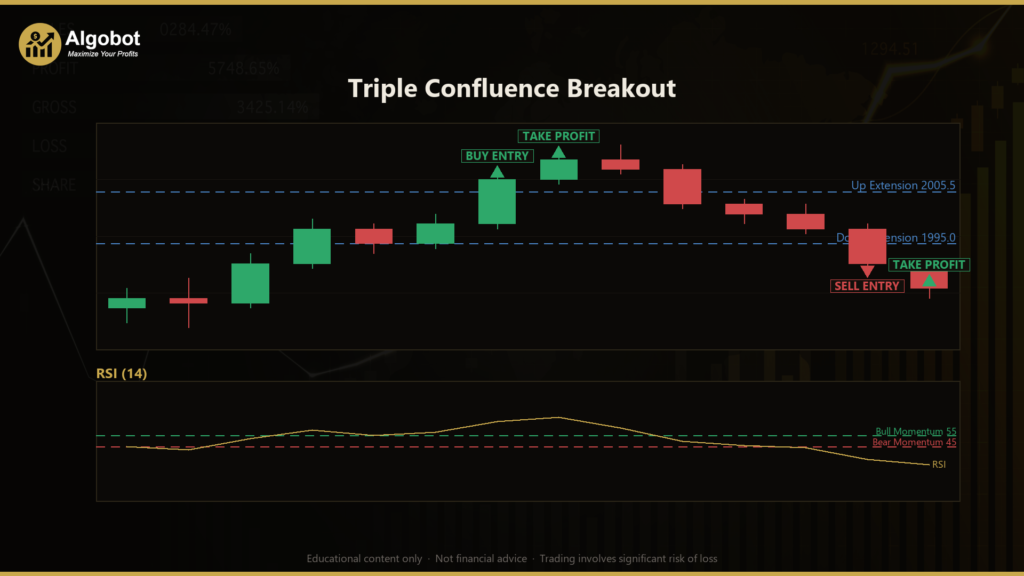
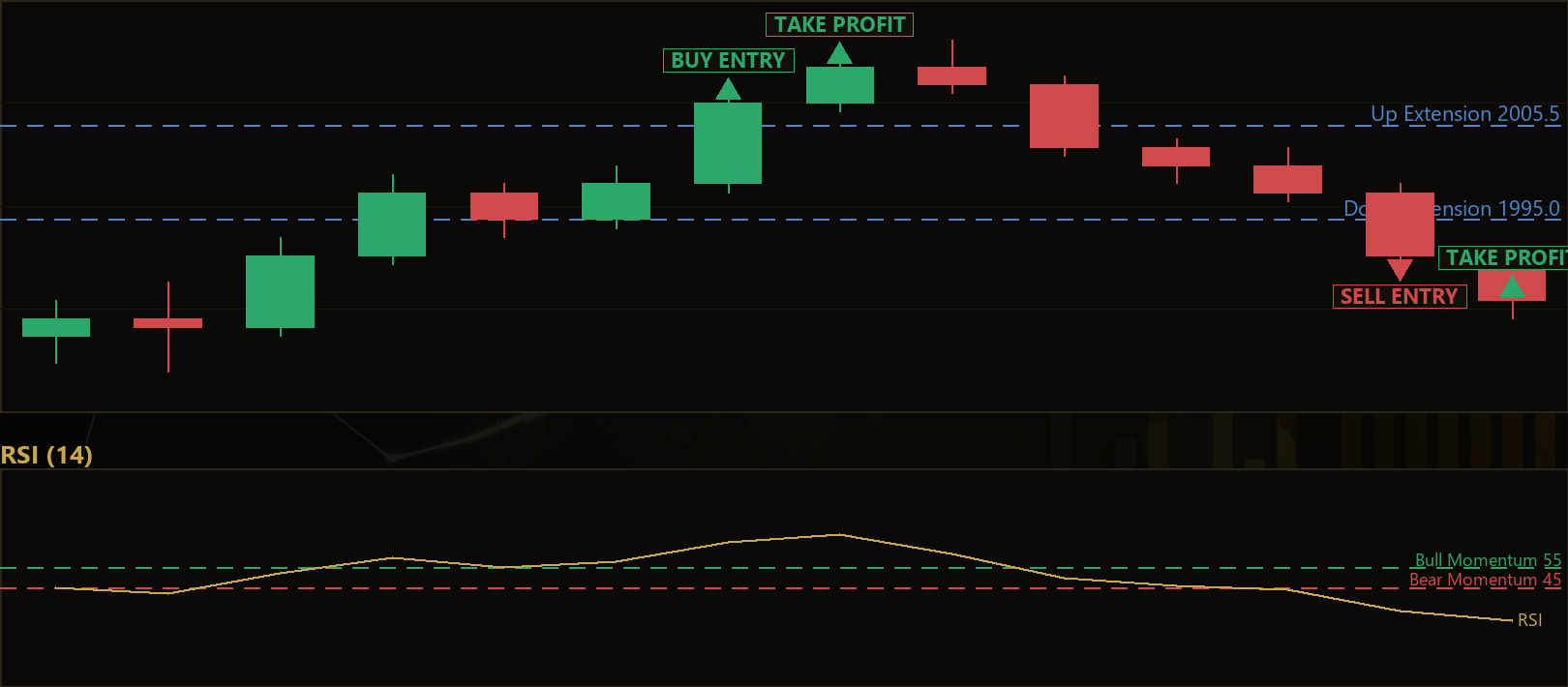
- Confluence 1 — Extension break: The bar closes across the extension level for the first time. The previous bar's close must have been on the other side, so the strategy signals a fresh break rather than reacting to a stale, already-extended trend.
- Confluence 2 — Momentum: RSI confirms direction. For a long, RSI must be at or above
MomentumThreshold; for a short, RSI must be at or below100 − MomentumThreshold. - Confluence 3 — Volatility expansion: The breakout candle's range must be at least
ATR × VolExpansionMult. This helps ensure the break happens on a genuine volatility surge rather than a slow drift.
Entry, stop-loss, and take-profit:
- Entry: When all three confluences fire and no position is open, the strategy signals a market Buy (long) or Sell (short) in the impulse direction.
- Stop-loss (ATR-based): For a long,
SL = entry − ATR × SlAtrMult; for a short,SL = entry + ATR × SlAtrMult. Sizing the stop to ATR lets it adapt to current volatility. - Take-profit (ATR-based): For a long,
TP = entry + ATR × TpAtrMult; for a short,TP = entry − ATR × TpAtrMult. The default target multiple is deliberately kept tight and scalp-friendly.
The long and short rule sets are full mirror images of one another, so the strategy treats bullish and bearish breakouts symmetrically.
Strategy Parameters
| Parameter | Default | Min | Max | Description |
|---|---|---|---|---|
| SwingWing | 4 | 2 | 15 | Number of bars on each side required to confirm a swing high or swing low pivot. Larger values demand more prominent, less frequent swings. |
| ExtFactor | 1.272 | 1.05 | 2.618 | Fibonacci extension multiple of the impulse leg used to project the breakout trigger level. |
| RsiPeriod | 14 | 5 | 30 | Lookback period for the RSI momentum oscillator. |
| MomentumThreshold | 55.0 | 50.0 | 70.0 | RSI gate for longs; shorts use the mirror value (100 − this). Higher values demand stronger momentum. |
| VolExpansionMult | 1.20 | 0.50 | 3.0 | The breakout candle's range must be at least ATR × this value to qualify as a volatility expansion. |
| AtrPeriod | 14 | 5 | 40 | Lookback period for the ATR volatility measure used in the volatility filter and stops. |
| SlAtrMult | 1.20 | 0.50 | 4.0 | Stop-loss distance expressed as a multiple of ATR. |
| TpAtrMult | 1.80 | 0.50 | 5.0 | Take-profit distance expressed as a multiple of ATR. |
| Lots | 0.10 | 0.01 | 10.0 | Trade volume in lots. |
| Magic | 20260714 | 1 | 999999999 | Unique magic number identifying trades opened by this EA. |

Recommended Chart Settings
The Triple Confluence Breakout was designed with volatile instruments in mind — for example XAUUSD (gold) or BTCUSD — on a low scalping timeframe such as M5 or M15. Because its stops, targets, and volatility filter are all scaled to ATR, it can adapt to different instruments, but the character of each market matters: highly volatile, expansion-prone symbols are the environment the breakout logic was built to study. Keep in mind that the EA is timeframe-agnostic and will run on any chart you attach it to, and that results will vary considerably across different symbols, sessions, and market conditions. Always test on your own broker's data before drawing conclusions.
How to Install on MetaTrader 5
- Download the .ex5 file from the link below
- Copy it to your MT5
MQL5\Expertsfolder - Restart MetaTrader 5 or refresh the Navigator panel
- Drag the EA onto a chart matching the recommended symbol and timeframe
- Configure the input parameters and enable Algo Trading
What to Consider Before Using This EA
Every mechanical strategy has strengths and trade-offs, and understanding both is part of learning to evaluate an EA critically.
Strengths of this approach:
- Triple filtering. Requiring a fresh extension break, momentum confirmation, and a volatility surge on the same bar helps reduce reaction to low-conviction moves.
- Volatility-adaptive risk. Because stops and targets scale with ATR, the strategy sizes its risk to current conditions rather than using fixed pip distances.
- Symmetry. Longs and shorts follow identical, mirrored logic, avoiding a directional bias baked into the code.
Known limitations:
- Breakout strategies face false breaks. Price can close through an extension level and then reverse. The "fresh break" and volatility filters reduce, but cannot eliminate, this common failure mode.
- Range-bound markets are challenging. In quiet, sideways conditions, genuine expansion candles are rare, so signals may be infrequent or may fire near the end of a move.
- Parameter sensitivity. Swing-wing size, the extension factor, and the momentum threshold interact. Over-tuning them to past data (curve-fitting) can produce results that do not hold up going forward.
- Costs matter for scalping. On low timeframes, spread, slippage, and commission can materially affect outcomes, so realistic testing conditions are essential.
Treat this EA as a framework for studying how confluence-based breakout logic behaves — not as a finished, hands-off system.
Risk Management Tips
Sound risk management is the foundation of any trading education, regardless of the strategy involved:
- Risk a small, fixed fraction per trade. A common guideline is to risk no more than 1–2% of account equity on any single position, adjusting lot size accordingly rather than trading a fixed lot blindly.
- Test on a demo account first. Run the EA on a demo account long enough to understand how often it trades, how it behaves in different sessions, and how it handles losing streaks before considering any live use.
- Understand drawdown. Even a well-designed strategy will experience losing runs. Know the maximum peak-to-trough decline you are prepared to tolerate, and size your risk so that a normal drawdown does not force you to abandon the plan.
- Account for real costs. Include spread, slippage, and commission in your evaluation, especially on scalping timeframes where they weigh more heavily.
- Never over-leverage. Leverage amplifies both gains and losses; keep position sizes conservative relative to your account.
Good risk management is about survival and consistency, not maximizing a single outcome.
Risk Warning
Trading foreign exchange, CFDs, and other leveraged financial instruments involves substantial risk of loss and is not suitable for all investors. The strategies and tools discussed on this page are provided for educational purposes only and do not constitute financial advice, investment recommendations, or solicitation to trade. Always consult a qualified financial adviser before making trading decisions. Past backtest performance is not indicative of future results.
Downloads
- Expert Advisor: TripleConfluenceBreakout.ex5 (59 downloads)
- Source Code: TripleConfluenceBreakout.mq5 (53 downloads)
- Documentation: TripleConfluenceBreakout.pdf (57 downloads)