
Disclaimer: This article is for educational and informational purposes only. It does not constitute financial or investment advice. Trading forex and CFDs carries significant risk of loss. Past performance of any strategy — including backtests — does not guarantee future results. Never trade with money you cannot afford to lose.
What Is This Strategy?
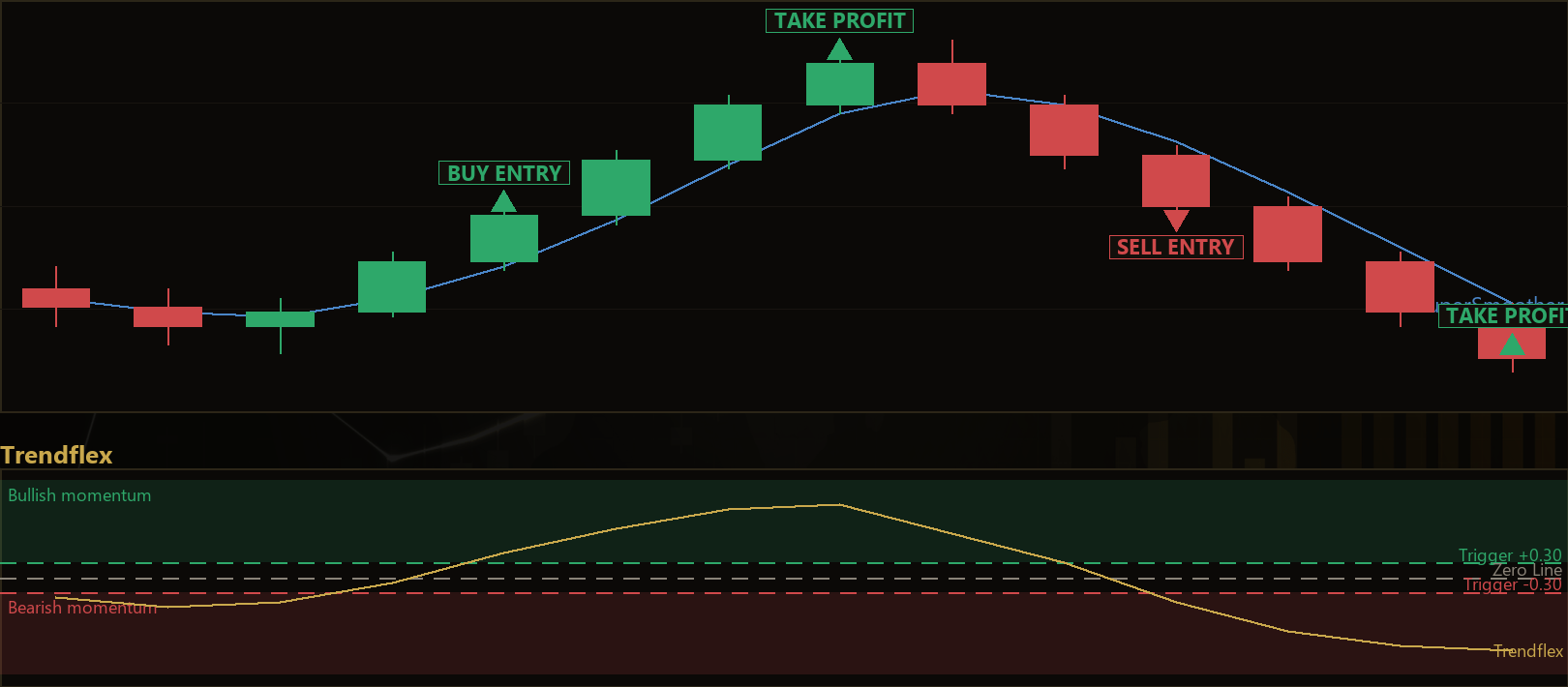
The Trendflex Momentum Cross is a trend-following momentum strategy built around the Trendflex oscillator, a technical tool introduced by John Ehlers in his 2020 work "Reflex and Trendflex Indicators." Unlike a traditional moving-average crossover, Trendflex is a purpose-built displacement measure: it runs price through a near-zero-lag smoothing filter and then measures how far that smoothed price sits above or below the average of its own recent history. The result is a self-scaling oscillator that hovers near zero when a market is choppy and swings to strong positive or negative readings when a sustained trend takes hold.
This strategy is designed for trending, liquid markets where directional moves have room to develop — for example, major forex pairs such as EURUSD and GBPUSD, or gold (XAUUSD), typically on intraday timeframes like M15 through H1. The core idea is to detect the moment trend displacement flips sign (the Trendflex zero-line cross) and to act only when the underlying smoothed price agrees with that direction. A separate slope filter is used to skip counter-trend signals that tend to appear in flat, range-bound conditions.
As a learning tool, the Trendflex Momentum Cross is well suited to traders who want to understand how modern digital-signal-processing indicators differ from classic lagging averages. It demonstrates how noise reduction, self-normalisation, and a regime filter can be combined into a single, symmetric long-and-short framework. Treat this as a study of strategy mechanics and market behaviour — not as a shortcut to trading results.
How It Works
The strategy processes one completed bar at a time on the primary chart timeframe. On each newly closed bar it updates its internal series and checks whether a fresh, aligned signal has occurred.
Building the Trendflex oscillator:
- Price closes are first passed through a two-pole SuperSmoother filter — a near-zero-lag Butterworth low-pass filter that strips out high-frequency noise and aliasing while preserving the underlying trend.
- Trendflex then measures displacement: for a window of
SmootherLengthbars, it averages the difference between the current smoothed value and each of its previous values. Because no slope line is subtracted (the key difference from Ehlers' Reflex indicator), Trendflex reads sustained trend displacement rather than cyclic swing. - That raw displacement is normalised by its own rolling root-mean-square (RMS), producing a self-scaling reading that naturally stays near zero in chop and expands to strong ± values during genuine trends.
Entry conditions (symmetric long and short):
- The strategy signals a potential long when Trendflex crosses up through the zero line and rises above the
TriggerLevelnoise gate, indicating bullish momentum onset. - The strategy signals a potential short when Trendflex crosses down through zero and falls below the negative
TriggerLevel, indicating bearish momentum onset. - A regime filter is then applied: the SuperSmoother must be sloping in the same direction over the
SlopeLookbackwindow. A long is only taken when the smoother is rising; a short only when it is falling. This helps filter out whipsaw crosses in directionless markets.
Position management:
- On a fresh aligned signal, the strategy first closes any position held in the opposite direction (momentum has flipped), then opens a new position in the signalled direction.
- Only one position per direction is held at a time — if an aligned position already exists, no duplicate is added.
Stop-loss and take-profit logic:
- Risk is sized from a raw Average True Range (ATR) — a plain average of true range over
AtrPeriodbars, measuring recent volatility. - The stop-loss is placed
AtrStopMult× ATR away from the entry price. - The take-profit is set at
RewardRisk× the stop distance, giving a fixed reward-to-risk relationship. For example, a 1.5 reward-risk with a 2-ATR stop targets a move three ATRs in the favourable direction.
Strategy Parameters
| Parameter | Default | Min | Max | Description |
|---|---|---|---|---|
| SmootherLength | 20 | 8 | 60 | SuperSmoother and Trendflex window length — the dominant trend horizon. Larger values track slower, longer trends. |
| SlopeLookback | 5 | 1 | 20 | Number of bars over which the SuperSmoother must slope one way to confirm the regime and validate a cross. |
| TriggerLevel | 0.30 | 0.00 | 2.00 | Minimum absolute Trendflex reading required at the cross — a noise gate that filters weak signals. |
| AtrPeriod | 14 | 5 | 40 | Lookback used to compute ATR for stop and target sizing. |
| AtrStopMult | 2.00 | 0.50 | 6.00 | Stop-loss distance expressed as this many ATRs from the entry price. |
| RewardRisk | 1.50 | 0.50 | 5.00 | Take-profit distance as a reward-to-risk multiple of the stop distance. |
| Lots | 0.10 | 0.01 | 1.00 | Fixed trade size in lots. |

Recommended Chart Settings
This strategy is designed to be instrument-agnostic — it reads whatever symbol and timeframe you attach it to. In practice it is intended for trending, liquid markets: major forex pairs such as EURUSD or GBPUSD, or gold (XAUUSD), typically on the M15 to H1 timeframes. These conditions give the Trendflex oscillator enough clean directional movement for the zero-line cross and slope filter to work as intended.
Keep in mind that results will vary considerably across different symbols, timeframes, and market conditions. A setting that behaves well on one instrument during a trending phase may generate frequent false signals on another instrument or during range-bound periods. Always test any configuration on historical data and a demo account before considering live use.
How to Install on MetaTrader 5
- Download the .ex5 file from the link below
- Copy it to your MT5
MQL5\Expertsfolder - Restart MetaTrader 5 or refresh the Navigator panel
- Drag the EA onto a chart matching the recommended symbol and timeframe
- Configure the input parameters and enable Algo Trading
What to Consider Before Using This EA
Strengths of this approach. The Trendflex oscillator is a genuinely modern construction. Its SuperSmoother stage reduces the lag and noise that plague simple moving-average crossovers, and its RMS self-normalisation means the same TriggerLevel threshold behaves consistently across instruments of different price scales. Pairing the zero-line cross with a slope-based regime filter is a sensible attempt to trade momentum and trend agreement together, rather than reacting to every oscillation. The ATR-based stops and targets keep risk proportional to current volatility instead of using fixed pip distances.
Known limitations. Like all trend-following systems, this strategy depends on trends actually occurring. In extended sideways or choppy markets, the zero-line cross can fire repeatedly, and even with the noise gate and slope filter, a series of small losing trades is possible as the market fails to follow through. Because it flips from long to short (and vice versa) on aligned crosses, sharp reversals can occasionally result in being stopped out shortly after entry. The fixed reward-to-risk target also means strong trends may be exited before their full extent is captured.
Where it may underperform. Low-volatility ranging conditions, news-driven spikes, and instruments with wide spreads relative to their ATR are the most challenging environments. The strategy has no time-of-day or session filter, so it may signal during thin liquidity periods where slippage is higher. Evaluate these factors for your specific broker and instrument before relying on the default settings.
Risk Management Tips
Sound risk management matters more than any single indicator. Consider these general principles as part of your education:
- Risk a small, fixed fraction per trade. Many educational sources suggest never risking more than 1–2% of account equity on any single position. Adjust the
Lotssize so that the ATR-based stop distance corresponds to that fraction of your account. - Understand drawdown. Even a well-designed trend strategy will experience losing streaks. Study the maximum historical drawdown before deciding whether a configuration fits your risk tolerance.
- Always start on a demo account. Run the EA on a demo or paper-trading account long enough to observe how it behaves across trending and ranging phases before considering any live capital.
- Match position size to volatility. Because stops here scale with ATR, a wider ATR means a wider stop and larger risk per lot. Recalculate your sizing when volatility changes.
- Never over-leverage. Leverage magnifies both gains and losses. Keep total exposure conservative, especially when running an automated system unattended.
Approach this EA as a tool for learning how systematic momentum strategies are structured, not as a substitute for disciplined risk control and ongoing monitoring.
Risk Warning
Trading foreign exchange, CFDs, and other leveraged financial instruments involves substantial risk of loss and is not suitable for all investors. The strategies and tools discussed on this page are provided for educational purposes only and do not constitute financial advice, investment recommendations, or solicitation to trade. Always consult a qualified financial adviser before making trading decisions. Past backtest performance is not indicative of future results.
Downloads
- Expert Advisor: TrendflexMomentumCross.ex5 (31 downloads)
- Source Code: TrendflexMomentumCross.mq5 (33 downloads)
- Documentation: TrendflexMomentumCross.pdf (35 downloads)