
Disclaimer: This article is for educational and informational purposes only. It does not constitute financial or investment advice. Trading forex and CFDs carries significant risk of loss. Past performance of any strategy — including backtests — does not guarantee future results. Never trade with money you cannot afford to lose.
What Is This Strategy?
The Time Segmented Volume Shift strategy is a volume-momentum trend-following system built around Time Segmented Volume (TSV), a volume indicator originally developed by the Worden Brothers. TSV belongs to the family of "smart money" volume tools, but it works differently from more familiar names like On-Balance Volume (OBV) or the Chaikin Money Flow. Instead of simply adding or subtracting whole blocks of volume, TSV weights each bar's actual close-to-close price displacement by that bar's volume and then sums the result over a rolling window. In plain terms, a large price move backed by heavy volume adds a big chunk to the total, while a tiny move on thin volume barely registers at all.
Because of this design, TSV rises fastest when strong directional price moves are genuinely supported by trading activity — the classic footprint of accumulation (buyers stepping in) or its mirror image, distribution (sellers offloading). The strategy treats the crossover of TSV through its own signal line as a momentum shift: the moment accumulation or distribution flow accelerates past its recent average. A price-based EMA (Exponential Moving Average) baseline then supplies the trend regime, so the system only acts on volume shifts that agree with the prevailing direction of the market.
As a learning tool, this strategy is well suited to traders who want to understand how volume can be blended with price momentum and a trend filter. It is designed for trending market conditions on liquid instruments, and it demonstrates several important concepts at once: volume weighting, signal-line crossovers, regime filtering, and volatility-based risk framing. It is not a shortcut of any kind — it is a structured example of disciplined, rules-based strategy design.
How It Works
The strategy processes one signal per closed bar. It maintains three core calculations: the TSV line, its EMA signal line, and a price EMA trend baseline. Here is how each piece contributes to a decision.
The core calculation:
- Flow for each bar = (current close − previous close) × that bar's volume. This is signed and magnitude-aware — direction and size both matter.
- TSV = the rolling sum of Flow over the last
TsvPeriodbars, representing net accumulation across the window. - Signal line = an EMA of the TSV line over
SignalPeriodbars, used as the crossover trigger. - Trend baseline = an EMA of price over
TrendPeriodbars, with its slope measured over a short lookback to confirm direction.
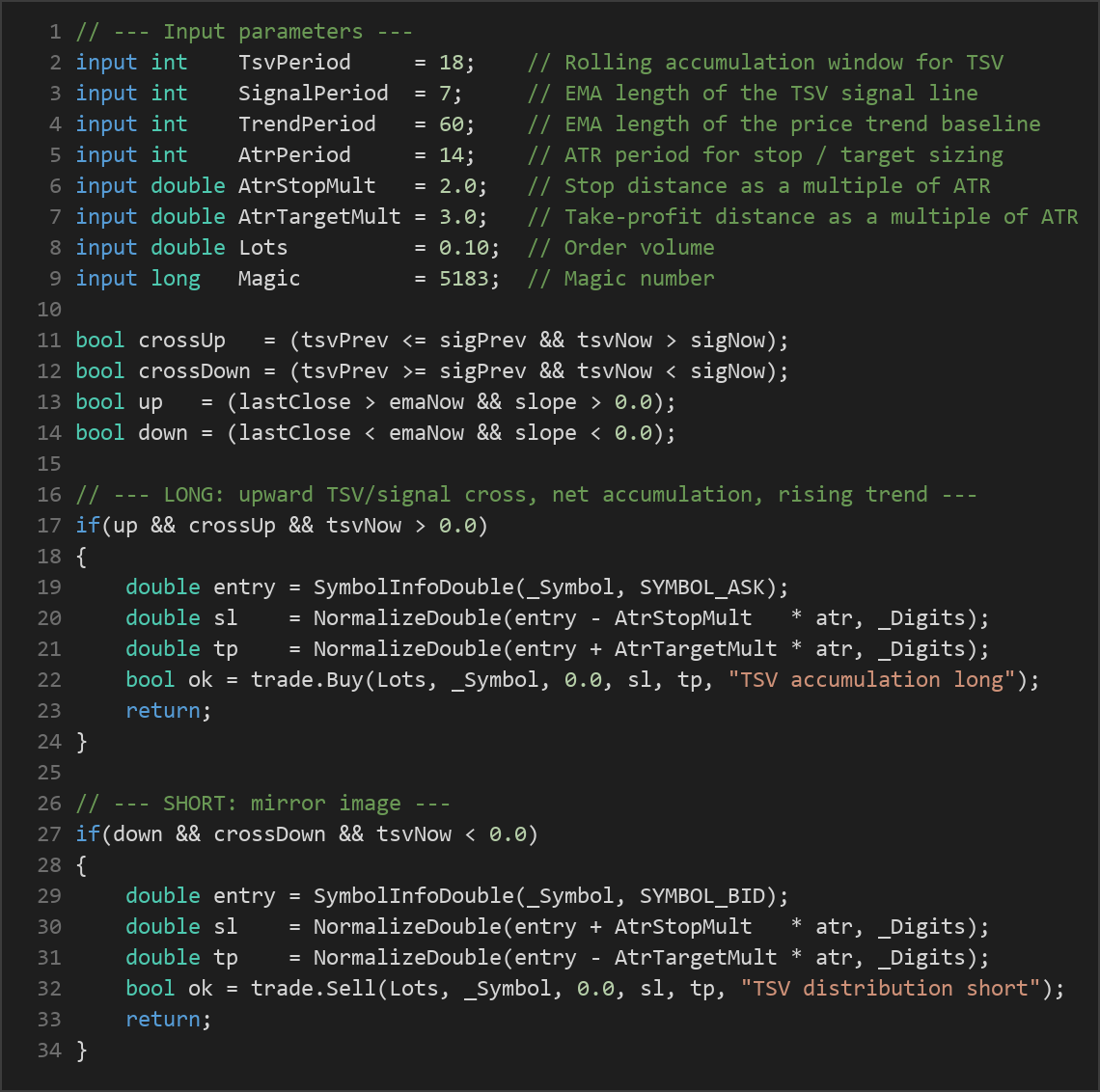
Long entry — the strategy signals a buy when all of the following are true:
- TSV crosses up through its signal line (a fresh upward momentum shift).
- TSV is net-positive, indicating accumulation currently dominates the ledger.
- Price is above the trend EMA baseline, and that baseline is rising (slope greater than zero).
Short entry — the strategy signals a sell when the mirror conditions hold:
- TSV crosses down through its signal line (a fresh downward momentum shift).
- TSV is net-negative, indicating distribution currently dominates.
- Price is below the trend EMA baseline, and that baseline is falling (slope less than zero).
Stop-loss logic:
- Every trade is framed by a volatility-based stop using the Average True Range (ATR), a measure of typical price movement. The stop is placed
AtrStopMult× ATR away from entry, so the protective distance automatically widens in volatile conditions and tightens in calm ones.
Take-profit logic:
- The target is placed
AtrTargetMult× ATR from entry. With the default multipliers (stop 2.0×, target 3.0×), the framework aims for a reward-to-risk ratio of roughly 1.5:1 before costs.
Early exit on flow reversal:
- If TSV crosses back through its signal line against an open position, the strategy interprets this as the flow thesis having failed and closes the trade early — before the fixed stop or target is reached. Only one position per symbol is held at a time; the system never stacks entries.

Strategy Parameters
| Parameter | Default | Min | Max | Description |
|---|---|---|---|---|
| TsvPeriod | 18 | 6 | 50 | Rolling accumulation window for TSV — the number of Flow terms summed. Larger values smooth the volume-momentum reading. |
| SignalPeriod | 7 | 3 | 25 | EMA length of the TSV signal line, which acts as the crossover trigger. Shorter values react faster to shifts. |
| TrendPeriod | 60 | 20 | 200 | EMA length of the price trend baseline used as the regime and direction filter. |
| AtrPeriod | 14 | 5 | 40 | ATR period used for stop and target sizing. |
| AtrStopMult | 2.0 | 0.5 | 6.0 | Stop-loss distance as a multiple of ATR. |
| AtrTargetMult | 3.0 | 0.5 | 10.0 | Take-profit distance as a multiple of ATR. |
| Lots | 0.10 | 0.01 | 1.0 | Order volume (position size) per trade. |
Recommended Chart Settings
The Time Segmented Volume Shift EA is designed to run on any liquid symbol and on whatever single primary timeframe you select at test time. Because TSV relies on volume, it is best paired with instruments that have consistent, meaningful volume data — major forex pairs, liquid indices, or actively traded commodities. The EA uses tick volume as its volume proxy, which is standard for MetaTrader 5 forex feeds.
A common starting point for study is a higher intraday timeframe such as H1 or H4, where trend and volume relationships tend to be cleaner and signals less frequent. Lower timeframes generate more signals but also more noise. Whatever you choose, remember that results will vary considerably across different symbols, brokers, and market conditions. Always evaluate the default parameters against your chosen market before drawing any conclusions, and re-test whenever you change the timeframe.
How to Install on MetaTrader 5
- Download the
.ex5file from the link below. - Copy it to your MT5
MQL5\Expertsfolder. - Restart MetaTrader 5 or refresh the Navigator panel.
- Drag the EA onto a chart matching the recommended symbol and timeframe.
- Configure the input parameters and enable Algo Trading.
What to Consider Before Using This EA
Like every strategy, Time Segmented Volume Shift has both strengths and limitations, and understanding them is part of the learning process.
Strengths of this approach:
- Volume confirmation. By weighting price moves by volume, TSV can help distinguish moves driven by genuine participation from thin, low-conviction drifts.
- Multiple layers of agreement. Requiring a crossover, a net-positive or net-negative TSV, and an aligned trend baseline reduces the number of low-quality signals compared with a single-condition system.
- Volatility-aware risk framing. ATR-based stops and targets adapt to changing market conditions rather than using fixed distances.
- Built-in exit discipline. The flow-reversal exit gives the strategy a way to leave a trade when its underlying rationale weakens.
Known limitations:
- Trend dependency. This is a trend-following design. In choppy, sideways, or range-bound markets, momentum crossovers can whipsaw and produce a string of small losing trades.
- Tick-volume caveat. In forex, tick volume approximates the number of price changes, not true traded volume. It is a widely used proxy, but it is not identical to exchange-reported volume, and its quality can vary by broker.
- Lag from smoothing. The EMA signal line and trend baseline introduce lag by design. Fast reversals may already be underway before a signal confirms.
- Parameter sensitivity. Different periods and ATR multipliers can materially change behavior. Values that historically suited one market may not suit another.
The strategy is best viewed as a framework for studying how volume, momentum, and trend filters interact — not as a finished, guaranteed system.
Risk Management Tips
Sound risk management matters more than any single entry rule. Consider these general principles as you study this or any strategy:
- Position sizing. Keep the risk on any single trade small — many educational sources suggest risking no more than 1–2% of account equity per trade. Adjust the
Lotsparameter to fit your own account size and risk tolerance. - Use a demo account first. Test the EA thoroughly in a demo or simulated environment before considering any live capital. This lets you observe behavior across different conditions without financial exposure.
- Understand drawdown. Every strategy experiences losing streaks. Know the maximum historical drawdown you are willing to tolerate, and size positions so that a normal losing sequence does not threaten your account.
- Account for costs. Spreads, commissions, and slippage all erode results, especially on lower timeframes with frequent signals.
- Diversify and avoid over-leverage. Concentrating risk in a single instrument or using excessive leverage magnifies both gains and losses.
Risk management is not a one-time setup — it is an ongoing discipline that protects your ability to keep learning and trading.
Risk Warning
Trading foreign exchange, CFDs, and other leveraged financial instruments involves substantial risk of loss and is not suitable for all investors. The strategies and tools discussed on this page are provided for educational purposes only and do not constitute financial advice, investment recommendations, or solicitation to trade. Always consult a qualified financial adviser before making trading decisions. Past backtest performance is not indicative of future results.
Downloads
- Expert Advisor: TimeSegmentedVolumeShift.ex5 (34 downloads)
- Source Code: TimeSegmentedVolumeShift.mq5 (32 downloads)
- Documentation: TimeSegmentedVolumeShift.pdf (32 downloads)