Disclaimer: This article is for educational and informational purposes only. It does not constitute financial or investment advice. Trading forex and CFDs carries significant risk of loss. Past performance of any strategy — including backtests — does not guarantee future results. Never trade with money you cannot afford to lose.
What Is This Strategy?
The Tillson Trend Resumption strategy is a trend-pullback continuation system built on the Tillson T3 moving average, a six-stage cascaded exponential smoother designed to track price with far less lag than a plain moving average while remaining smooth. Rather than reacting to a simple line crossover, this strategy studies the breathing of two T3 lines — a fast one and a slow one — and looks for the moment an established trend re-accelerates after a shallow pause. It is a trend-following approach at heart, aimed at catching the resumption of a move that is already underway rather than trying to predict tops and bottoms.
The strategy is designed for trending market conditions — the kind of directional intraday-to-swing behaviour often seen on liquid instruments such as EURUSD, XAUUSD (gold), or index CFDs like US100 on the M30 to H4 timeframes. Its core mechanism deliberately filters out flat, choppy markets, where the "breathing" of two moving averages is just noise rather than a meaningful signal. In other words, it tries to participate only when there is a genuine trend to ride.
As a learning tool, the Tillson Trend Resumption EA is well suited to traders who want to understand how adaptive moving averages, spread dynamics, and volatility-normalised filters combine into a single rules-based system. It is a strategy analysis, not a shortcut — the value here is in seeing how each condition contributes to the entry logic, and in appreciating how a "structurally favourable" entry (buying a dip inside an intact trend) is defined mechanically. Beginners and intermediate traders alike can use it to study T3 behaviour, ATR-based risk placement, and the discipline of one-position-at-a-time trade management.
How It Works
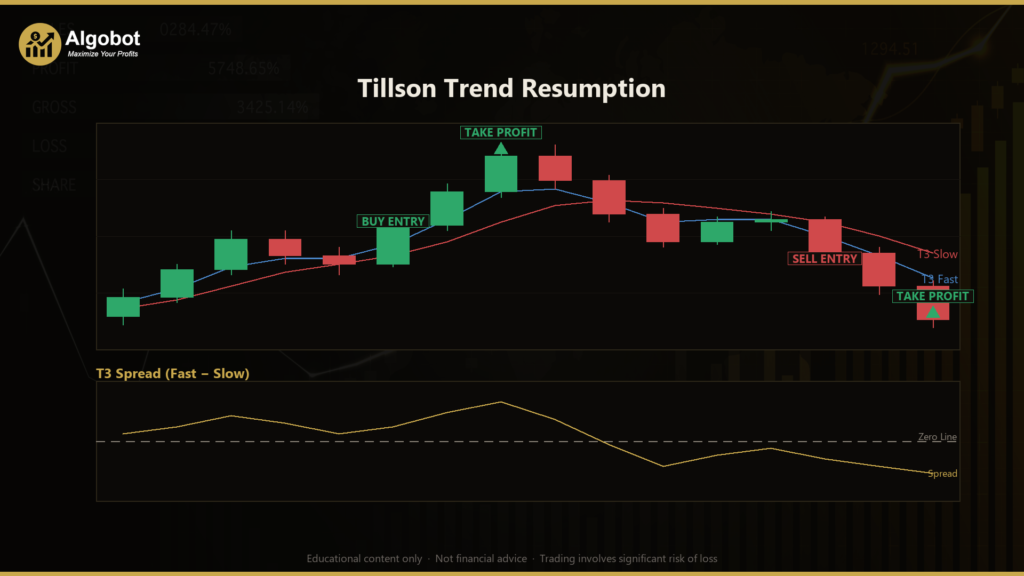
The strategy runs two Tillson T3 lines and watches the spread between them:
`
spread = T3fast − T3slow
`
In a healthy uptrend the fast line rides above the slow line, so the spread is positive. During a pullback the fast line drifts back toward the slow line and the spread shrinks — but if the trend is genuinely intact, the spread stays positive rather than crossing below zero. When buyers step back in, the fast line pulls away again and the spread makes a fresh local turn upward. That turn is the moment the strategy signals a resumption. Downtrends are the exact mirror.
The strategy signals a long entry when all of the following are true:
- The slow T3 line is genuinely rising — its slope over the lookback window is at least
SlopeMinAtr × ATR, confirming a real uptrend rather than flat drift. - The spread is positive (the fast line is above the slow line), and it stayed positive through the pullback — meaning the retrace was shallow and the trend never flipped.
- The spread has just turned back up to form a local minimum (the current spread is greater than the previous bar, which was less than or equal to the bar before it).
The strategy signals a short entry under the exact mirror conditions: the slow T3 line is falling by the same magnitude, the spread is negative and stayed negative through the pullback, and the spread has just turned back down to form a local maximum.
Exit and risk logic:
- Stop-loss: Placed at a distance of
AtrStopMult × ATRfrom the entry price — a volatility-scaled stop that widens in fast markets and tightens in calm ones. - Take-profit: Set at
RewardRisk × (AtrStopMult × ATR)from entry, so the target is a fixed multiple of the risk taken. - Trend-flip exit: If the spread sign flips against an open position (for example, the fast line falls below the slow line while holding a long), the strategy reads this as the trend having broken and closes the position early.
- One position at a time: The strategy never stacks trades — while a position is open, it only manages the exit and does not look for new entries.
The system also includes a warm-up period so the recursive T3 cascade has time to "season" before any signals are considered, which helps the calculated values stabilise before the first trade.

Strategy Parameters
| Parameter | Default | Min | Max | Description |
|---|---|---|---|---|
| FastPeriod | 8 | 3 | 20 | Length of the fast Tillson T3 line. Lower values make it more responsive to recent price. |
| SlowPeriod | 21 | 10 | 60 | Length of the slow Tillson T3 line, which defines the underlying trend. Automatically kept above FastPeriod. |
| VolumeFactor | 0.70 | 0.30 | 0.90 | Tillson "volume factor" v (0–1). Higher values make the T3 snappier with more overshoot; lower values make it smoother. |
| SlopeLookback | 3 | 1 | 10 | Number of bars over which the slow-T3 slope is measured for the trend gate. |
| SlopeMinAtr | 0.10 | 0.00 | 0.60 | Minimum required slope magnitude, expressed in ATR units, to confirm a genuine trend and filter out flat chop. |
| AtrPeriod | 14 | 5 | 30 | Lookback period for the Average True Range used in slope scaling and risk placement. |
| AtrStopMult | 2.0 | 0.5 | 5.0 | Stop-loss distance as a multiple of ATR. |
| RewardRisk | 1.6 | 0.8 | 4.0 | Take-profit distance as a multiple of the risk (stop) distance. |
| Lots | 0.10 | 0.01 | 1.0 | Fixed trade size in lots. |
Note: The EA also exposes a
Magicnumber (default 7307) so it can identify and manage only its own positions on the chart.

Recommended Chart Settings
This strategy was designed to operate on a single, freely selectable timeframe — it reads whatever timeframe the chart or backtest is set to rather than hardcoding one. Based on its design intent, it is best suited to trending intraday-to-swing instruments such as:
- EURUSD, XAUUSD (gold), or index CFDs like US100
- M30 to H4 timeframes, where trends have room to develop but signals still arrive frequently enough to study
Because the strategy depends on directional movement, results will vary considerably across different market conditions. In strongly trending phases the spread-breathing logic has clear structure to work with; in range-bound or erratic conditions the slope gate is intended to keep the strategy on the sidelines, which means fewer trades. As always, test any settings on your specific symbol and timeframe before drawing conclusions.
How to Install on MetaTrader 5
- Download the .ex5 file from the link below
- Copy it to your MT5
MQL5\Expertsfolder - Restart MetaTrader 5 or refresh the Navigator panel
- Drag the EA onto a chart matching the recommended symbol and timeframe
- Configure the input parameters and enable Algo Trading
What to Consider Before Using This EA
Strengths of the approach. The Tillson T3 moving average is genuinely low-lag for its degree of smoothness, so the spread-turn signal can fire relatively early in a resumption. The "spread never crossed zero" rule is a thoughtful filter: it rejects deep retracements and regime flips, keeping the strategy focused on trends that are still intact. Layering an ATR-normalised slope gate on top helps it avoid flat, low-conviction markets where two moving averages simply weave around each other. The volatility-scaled stop and fixed reward-to-risk target give the trade management a consistent, rules-based structure.
Known limitations. Like all trend-continuation systems, this strategy can struggle when a market transitions from trending to ranging. The very pullbacks it is designed to buy can become the start of a reversal, and the trend-flip exit — while protective — realises a loss when that happens. The T3's responsiveness is a double-edged sword: the VolumeFactor that reduces lag also introduces overshoot, which can produce false spread-turns near the end of a move. Whipsaw conditions, news-driven spikes, and low-liquidity sessions can all generate signals that do not follow through.
Where it may underperform. Choppy, directionless markets are the natural weakness — even with the slope gate, a barely-qualifying trend can produce a string of small losing trades. Very tight or very wide ATR-based stops (driven by parameter choices) can also degrade performance, either by getting stopped out prematurely or by risking too much per trade. This EA is a tool for studying trend-resumption mechanics, not a set-and-forget solution, and it should be evaluated critically rather than assumed to fit every instrument.
Risk Management Tips
Sound risk management matters more than any single entry signal. Consider these general principles as you study this strategy:
- Risk a small, fixed percentage per trade. Many educators suggest never risking more than 1–2% of account equity on any single position. Because this EA uses a fixed
Lotsvalue, you should size that lot so the ATR-based stop distance corresponds to an acceptable percentage of your account. - Understand drawdown. Every strategy experiences losing streaks. Study how deep and how long historical drawdowns can run so you are mentally and financially prepared, and never assume a smooth equity curve.
- Start on a demo account. Run the strategy on a demo or paper-trading account first to observe how it behaves in live market conditions before committing any real capital.
- Match risk to volatility. The ATR-based stop already adapts to volatility, but you should still confirm that the resulting monetary risk per trade is within your tolerance on your chosen symbol.
- Never over-leverage. Leverage amplifies both gains and losses. Use it conservatively, and only trade with capital you can afford to lose entirely.
- Review and adjust. Markets evolve. Periodically re-examine whether the parameters and instrument still suit current conditions rather than leaving the EA unattended indefinitely.
Risk Warning
Trading foreign exchange, CFDs, and other leveraged financial instruments involves substantial risk of loss and is not suitable for all investors. The strategies and tools discussed on this page are provided for educational purposes only and do not constitute financial advice, investment recommendations, or solicitation to trade. Always consult a qualified financial adviser before making trading decisions. Past backtest performance is not indicative of future results.
Downloads
- Expert Advisor: TillsonTrendResumption.ex5 (55 downloads)
- Source Code: TillsonTrendResumption.mq5 (51 downloads)
- Documentation: TillsonTrendResumption.pdf (54 downloads)