
Disclaimer: This article is for educational and informational purposes only. It does not constitute financial or investment advice. Trading forex and CFDs carries significant risk of loss. Past performance of any strategy — including backtests — does not guarantee future results. Never trade with money you cannot afford to lose.
What Is This Strategy?
The Three Line Break Reversal is a trend-following, stop-and-reverse strategy built on the Three Line Break (3LB) chart transform, a time-independent price technique popularized by Steve Nison. Instead of plotting price against evenly spaced time bars, a Three Line Break chart is constructed from a sequence of "lines" (or blocks) that are defined purely by closing-price extremes. A trend continues as long as new closes push to fresh extremes, and it only reverses when a close breaks beyond the range of several prior lines. This strategy trades those confirmed reversals directly, using the Average True Range (ATR) indicator — a measure of recent volatility — to size its noise buffer, stop-loss, and take-profit.
The core idea is regime persistence. While a trend runs, every close that makes a new high (in an uptrend) or new low (in a downtrend) simply extends the current line in the same direction. Closes that fail to make a new extreme are discarded entirely, so the chart naturally filters out sideways chop. The trend only flips when a close overcomes the extreme of the last N lines — classically three. Because a reversal must break through the combined range of multiple prior blocks, a flip signals a more meaningful change of character rather than a single-bar wiggle.
This approach is designed for trending markets and periods of sustained directional movement, where the multi-line break filter can keep a position aligned with the dominant move. As a learning tool, it is well suited to traders who want to study how price transforms like Three Line Break differ from time-based candlestick charts, and how a "stop-and-reverse" system continuously holds a position on one side of the market. Note that this is not Renko (which uses fixed brick sizes), a Darvas box, or the three-line-strike candlestick pattern — the 3LB line sizes here are variable and defined by real close extremes.
How It Works
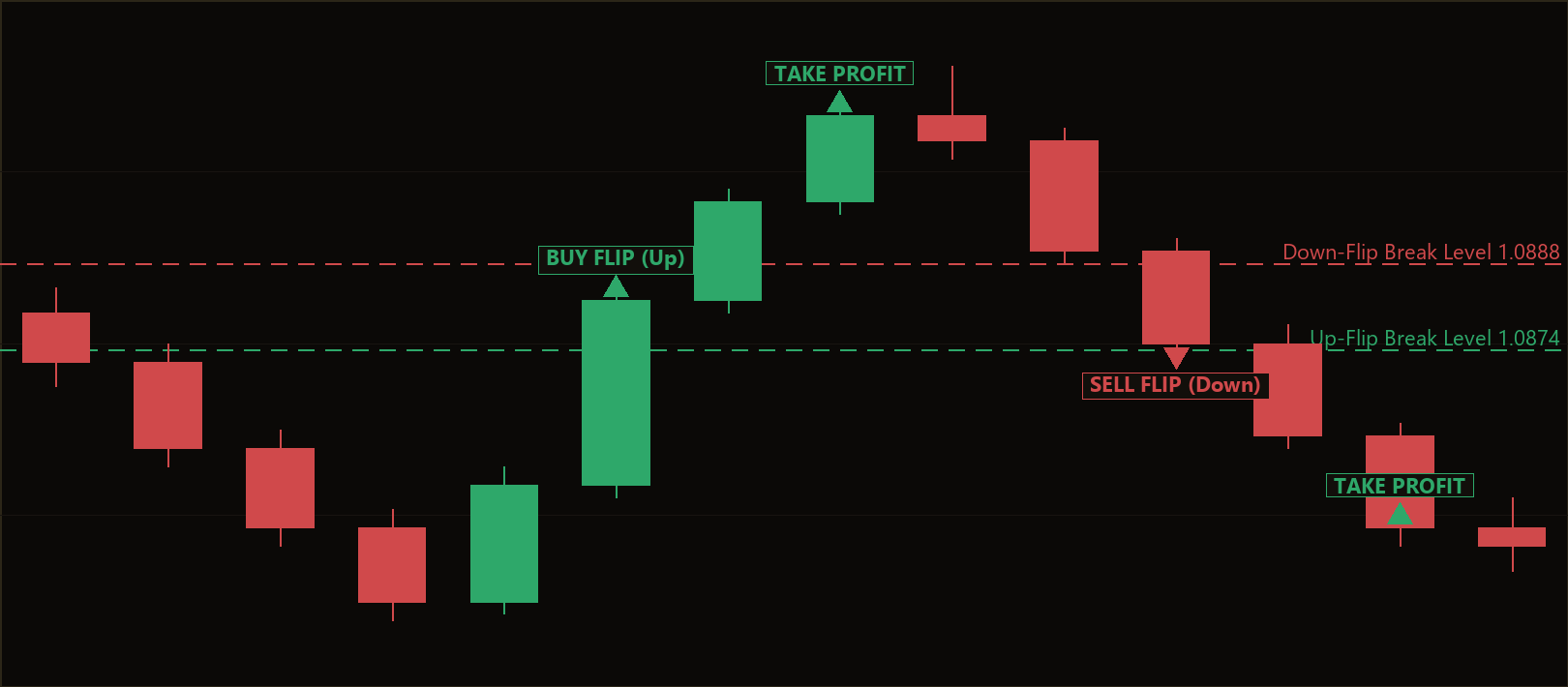
The strategy processes one freshly-closed bar at a time on the chart's primary timeframe. For each closed bar it updates the Three Line Break block structure and checks whether the trend has flipped. Here is what the strategy signals:
- Building the blocks: The system seeds its first line from the first two closes, then feeds each subsequent close into the 3LB structure. In an up-run, a close above the last line's top extends the uptrend; in a down-run, a close below the last line's bottom extends the downtrend.
- Long entry: The block trend flips up when a close breaks above the highest top of the last N lines (after a down-run), exceeding that break level by the ATR noise buffer. When this happens, the strategy signals a buy.
- Short entry: The block trend flips down when a close breaks below the lowest bottom of the last N lines (after an up-run), by the same ATR buffer. When this happens, the strategy signals a sell.
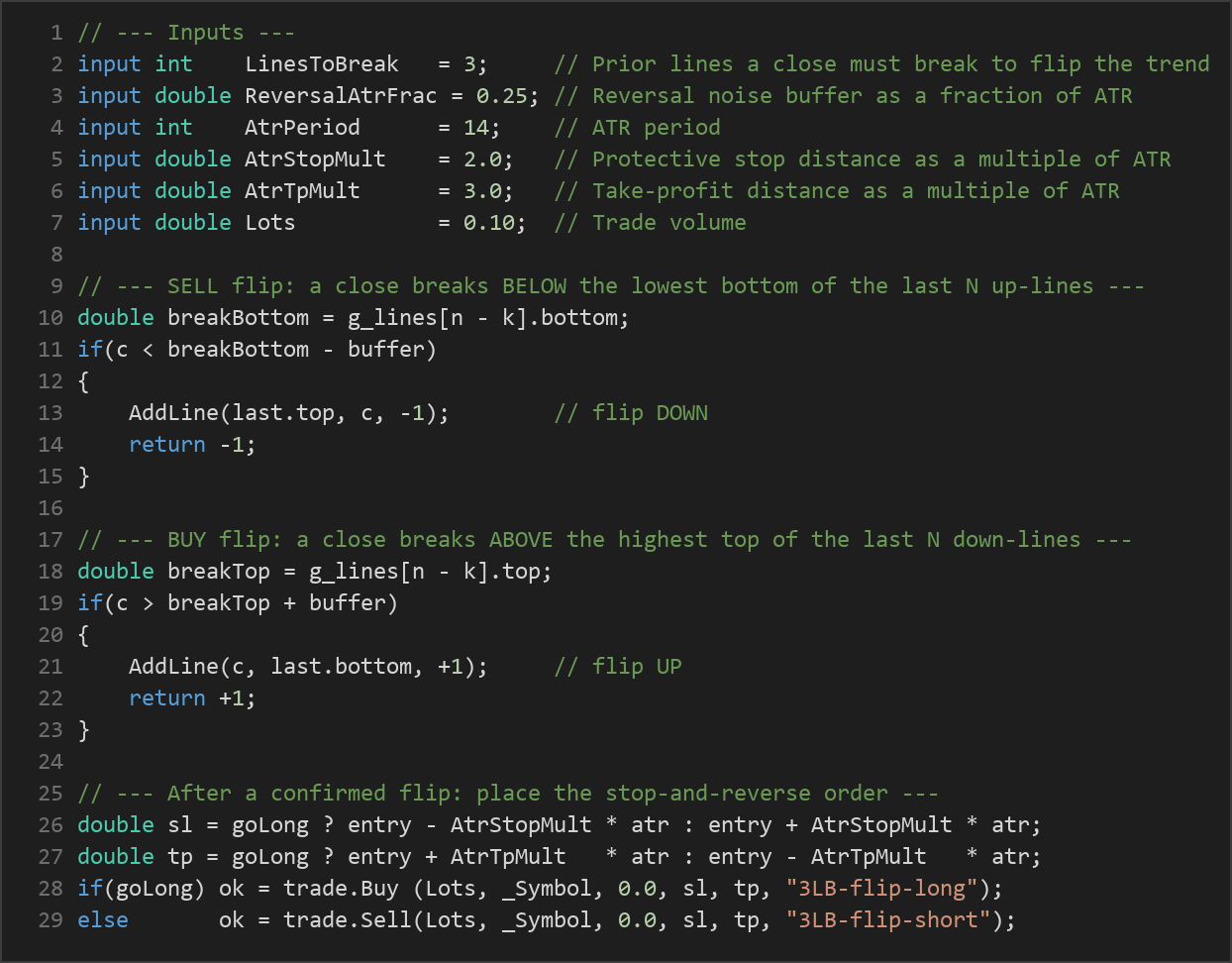
- Noise buffer: The breaking close must clear the reversal level by a fraction of ATR (
ReversalAtrFrac × ATR). This buffer helps require a decisive break rather than a marginal one that barely nudges past the level. - Stop-and-reverse exit: On every flip, the strategy first closes any open position tagged with its magic number, then opens a fresh position in the new direction. This means the system is effectively always positioned — a reversal signal both exits the old trade and enters the new one.
- Stop-loss: A protective stop is placed at a multiple of ATR away from the entry (
AtrStopMult × ATR) — below entry for longs, above entry for shorts — so the risk distance adapts to current volatility. - Take-profit: A take-profit target is set at a separate ATR multiple (
AtrTpMult × ATR). A trade may also be closed early if an opposite flip occurs via the stop-and-reverse logic before either the stop or target is reached.
Because ATR is the only indicator involved, the strategy is deliberately indicator-light: the Three Line Break structure itself does the trend detection, while ATR handles volatility-adaptive sizing.
Strategy Parameters
| Parameter | Default | Min | Max | Description |
|---|---|---|---|---|
| LinesToBreak | 3 | 2 | 5 | How many prior lines a close must break to flip the trend. The classic Three Line Break value is 3; higher values require a more substantial move to reverse. |
| ReversalAtrFrac | 0.25 | 0.0 | 1.5 | Reversal noise buffer. The breaking close must exceed the break level by this fraction of ATR, filtering out marginal breaks. |
| AtrPeriod | 14 | 5 | 30 | The lookback period for the ATR volatility calculation used in the buffer, stop, and target. |
| AtrStopMult | 2.0 | 0.5 | 5.0 | Protective stop-loss distance expressed as a multiple of ATR. |
| AtrTpMult | 3.0 | 0.5 | 8.0 | Take-profit distance expressed as a multiple of ATR. |
| Lots | 0.10 | 0.01 | 1.0 | Trade volume (position size) in lots. |
Recommended Chart Settings
The strategy is single-timeframe and timeframe-agnostic — it reads whatever symbol and timeframe the chart is set to, so it can be evaluated on any combination you choose at backtest time. As a trend-following system, it tends to be more at home on higher timeframes such as H1, H4, or Daily, where individual bar noise is reduced and directional moves are more persistent. Major, liquid instruments — such as widely-traded forex pairs like EUR/USD or GBP/USD — are a sensible starting point for study because their tighter spreads suit an ATR-based stop framework.
Keep in mind that results will vary considerably across different symbols, timeframes, and market conditions. A configuration that behaves well on one instrument during a trending phase may behave very differently during range-bound or highly volatile periods. Always test on your specific broker's data before drawing any conclusions.
How to Install on MetaTrader 5
- Download the .ex5 file from the link below
- Copy it to your MT5
MQL5\Expertsfolder - Restart MetaTrader 5 or refresh the Navigator panel
- Drag the EA onto a chart matching the recommended symbol and timeframe
- Configure the input parameters and enable Algo Trading
What to Consider Before Using This EA
The Three Line Break Reversal has some genuine structural strengths worth understanding. Its main advantage is noise filtering: by discarding closes that fail to make new extremes and requiring a break of several lines to reverse, it aims to stay with a trend through minor pullbacks that would shake out more reactive systems. The ATR-based buffer and stops also mean the strategy adapts to volatility rather than using fixed pip distances, which can help it behave more consistently across changing market conditions.
However, the approach has real limitations you should study carefully. Like all trend-following methods, it is vulnerable to choppy, range-bound markets. When price oscillates without committing to a direction, the multi-line break rule can still trigger repeated flips, each incurring spread and potential whipsaw losses. Because it is a stop-and-reverse system, it is always in the market, so there is no "flat" state to sit out unfavorable conditions — the strategy will keep taking the next flip whether or not conditions are favorable. The reliance on closing prices also means signals arrive only after a bar has closed, which introduces some lag relative to intrabar moves. Finally, the take-profit target may cap gains during strong extended trends, while the stop-and-reverse logic exposes the account to reversals that occur before a target is reached.
None of this makes the strategy good or bad in isolation — it makes it a specific tool with a specific personality. The educational value lies in observing exactly when the Three Line Break structure keeps you aligned with a move and when it repeatedly flips against you.
Risk Management Tips
Regardless of the strategy, sound risk management is what separates disciplined study from reckless speculation. Consider these general principles:
- Position sizing: Size each trade so that a stop-out costs only a small, predefined fraction of your account. A common educational guideline is to risk no more than 1–2% of account equity per trade.
- Respect drawdown: Every strategy experiences losing streaks. Understand the maximum drawdown you could tolerate emotionally and financially before committing real capital.
- Use a demo account first: Test the EA thoroughly on a demo or backtest environment across multiple market conditions before considering any live use. This costs nothing and teaches you how the system behaves.
- Account for costs: Spreads, commissions, and slippage all erode results, especially for a system that reverses frequently. Include realistic costs in any evaluation.
- Avoid over-optimization: Tuning parameters until a backtest looks flawless often produces a fragile fit to past data that fails going forward. Favor robust settings that work reasonably across a range of conditions.
Risk Warning
Trading foreign exchange, CFDs, and other leveraged financial instruments involves substantial risk of loss and is not suitable for all investors. The strategies and tools discussed on this page are provided for educational purposes only and do not constitute financial advice, investment recommendations, or solicitation to trade. Always consult a qualified financial adviser before making trading decisions. Past backtest performance is not indicative of future results.
Downloads
- Expert Advisor: ThreeLineBreakReversal.ex5 (44 downloads)
- Source Code: ThreeLineBreakReversal.mq5 (49 downloads)
- Documentation: ThreeLineBreakReversal.pdf (57 downloads)