Disclaimer: This article is for educational and informational purposes only. It does not constitute financial or investment advice. Trading forex and CFDs carries significant risk of loss. Past performance of any strategy — including backtests — does not guarantee future results. Never trade with money you cannot afford to lose.
What Is This Strategy?
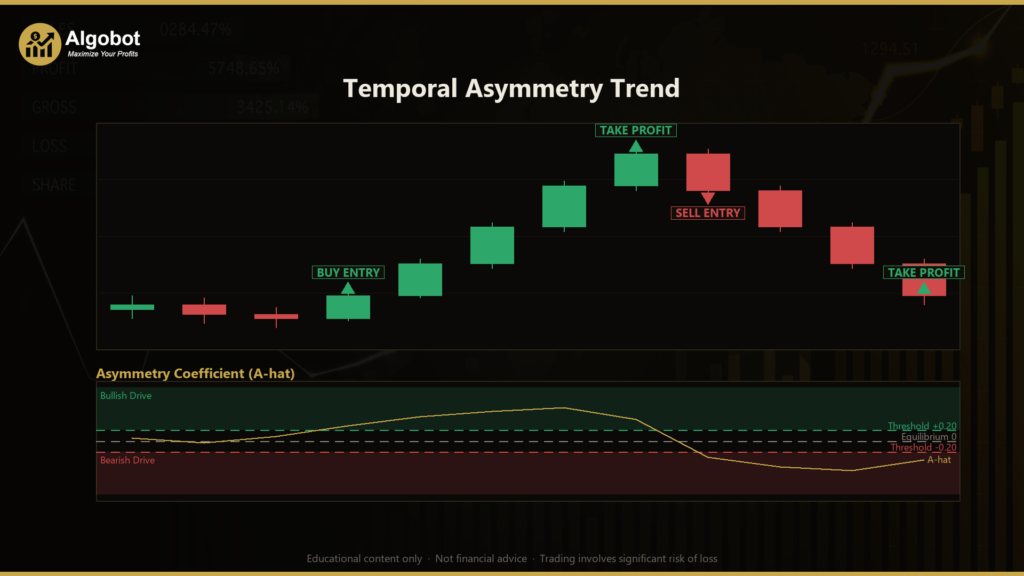
Temporal Asymmetry Trend is a single-timeframe expert advisor (EA) for MetaTrader 5 that builds its trade decisions on a time-irreversibility statistic — a measure borrowed from statistical mechanics — rather than on a conventional indicator, candlestick pattern, or support/resistance level. In plain terms, it studies whether the recent sequence of price returns "looks the same played forwards as it does played backwards." When a market is quietly in balance, its price path is roughly time-reversible and this statistic sits near zero. When persistent buying or selling pressure is driving the market out of balance, the path becomes irreversible, and the sign of that irreversibility is used to point the strategy long or short.
The core calculation, which the code calls the asymmetry coefficient (labelled Ahat), is computed from a rolling window of close-to-close returns. It is then divided by the volatility of those returns so the number becomes dimensionless — comparable across symbols and timeframes. A dynamic Average True Range (ATR) — a standard volatility gauge that measures the typical size of a bar's range — sets the stop-loss and take-profit distances so the same rule adapts to calm or fast markets.
This is best understood as a trend/momentum-style analytical tool, and it is aimed at intermediate traders and students who want to explore an unconventional, first-principles signal. Treat it as a learning instrument for studying market microstructure and momentum concepts — not as a shortcut to returns. As with any systematic approach, its behavior should be examined carefully before it is trusted with real capital.
How It Works
The strategy evaluates one signal per completed bar (it acts only when a new bar opens, so it never reacts to an unfinished candle). On each new bar it rebuilds the window of returns, computes the asymmetry coefficient, and then either manages an open trade or looks for a fresh entry.
- The signal: Over the last N close-to-close returns, the strategy computes
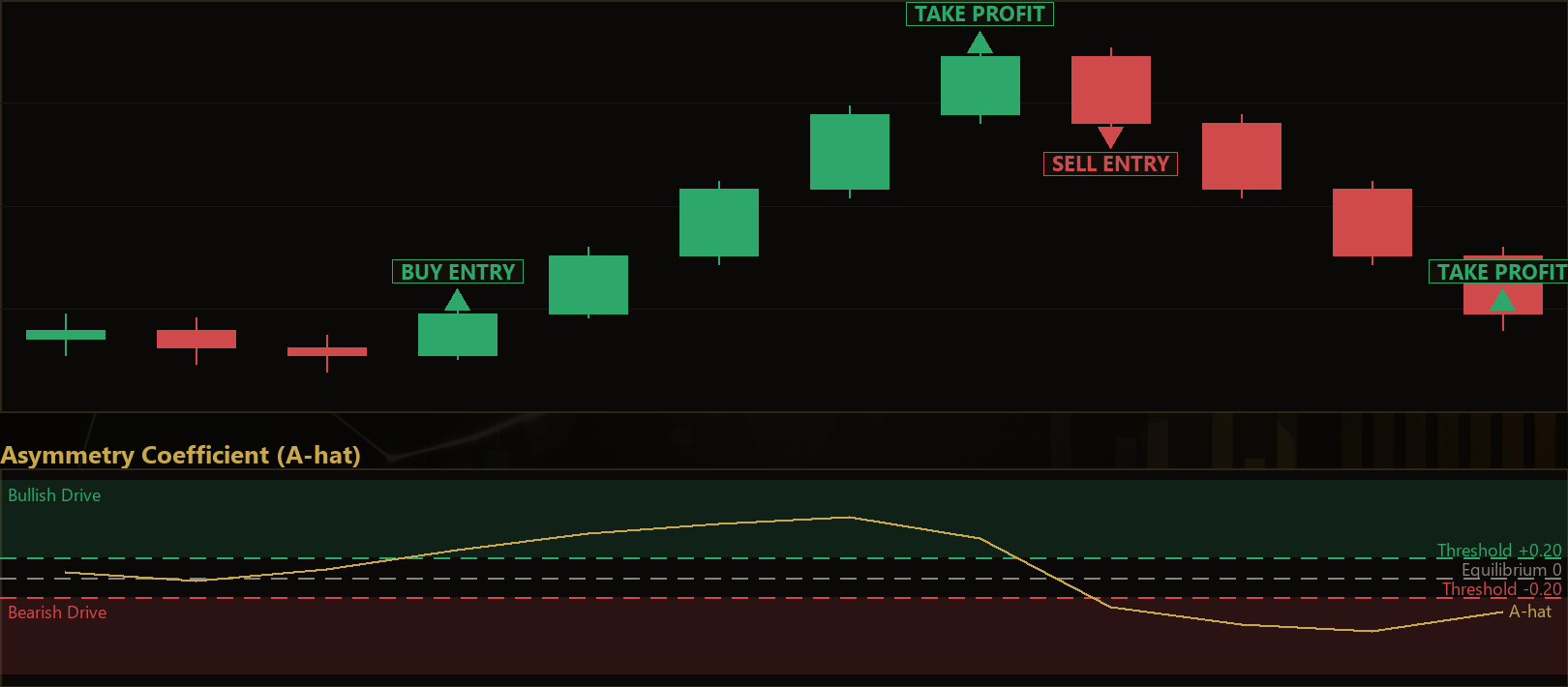
A = mean of [ r_i × r_{i-1} × (r_i − r_{i-1}) ], then scales it by the cube of the return volatility (sigma) to getAhat = A / sigma³. A positive value historically corresponds to an accelerating-up or decelerating-down drive (bullish); a negative value corresponds to an accelerating-down or decelerating-up drive (bearish). - Long entry: The strategy signals a buy when
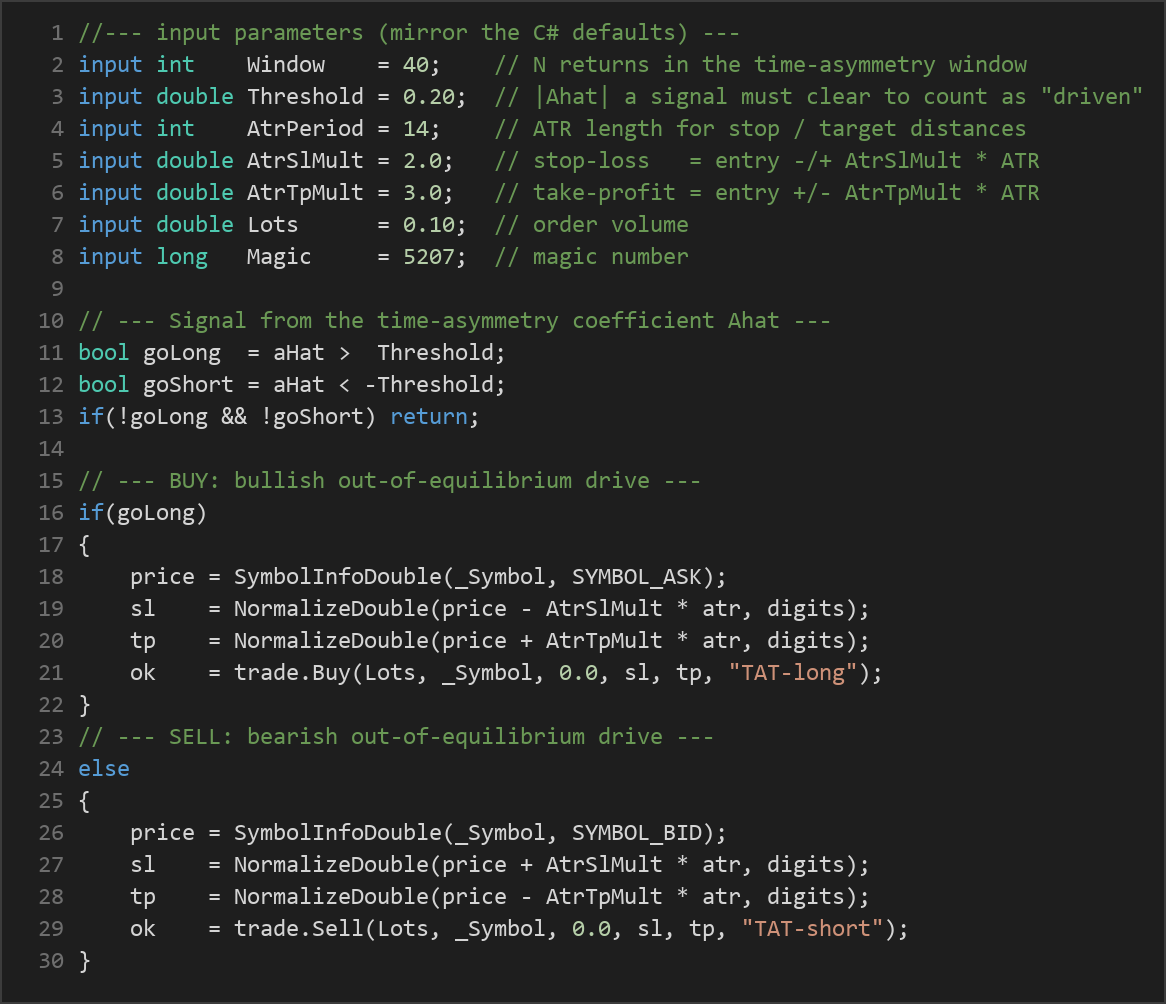
Ahatrises above the positive Threshold, which it interprets as a significant, directed bullish drive. - Short entry: The strategy signals a sell when
Ahatfalls below the negative Threshold, interpreted as a directed bearish drive. - Exit on reversal: If a position is open and
Ahatflips to the opposite sign — a buy whileAhatturns negative, or a sell whileAhatturns positive — the strategy reads this as the drive dissipating or reversing and closes the position. This is the concept-consistent exit built into the logic. - Stop-loss logic: For a long, the stop is placed at
entry − (AtrSlMult × ATR); for a short, atentry + (AtrSlMult × ATR). Because it is tied to ATR, the protective distance widens in volatile conditions and tightens in quiet ones. - Take-profit logic: For a long, the target is
entry + (AtrTpMult × ATR); for a short,entry − (AtrTpMult × ATR). With the default multipliers (2.0 stop, 3.0 target), the target distance is larger than the stop distance. - One position at a time: The EA holds a single position per magic number and does not stack additional trades in the same direction while one is already open.
A built-in guard skips any bar where the return window is completely flat (volatility of zero) or where the math produces an invalid number, so the strategy simply waits for cleaner data instead of forcing a trade.
Strategy Parameters
| Parameter | Default | Min | Max | Description | ||
|---|---|---|---|---|---|---|
| Window | 40 | 15 | 120 | Number of close-to-close returns (N) in the time-asymmetry window. Larger values smooth the signal and react more slowly; smaller values are more sensitive. | ||
| Threshold | 0.20 | 0.05 | 1.0 | The minimum dimensionless ` | Ahat | ` a signal must clear to count as a "driven" market. Higher thresholds demand stronger, rarer signals; lower thresholds trade more often. |
| AtrPeriod | 14 | 7 | 30 | Number of bars used to calculate the ATR that sets stop and target distances. Shorter periods react faster to volatility changes. | ||
| AtrSlMult | 2.0 | 1.0 | 4.0 | Stop-loss distance as a multiple of ATR. Larger values give the trade more room but risk more per position. | ||
| AtrTpMult | 3.0 | 1.0 | 6.0 | Take-profit distance as a multiple of ATR. This sets the reward side of the risk-to-reward ratio. | ||
| Lots | 0.10 | 0.01 | 1.0 | Fixed order volume in lots. Should be sized to your account and risk tolerance. |
Recommended Chart Settings
Temporal Asymmetry Trend is single-timeframe by design — every calculation uses the symbol and period of the chart it is attached to, so the timeframe you select at attach time is the strategy's operating timeframe. There is no hard-coded symbol, which makes it flexible, but the dimensionless nature of the coefficient means it is intended to behave consistently across instruments.
A sensible starting point for study is a liquid major forex pair (for example EUR/USD) on an intraday-to-swing timeframe such as H1 or H4, where clean close-to-close returns and stable ATR readings are easier to obtain. Higher timeframes produce fewer but more considered signals. Whatever you choose, remember that results will vary considerably across different symbols, sessions, and market conditions, and that a setting which looks reasonable on one instrument may behave very differently on another.
How to Install on MetaTrader 5
- Download the .ex5 file from the link below
- Copy it to your MT5
MQL5\Expertsfolder - Restart MetaTrader 5 or refresh the Navigator panel
- Drag the EA onto a chart matching the recommended symbol and timeframe
- Configure the input parameters and enable Algo Trading
What to Consider Before Using This EA
Strengths of the approach. The signal is grounded in a clear first-principles idea — time-reversal symmetry — rather than a curve-fitted pattern, which makes its logic transparent and easy to reason about. Because the coefficient is normalized by volatility, it is symbol- and timeframe-agnostic in construction. The ATR-based stops and targets mean the risk framework self-adjusts to current volatility, and the "exit when the drive reverses" rule keeps the strategy conceptually consistent from entry to exit.
Known limitations. The strategy responds to changes in the drive, not to steady trends: a perfectly constant drift produces a coefficient of zero, so a smooth, quiet trend can be invisible to it while a choppy, accelerating one lights up. Cubic statistics are sensitive to outliers — a single large return can dominate the window and produce an oversized reading, which is why the volatility normalization and Threshold matter so much. In ranging, low-volatility, or noisy conditions, the sign of the coefficient can flip frequently, which may cause the reversal-exit rule to close trades quickly or generate whipsaw entries. The EA also trades a single fixed lot size and does not include news filters, spread controls, or session filters, so those risks must be managed externally.
Where it may underperform. Expect weaker behavior during thin, gap-prone, or headline-driven sessions where returns are erratic, and during tight consolidations where genuine directional drive is absent. As with any threshold-based system, the choice of Window and Threshold strongly shapes how often it trades and how it behaves — these should be studied, not assumed.
Risk Management Tips
Sound risk management matters more than any single signal. Consider these general principles as you study this or any EA:
- Risk a small, fixed fraction per trade. Many educators suggest risking no more than 1–2% of account equity on any single position. Size your Lots so that the ATR-based stop distance translates into that fraction, rather than trading a fixed lot blindly.
- Test on a demo account first. Run the EA on a demo or simulated account across varied conditions before committing real funds, so you understand its trade frequency and behavior.
- Understand drawdown. Every strategy experiences losing streaks. Know the maximum peak-to-trough decline you are willing to tolerate, and stop to reassess if it is reached.
- Diversify and avoid over-leverage. Concentrated, highly leveraged positions amplify both outcomes. Leverage magnifies losses just as it magnifies gains.
- Review parameters periodically. Markets evolve; settings that suited one regime may not suit another. Re-examine your assumptions rather than assuming a fixed configuration will remain appropriate.
Risk Warning
Trading foreign exchange, CFDs, and other leveraged financial instruments involves substantial risk of loss and is not suitable for all investors. The strategies and tools discussed on this page are provided for educational purposes only and do not constitute financial advice, investment recommendations, or solicitation to trade. Always consult a qualified financial adviser before making trading decisions. Past backtest performance is not indicative of future results.
Downloads
- Expert Advisor: TemporalAsymmetryTrend.ex5 (61 downloads)
- Source Code: TemporalAsymmetryTrend.mq5 (78 downloads)
- Documentation: TemporalAsymmetryTrend.pdf (68 downloads)