Disclaimer: This article is for educational and informational purposes only. It does not constitute financial or investment advice. Trading forex and CFDs carries significant risk of loss. Past performance of any strategy — including backtests — does not guarantee future results. Never trade with money you cannot afford to lose.
What Is This Strategy?
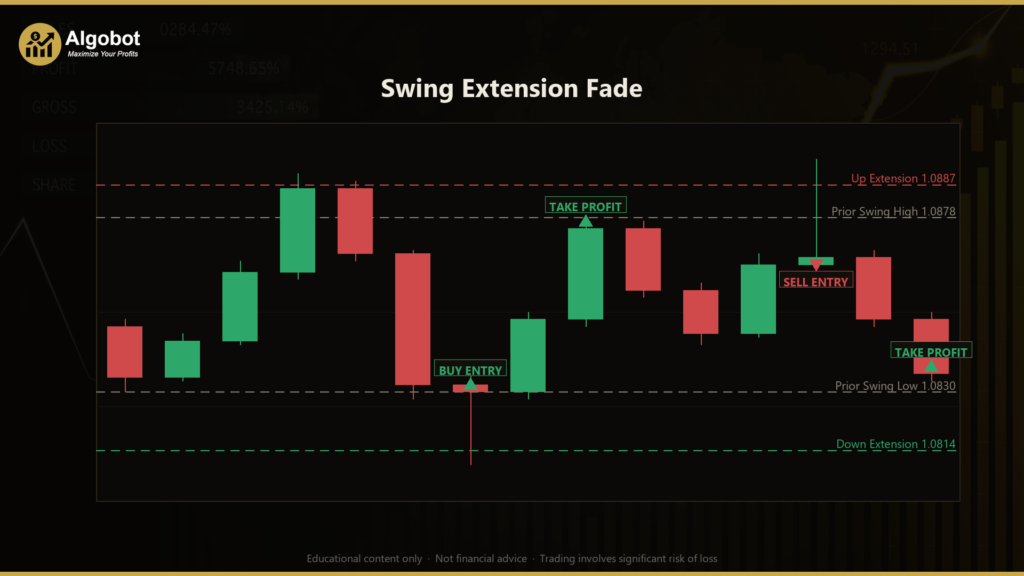
The Swing Extension Fade is a pure price-action, mean-reversion strategy built on fractal swing pivots and measured-move extensions — no oscillators or moving averages drive its signals. A fractal swing pivot is simply a local high or low that stands out from the bars around it (a turning point in the chart). A measured-move extension is a projection that estimates how far price might overshoot once an impulse leg completes, conceptually similar to a 1.27 or 1.618 Fibonacci extension. The strategy's trading style is counter-trend exhaustion fading: it waits for price to stretch beyond a measured target and then "fades" (trades against) that overshoot when a rejection candle appears.
The core idea is that markets tend to travel in impulse legs between swing pivots, and after a fresh leg completes, price frequently pushes past a projected extension before snapping back toward equilibrium. This strategy is designed for that snap-back. It is best suited to ranging or choppy market conditions where price respects structure and reverts to the mean — and it tends to struggle in strong, sustained trends where overshoots simply keep extending.
As a learning tool, the Swing Extension Fade is well suited to traders who want to study swing structure, measured moves, and candlestick rejection patterns without relying on lagging indicators. It demonstrates how to combine objective pivot detection with candle-shape filters and ATR-based risk sizing. Treat it as a framework for understanding mean-reversion logic rather than as a finished, profit-generating system.
How It Works
The Swing Extension Fade builds its setups in stages. Each step below describes what the strategy signals, not a guaranteed outcome:
- Swing detection: The strategy scans for fractal pivots. A bar is confirmed as a swing high or swing low only when it is a strict local extreme with
SwingLookbackbars on each side that do not exceed it. Because confirmation requires bars on both sides, every pivot is confirmedSwingLookbackbars after it actually formed. - Leg measurement: The most recent impulse leg is the distance between the two latest opposite pivots. A prior swing low up to a new swing high is an up-leg; a prior swing high down to a new swing low is a down-leg.
- Extension target: A measured extension is projected beyond the completed leg in the direction of travel. For a long setup, the down-extension sits below the swing high by
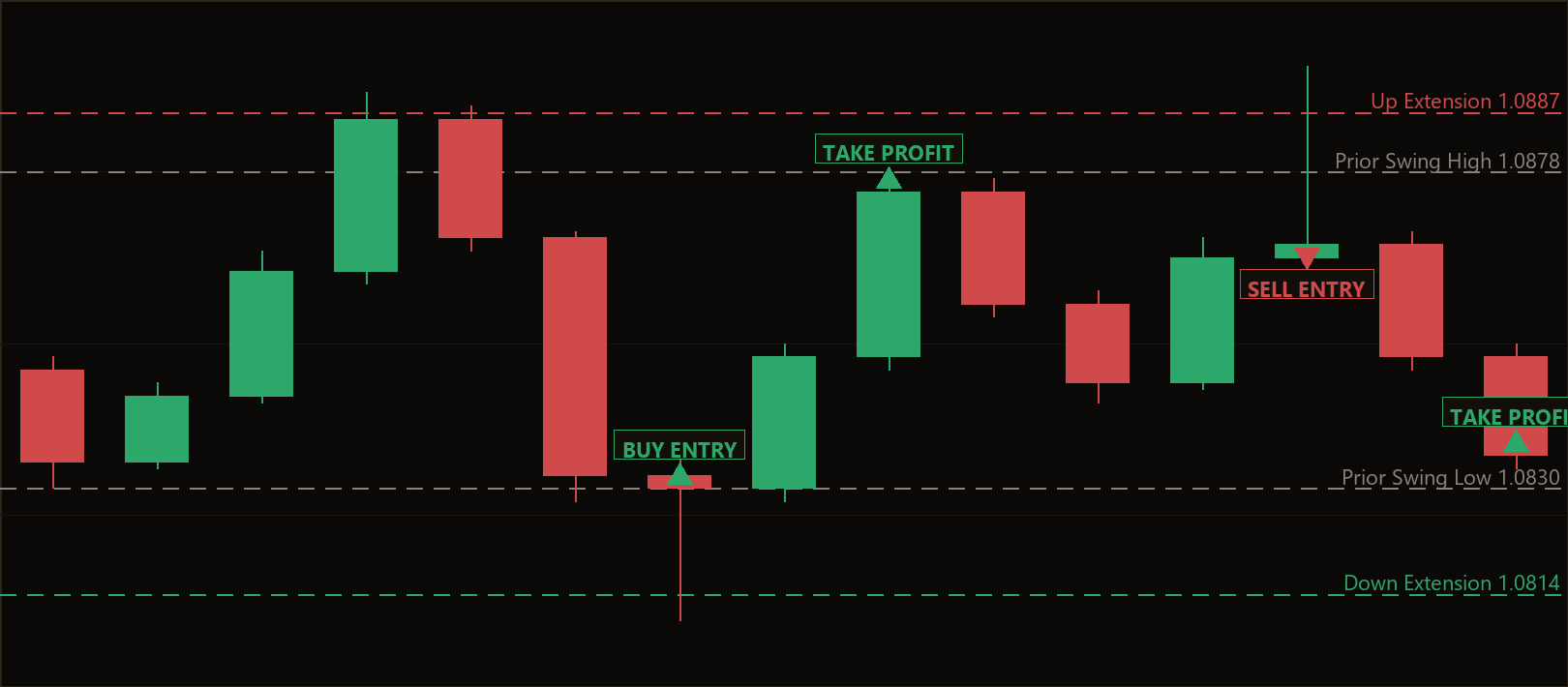
ExtensionFactortimes the leg height. For a short setup, the up-extension sits above the swing low byExtensionFactortimes the leg height. - Long entry signal: After an up-leg completes, the strategy arms a long fade of a subsequent overshoot downward. It signals an entry when a later closed bar dips to or below the down-extension and prints a bullish rejection candle — defined as a lower wick at least
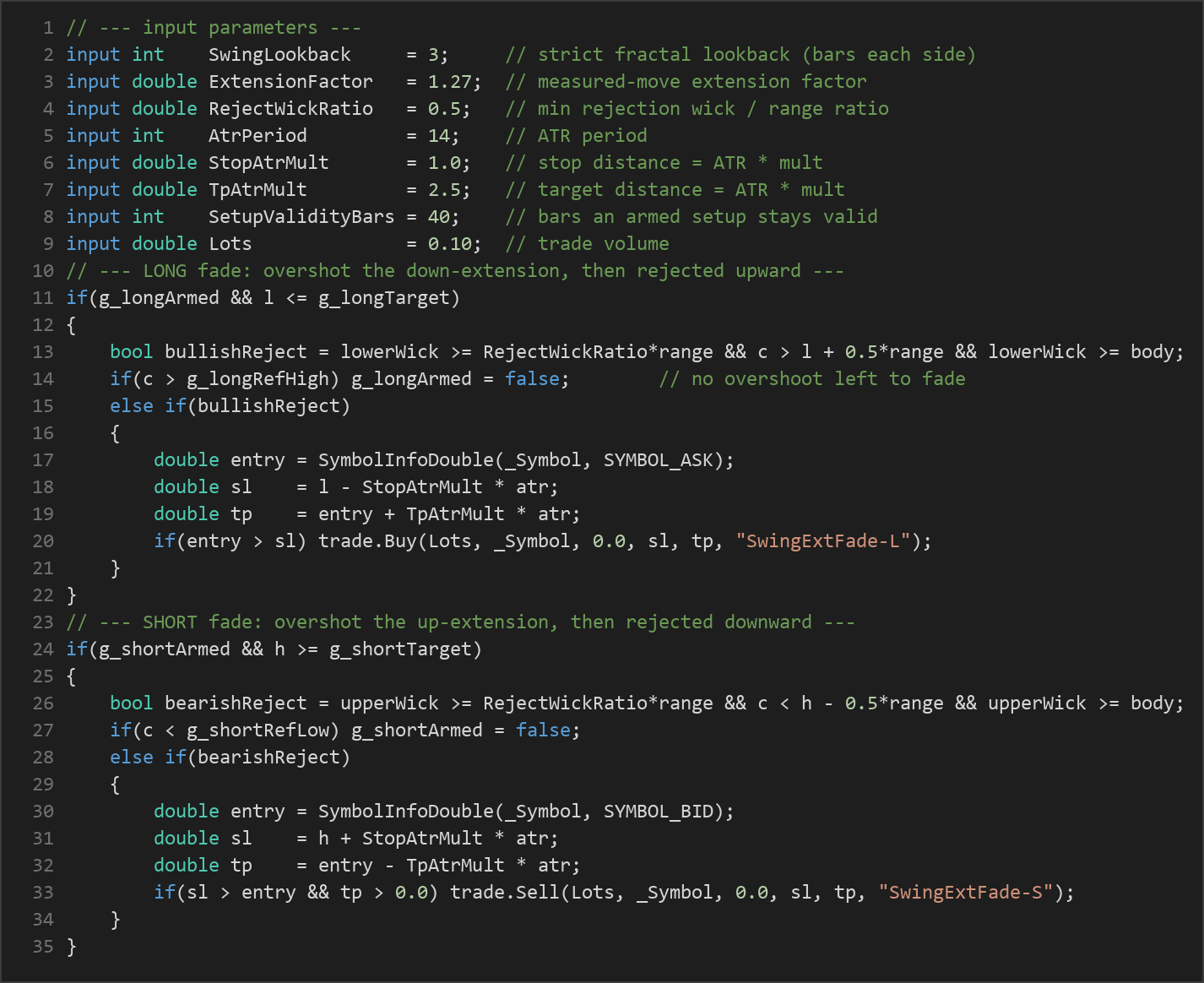
RejectWickRatioof the bar's total range, a close in the upper half of the range, and a lower wick at least as large as the candle body. If price has already closed back above the reference swing high, the setup is cancelled because there is no overshoot left to fade. - Short entry signal: After a down-leg completes, the strategy arms a short fade of a subsequent overshoot upward. It signals an entry when a later closed bar reaches or exceeds the up-extension and prints a bearish rejection candle — an upper wick at least
RejectWickRatioof the range, a close in the lower half of the range, and an upper wick at least as large as the body. If price has already closed back below the reference swing low, the setup is cancelled. - Stop-loss logic: Stops are placed beyond the rejection candle's extreme and padded with volatility. For longs, the stop sits below the rejection bar's low by
StopAtrMulttimes the Average True Range (ATR — a common measure of recent price volatility). For shorts, it sits above the rejection bar's high by the same amount. - Take-profit logic: Targets are a fixed ATR multiple from entry. A long targets entry plus
TpAtrMulttimes ATR; a short targets entry minusTpAtrMulttimes ATR. With the default settings, this produces a wider target than stop. - One trade per setup: Each armed setup is traded only once and automatically expires after
SetupValidityBarsbars if no qualifying trigger appears. The strategy also holds only one open position at a time, so it will not stack trades.
Strategy Parameters
| Parameter | Default | Min | Max | Description |
|---|---|---|---|---|
| SwingLookback | 3 | 2 | 6 | Number of bars required on each side of a pivot to confirm a strict fractal swing high or low. Larger values find fewer, more significant pivots. |
| ExtensionFactor | 1.27 | 1.0 | 2.0 | Measured-move multiplier that projects the extension target beyond the completed leg. Higher values demand a deeper overshoot before a fade is considered. |
| RejectWickRatio | 0.5 | 0.3 | 0.7 | Minimum ratio of the rejection wick to the candle's total range. Higher values require a more pronounced rejection wick. |
| AtrPeriod | 14 | 7 | 30 | Lookback period for the ATR used to size stops and targets. |
| StopAtrMult | 1.0 | 0.5 | 4.0 | Stop-loss distance as a multiple of ATR, placed beyond the rejection candle's extreme. |
| TpAtrMult | 2.5 | 0.5 | 6.0 | Take-profit distance as a multiple of ATR from the entry price. |
| SetupValidityBars | 40 | 10 | 100 | Number of bars an armed setup remains valid before it expires unfilled. |
| Lots | 0.10 | 0.01 | 1.0 | Fixed trade volume in lots. |
Recommended Chart Settings
The Swing Extension Fade is a structure-based mean-reversion strategy, so it is best studied on liquid instruments and clean, intermediate timeframes such as M15, M30, or H1, where swing pivots are well-defined and noise is reduced. Major forex pairs (for example EUR/USD or GBP/USD) are reasonable starting points for educational testing because of their tight spreads and consistent structure.
Because the logic relies on price reverting after an overshoot, the strategy is most at home in ranging or balanced conditions. Results will vary significantly across different symbols, timeframes, and market regimes, and the same parameter set rarely behaves identically on two different instruments. Always evaluate the strategy on the specific market and timeframe you intend to study before drawing any conclusions.
How to Install on MetaTrader 5
- Download the
SwingExtensionFade.ex5file from the link below. - Copy it to your MT5
MQL5\Expertsfolder. - Restart MetaTrader 5 or refresh the Navigator panel.
- Drag the EA onto a chart matching the recommended symbol and timeframe.
- Configure the input parameters and enable Algo Trading.
What to Consider Before Using This EA
Like every approach, the Swing Extension Fade has clear strengths and clear limitations, and understanding both is part of the learning process.
Strengths. The strategy is fully rules-based and transparent — every entry depends on objective swing structure, a measured extension level, and a quantifiable candle-shape filter. Because it uses no oscillators, it avoids the lag that often plagues indicator-driven systems. The ATR-padded stops adapt to current volatility, and the fixed validity window and single-position rule keep exposure contained and easy to reason about.
Known limitations. Fading overshoots is, by nature, counter-trend trading. In strong, trending markets a "completed" leg can keep extending well past the projected target, and a rejection candle may form only briefly before the trend resumes — leading to losing trades that hit their stops. The strategy is therefore most vulnerable during breakouts, news-driven momentum, and sustained directional runs. Because pivots are confirmed only SwingLookback bars after they form, there is also an inherent delay between a real turning point and the moment a setup becomes armed.
Conditions where it may underperform. Expect weaker behaviour in low-liquidity sessions, on instruments with erratic spreads, and during high-impact economic releases when wicks and ranges become unpredictable. The rejection-candle filter helps screen out some poor entries, but no filter eliminates false signals. Mean reversion can also experience long sequences of small losses while waiting for the snap-backs that the logic depends on, so patience and realistic expectations are essential.
Risk Management Tips
Sound risk management matters more than any single entry signal. Consider these general principles as you study the strategy:
- Risk a small, fixed fraction per trade. Many educational sources suggest risking no more than 1–2% of account equity on any single position, so that a string of losses does not threaten your capital.
- Size positions to your stop, not the other way around. The default
Lotsvalue is fixed; align your lot size with your stop distance and account size rather than trading an arbitrary volume. - Test on a demo account first. Use a demo or simulated environment to understand how the strategy behaves across different conditions before considering any live use.
- Understand drawdown. Every strategy experiences losing streaks. Review the maximum drawdown you would have to tolerate and confirm it is acceptable to you, both financially and emotionally.
- Account for costs. Spreads, commissions, and slippage all affect outcomes, especially for a strategy that trades against momentum. Factor realistic costs into any evaluation.
- Avoid over-optimisation. Tuning parameters until past results look ideal often produces a curve-fit that fails on new data. Favour robust settings that perform reasonably across a range of conditions.
Risk Warning
Trading foreign exchange, CFDs, and other leveraged financial instruments involves substantial risk of loss and is not suitable for all investors. The strategies and tools discussed on this page are provided for educational purposes only and do not constitute financial advice, investment recommendations, or solicitation to trade. Always consult a qualified financial adviser before making trading decisions. Past backtest performance is not indicative of future results.
Downloads
- Expert Advisor: SwingExtensionFade.ex5 (65 downloads)
- Source Code: SwingExtensionFade.mq5 (65 downloads)
- Documentation: SwingExtensionFade.pdf (65 downloads)