Disclaimer: This article is for educational and informational purposes only. It does not constitute financial or investment advice. Trading forex and CFDs carries significant risk of loss. Past performance of any strategy — including backtests — does not guarantee future results. Never trade with money you cannot afford to lose.
What Is This Strategy?
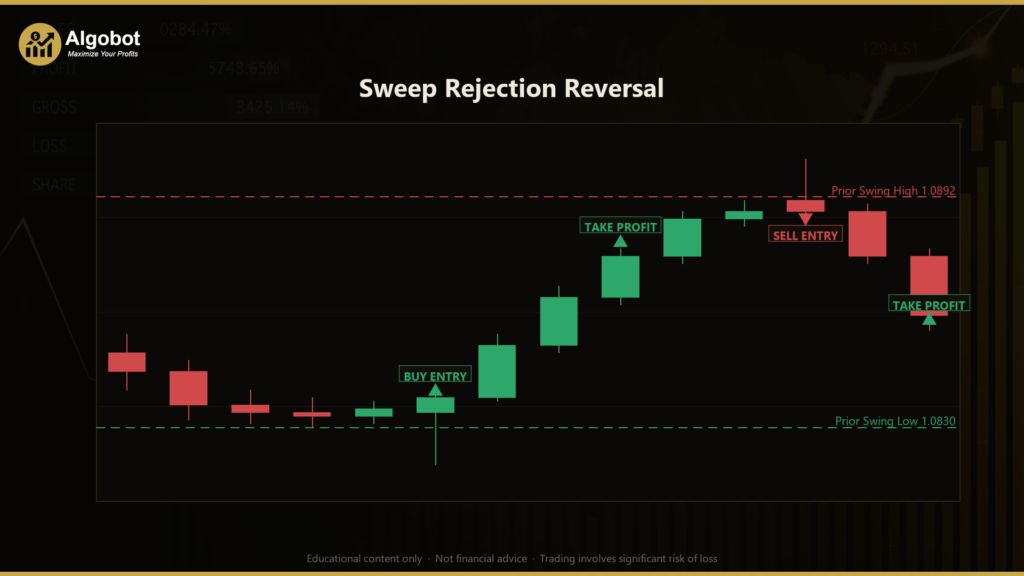
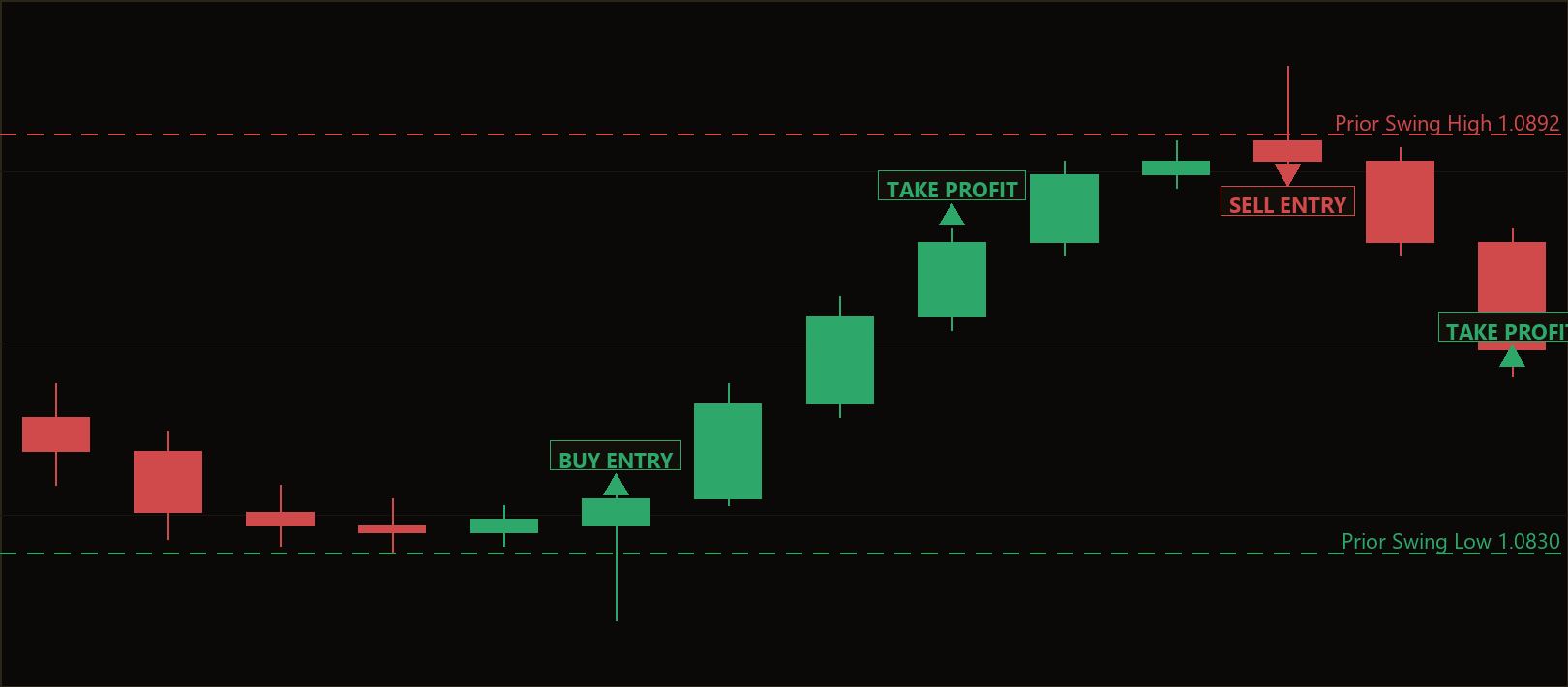
The Sweep Rejection Reversal is a pure price-action reversal strategy built on two well-known concepts: the liquidity sweep (also called a stop-hunt) and the rejection candle (commonly known as a pin bar). A liquidity sweep occurs when price briefly pokes beyond a recent support or resistance level — just far enough to trigger the resting stop-loss orders clustered there — before snapping back. A rejection candle is a bar with a long wick and a small body, showing that the move beyond the level was firmly refused by the market.
Unlike many automated systems, this strategy uses no indicators at all. Every decision is derived from raw open-high-low-close (OHLC) candle geometry. The Expert Advisor (EA) looks at the most recent swing high and swing low, watches for a candle that sweeps one of those levels and then closes back on the original side with a long rejection wick, and treats that as a failed breakout — the classic "stop-hunt then snap back" pattern that often precedes a short-term reversal.
This makes the Sweep Rejection Reversal a useful learning tool for traders who want to study counter-trend and mean-reversion price action in a transparent, rules-based form. Because stops and targets are calculated from the trigger bar's own range, the logic is fully timeframe-agnostic and can be studied on whatever timeframe you select. It is best suited to intermediate students who already understand basic candle anatomy and want to see how a discretionary "liquidity grab" idea can be encoded into objective, repeatable rules.
How It Works
The strategy evaluates only the most recently completed candle (shift 1) once per bar, which avoids repainting and ensures signals are based on finalized data. It looks for one of two mirror-image setups.
Defining the level (support / resistance):
- The strategy scans the prior
Lookbackbars (default 12) to find the highest high and lowest low. These become the resistance and support levels that may be swept.
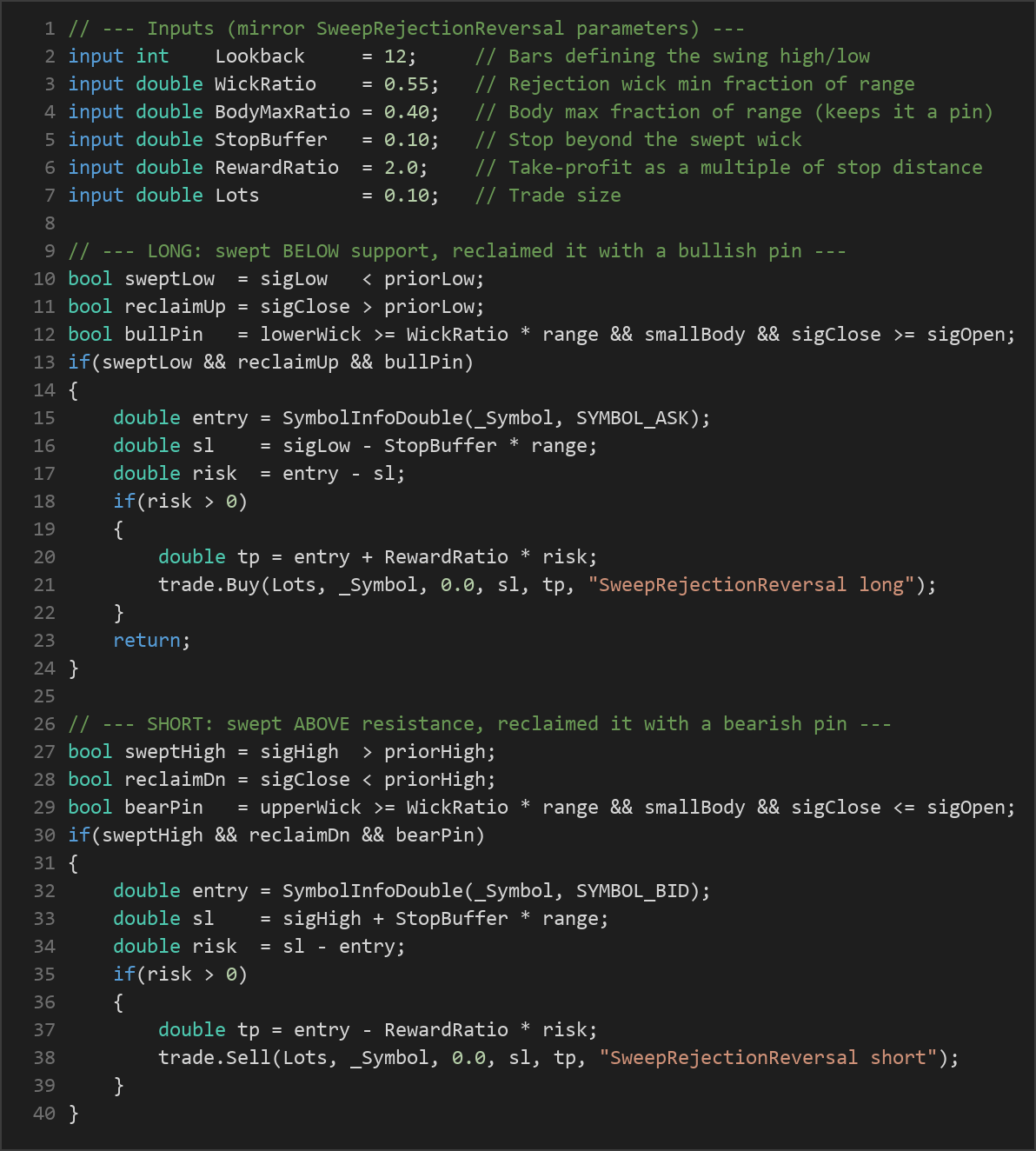
Long (bullish) entry — the strategy signals a buy when all of these are true:
- The trigger bar's low dips below the recent swing low (the resting stops under support were swept).
- The trigger bar closes back above that swing low (price reclaimed the level).
- The bar is a bullish rejection pin: the lower wick is at least
WickRatioof the bar's total range, the body is no larger thanBodyMaxRatioof the range, and the close is at or above the open.
Short (bearish) entry — the strategy signals a sell when all of these are true:
- The trigger bar's high pushes above the recent swing high (the stops above resistance were swept).
- The trigger bar closes back below that swing high (price was rejected from the level).
- The bar is a bearish rejection pin: the upper wick is at least
WickRatioof the range, the body is no larger thanBodyMaxRatioof the range, and the close is at or below the open.
Stop-loss logic:
- For longs, the stop is placed just below the trigger bar's low, padded by
StopBuffer× the bar's range. - For shorts, the stop is placed just above the trigger bar's high, padded by the same buffer.
- Placing the stop beyond the swept wick means the trade is invalidated only if price genuinely breaks back through the level that was just defended.
Take-profit logic:
- The take-profit distance is set as a multiple of the stop distance, controlled by
RewardRatio(default 2.0). With the default, the strategy targets twice the risk, giving a 1:2 risk-to-reward profile.
Trade management:
- Only one position at a time is allowed per the strategy's magic number, so signals are ignored while a trade is already open. There is no pyramiding or averaging in.
Strategy Parameters
| Parameter | Default | Min | Max | Description |
|---|---|---|---|---|
| Lookback | 12 | 5 | 40 | Number of prior bars used to define the swing high/low that acts as support/resistance. Higher values reference larger, less frequent levels. |
| WickRatio | 0.55 | 0.40 | 0.80 | Minimum size of the rejection wick as a fraction of the trigger bar's total range. Higher values demand a more pronounced rejection. |
| BodyMaxRatio | 0.40 | 0.20 | 0.60 | Maximum body size as a fraction of the range, keeping the signal a pin bar rather than a full-bodied candle. Lower values are stricter. |
| StopBuffer | 0.10 | 0.00 | 0.50 | Extra distance, as a fraction of the trigger range, placed beyond the swept wick when setting the stop-loss. |
| RewardRatio | 2.0 | 1.0 | 4.0 | Take-profit distance expressed as a multiple of the stop distance (risk-to-reward ratio). |
| Lots | 0.10 | 0.01 | 1.0 | Fixed trade size in lots for each position. |
Recommended Chart Settings
Because the Sweep Rejection Reversal derives all of its stops and targets from the trigger bar's own range, it is timeframe-agnostic and will run on whatever symbol and timeframe you attach it to. As a starting point for study, many price-action traders examine pin-bar and liquidity-sweep patterns on the H1 (1-hour) or H4 (4-hour) charts of liquid major forex pairs such as EUR/USD or GBP/USD, where swing highs and lows tend to be cleaner and spreads are tighter.
That said, the optimal settings are not fixed. The behaviour of the pattern can differ greatly between a quiet ranging market and a strongly trending one, and between volatile and calm sessions. Treat any timeframe or symbol choice as a hypothesis to be tested in the Strategy Tester, and expect results to vary across different market conditions.
How to Install on MetaTrader 5
- Download the .ex5 file from the link below.
- Copy it to your MT5
MQL5\Expertsfolder. - Restart MetaTrader 5 or refresh the Navigator panel.
- Drag the EA onto a chart matching the recommended symbol and timeframe.
- Configure the input parameters and enable Algo Trading.
What to Consider Before Using This EA
Strengths. The strategy is transparent and easy to reason about — there are no lagging indicators, no curve-fit thresholds buried in calculations, just clear OHLC geometry. The liquidity-sweep-plus-rejection concept it encodes is one of the more durable price-action ideas, reflecting real order-flow behaviour as stops are triggered and breakouts fail. Risk is defined on every trade: the stop sits beyond a structurally meaningful level, and the reward is a fixed multiple of that risk.
Known limitations. Reversal strategies, by definition, trade against the immediate move, so they can struggle badly in strong, persistent trends where levels are swept and then continue rather than reverse. A "failed breakout" can itself fail. The strict pin-bar filters (wick and body ratios) mean valid-looking setups are sometimes skipped, and the one-position-at-a-time rule means the EA may sit idle through clusters of opportunity. Because entries fill at the next available price after the signal bar closes, slippage and spread can erode the modelled risk-to-reward, especially on lower timeframes.
Where it may underperform. Low-liquidity periods, news spikes, and choppy markets with no clear swing structure can all generate misleading sweeps. The fixed Lots sizing does not adapt to account equity or volatility, so position risk in currency terms varies from trade to trade. None of this means the idea is unsound — it means the strategy should be studied, stress-tested, and understood before any consideration of live use.
Risk Management Tips
Sound risk management matters more than any single entry signal. Consider these general principles as part of your education:
- Risk a small, fixed fraction per trade. Many educators suggest risking no more than 1–2% of account equity on any single position, and sizing your lots accordingly rather than using a fixed lot blindly.
- Test on a demo account first. Run the EA on a demo or in the MT5 Strategy Tester across varied market conditions and timeframes before risking any real capital.
- Understand drawdown. Even a logically sound strategy will experience losing streaks. Study the maximum drawdown a parameter set produced historically and ask whether you could tolerate it emotionally and financially.
- Account for costs. Include realistic spread, commission, and slippage in any testing, since these directly reduce the effective reward-to-risk ratio.
- Never over-leverage. Leverage magnifies both gains and losses; keep it conservative while you are still learning how the strategy behaves.
Risk Warning
Trading foreign exchange, CFDs, and other leveraged financial instruments involves substantial risk of loss and is not suitable for all investors. The strategies and tools discussed on this page are provided for educational purposes only and do not constitute financial advice, investment recommendations, or solicitation to trade. Always consult a qualified financial adviser before making trading decisions. Past backtest performance is not indicative of future results.
Downloads
- Expert Advisor: SweepRejectionReversal.ex5 (56 downloads)
- Source Code: SweepRejectionReversal.mq5 (60 downloads)
- Documentation: SweepRejectionReversal.pdf (57 downloads)