Disclaimer: This article is for educational and informational purposes only. It does not constitute financial or investment advice. Trading forex and CFDs carries significant risk of loss. Past performance of any strategy — including backtests — does not guarantee future results. Never trade with money you cannot afford to lose.
What Is This Strategy?
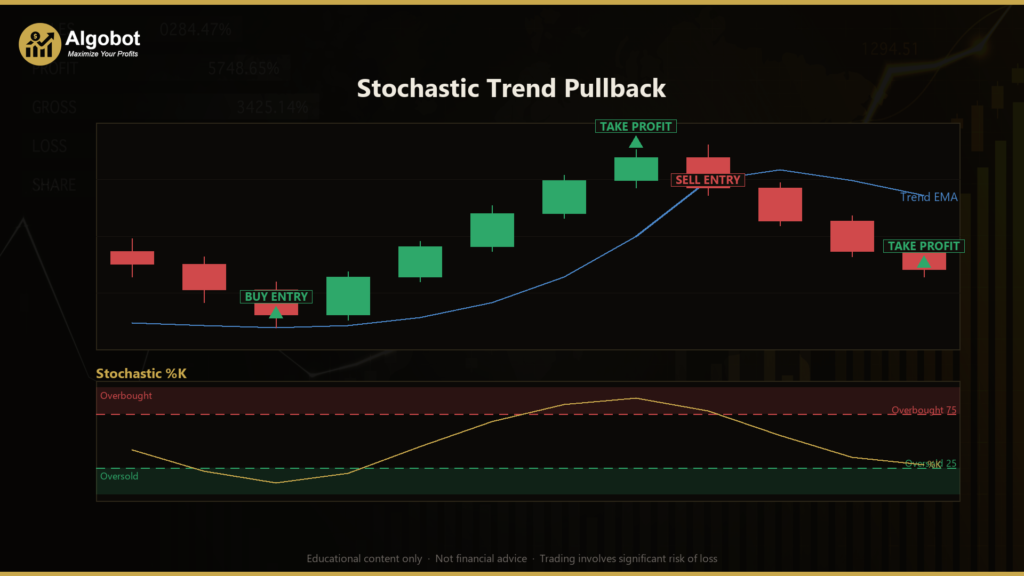
The Stochastic Trend Pullback is a trend-following pullback system that combines the slow Stochastic oscillator with an exponential moving average (EMA) trend filter to time re-entries after a shallow counter-trend dip. The Stochastic oscillator is a momentum indicator that measures where the current close sits relative to the high-low range over a lookback period, producing a value between 0 and 100. This strategy uses that reading not to fade the trend, but to buy dips in an uptrend and sell rallies in a downtrend.
The core idea it teaches is simple: strong trends rarely move in a straight line. They pause, pull back against the prevailing direction, and then resume. A raw oscillator strategy that buys every oversold reading gets repeatedly punished during trends because it keeps betting against momentum. The Stochastic Trend Pullback addresses this by adding a directional gate — an EMA of closing prices — that only permits trades in the direction of the larger trend. The oscillator's job is reduced to timing, not direction.
As a learning tool, this strategy is well suited to traders who want to understand how to layer a momentum trigger on top of a trend filter, and how ATR-based risk controls (Average True Range, a volatility measure) can standardize stops, targets, and trailing exits. It is best studied as an example of disciplined signal filtering rather than viewed as a shortcut. Treat the sections below as an analysis of how the logic behaves, not as a claim about outcomes.
How It Works
The strategy evaluates its logic once per newly closed bar on a single (primary) timeframe. All indicators — the EMA trend filter, the Stochastic %K and %D lines, and the ATR — are computed from raw price data on that same timeframe.
Trend filter (direction gate):
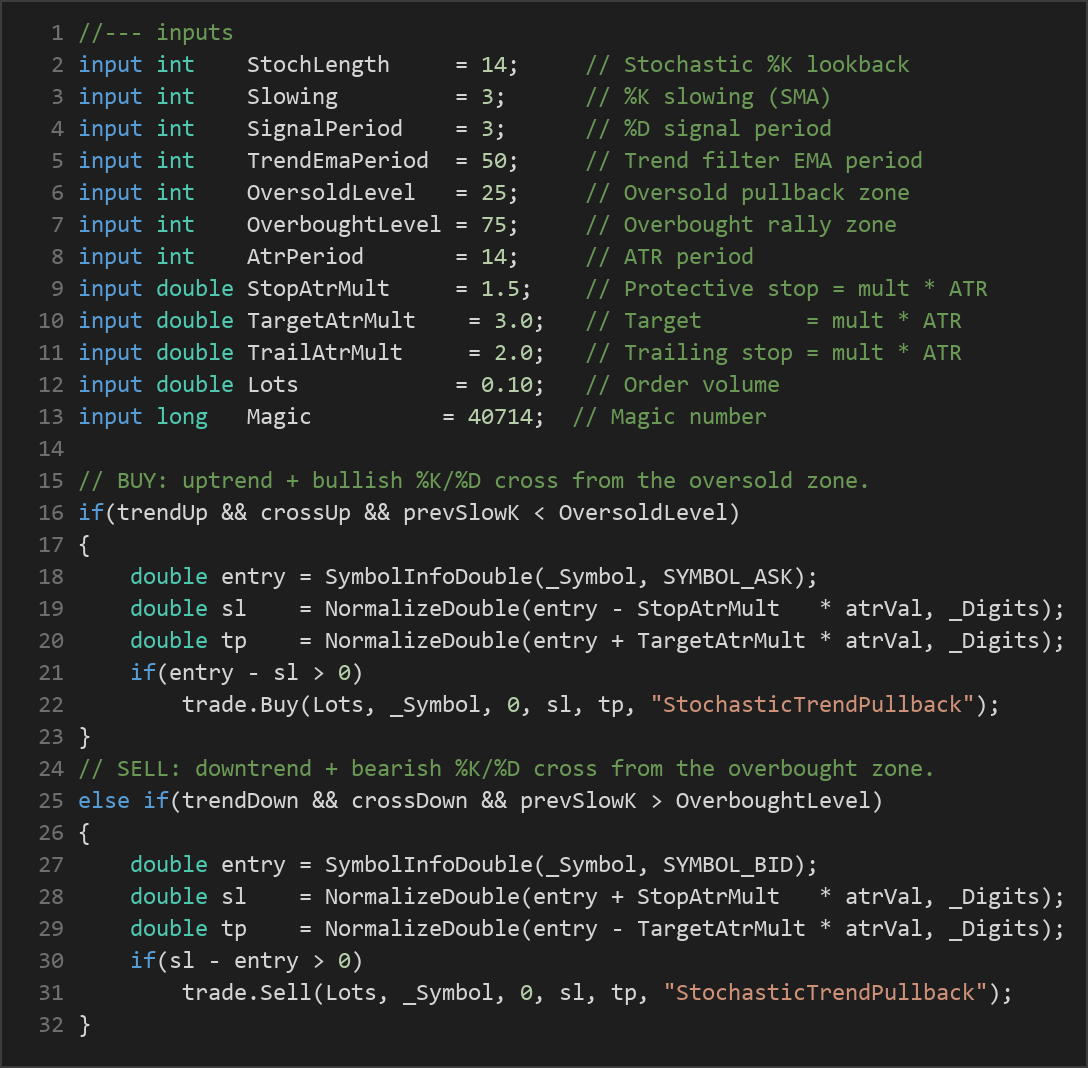
- The strategy computes an EMA of closing prices over the
TrendEmaPeriod. - If the closed bar's price is above the EMA, only long (buy) setups are allowed.
- If price is below the EMA, only short (sell) setups are allowed.
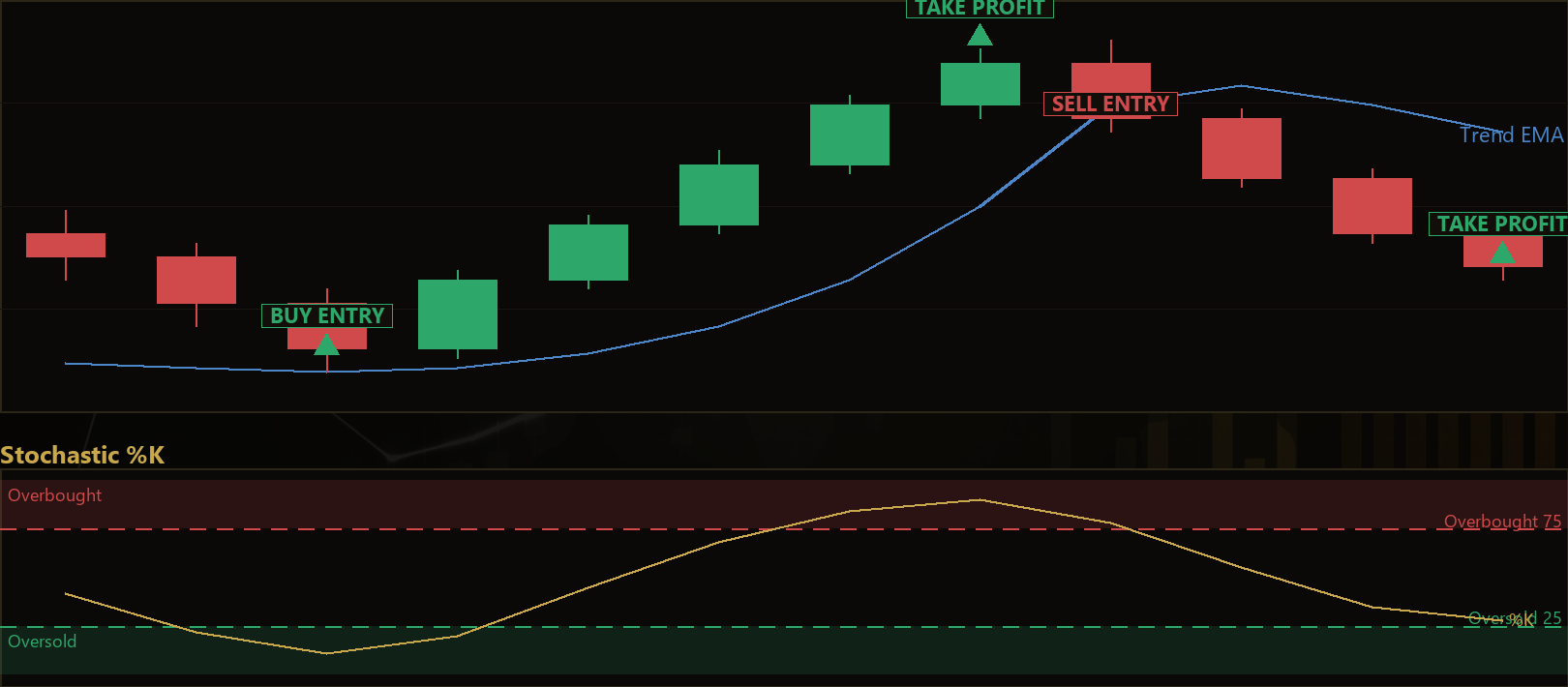
Entry conditions — the strategy signals a BUY when:
- The trend is up (close is above the EMA), and
- The slow %K line had recently dipped below the
OversoldLevel— the pullback into the oversold zone, and - The %K line then crosses back up through the %D signal line, indicating momentum is turning back in the direction of the trend.
Entry conditions — the strategy signals a SELL when:
- The trend is down (close is below the EMA), and
- The slow %K line had recently rallied above the
OverboughtLevel— the pullback into the overbought zone, and - The %K line then crosses back down through the %D signal line.
Stop-loss logic:
- On entry, a protective stop is placed at a fixed ATR distance from the entry price:
StopAtrMult × ATRbelow a buy, or above a sell. - This ties the risk on every trade to current market volatility rather than a fixed pip amount.
Take-profit logic:
- A fixed target is set at
TargetAtrMult × ATRfrom entry. - With the default settings (stop at 1.5× ATR, target at 3.0× ATR), the intended reward is larger than the risk — a reward-to-risk structure greater than 1:1.
Trade management (ATR trailing stop):
- Once a position moves into profit, a per-bar ATR trailing stop activates at a distance of
TrailAtrMult × ATRfrom current price. - The trailing stop only ever tightens toward price — it locks in gains and never loosens.
- Only one position per magic number is allowed open at a time, so the strategy never stacks trades.
Strategy Parameters
| Parameter | Default | Min | Max | Description |
|---|---|---|---|---|
| StochLength | 14 | 5 | 30 | Lookback period for the Stochastic %K high-low range |
| Slowing | 3 | 1 | 10 | Smoothing (SMA) applied to raw %K to produce the slowed %K line |
| SignalPeriod | 3 | 1 | 10 | Period of the %D signal line (SMA of the slowed %K) |
| TrendEmaPeriod | 50 | 20 | 200 | Period of the EMA trend filter that gates trade direction |
| OversoldLevel | 25 | 10 | 40 | %K threshold defining the oversold pullback zone for buys |
| OverboughtLevel | 75 | 60 | 90 | %K threshold defining the overbought rally zone for sells |
| AtrPeriod | 14 | 5 | 30 | Lookback period for the ATR volatility measure |
| StopAtrMult | 1.5 | 0.5 | 4.0 | Protective stop distance as a multiple of ATR |
| TargetAtrMult | 3.0 | 1.0 | 6.0 | Take-profit distance as a multiple of ATR |
| TrailAtrMult | 2.0 | 0.5 | 5.0 | Trailing-stop distance as a multiple of ATR |
| Lots | 0.10 | 0.01 | 1.0 | Fixed order volume in lots |
Recommended Chart Settings
This strategy was designed to run on a single primary timeframe, using whichever symbol and timeframe you attach it to. Because the logic evaluates on each closed bar and relies on a 50-period EMA trend filter by default, intermediate timeframes such as the H1 (1-hour) or H4 (4-hour) charts on liquid major forex pairs are a reasonable starting point for study — they produce enough bars for the trend filter and Stochastic to warm up while keeping the number of signals manageable.
That said, the behavior of any trend-plus-oscillator system changes meaningfully across instruments and timeframes. Trending markets suit the design; choppy, range-bound conditions do not. Results will vary across different market conditions, so treat any single chart setting as a starting point for testing rather than a fixed recommendation.
How to Install on MetaTrader 5
- Download the .ex5 file from the link below
- Copy it to your MT5
MQL5\Expertsfolder - Restart MetaTrader 5 or refresh the Navigator panel
- Drag the EA onto a chart matching the recommended symbol and timeframe
- Configure the input parameters and enable Algo Trading
What to Consider Before Using This EA
Strengths of this approach. The most valuable idea in the Stochastic Trend Pullback is the way the EMA filter removes the counter-trend signals that plague a raw Stochastic. By only trading in the trend's direction and waiting for a pullback-and-cross, the strategy aims for entries near a swing extreme, which allows a tighter stop and a more favourable reward-to-risk footprint. Its ATR-based stops, targets, and trailing logic also adapt automatically to changing volatility, which is more robust than fixed pip distances.
Known limitations. No trend filter is perfect. In sideways or ranging markets, price whipsaws around the EMA, and the strategy can generate signals in a "trend" that reverses almost immediately — a classic weakness of moving-average filters. The Stochastic itself can remain pinned in overbought or oversold territory during strong momentum, so a valid pullback signal may never arrive, or may arrive late. Because only one position is allowed at a time, the strategy also sits out additional opportunities while a trade is open.
Where it may underperform. Expect the most difficulty during low-volatility consolidation, during sharp news-driven reversals that gap through the ATR stop, and around major economic releases. The fixed-lot sizing does not scale to account equity, so risk per trade in currency terms stays constant even as your balance changes. Study these behaviors on historical data and a demo account before drawing any conclusions.
Risk Management Tips
Sound risk management matters far more than any single entry signal. Consider these general principles as you study this strategy:
- Risk a small, fixed fraction per trade. A common educational guideline is to risk no more than 1–2% of account equity on any single position. Because this EA uses a fixed lot size, you may need to adjust the
Lotsvalue so that the ATR-based stop distance corresponds to that fraction of your account. - Understand your drawdown tolerance. Even a well-structured strategy will experience losing streaks. Know how large a peak-to-trough decline you can accept before you deploy any system.
- Always test on a demo account first. Run the strategy in a risk-free simulated environment until you understand exactly how it enters, exits, and trails — before considering any live capital.
- Account for spread and slippage. ATR-based stops and targets can be small on lower timeframes; make sure the spread and execution costs of your broker do not overwhelm the intended reward-to-risk.
- Never trade money you cannot afford to lose, and treat leverage with respect — it magnifies losses as much as gains.
Risk Warning
Trading foreign exchange, CFDs, and other leveraged financial instruments involves substantial risk of loss and is not suitable for all investors. The strategies and tools discussed on this page are provided for educational purposes only and do not constitute financial advice, investment recommendations, or solicitation to trade. Always consult a qualified financial adviser before making trading decisions. Past backtest performance is not indicative of future results.
Downloads
- Expert Advisor: StochasticTrendPullback.ex5 (61 downloads)
- Source Code: StochasticTrendPullback.mq5 (62 downloads)
- Documentation: StochasticTrendPullback.pdf (61 downloads)