Disclaimer: This article is for educational and informational purposes only. It does not constitute financial or investment advice. Trading forex and CFDs carries significant risk of loss. Past performance of any strategy — including backtests — does not guarantee future results. Never trade with money you cannot afford to lose.
What Is This Strategy?
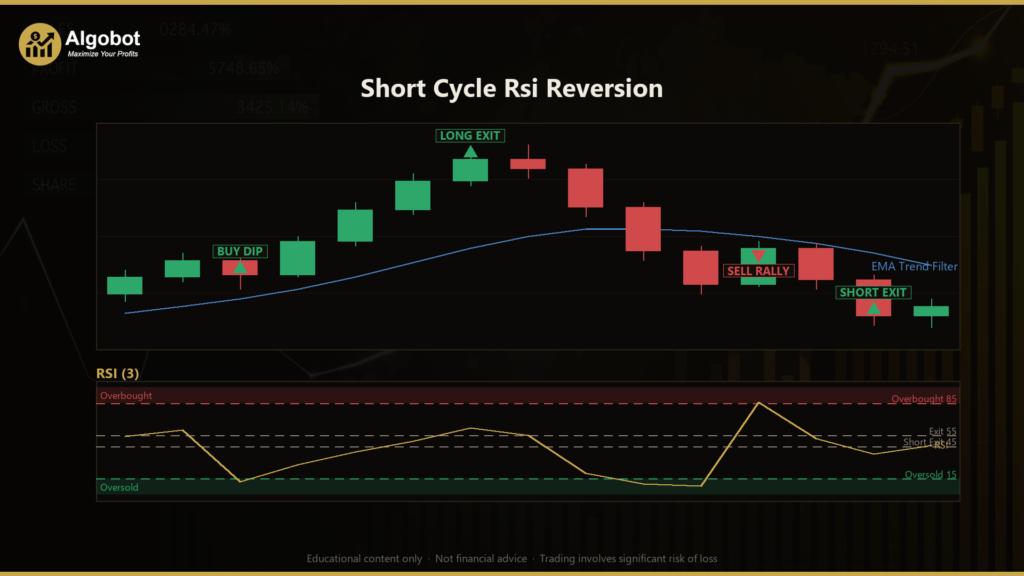
The Short Cycle Rsi Reversion strategy is a trend-aligned mean-reversion system for MetaTrader 5 that combines a long-period Exponential Moving Average (EMA) trend filter with a very short-period Relative Strength Index (RSI) timing trigger. In plain terms, it is a trend-following idea at heart, but it uses a fast oscillator to time its entries — waiting to join the dominant move only when a temporary counter-move looks exhausted.
The core premise is that a healthy trend rarely travels in a straight line. Instead, it advances in impulses and then pauses to catch its breath. Those pauses show up as shallow, counter-trend pullbacks. The strategy is designed to treat those pullbacks as the lower-risk moments to align with the prevailing direction, rather than fading strength blindly — an approach that naive oscillator systems often struggle with. Concretely, it only looks to buy dips inside an established uptrend and only looks to sell rallies inside an established downtrend. The dominant trend provides the directional bias; the short-cycle RSI merely times when to act.
As a learning tool, this strategy is well suited to traders who want to study how to combine a directional filter with a counter-trend entry signal. It illustrates a common professional concept: separating the question of which way to trade (the trend filter) from the question of when to enter (the oscillator). It is not a profit opportunity or a shortcut — it is a structured framework for understanding disciplined, rules-based entries and volatility-scaled risk. Beginners can use it to see how EMAs, RSI, and the Average True Range (ATR) work together, while more experienced traders may use it to explore parameter behavior across different symbols and timeframes.
How It Works
The strategy evaluates its rules once per newly-closed bar and holds only one position per magic number at a time, so entries never stack while a snap-back is still resolving. It relies on three ingredients, each with a distinct job.
Trend filter (direction). A long EMA plus its slope defines the dominant trend. The strategy does not just check whether price is above or below the EMA — it also checks whether the EMA itself is rising or falling by comparing it to where it stood several bars ago. Requiring the slope helps reject flat, directionless markets where mean-reversion entries tend to get chopped up.
Pullback timer (entry). A very short-period RSI (an oscillator that measures the speed and size of recent price moves on a 0–100 scale) acts as the timing trigger. Because the period is deliberately short, the RSI is "jumpy" — it snaps to an oversold extreme on the smallest dip and to an overbought extreme on the smallest pop. Inside a trend, those extremes may indicate the exhaustion of the counter-move.
Risk and exit (management). The ATR, a measure of recent volatility, scales the stop-loss and take-profit so they adapt to any symbol or timeframe. The primary profit-taker, however, is an RSI-reversion exit rather than the fixed target.
Here is how the strategy signals, in plain English:
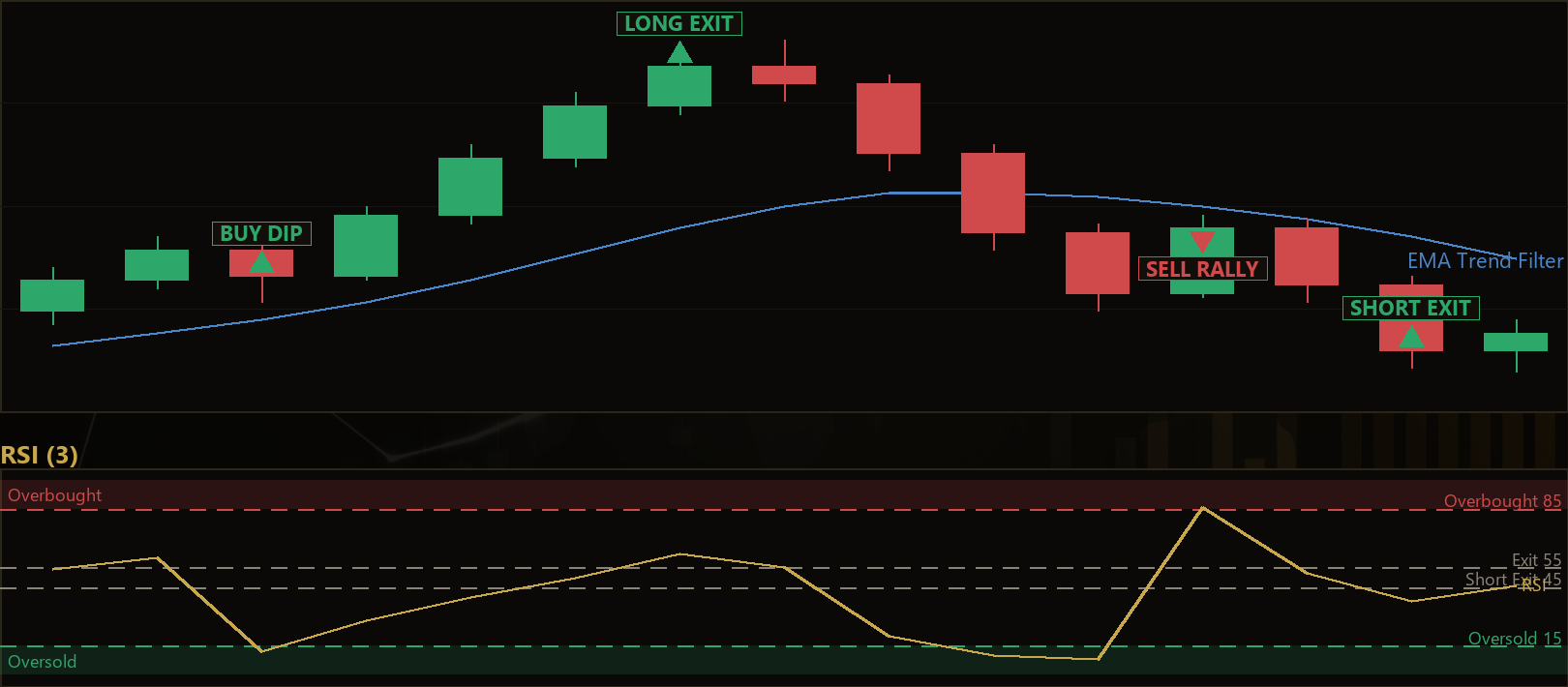
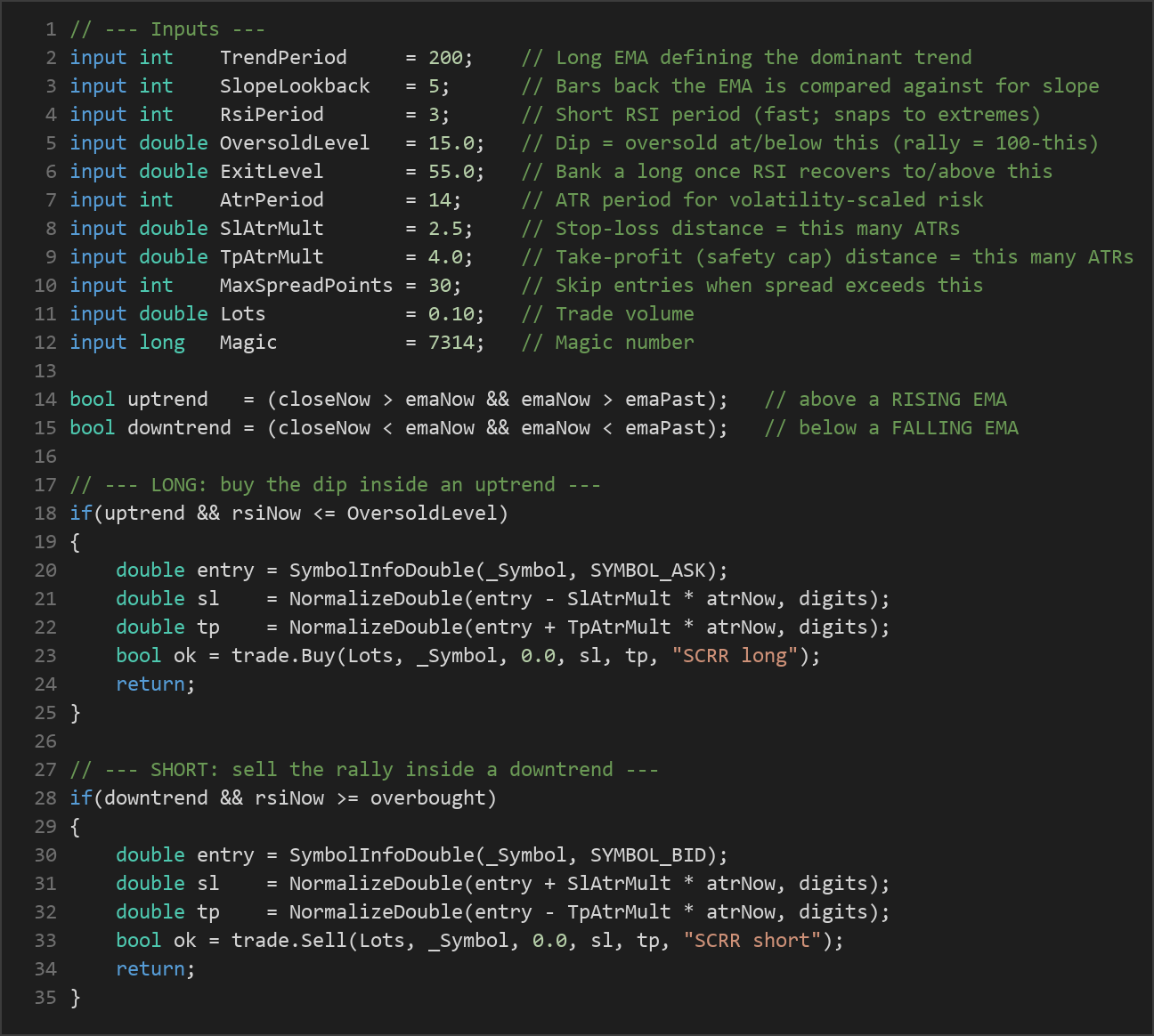
- Long entry: The strategy signals a potential buy when the last closed price is above a rising EMA (an uptrend) and the short RSI has dropped to or below the oversold level — historically interpreted as a dip within an uptrend.
- Short entry: The strategy signals a potential sell when the last closed price is below a falling EMA (a downtrend) and the short RSI has risen to or above the overbought level (calculated as
100 − OversoldLevel) — a rally within a downtrend. - Spread gate: Before any entry, the strategy checks the current spread. If the spread in points exceeds the maximum allowed, the entry is skipped because execution is considered too expensive.
- RSI-reversion exit (primary): For an open long, the strategy closes the trade once the RSI recovers to or above the exit level, signalling the snap-back it was waiting for may have played out. For an open short, it closes once the RSI falls to or below
100 − ExitLevel. - Stop-loss (safety): The stop is placed a volatility multiple away from entry —
SlAtrMult × ATRbelow entry for longs and above entry for shorts. - Take-profit (safety cap): A more generous ATR-based target sits
TpAtrMult × ATRfrom entry, acting as a backstop in case the RSI exit does not trigger.
Strategy Parameters
| Parameter | Default | Min | Max | Description |
|---|---|---|---|---|
| TrendPeriod | 200 | 50 | 300 | Period of the long EMA that defines the dominant trend direction. |
| SlopeLookback | 5 | 1 | 30 | How many bars back the EMA is compared against to judge whether it is rising or falling. |
| RsiPeriod | 3 | 2 | 14 | Short RSI period; deliberately fast so it snaps to extremes on shallow pullbacks. |
| OversoldLevel | 15.0 | 5.0 | 40.0 | A dip counts as oversold at or below this value (a rally counts as overbought at or above 100 − this). |
| ExitLevel | 55.0 | 45.0 | 75.0 | RSI-reversion exit: a long is closed once RSI recovers to or above this level (short uses 100 − this). |
| AtrPeriod | 14 | 7 | 30 | ATR period used for volatility-scaled stop and target distances. |
| SlAtrMult | 2.5 | 1.0 | 5.0 | Stop-loss distance expressed as this many ATRs from entry. |
| TpAtrMult | 4.0 | 1.0 | 8.0 | Take-profit (safety cap) distance expressed as this many ATRs from entry. |
| MaxSpreadPoints | 30 | 1 | 200 | Entries are skipped when the current spread (in points) exceeds this value. |
| Lots | 0.10 | 0.01 | 1.00 | Fixed trade volume in lots. |
| Magic | 7314 | 0 | 9,999,999 | Magic number used to identify and manage this EA's own positions. |
Recommended Chart Settings
The Short Cycle Rsi Reversion strategy was designed with liquid, trending instruments in mind — for example, major forex pairs such as EURUSD or GBPUSD, or a widely-traded instrument like XAUUSD (gold). Its natural home is the M15 to H1 timeframe range, where short-cycle pullbacks within a broader trend are frequent enough to generate signals but not so noisy that the trend filter loses meaning.
Because the stop, target, and trend logic are all scaled by ATR and EMA rather than fixed pip values, the same settings can be applied across different symbols. That said, results will vary considerably across different market conditions, instruments, and broker execution. Always study the behavior on a demo account first, and expect that parameter values which suit one symbol or timeframe may need adjustment for another.
How to Install on MetaTrader 5
- Download the .ex5 file from the link below
- Copy it to your MT5
MQL5\Expertsfolder - Restart MetaTrader 5 or refresh the Navigator panel
- Drag the EA onto a chart matching the recommended symbol and timeframe
- Configure the input parameters and enable Algo Trading
What to Consider Before Using This EA
Every strategy has strengths and limitations, and an honest assessment helps you learn faster.
Strengths. The design couples a directional edge (only trading with a sloping trend) to a timing trigger (short-RSI exhaustion of a pullback). Requiring the EMA slope — not just price relative to the EMA — is a thoughtful touch that helps the strategy stand aside during flat, directionless regimes. The ATR-based risk scales naturally across instruments, and the one-position-per-magic rule prevents entries from stacking during an unresolved move. The spread gate also avoids entering when execution costs are unusually high.
Limitations. Mean-reversion entries assume the pullback will end and the trend will resume — but trends do end, and a "dip" inside what looked like an uptrend can turn into a full reversal. In that case the ATR stop is the last line of defense, and a sequence of failed pullbacks can produce a run of losing trades. A very short RSI period is sensitive by design, which means it can fire frequently in choppy conditions. Because the strategy acts only on closed bars, signals occur with a one-bar delay relative to intrabar price action.
Where it may underperform. Ranging or whipsaw markets with no clear EMA slope, sudden high-impact news that gaps through the stop, and low-liquidity sessions with wide spreads are all conditions where this approach may historically struggle. It is designed to reduce false signals by standing aside when there is no trend, but no filter is perfect.
Risk Management Tips
Sound risk management matters more than any single indicator setting. Consider these general principles as part of your education:
- Position sizing: Size trades so that a single loss is a small, survivable fraction of your account. A common guideline is to risk no more than 1–2% of account equity per trade.
- Use the stop-loss: The ATR-based stop exists for a reason. Avoid the temptation to widen or remove it after entry.
- Test on a demo account first: Run the strategy on a demo or simulator until you understand how it behaves across different conditions before considering any live capital.
- Understand drawdown: Even a well-designed system experiences losing streaks. Study the depth and duration of drawdown so its behavior does not surprise you.
- Account for costs: Spreads, commissions, and slippage all affect real-world results and are often understated in idealized tests.
- Keep expectations realistic: No strategy wins every trade, and no parameter set works in every market forever.
Risk Warning
Trading foreign exchange, CFDs, and other leveraged financial instruments involves substantial risk of loss and is not suitable for all investors. The strategies and tools discussed on this page are provided for educational purposes only and do not constitute financial advice, investment recommendations, or solicitation to trade. Always consult a qualified financial adviser before making trading decisions. Past backtest performance is not indicative of future results.
Downloads
- Expert Advisor: ShortCycleRsiReversion.ex5 (65 downloads)
- Source Code: ShortCycleRsiReversion.mq5 (67 downloads)
- Documentation: ShortCycleRsiReversion.pdf (60 downloads)