Disclaimer: This article is for educational and informational purposes only. It does not constitute financial or investment advice. Trading forex and CFDs carries significant risk of loss. Past performance of any strategy — including backtests — does not guarantee future results. Never trade with money you cannot afford to lose.
What Is This Strategy?
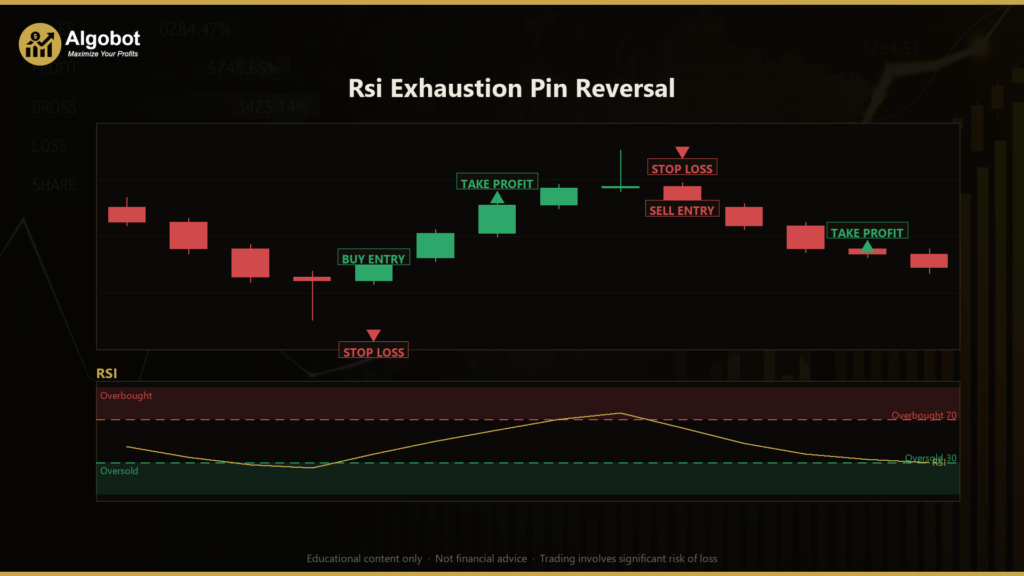
The Rsi Exhaustion Pin Reversal is a counter-trend, mean-reversion trading strategy that combines the Relative Strength Index (RSI) — a momentum oscillator that measures how stretched recent price moves have become — with a single, classic price-action candle known as the pin bar (a candle with a long rejection wick). It is built as a MetaTrader 5 Expert Advisor (EA), and it deliberately uses nothing else: no moving averages, no ATR, no Bollinger Bands. RSI decides when a move looks exhausted, and the pin bar confirms whether the crowd has actually flinched before the strategy fades the move.
The core idea addresses a well-known weakness of naive RSI trading. On its own, RSI can sit "pinned" in oversold or overbought territory for many bars while price keeps drifting in the same direction — the classic problem of catching a falling knife. The Rsi Exhaustion Pin Reversal tries to sidestep this by refusing to act on RSI alone. It waits for two independent conditions to line up on the same closed bar: a stretched RSI reading and a visible price rejection candle. One without the other is ignored, and that filter is the whole point of the design.
As a learning tool, this strategy suits traders who want to study how oscillator signals can be combined with price-action confirmation, and how a stop-loss can be anchored to market structure rather than to a fixed point count. It is framed here as a strategy analysis — a way to understand counter-trend mechanics and risk-to-reward design — not as a profit opportunity. It is best appreciated by intermediate learners who already understand basic candlestick anatomy and want to see those ideas expressed in code.
How It Works
The strategy evaluates conditions once per newly closed bar. The bar that just closed becomes the "signal bar." Both an RSI condition and a candle condition must agree on that same bar before any order is placed.
- RSI exhaustion (the momentum filter): The strategy looks back over the last several closed RSI readings (set by
ExtremeLookback). For a long setup, RSI must have dipped to or below theOversoldLevelsomewhere inside that window — signalling that sellers may be exhausted. For a short setup, RSI must have pushed to or above theOverboughtLevel, signalling that buyers may be exhausted. - Pin-bar rejection (the price-action filter): On the signal bar, the strategy measures the candle's range (High − Low), body (the distance between Open and Close), and the two wicks. A bullish pin requires a long lower wick that is at least
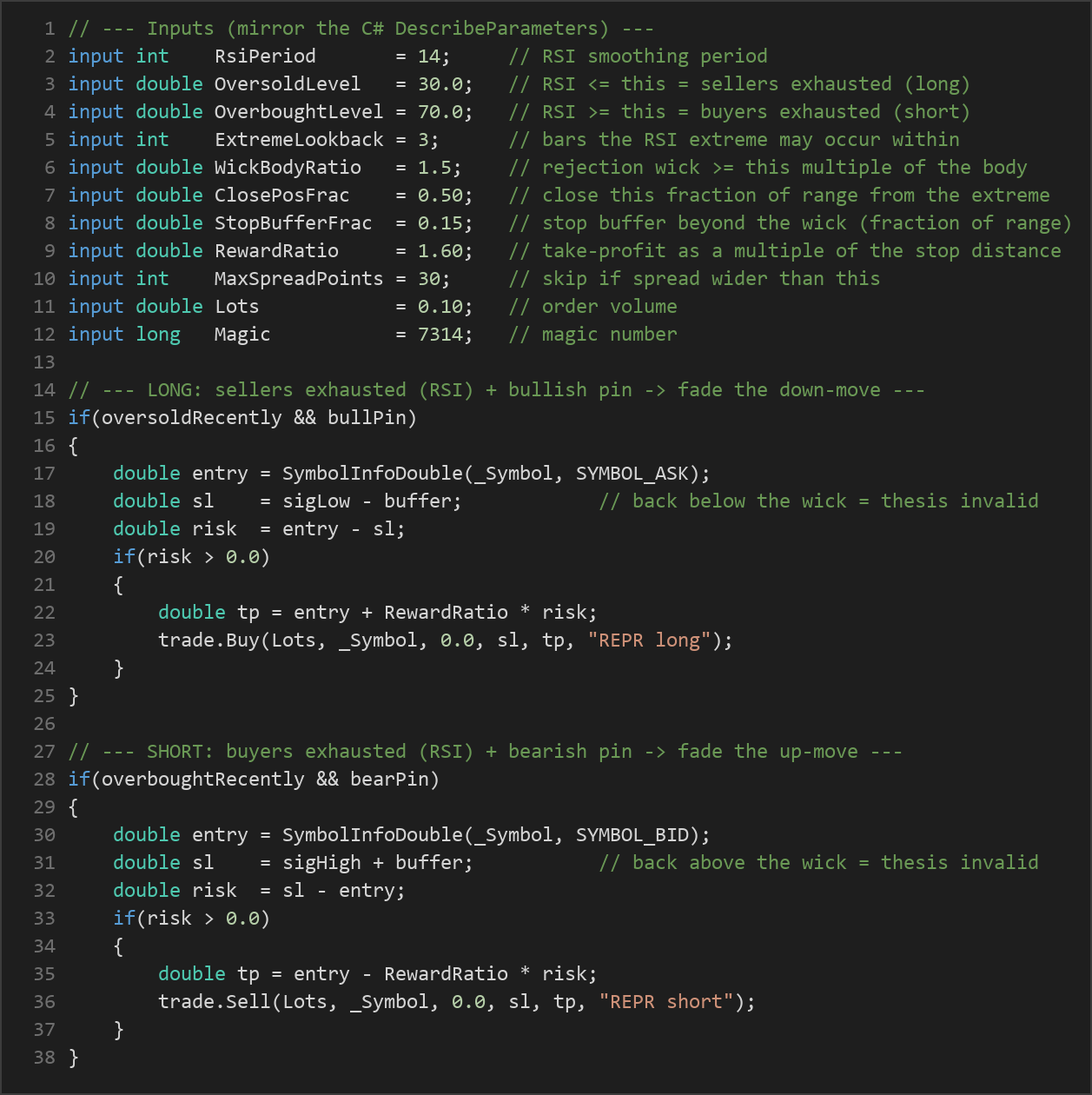
WickBodyRatiotimes the body, a lower wick at least as large as the upper wick, and a close in the upper part of the range (controlled byClosePosFrac). A bearish pin is the exact mirror: a long upper wick, dominant over the body and lower wick, with the close in the lower part of the range. - Long entry signal: When RSI was recently oversold and a bullish pin prints, the strategy signals a buy at the Ask price — fading the down-move.
- Short entry signal: When RSI was recently overbought and a bearish pin prints, the strategy signals a sell at the Bid price — fading the up-move.
- Stop-loss logic (structural): The stop is placed just beyond the rejected extreme of the signal bar — below its Low for a long, above its High for a short — buffered by a fraction of the bar's range (
StopBufferFrac). The reasoning is simple: if price trades back through the very wick that was supposed to reject it, the reversal thesis is considered dead, so the position is closed. - Take-profit logic: The target is set at a fixed reward-to-risk multiple (
RewardRatio) of that structural stop distance. Because both the stop and target are derived from the signal bar itself, the approach self-scales to any symbol or timeframe without point or pip math. - Trade management filters: Only one position per magic number is allowed at a time, and the structural stop and target manage the exit. A spread gate (
MaxSpreadPoints) skips the trade when the current spread is wider than the configured limit.
Strategy Parameters
| Parameter | Default | Min | Max | Description |
|---|---|---|---|---|
| RsiPeriod | 14 | 7 | 28 | Number of bars used to smooth the RSI calculation. |
| OversoldLevel | 30.0 | 10.0 | 40.0 | RSI at or below this level within the lookback marks sellers as exhausted (long context). |
| OverboughtLevel | 70.0 | 60.0 | 90.0 | RSI at or above this level within the lookback marks buyers as exhausted (short context). |
| ExtremeLookback | 3 | 1 | 10 | How many recent closed bars the RSI extreme may have occurred within. |
| WickBodyRatio | 1.5 | 0.5 | 4.0 | The rejection wick must be at least this multiple of the candle body. |
| ClosePosFrac | 0.50 | 0.30 | 0.90 | The close must sit at least this fraction of the range away from the rejected extreme. |
| StopBufferFrac | 0.15 | 0.00 | 1.00 | Stop buffer placed beyond the rejected wick, as a fraction of the signal bar's range. |
| RewardRatio | 1.60 | 0.80 | 4.00 | Take-profit distance as a multiple of the structural stop distance. |
| MaxSpreadPoints | 30 | 1 | 200 | Skip the trade if the current spread (in points) is wider than this. |
| Lots | 0.10 | 0.01 | 1.00 | Order volume in lots. |
| Magic | 7314 | 0 | 9,999,999 | Unique identifier the EA uses to tag and manage its own positions. |
Recommended Chart Settings
The Rsi Exhaustion Pin Reversal was designed with a mean-reverting major currency pair in mind — such as EURUSD or AUDUSD — on the M15 or M30 timeframe, reflecting a swing / mean-reversion trading style. These conditions tend to produce the kind of crowded, stretched moves followed by visible rejection candles that the logic is built to detect. As with any strategy, results will vary across different instruments, timeframes, and market conditions, so any settings should be studied carefully on each symbol you intend to test rather than assumed to transfer unchanged.
How to Install on MetaTrader 5
- Download the
RsiExhaustionPinReversal.ex5file from the link below. - Copy it to your MT5
MQL5\Expertsfolder. - Restart MetaTrader 5 or refresh the Navigator panel.
- Drag the EA onto a chart matching the recommended symbol and timeframe.
- Configure the input parameters and enable Algo Trading.
What to Consider Before Using This EA
The main strength of this approach is its insistence on confirmation. By requiring both a stretched RSI reading and a same-bar rejection candle, the strategy historically screens out many of the open-ended trends where a lone oversold or overbought fade would simply get run over. Anchoring the stop to the rejected wick — real price structure rather than an arbitrary distance — also gives each trade a clearly defined invalidation point and a self-scaling reward-to-risk profile.
The limitations are equally important to understand. Counter-trend strategies, by definition, trade against the prevailing move, and strong trending markets can produce repeated pin-bar-like candles that still fail to reverse. RSI extremes can persist far longer than expected during powerful trends, so the strategy may underperform in directional, news-driven environments. Because it acts only on closed bars and takes one position at a time, it may also sit idle for long stretches, and tight structural stops can be vulnerable to the normal noise of fast or thin markets. This EA may indicate potential reversal points, but no filter eliminates losing trades, and it should be evaluated as an educational model rather than a finished system.
Risk Management Tips
Sound risk management matters more than any single entry rule. Consider these general principles as you study the strategy:
- Position sizing: Size each trade so that a stop-out costs only a small, predefined slice of your account. A common educational guideline is to risk no more than 1–2% of account equity per trade.
- Demo first: Test the EA on a demo account across varied market conditions before considering any live use, so you understand its behaviour without financial pressure.
- Understand drawdown: Every strategy experiences losing streaks. Review the worst historical drawdown in your testing and ask honestly whether you could tolerate it.
- Mind costs and spread: Spread, commissions, and slippage all erode results. The built-in spread gate helps, but real trading costs should be part of any evaluation.
- Keep settings honest: Avoid over-optimising parameters to a single historical period — settings that look perfect in the past often fail to repeat.
Risk Warning
Trading foreign exchange, CFDs, and other leveraged financial instruments involves substantial risk of loss and is not suitable for all investors. The strategies and tools discussed on this page are provided for educational purposes only and do not constitute financial advice, investment recommendations, or solicitation to trade. Always consult a qualified financial adviser before making trading decisions. Past backtest performance is not indicative of future results.
Downloads
- Expert Advisor: RsiExhaustionPinReversal.ex5 (56 downloads)
- Source Code: RsiExhaustionPinReversal.mq5 (62 downloads)
- Documentation: RsiExhaustionPinReversal.pdf (58 downloads)