Disclaimer: This article is for educational and informational purposes only. It does not constitute financial or investment advice. Trading forex and CFDs carries significant risk of loss. Past performance of any strategy — including backtests — does not guarantee future results. Never trade with money you cannot afford to lose.
What Is This Strategy?
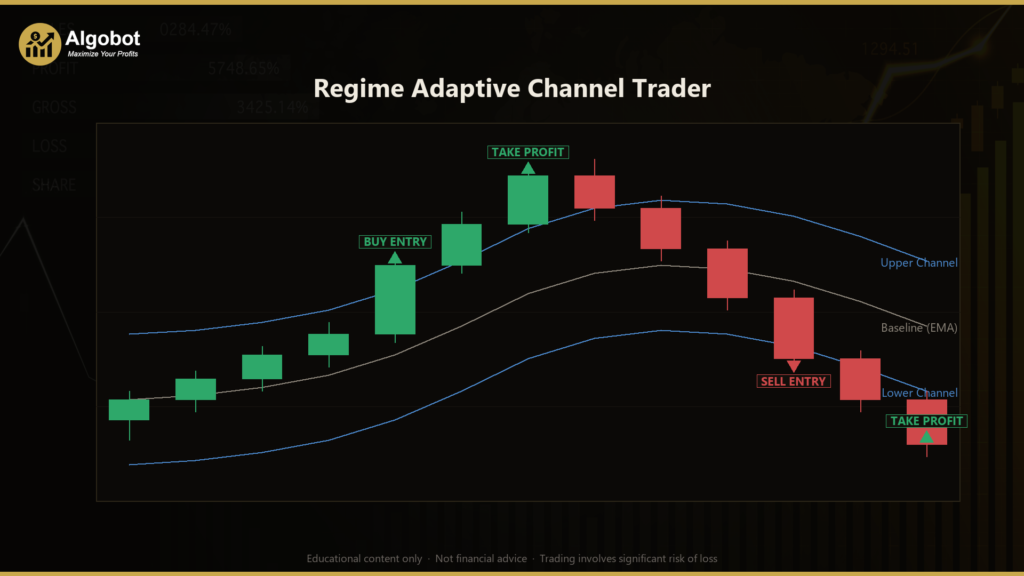
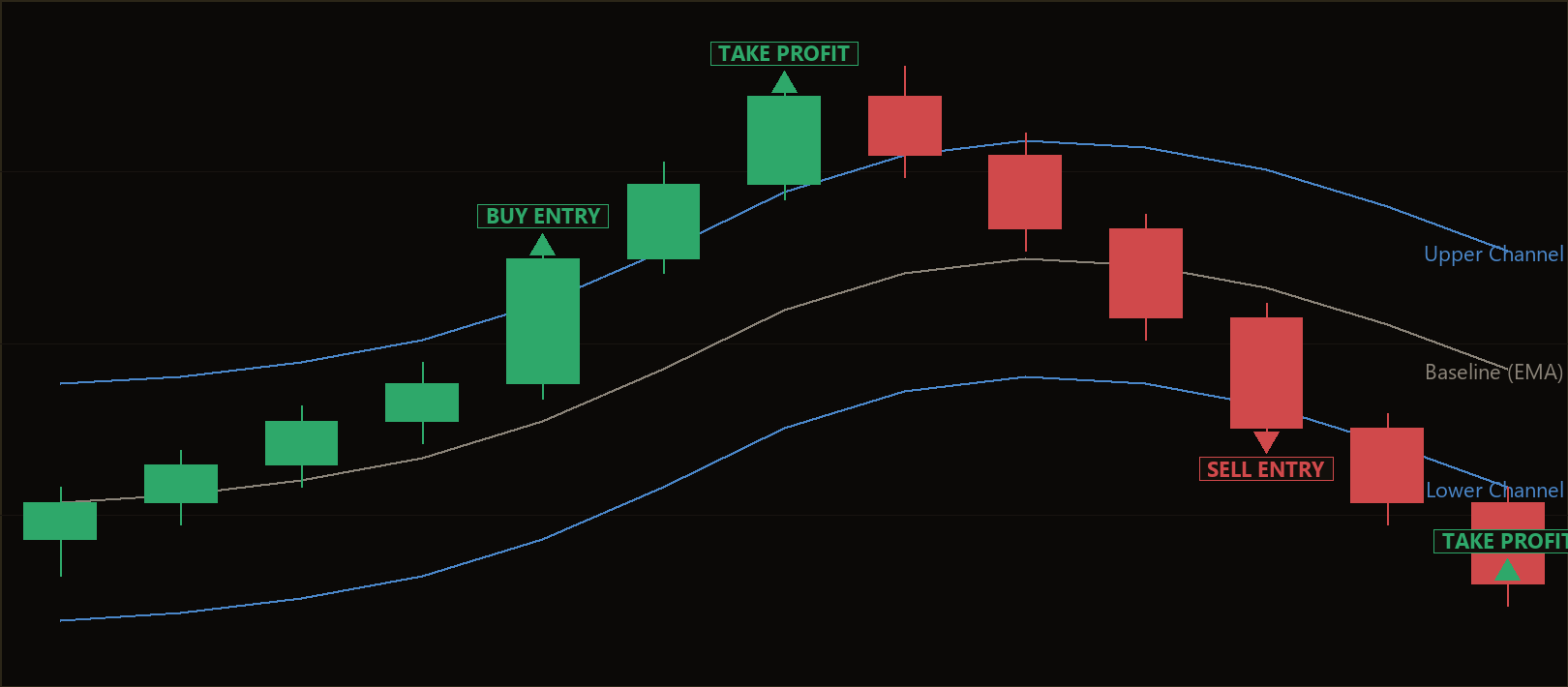
The Regime Adaptive Channel Trader is an MetaTrader 5 expert advisor built around a Keltner-style volatility channel — an envelope drawn a set number of Average True Range (ATR) units above and below an Exponential Moving Average (EMA) baseline. ATR is a common measure of how much price moves in an average bar, and the EMA is a moving average that reacts faster to recent prices than a simple average. Rather than committing to a single trading style, this strategy first classifies the current market "regime" as either trending or ranging, and only then applies the entry logic that historically suits that regime.
The core idea addresses a well-known problem in systematic trading: a pure breakout system tends to bleed capital in sideways markets because it keeps buying tops and selling bottoms that immediately reverse, while a pure mean-reversion system can be run over during strong trends because it keeps fading moves that never turn back. The Regime Adaptive Channel Trader attempts to sidestep both failure modes by measuring the slope of its EMA baseline — normalised into ATR units so it means the same thing across instruments — and switching between breakout-continuation logic in a trend and fade-the-edge logic in a range.
As a learning tool, this strategy is well suited to intermediate traders who already understand moving averages and want to study how a single system can adapt its rules to changing conditions. It is a useful case study in regime detection, volatility normalisation, and disciplined risk management. It is framed here as a strategy analysis, not as a profit opportunity — the goal is to understand how and why it makes decisions.
How It Works
The strategy evaluates its rules once per bar, acting only on the bar that has just closed so that signals never repaint (change after the fact) intrabar. Every calculation is derived from a single primary timeframe.
The building blocks the strategy computes each bar:
- Baseline: an EMA of closing prices over
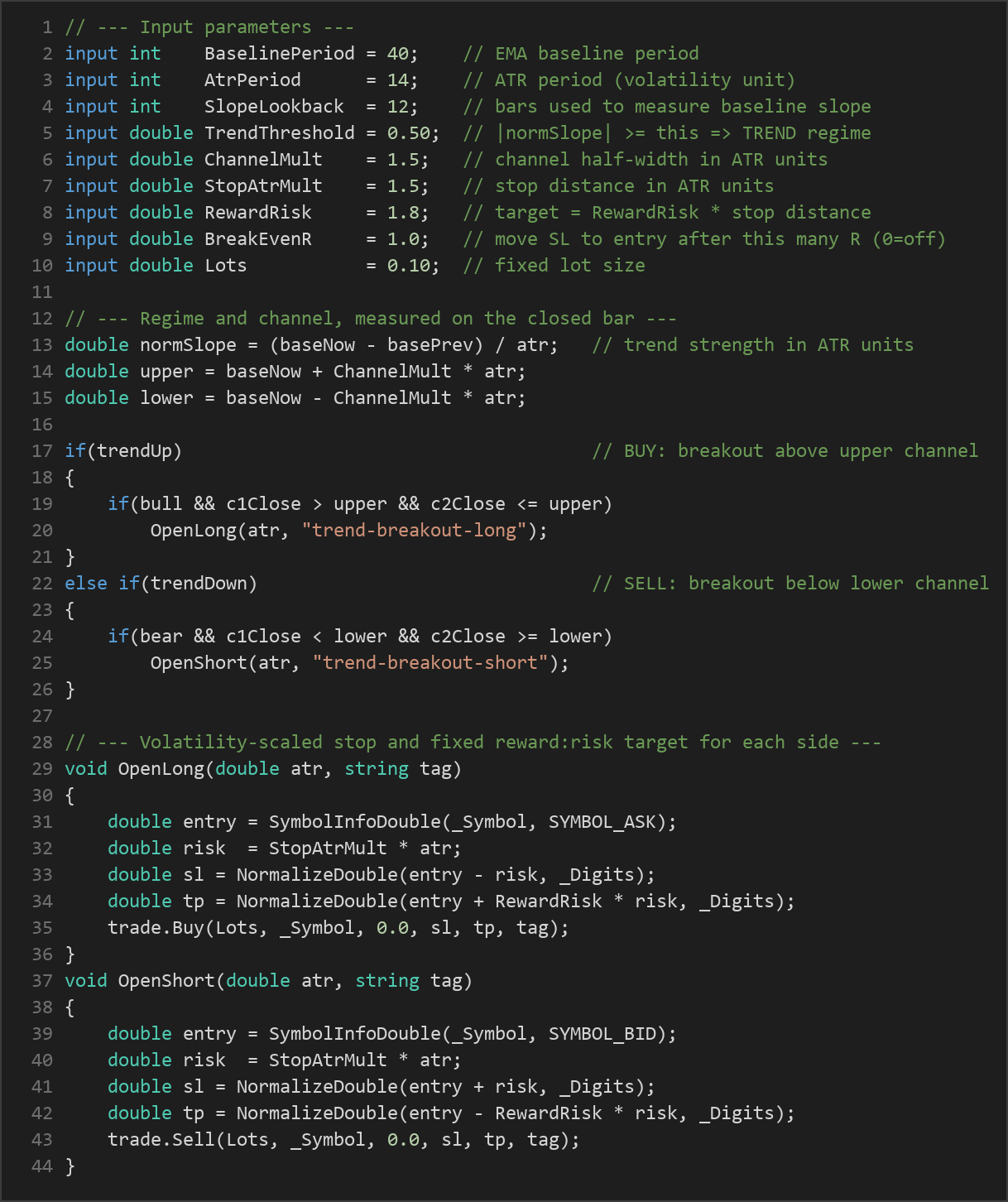
BaselinePeriodbars, treated as a "fair value" anchor. - Volatility unit: ATR over
AtrPeriodbars, used to scale everything else. - Channel: the baseline plus and minus
ChannelMult × ATR, forming the upper and lower envelope edges. - Regime measure: the change in the baseline over
SlopeLookbackbars, divided by ATR, producing a normalised slope. If its absolute value is at or aboveTrendThreshold, the market is treated as trending; otherwise it is treated as ranging.
In a trend regime (ride the expansion in the trend direction):
- When the slope is positive and a bar closes above the upper channel for the first time — with a bullish body (close above open) — the strategy signals a buy as a breakout continuation.
- When the slope is negative and a bar closes below the lower channel for the first time with a bearish body (close below open), the strategy signals a sell.
- Only trades that align with the slope are taken, so counter-trend breakouts are ignored.
In a range regime (fade the edges back toward fair value):
- When a bar pokes above the upper channel but closes back inside it with a bearish body — a failed breakout — the strategy signals a sell back toward the baseline.
- When a bar pokes below the lower channel but closes back inside with a bullish body, the strategy signals a buy.
- Requiring the close back inside the channel is what filters out genuine breakouts that would otherwise trap a naive fader.
Exit, stop-loss, and take-profit logic (identical for every entry):
- The stop-loss is placed
StopAtrMult × ATRaway from entry, so it automatically widens in volatile conditions and tightens in quiet ones. - The take-profit is set at
RewardRisk ×the stop distance, giving a fixed reward-to-risk ratio on every trade. - A break-even rule pulls the stop to the entry price once price has advanced
BreakEvenRmultiples of the initial risk, which may reduce the risk on a running position (setting it to 0 disables this). - Only one position per magic number is held at a time, so the strategy never stacks trades.
Strategy Parameters
| Parameter | Default | Min | Max | Description |
|---|---|---|---|---|
| BaselinePeriod | 40 | 20 | 120 | Number of bars in the EMA baseline (the "fair value" anchor). Higher values give a smoother, slower baseline. |
| AtrPeriod | 14 | 7 | 28 | Number of bars used to calculate ATR, the volatility unit that scales the channel and the stops. |
| SlopeLookback | 12 | 4 | 40 | How many bars back the baseline slope is measured over to classify the regime. |
| TrendThreshold | 0.50 | 0.10 | 1.50 | Normalised slope (in ATR units) at or above which the market is treated as trending rather than ranging. |
| ChannelMult | 1.5 | 0.5 | 4.0 | Channel half-width in ATR units — how far the envelope sits from the baseline. |
| StopAtrMult | 1.5 | 0.5 | 4.0 | Stop-loss distance from entry, expressed in ATR units. |
| RewardRisk | 1.8 | 1.0 | 4.0 | Take-profit distance as a multiple of the stop distance (the fixed reward-to-risk ratio). |
| BreakEvenR | 1.0 | 0.0 | 3.0 | Move the stop to break-even after price advances this many multiples of risk (0 disables). |
| Lots | 0.10 | 0.01 | 1.0 | Fixed position size in lots for each trade. |
Recommended Chart Settings
The Regime Adaptive Channel Trader is designed to run on a single primary timeframe and works conceptually with any liquid instrument that exhibits alternating trending and ranging phases — major forex pairs such as EUR/USD or GBP/USD on the H1 or H4 timeframe are a reasonable starting point for study. Because every threshold is normalised by ATR, the logic is intended to behave consistently across instruments with different price scales. That said, results will vary considerably across symbols, timeframes, and market conditions, and the default parameters are a starting point for research rather than a tuned configuration. Always test any settings on your specific instrument and broker feed before drawing conclusions.
How to Install on MetaTrader 5
- Download the .ex5 file from the link below.
- Copy it to your MT5
MQL5\Expertsfolder. - Restart MetaTrader 5 or refresh the Navigator panel.
- Drag the EA onto a chart matching the recommended symbol and timeframe.
- Configure the input parameters and enable Algo Trading.
What to Consider Before Using This EA
The main strength of this approach is its attempt at robustness across conditions. By measuring the regime before acting, it avoids applying breakout logic in a chop or fade logic in a strong trend — the two situations that most often damage single-style systems. The volatility-normalised design also means the same parameters carry a consistent meaning across different instruments, and the "trade only on the closed bar" rule removes a common source of misleading backtest results.
There are real limitations to weigh, however. Regime classification is never perfect: a normalised slope hovering near the TrendThreshold can flip between trend and range readings from bar to bar, producing whipsaw signals in transitional markets. Channel-based systems in general can suffer during sudden volatility spikes, when ATR-scaled stops widen and a single adverse bar can reach them. Fade entries in a range assume the edge will hold — when a range resolves into a genuine breakout, several fade signals may fire against the eventual move before the regime flips. And because the strategy holds only one position at a time, it can sit idle through opportunities while a single trade is open. This EA is best understood as a framework for studying regime adaptation, not as a finished, hands-off system.
Risk Management Tips
Sound risk management matters far more than any single entry rule. Consider these general principles as part of your education:
- Size positions to your account, not to the default lot. A common guideline is to risk no more than 1–2% of account equity on any single trade, adjusting the lot size so the stop-loss distance corresponds to that fraction.
- Always test on a demo account first. Run the strategy in simulated conditions long enough to see how it behaves across both trending and ranging phases before considering any live capital.
- Understand drawdown. Every strategy experiences losing streaks; know the depth of drawdown you are psychologically and financially able to tolerate before you begin.
- Respect the stop-loss. The ATR-scaled stop is central to this design — disabling or widening it to avoid a loss removes the very mechanism that limits risk.
- Never trade with money you cannot afford to lose, and treat every backtest as a hypothesis about the past, not a prediction of the future.
Risk Warning
Trading foreign exchange, CFDs, and other leveraged financial instruments involves substantial risk of loss and is not suitable for all investors. The strategies and tools discussed on this page are provided for educational purposes only and do not constitute financial advice, investment recommendations, or solicitation to trade. Always consult a qualified financial adviser before making trading decisions. Past backtest performance is not indicative of future results.
Downloads
- Expert Advisor: RegimeAdaptiveChannelTrader.ex5 (3 downloads)
- Source Code: RegimeAdaptiveChannelTrader.mq5 (2 downloads)
- Documentation: RegimeAdaptiveChannelTrader.pdf (2 downloads)