Disclaimer: This article is for educational and informational purposes only. It does not constitute financial or investment advice. Trading forex and CFDs carries significant risk of loss. Past performance of any strategy — including backtests — does not guarantee future results. Never trade with money you cannot afford to lose.
What Is This Strategy?
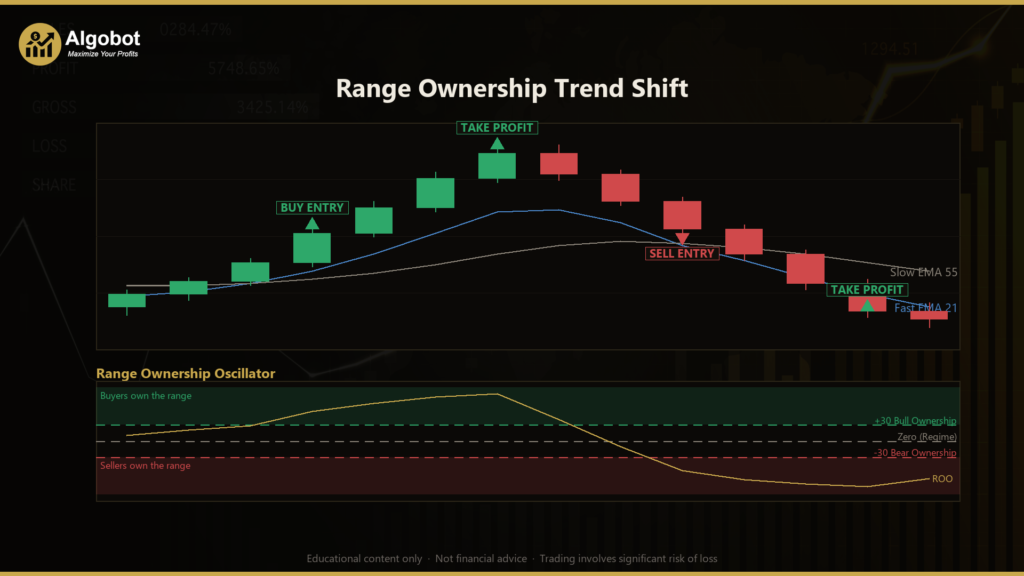
The Range Ownership Trend Shift strategy is a trend-continuation system for MetaTrader 5 built around an original oscillator its author calls Range Ownership (ROO). Where most candle-flow indicators net each bar's body (the distance from open to close), this one asks a subtly different question: over the recent window of bars, which side owns the volatility? Every completed bar's full range (High minus Low) is credited to whichever side closed it — bulls if the bar closed up, bears if it closed down — and the oscillator reports the net share on a bounded scale from −100 to +100.
The design logic is that a genuine trend is carried by wide, decisive bars, not by a drift of tiny doji-sized candles. Body-flow oscillators can be fooled when a swarm of small bars collectively outweighs the one large bar that actually mattered. By weighting each bar by how much of the period's total movement that side captured, Range Ownership tries to reward real directional conviction. A reading near +100 means the big-range bars have belonged to buyers; a reading near −100 means sellers have owned the movement.
This is best understood as a learning tool for studying volatility-weighted momentum and disciplined trade management, not as a shortcut to any particular outcome. It pairs the ROO oscillator with a classic exponential moving average (EMA) trend filter and a tight, rule-based risk framework. It may suit intermediate traders who already understand moving averages and the Average True Range (ATR) — a common measure of typical bar movement — and who want to explore how a novel oscillator behaves inside a structured, single-timeframe expert advisor (EA).
How It Works
The strategy evaluates its signals once per completed bar and manages any open trade on every tick. Here is the logic in plain English.
The trend gate (EMA filter). Before any entry is considered, the strategy checks that the market is trending on the current timeframe:
- Uptrend: the Fast EMA is above the Slow EMA and the Slow EMA is rising.
- Downtrend: the Fast EMA is below the Slow EMA and the Slow EMA is falling.
- If neither condition holds, no new trade is taken.
The entry — an "ownership shift" confirmed by trend. The strategy signals a trade only when the ROO oscillator makes a fresh cross through a threshold in the trend's direction:
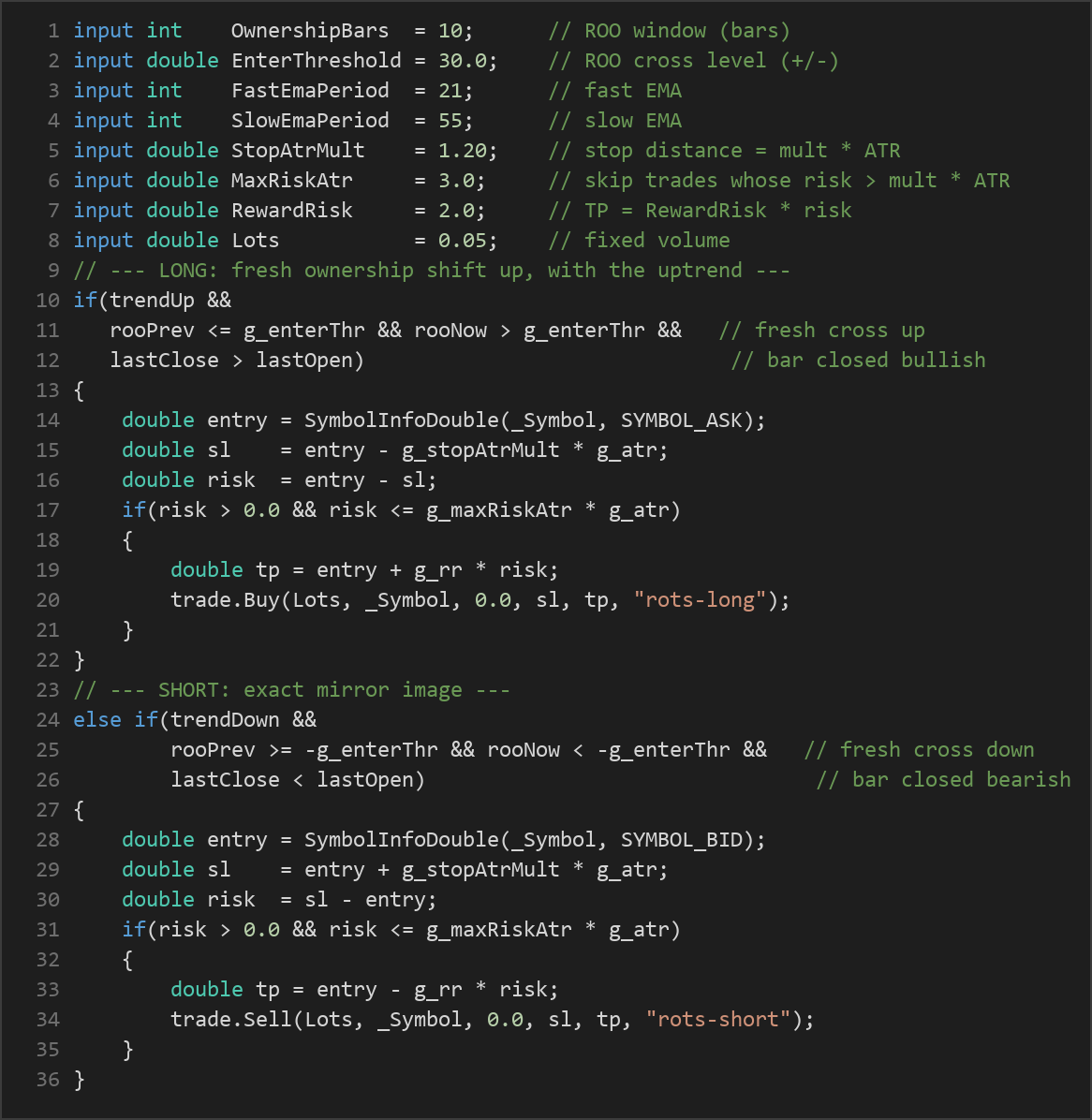
- Long: the trend is up, ROO was at or below the positive
EnterThresholdon the prior bar and crosses above it now, and the signal bar closed bullish (close above open). - Short: the exact mirror image — the trend is down, ROO was at or above the negative
EnterThresholdand crosses below it, and the signal bar closed bearish.
Requiring a fresh cross (rather than simply being above the level) means the strategy engages the moment ownership tips decisively, which it treats as a continuation ignition rather than a late chase.
The stop-loss. On entry, a stop is placed at StopAtrMult × ATR away from the fill price. The distance from entry to stop defines the trade's risk in price units. As a safety valve, any trade whose risk would exceed MaxRiskAtr × ATR is skipped entirely, so no single position carries an outsized stop.
The take-profit. A fixed target is set at RewardRisk × risk — for example, with the default reward-to-risk of 2.0, the target sits twice as far away as the stop.
Break-even and trailing. Once a trade moves BreakevenR risk-multiples into profit, the stop is pulled up to the entry price (break-even) and then trailed behind price by TrailAtrMult × ATR. The stop is only ever tightened, never loosened, which is intended to lock in and protect open profit.
The regime exit. This is the distinctive risk feature. If the ROO oscillator flips against an open trade — crossing back through zero, meaning the wide-range bars have stopped belonging to your side — the position is closed immediately. Cutting a trade the moment ownership reverses is the mechanism the author cites as the main driver of low drawdown. The strategy holds one position at a time, tagged with the Magic number, and never closes and re-opens within the same bar.

Strategy Parameters
| Parameter | Default | Min | Max | Description |
|---|---|---|---|---|
| OwnershipBars | 10 | 4 | 40 | Number of bars in the Range Ownership window — how far back the oscillator credits volatility. |
| EnterThreshold | 30.0 | 5.0 | 70.0 | The ± ROO level a fresh cross must clear to signal an entry. |
| FastEmaPeriod | 21 | 5 | 60 | Period of the fast EMA used in the trend gate. |
| SlowEmaPeriod | 55 | 20 | 200 | Period of the slow EMA; its slope also confirms trend direction. |
| AtrPeriod | 14 | 5 | 40 | Lookback for the ATR that sizes stops, targets, and the risk cap. |
| StopAtrMult | 1.20 | 0.5 | 3.0 | Stop distance as a multiple of ATR. |
| MaxRiskAtr | 3.0 | 1.0 | 8.0 | Trades whose risk exceeds this multiple of ATR are skipped. |
| RewardRisk | 2.0 | 1.0 | 5.0 | Take-profit distance as a multiple of the trade's risk. |
| BreakevenR | 1.0 | 0.3 | 2.0 | Profit (in risk-multiples) required before the stop moves to break-even. |
| TrailAtrMult | 2.0 | 0.5 | 5.0 | ATR multiple used for the trailing stop once break-even is reached. |
| Lots | 0.05 | 0.01 | 1.0 | Fixed trade volume in lots. |
| Magic | 5417 | 0 | 9,999,999 | Unique identifier tagging this EA's positions. |
Recommended Chart Settings
The strategy is deliberately single-timeframe — every calculation uses the chart's own symbol and period, so nothing is hardcoded to a specific instrument. The author notes it is well suited to liquid FX majors, metals, and indices in the M15 to H1 range, where ATR-based stops and the ROO window have enough clean movement to work with. As always, behavior can differ markedly between instruments and across changing market conditions, so treat any timeframe choice as a starting point for your own study rather than a fixed recommendation.
How to Install on MetaTrader 5
- Download the .ex5 file from the link below
- Copy it to your MT5
MQL5\Expertsfolder - Restart MetaTrader 5 or refresh the Navigator panel
- Drag the EA onto a chart matching the recommended symbol and timeframe
- Configure the input parameters and enable Algo Trading
What to Consider Before Using This EA
Strengths. The volatility-weighting idea is genuinely different from conventional body-flow, wick-asymmetry, and close-location oscillators, and it gives you a fresh lens on how conviction shows up in price. The trade-management layer is thoughtful: an ATR-scaled stop, a hard risk cap that skips oversized setups, a break-even lock, an ATR trail, and a regime exit that cuts losers when ownership reverses. Together these are designed to keep individual losses contained.
Known limitations. Like every trend-continuation approach, the strategy depends on trends actually following through. In choppy, range-bound markets the EMA gate may flip back and forth and the fresh ROO cross can trigger entries that stall — a classic source of repeated small losses (whipsaws). The regime exit trims those losses quickly, but frequent stop-outs and break-even exits can still accumulate. Because ROO credits full range to the closing side, a single unusually wide bar can swing the oscillator sharply, so the OwnershipBars window and EnterThreshold matter a great deal. The fixed Lots sizing does not scale with account equity or volatility, and the fixed reward-to-risk target will not suit every instrument.
Where it may underperform. Expect the weakest behavior during low-volatility consolidations, around major news spikes, and in markets that grind sideways beneath tangled EMAs. It is not a set-and-forget system; it is a framework to study.
Risk Management Tips
Sound risk management matters far more than any single indicator. As you study this or any EA, consider these principles:
- Risk a small, fixed fraction per trade. Many educators suggest never risking more than 1–2% of account equity on a single position, and sizing your lots to respect that limit rather than using a fixed volume blindly.
- Test on a demo account first. Run the strategy on a demo or a small account for a meaningful period before considering any live capital, so you can observe how it behaves across different conditions.
- Understand drawdown. Even a well-managed system will string together losing trades. Know the largest peak-to-trough decline you are prepared to tolerate before you begin.
- Account for costs. Spreads, commissions, and slippage all erode results, especially on shorter timeframes with frequent trades.
- Keep records and review. Journaling entries, exits, and parameter changes helps you learn what the strategy is actually doing rather than guessing.
Risk Warning
Trading foreign exchange, CFDs, and other leveraged financial instruments involves substantial risk of loss and is not suitable for all investors. The strategies and tools discussed on this page are provided for educational purposes only and do not constitute financial advice, investment recommendations, or solicitation to trade. Always consult a qualified financial adviser before making trading decisions. Past backtest performance is not indicative of future results.
Downloads
- Expert Advisor: RangeOwnershipTrendShift.ex5 (45 downloads)
- Source Code: RangeOwnershipTrendShift.mq5 (44 downloads)
- Documentation: RangeOwnershipTrendShift.pdf (48 downloads)