Disclaimer: This article is for educational and informational purposes only. It does not constitute financial or investment advice. Trading forex and CFDs carries significant risk of loss. Past performance of any strategy — including backtests — does not guarantee future results. Never trade with money you cannot afford to lose.
What Is This Strategy?
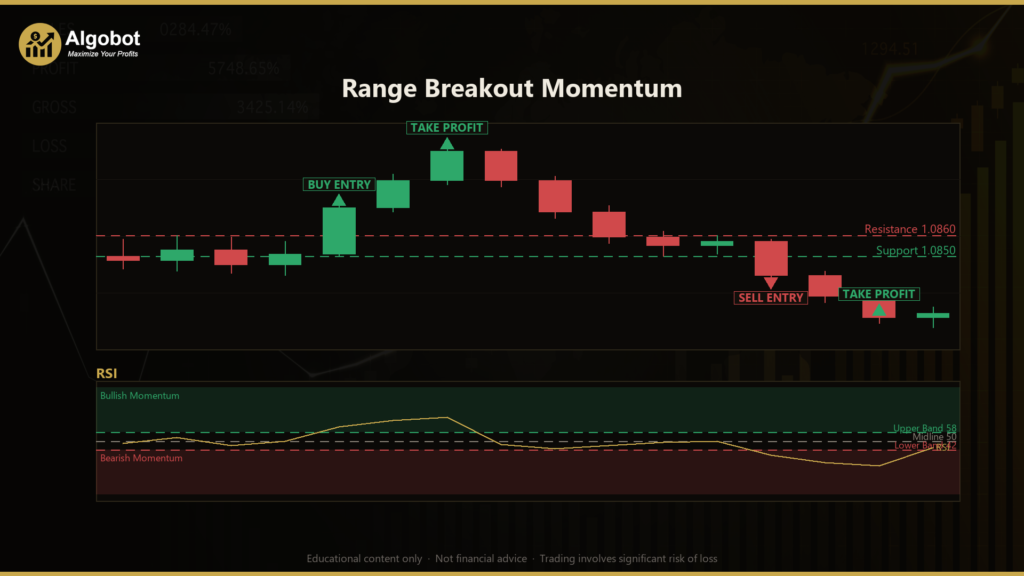
Range Breakout Momentum is a trend-following expert advisor (EA) that combines two classic technical concepts: the price breakout and momentum as measured by the Relative Strength Index (RSI). The RSI is a momentum oscillator that moves between 0 and 100 and helps gauge whether a market is gaining or losing directional strength. Rather than buying every move that pokes past a key level, this strategy waits for a breakout that is confirmed by genuine momentum, which is the core idea it was built to study.
The thinking behind Range Breakout Momentum is simple to state but important to understand. Markets frequently spend long stretches consolidating inside a horizontal "shelf" of support and resistance. When price finally pushes beyond that shelf, many of those breaks fail — price pokes past the level, traps eager traders, and snaps back. This strategy is designed to filter out those low-conviction breaks by requiring the most recently closed bar to close beyond a rolling support/resistance level by a volatility-scaled buffer, and by demanding that RSI confirm momentum in the same direction at the same time.
As a learning tool, this approach is well suited to traders who want to study how breakout entries and momentum filters interact, and how an Average True Range (ATR) measurement — a gauge of recent volatility — can be used to size stops, targets, and entry buffers dynamically. It is best viewed as a structured example of disciplined, single-timeframe trend-following logic, not as a shortcut to results. Treat it as a framework for understanding why certain breakouts may be worth acting on while others are better ignored.
How It Works
Range Breakout Momentum operates on a single timeframe and evaluates its rules once per completed bar, using the bar that has just closed. This avoids reacting to noisy, mid-bar price flicker. Here is how the logic flows:
- Build the range shelf. The strategy scans the most recent
RangeLookbackbars preceding the breakout bar and records the highest high (resistance) and the lowest low (support). This forms the rolling "shelf" that price must break out of. - Measure volatility and momentum. It calculates ATR over
AtrPeriodbars to quantify current volatility, and RSI overRsiPeriodbars to quantify momentum on the just-closed bar. - Apply the breakout buffer. A buffer equal to
BreakBufferAtr × ATRis added above resistance and below support. Price must clear the shelf by this volatility-scaled cushion, which helps screen out marginal pokes through the level. - Confirm with momentum. RSI must agree with the direction of the break. For longs, RSI must be at or above
50 + RsiMomBand; for shorts, RSI must be at or below50 − RsiMomBand. The midline of 50 separates bullish from bearish momentum, and the band keeps weak signals out.
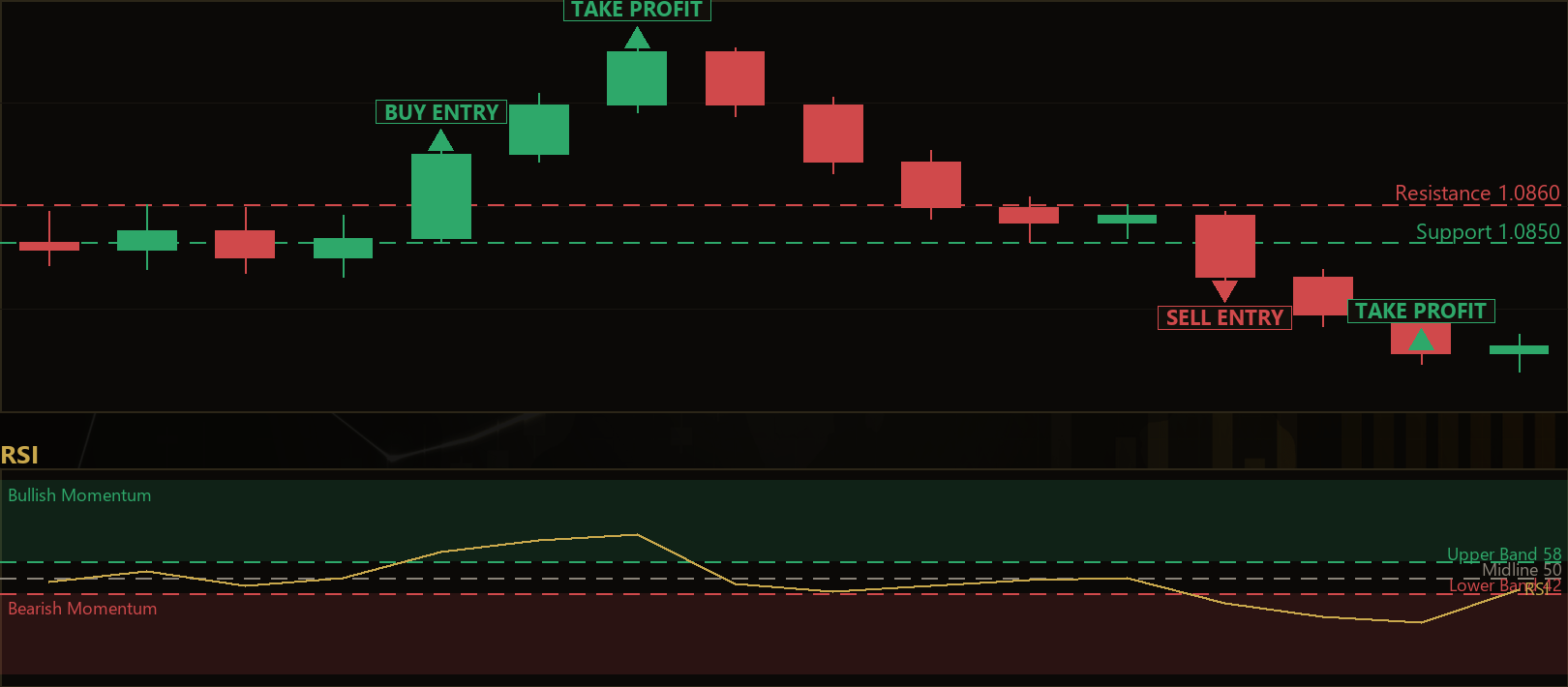
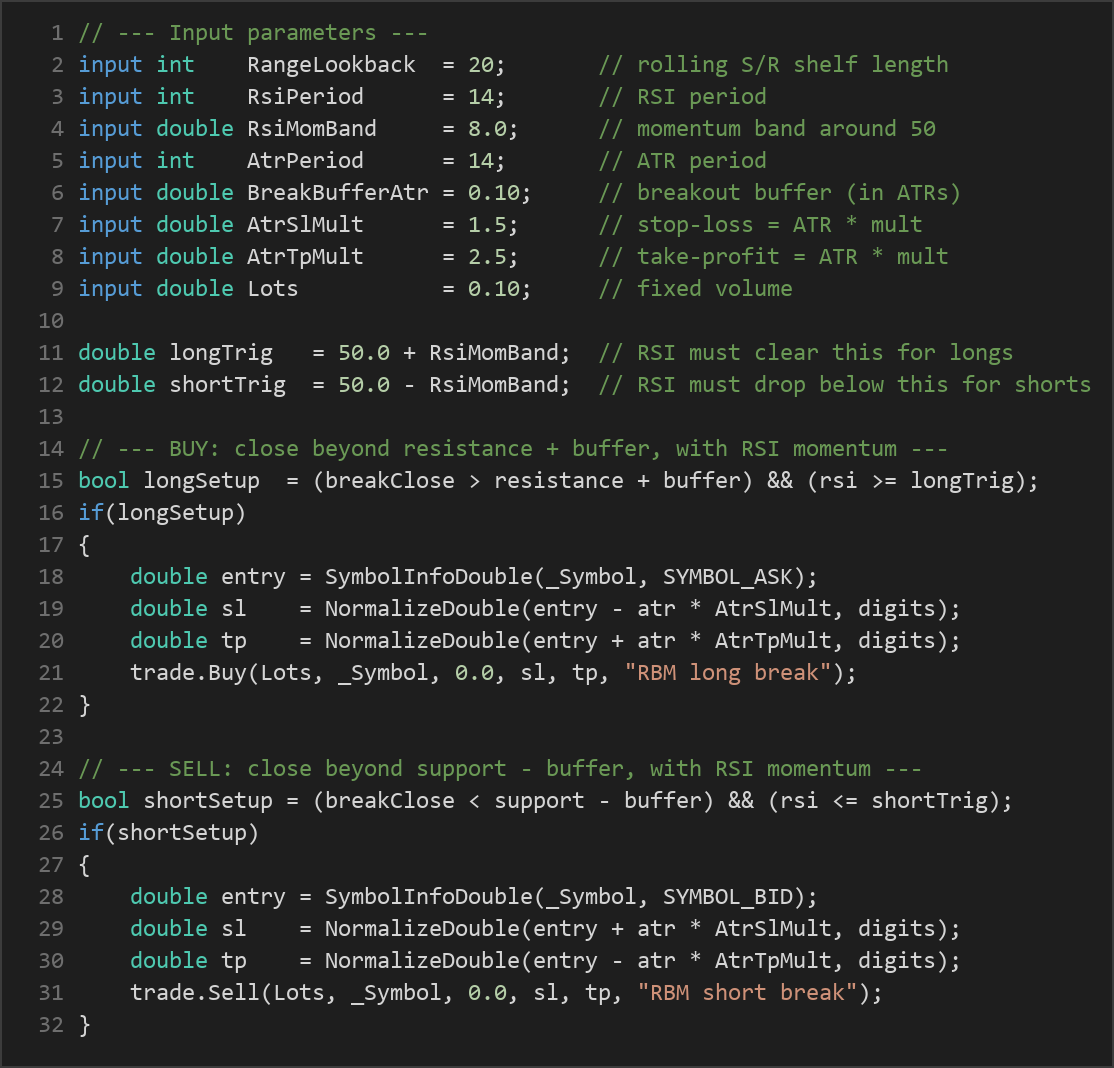
Long entry — the strategy signals a buy when:
- The just-closed bar closes above resistance plus the ATR buffer, and
- RSI is at or above the long momentum trigger (
50 + RsiMomBand).
Short entry — the strategy signals a sell when:
- The just-closed bar closes below support minus the ATR buffer, and
- RSI is at or below the short momentum trigger (
50 − RsiMomBand).
Stop-loss and take-profit logic. When a trade is opened, the stop-loss and take-profit are both derived from ATR so they adapt to current volatility:
- Stop-loss: placed at
ATR × AtrSlMultaway from entry (below entry for longs, above for shorts). - Take-profit: placed at
ATR × AtrTpMultaway from entry (above entry for longs, below for shorts).
Active momentum-fade exit. Beyond the fixed stop and target, the strategy includes an active exit that is meant to be its main false-signal filter. While a position is open, if RSI collapses back through the 50 midline against the trade — RSI falling below 50 for a long, or rising above 50 for a short — the strategy closes the position early. The reasoning is that once momentum fades, the breakout has likely lost conviction. The EA also holds one position at a time and will not stack new trades while it is managing an existing one.
Strategy Parameters
| Parameter | Default | Min | Max | Description |
|---|---|---|---|---|
| RangeLookback | 20 | 10 | 60 | Number of bars used to build the rolling support/resistance shelf that price must break out of. |
| RsiPeriod | 14 | 7 | 28 | Lookback length for the RSI momentum oscillator. |
| RsiMomBand | 8.0 | 2.0 | 20.0 | Momentum band around the RSI midline of 50; a wider band demands stronger momentum to confirm a breakout. |
| AtrPeriod | 14 | 7 | 28 | Lookback length for the ATR volatility measure used to size buffers, stops, and targets. |
| BreakBufferAtr | 0.10 | 0.0 | 1.0 | Breakout cushion expressed in ATRs; price must clear the shelf by this much to qualify. |
| AtrSlMult | 1.5 | 0.5 | 4.0 | Stop-loss distance as a multiple of ATR. |
| AtrTpMult | 2.5 | 1.0 | 6.0 | Take-profit distance as a multiple of ATR. |
| Lots | 0.10 | 0.01 | 1.0 | Fixed trade volume in lots. |
Recommended Chart Settings
Range Breakout Momentum is a single-timeframe system: every calculation uses the chart's own timeframe, so it should be attached to one chart and left to operate on that timeframe alone. A common starting point for studying breakout-and-momentum logic is a liquid major forex pair on an intraday timeframe such as the 15-minute (M15) or 1-hour (H1) chart, where ranges and breakouts are frequent enough to observe the rules in action. Because the strategy uses ATR-scaled stops, targets, and buffers, it adapts automatically to instruments and timeframes with different volatility profiles.
Keep in mind that no single symbol or timeframe is universally "correct." Results will vary considerably across different markets and market conditions, and any setting should be tested thoroughly on historical data and a demo account before being studied in a live environment.
How to Install on MetaTrader 5
- Download the .ex5 file from the link below.
- Copy it to your MT5
MQL5\Expertsfolder. - Restart MetaTrader 5 or refresh the Navigator panel.
- Drag the EA onto a chart matching the recommended symbol and timeframe.
- Configure the input parameters and enable Algo Trading.
What to Consider Before Using This EA
Like every approach, Range Breakout Momentum has both strengths and limitations, and understanding them is the whole point of studying it.
Strengths. The strategy's main appeal is its insistence on confirmation. By requiring both a buffered close beyond the shelf and RSI agreement, it is designed to ignore many of the half-hearted breaks that trap breakout traders. The ATR-based sizing means stops, targets, and buffers scale with volatility instead of being fixed, which is a sound and adaptable design principle. The active momentum-fade exit adds a layer of risk control that does not wait passively for the stop to be hit.
Known limitations. Breakout systems, by their nature, tend to struggle in choppy, sideways markets where price repeatedly breaks a level and reverses — a condition often called a "whipsaw." In such environments, the strategy may take repeated small losses on breaks that fail. RSI-based momentum filters can also lag, occasionally confirming a move just as it exhausts. Because the EA trades only one position at a time and acts once per bar, it may miss faster moves or pass on setups that resolve within a single candle. The momentum-fade exit, while protective, can also close trades early during normal pullbacks that would otherwise have continued.
This strategy is not a finished product to be deployed blindly. It is a transparent example of how breakout and momentum concepts can be combined, and it should be analyzed, tested, and adjusted with that educational mindset.
Risk Management Tips
Sound risk management matters far more than any single entry rule. As you study this or any strategy, keep these principles in mind:
- Risk only a small fraction per trade. Many educators suggest risking no more than 1–2% of account equity on any single position, so that a string of losses does not threaten the account.
- Size positions deliberately. Match your lot size to your stop distance and account size rather than using a fixed volume out of habit; the default
Lotsvalue here is a placeholder, not a recommendation. - Always start on a demo account. Test the strategy in a risk-free simulated environment until you understand exactly how it behaves before considering real capital.
- Understand drawdown. Every strategy experiences losing streaks. Know the maximum historical drawdown of any approach you study and ask whether you could tolerate it emotionally and financially.
- Never trade money you cannot afford to lose. Leverage magnifies both gains and losses, and capital preservation should always come first.
Risk Warning
Trading foreign exchange, CFDs, and other leveraged financial instruments involves substantial risk of loss and is not suitable for all investors. The strategies and tools discussed on this page are provided for educational purposes only and do not constitute financial advice, investment recommendations, or solicitation to trade. Always consult a qualified financial adviser before making trading decisions. Past backtest performance is not indicative of future results.
Downloads
- Expert Advisor: RangeBreakoutMomentum.ex5 (64 downloads)
- Source Code: RangeBreakoutMomentum.mq5 (55 downloads)
- Documentation: RangeBreakoutMomentum.pdf (63 downloads)