
Disclaimer: This article is for educational and informational purposes only. It does not constitute financial or investment advice. Trading forex and CFDs carries significant risk of loss. Past performance of any strategy — including backtests — does not guarantee future results. Never trade with money you cannot afford to lose.
What Is This Strategy?
The Random Walk Index Trend Emergence strategy is a trend-following expert advisor built around the Random Walk Index (RWI), a statistical trend gauge introduced by Michael Poulos. Unlike a moving average or a momentum oscillator, the RWI does not simply measure whether price is rising or falling — it asks a sharper question: is the current move larger than pure chance could reasonably produce? When the answer is yes, the strategy treats it as evidence that a genuine trend has emerged from the surrounding market noise, and it looks to join that move.
The idea rests on a well-known property of random walks. Over a stretch of n bars, a market that is merely wandering aimlessly is expected to drift only about the square root of n multiplied by a typical bar's range. The Random Walk Index compares the actual net displacement of price over recent bars against that random-walk expectation. If price has traveled meaningfully farther than randomness alone would explain, the RWI value climbs above 1, and progressively higher readings indicate progressively stronger, more statistically significant directional movement.
As a learning tool, this strategy is well suited to traders who want to understand how statistical reasoning can be applied to trend detection rather than relying on visual chart patterns. It is designed for liquid, trending instruments — major forex pairs, gold, and stock indices — on intraday-to-swing timeframes. This article frames the approach as a strategy analysis, not a profit opportunity: the goal is to understand how and why the logic behaves the way it does.
How It Works
The strategy evaluates its logic once per completed bar. On each new bar, it computes an Average True Range (ATR) value to represent the "typical bar range," then builds the Random Walk Index across a range of lookback lengths.
- Building the RWI: For every lookback length n between
MinLookbackandMaxLookback, the strategy forms two ratios from the just-completed bars. The up-swing ratio divides the recent high minus the low n bars ago byATR × √n. The down-swing ratio divides the high n bars ago minus the recent low by the same denominator. Taking the maximum of each ratio across all lookbacks (as Poulos prescribes) produces two headline numbers: RWIhigh and RWIlow. - Interpreting the values: An RWIhigh above 1 means the strongest up-move exceeds what a random walk can explain. An RWIlow above 1 means the same for the strongest down-move. Readings above the
Thresholdparameter flag a statistically significant directional move worth acting on. - Long entry signal: The strategy signals a long when RWIhigh crosses up through the
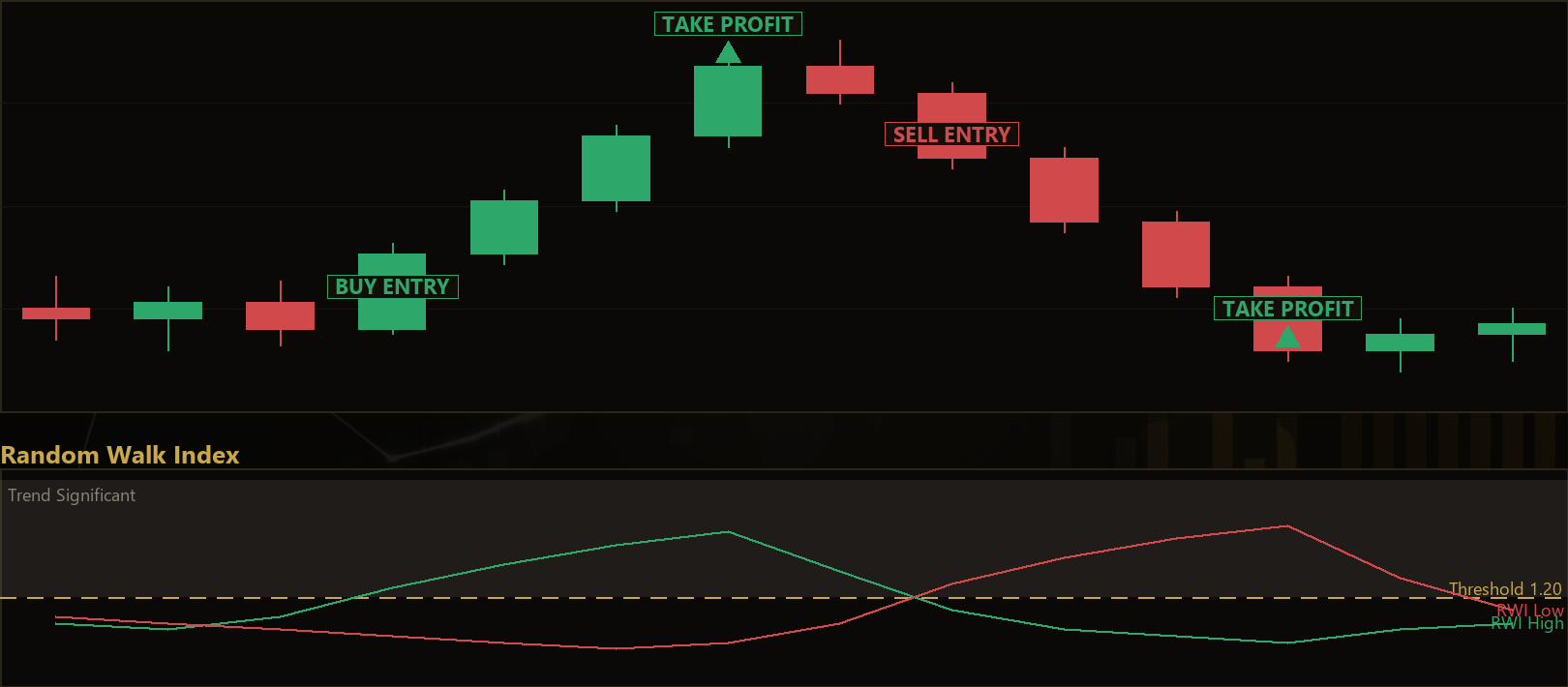
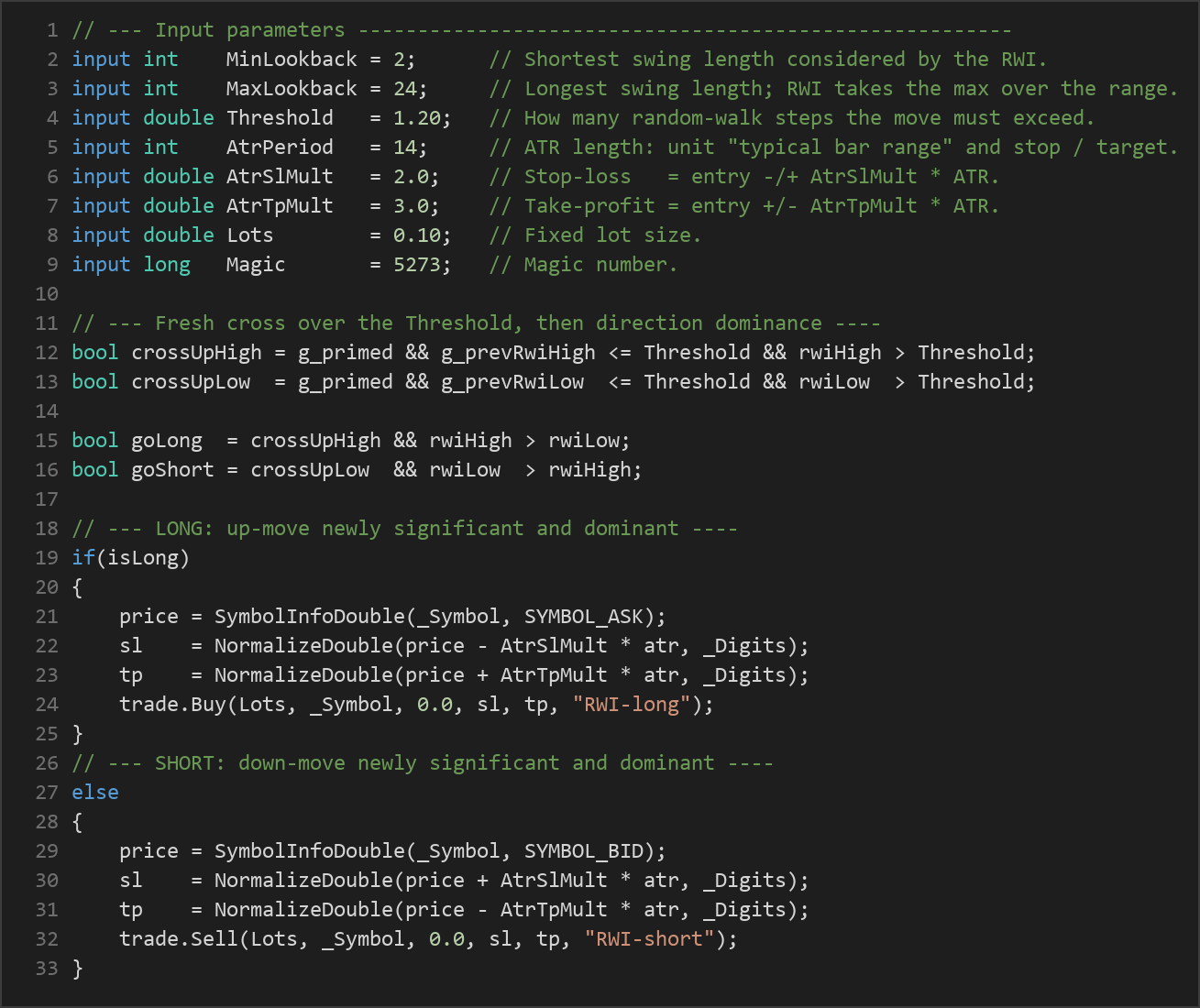
Threshold(it was at or below the threshold on the previous bar and is above it now) and RWIhigh is greater than RWIlow. This means the up-trend is both significant and dominant over any competing down-swing. - Short entry signal: The strategy signals a short when RWIlow crosses up through the
Thresholdand RWIlow is greater than RWIhigh — the mirror image of the long condition. - Why a fresh cross matters: By requiring a fresh cross rather than simply "above the threshold," the strategy aims to join a trend at the moment it emerges, rather than re-entering an already-mature move that may be closer to exhaustion.
- One position at a time: Only one position per magic number is held at any moment. If a trade is already open, no new entry is taken, though the strategy keeps tracking RWI values continuously so its cross detection stays accurate.
Exit, stop-loss, and take-profit logic are all anchored to ATR, so protective levels scale with current volatility:
- Stop-loss is placed
AtrSlMult × ATRaway from the entry price — below entry for longs, above entry for shorts. - Take-profit is placed
AtrTpMult × ATRaway from entry in the direction of the trade. - With the default multipliers (2.0 for the stop, 3.0 for the target), each trade carries a built-in reward-to-risk ratio of roughly 1.5-to-1 before costs. Positions close when either the stop or target is reached.
Strategy Parameters
| Parameter | Default | Min | Max | Description |
|---|---|---|---|---|
| MinLookback | 2 | 2 | 8 | Shortest swing length the RWI considers; skips single-bar noise. |
| MaxLookback | 24 | 10 | 60 | Longest swing length considered; the RWI takes the maximum ratio across the full range. |
| Threshold | 1.20 | 1.0 | 3.0 | Significance level — how many random-walk "standard steps" a move must exceed to count as a real trend. |
| AtrPeriod | 14 | 7 | 30 | ATR length used as the unit "typical bar range" and for stop/target sizing. |
| AtrSlMult | 2.0 | 1.0 | 4.0 | Stop-loss distance as a multiple of ATR. |
| AtrTpMult | 3.0 | 1.0 | 6.0 | Take-profit distance as a multiple of ATR. |
| Lots | 0.10 | 0.01 | 1.0 | Fixed lot size for each trade. |
The parameter set is deliberately small and broadly ranged. Few parameters with wide sensible ranges help resist curve-fitting — the temptation to over-tune settings to past data in a way that rarely holds up on new data.
Recommended Chart Settings
The Random Walk Index Trend Emergence strategy was designed for liquid, trending instruments — major forex pairs (such as EUR/USD or GBP/USD), gold (XAU/USD), and major stock indices. Because the logic uses a single timeframe and every calculation reads from whatever timeframe the chart is set to, it will run on the timeframe you select at backtest or deployment time.
Intraday-to-swing timeframes — for example H1 or H4 — are a reasonable starting point for study, since they give the RWI enough bars to distinguish genuine trends from noise while still producing a workable number of signals. Keep in mind that results will vary significantly across different symbols, timeframes, and market conditions. A setting that behaves well on one instrument during a trending period may behave very differently on another instrument or during a range-bound phase. Always study the behavior on a demo account across multiple market environments before drawing any conclusions.
How to Install on MetaTrader 5
- Download the .ex5 file from the link below.
- Copy it to your MT5
MQL5\Expertsfolder. - Restart MetaTrader 5 or refresh the Navigator panel.
- Drag the EA onto a chart matching the recommended symbol and timeframe.
- Configure the input parameters and enable Algo Trading.
What to Consider Before Using This EA
Strengths of the approach. The Random Walk Index brings a genuinely different lens to trend detection. Rather than reacting to price crossing a line, it quantifies how unusual a move is relative to random behavior, which can help filter out weak, choppy moves that trip up simpler trend systems. Scanning multiple lookback lengths and taking the maximum makes the signal responsive to both short bursts and longer sustained swings. The ATR-based stops and targets adapt automatically to volatility, and the "fresh cross" requirement is designed to enter trends early rather than late.
Known limitations. Like every trend-following method, this strategy is at its weakest in range-bound, sideways markets. In a choppy environment, the RWI can briefly exceed the threshold on false breakouts, leading to entries that quickly reverse into the stop. Because it acts only on completed bars, entries always occur one bar after the qualifying move, so some of the initial impulse is missed. The fixed-lot sizing does not scale risk to account equity, and a fixed take-profit can cut short an unusually strong trend that would have run much further. There is also no protection against gaps, news spikes, or slippage beyond the ATR-based stop.
When it may underperform. Expect weaker behavior during low-volatility consolidation, during major scheduled news events, and on illiquid or heavily spread instruments where the ATR unit poorly reflects tradable range. No parameter set makes a trend-follower immune to trendless markets.
Risk Management Tips
Sound risk management matters more than any single indicator. Consider these general principles as part of your education:
- Risk a small, fixed fraction per trade. Many educational sources suggest risking no more than 1–2% of account equity on any single position. The default fixed-lot sizing here does not do this automatically, so calculate your position size against your stop distance yourself.
- Test on a demo account first. Run the strategy in simulation across different symbols, timeframes, and market regimes before committing any real capital.
- Understand drawdown. Even a well-designed trend system endures losing streaks during ranging markets. Know the largest peak-to-trough decline you are prepared to tolerate, and study how the strategy behaves through such stretches.
- Account for costs. Spreads, commissions, and slippage all erode results, especially on shorter timeframes with frequent trades.
- Never over-leverage. Leverage magnifies losses as readily as gains. Keep exposure conservative and diversify rather than concentrating risk in one instrument or one trade.
Risk Warning
Trading foreign exchange, CFDs, and other leveraged financial instruments involves substantial risk of loss and is not suitable for all investors. The strategies and tools discussed on this page are provided for educational purposes only and do not constitute financial advice, investment recommendations, or solicitation to trade. Always consult a qualified financial adviser before making trading decisions. Past backtest performance is not indicative of future results.
Downloads
- Expert Advisor: RandomWalkIndexTrendEmergence.ex5 (54 downloads)
- Source Code: RandomWalkIndexTrendEmergence.mq5 (58 downloads)
- Documentation: RandomWalkIndexTrendEmergence.pdf (60 downloads)