Disclaimer: This article is for educational and informational purposes only. It does not constitute financial or investment advice. Trading forex and CFDs carries significant risk of loss. Past performance of any strategy — including backtests — does not guarantee future results. Never trade with money you cannot afford to lose.
What Is This Strategy?
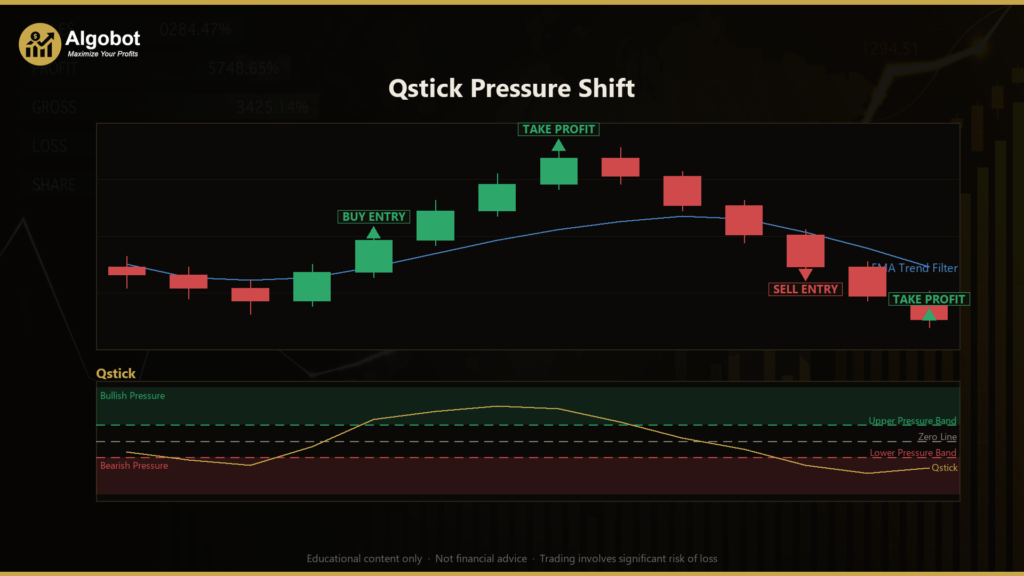
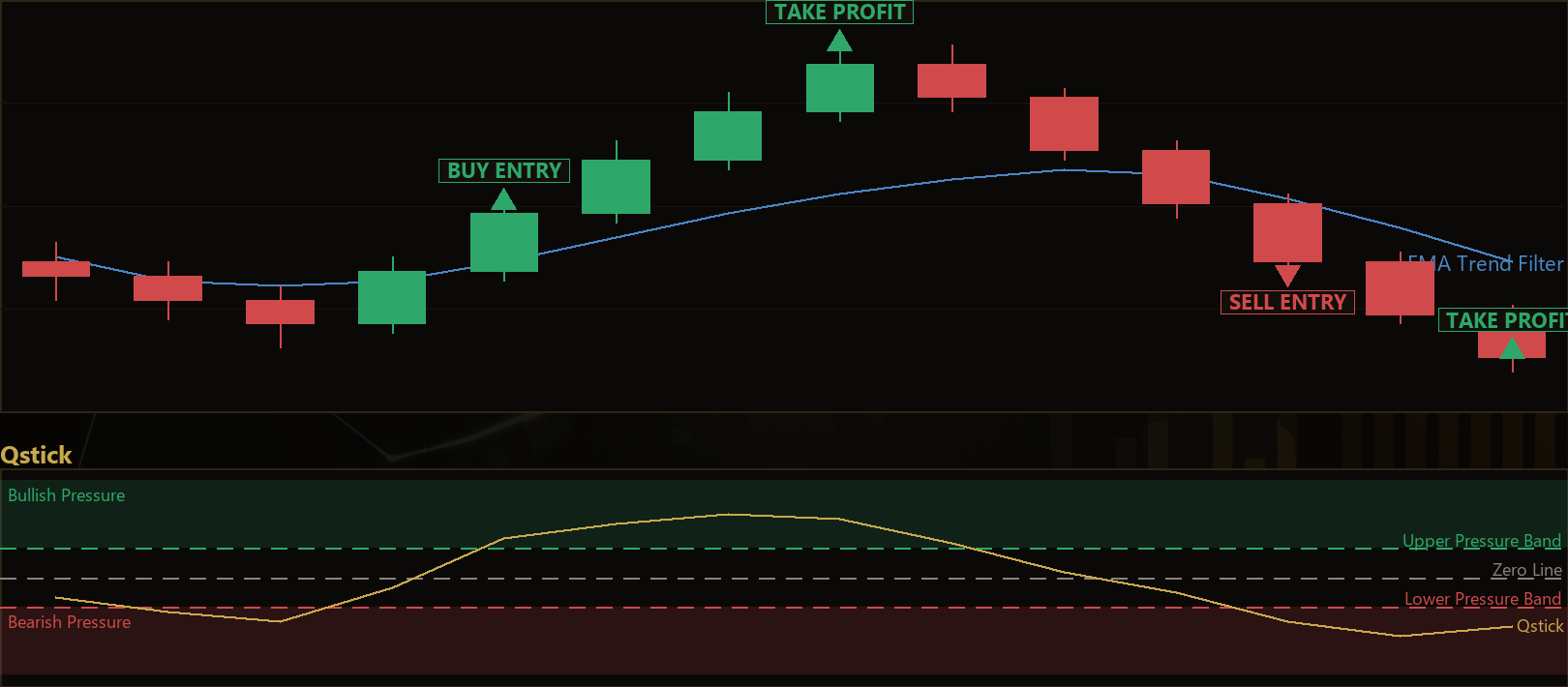
Qstick Pressure Shift is a trend-aligned momentum strategy built around Tushar Chande's Qstick indicator — a simple moving average of each candle's body (the Close minus the Open). Where most oscillators discard the opening price and work only from closes, Qstick keeps the open and reads the raw balance of intrabar buying versus selling. A run of bullish bodies pushes the value positive; a run of bearish bodies pushes it negative. In plain terms, Qstick measures body conviction — how decisively price is being pushed within each bar — that a close-only series never sees.
The strategy is designed for trending markets where directional pressure builds and sustains, rather than choppy, range-bound conditions. It combines three ideas: a volatility-normalised trigger (so the "meaningful" body-run threshold scales with market conditions via the Average True Range, or ATR), a fresh-cross rule that only acts the moment pressure genuinely shifts, and an EMA (Exponential Moving Average) trend filter that keeps trades aligned with the prevailing drift. This layering is what separates it from a bare zero-line crossover.
As a learning tool, Qstick Pressure Shift suits traders who want to study how momentum confirmation and trend filtering can be combined to reduce whipsaw entries. It is a clean, transparent example of turning a classic indicator into a rules-based system with explicit risk controls — useful for anyone learning to read body pressure, volatility scaling, and multi-condition entry logic. It is a study in strategy construction, not a shortcut to returns.
How It Works
The strategy evaluates its rules once per completed bar and trades symmetrically on both the long and short side. Here is what happens step by step.
Entry — the strategy signals a long when all of these align:
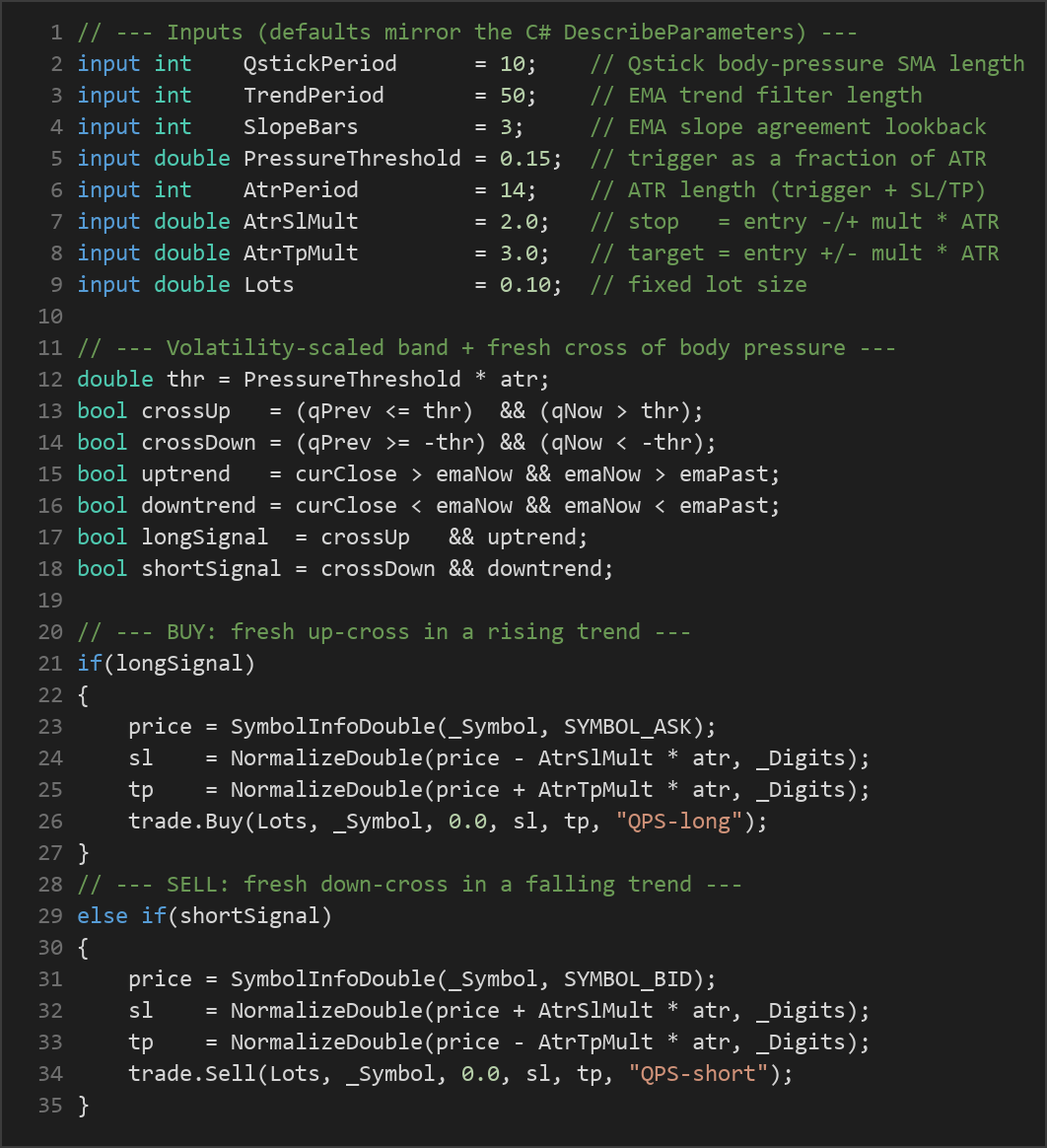
- Fresh upward pressure cross. Qstick was at or below the trigger band on the prior bar and has crossed above it on the just-completed bar. The trigger band is not a fixed number — it is
PressureThreshold × ATR, so it "breathes" with volatility and filters out limp, low-conviction bodies. - Price on the correct side of trend. The candle's close is above the EMA of close.
- Trend sloping the right way. The EMA is higher now than it was
SlopeBarsbars ago, confirming an upward drift.
Entry — the strategy signals a short when the mirror image holds:
- Qstick crosses down through the negative trigger band (
−PressureThreshold × ATR), having been at or above it the prior bar. - The candle's close is below the EMA.
- The EMA is sloping downward over the
SlopeBarslookback.
Exit and trade management:
- Reversal exit. If an opposing fresh pressure cross appears while a position is open (a downward cross during a long, or an upward cross during a short), the strategy closes the trade early rather than waiting for the stop or target.
- Stop-loss. On entry, the stop is placed at
AtrSlMult × ATRaway from the fill price — below entry for longs, above entry for shorts. Because it is ATR-based, the stop distance adapts to current volatility. - Take-profit. The target sits at
AtrTpMult × ATRfrom entry, in the direction of the trade. With the default settings, the target distance is larger than the stop distance. - One position at a time. The strategy holds a single position per magic number and uses fixed-lot sizing, keeping the logic simple and easy to audit.
The combination of a volatility-scaled trigger, a fresh-cross requirement, and a two-part trend filter (direction plus slope) is intended as an anti-whipsaw, drawdown-control layer — the strategy only takes pressure shifts that push with the prevailing trend and skips counter-trend pokes.
Strategy Parameters
| Parameter | Default | Min | Max | Description |
|---|---|---|---|---|
| QstickPeriod | 10 | 4 | 30 | Smoothing length of the Qstick body-pressure average. Shorter values react faster; longer values are steadier. |
| TrendPeriod | 50 | 20 | 200 | EMA length used for the trend filter (both price-side and slope). Larger values define a slower, longer-term trend. |
| SlopeBars | 3 | 1 | 10 | Lookback over which the EMA slope must agree with the trade direction. |
| PressureThreshold | 0.15 | 0.0 | 0.6 | Trigger level as a fraction of ATR. Larger values demand stronger, fewer pressure shifts. |
| AtrPeriod | 14 | 7 | 30 | ATR length used both for the trigger scale and for the stop / target distances. |
| AtrSlMult | 2.0 | 1.0 | 4.0 | Stop-loss distance as a multiple of ATR. |
| AtrTpMult | 3.0 | 1.0 | 6.0 | Take-profit distance as a multiple of ATR. |
| Lots | 0.10 | 0.01 | 1.0 | Fixed lot size per trade. |
The parameter set is deliberately small and broadly ranged. Fewer knobs with wide ranges are intended to resist curve-fitting — the temptation to over-tune a strategy to past data until it looks perfect in hindsight but fails going forward.
Recommended Chart Settings
Qstick Pressure Shift is timeframe-agnostic by design — every internal calculation uses the chart's own timeframe, so the strategy runs on whatever timeframe you attach it to. This makes it well suited to experimentation: you can study its behaviour on an H1 (1-hour) or H4 (4-hour) chart of a major forex pair such as EUR/USD or GBP/USD, where trends tend to be cleaner and spreads are typically tighter.
Higher timeframes (H1 and above) generally produce fewer but more deliberate signals and are a sensible starting point for study, because the ATR-scaled trigger and EMA slope filter have more room to work. Lower timeframes will generate more signals but are noisier and more sensitive to spread and slippage. Whatever you choose, remember that results will vary considerably across symbols, timeframes, and market conditions — a setting that behaves well in one environment may behave very differently in another. Always test on your own broker's data before drawing conclusions.
How to Install on MetaTrader 5
- Download the
.ex5file from the link below. - Copy it to your MT5
MQL5\Expertsfolder. - Restart MetaTrader 5 or refresh the Navigator panel.
- Drag the EA onto a chart matching the recommended symbol and timeframe.
- Configure the input parameters and enable Algo Trading.
What to Consider Before Using This EA
Strengths of this approach. The volatility-scaled trigger is a thoughtful touch: because the threshold is a fraction of ATR rather than a fixed price value, the strategy adapts its definition of "meaningful body pressure" to quiet and volatile regimes alike. The fresh-cross rule avoids entering trades that are already extended, and the two-part EMA filter (price side plus slope) is a reasonable defence against counter-trend entries. ATR-based stops and targets keep risk proportional to current volatility rather than fixed in pips.
Known limitations. Qstick is fundamentally a lagging, smoothed indicator — it averages bodies over a window, so it responds after pressure has already begun to build. In sharp reversals it can be late. The EMA trend filter compounds this lag: by insisting that price and slope both agree, the strategy will often miss the earliest part of a move and may sit out fast, news-driven swings entirely.
Where it may underperform. Like most trend-following momentum systems, this approach is most vulnerable in sideways, range-bound markets, where price repeatedly crosses the EMA and pressure shifts fail to follow through. In those conditions the reversal-exit logic and ATR stops help, but a run of small losing trades ("whipsaw") is still possible. It may also struggle around major economic releases, when volatility spikes can blow through ATR-based stops. Treat it as one lens on the market, not a complete system — and never assume past behaviour will repeat.
Risk Management Tips
Sound risk management matters far more than any single entry signal. As you study this strategy, keep these principles in mind:
- Position sizing. Size each trade so that a full stop-loss loss is a small, survivable fraction of your account. Many educators suggest risking no more than 1–2% of your capital per trade. The fixed-lot default here does not do this automatically — you are responsible for choosing a lot size appropriate to your account and stop distance.
- Use a demo account first. Test the EA on a demo account across many weeks and different market conditions before ever considering live capital. This lets you observe its behaviour without financial consequences.
- Understand drawdown. Every strategy experiences losing streaks. Know how large a drawdown you can tolerate — both financially and emotionally — before you begin, and size accordingly.
- Don't over-optimise. Resist the urge to tune the parameters until a backtest looks flawless. A strategy fitted too tightly to the past often fails on new data.
- Monitor, don't abandon. Automated does not mean unattended. Check that the EA is behaving as expected, especially around high-impact news and low-liquidity sessions.
The goal of studying a strategy like this is to learn how rules-based trading works — how signals, filters, and risk controls interact — not to find a shortcut. Approach it with curiosity and caution in equal measure.
Risk Warning
Trading foreign exchange, CFDs, and other leveraged financial instruments involves substantial risk of loss and is not suitable for all investors. The strategies and tools discussed on this page are provided for educational purposes only and do not constitute financial advice, investment recommendations, or solicitation to trade. Always consult a qualified financial adviser before making trading decisions. Past backtest performance is not indicative of future results.
Downloads
- Expert Advisor: QstickPressureShift.ex5 (39 downloads)
- Source Code: QstickPressureShift.mq5 (40 downloads)
- Documentation: QstickPressureShift.pdf (41 downloads)