Disclaimer: This article is for educational and informational purposes only. It does not constitute financial or investment advice. Trading forex and CFDs carries significant risk of loss. Past performance of any strategy — including backtests — does not guarantee future results. Never trade with money you cannot afford to lose.
What Is This Strategy?
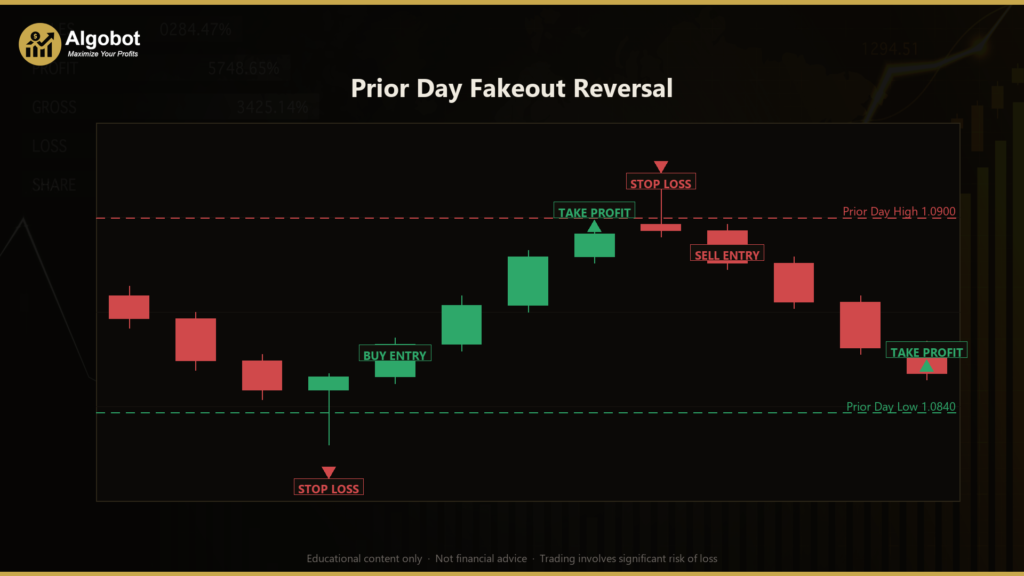
The Prior Day Fakeout Reversal is a pure price-action reversal strategy that fades failed breakouts of the previous calendar day's trading range — using no technical indicators at all. Its entire logic is built on two of the most widely watched reference levels in intraday trading: the prior day's High (PDH) and the prior day's Low (PDL). Instead of trying to predict direction in advance, the strategy waits for the market to attempt a breakout beyond one of these levels and then reverses sharply back inside the range, signaling a "fakeout" — a probe that failed to follow through.
The market condition this approach is designed for is the range-and-reject environment that often appears on intraday foreign exchange (FX) charts. When price pokes just above the prior day's High and then closes back below it on a bearish candle, the buyers who chased that breakout are now trapped — their stop-loss orders sit just beyond the level, creating a pool of resting liquidity. The strategy interprets that failed push as exhaustion and fades the move in the opposite direction. The mirror logic applies below the prior day's Low.
As a learning tool, this EA is well suited to traders who want to study support and resistance, liquidity sweeps, and reversal candles in a clearly defined, rules-based way. Because every threshold is expressed as a fraction of the prior-day range rather than a fixed pip value, the logic is symbol- and timeframe-agnostic, though it was built with intraday FX such as EUR/USD on the M15–H1 timeframes in mind. This article frames the strategy as an analytical study of a classic price-action pattern, not as a profit opportunity.
How It Works
The strategy evaluates conditions once per newly closed bar and only ever holds one position at a time, letting the stop-loss and take-profit manage each trade to completion. Here is the step-by-step logic in plain English:
- Build the prior-day range. From the bars on your chart, the strategy identifies the previous calendar day and records its highest High (PDH) and lowest Low (PDL). This range becomes the reference frame for every calculation.
- Watch the just-closed bar. The most recently completed candle is treated as the candidate "fakeout" bar. Its open, high, low, and close are compared against the prior-day levels.
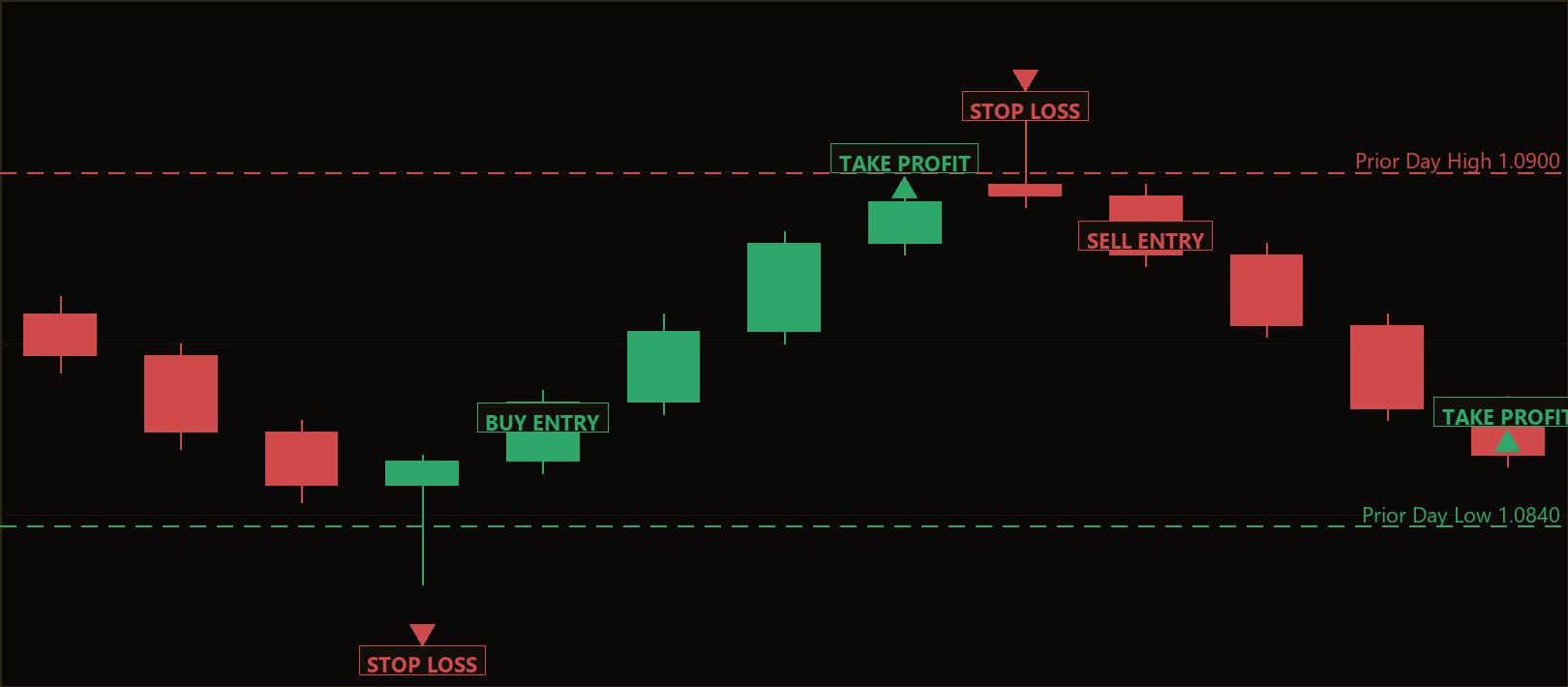
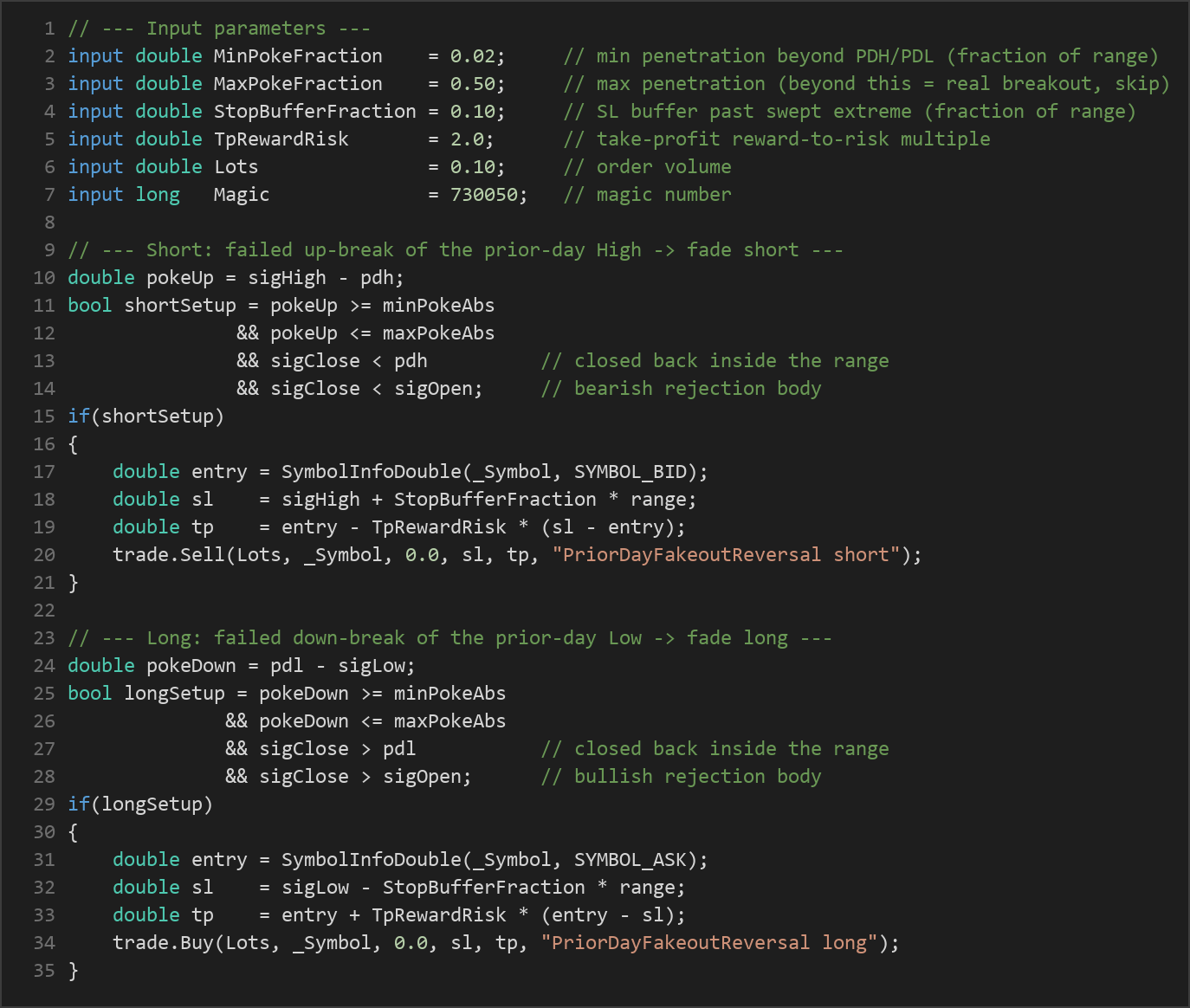
- Short setup (failed up-break). The strategy signals a short when the candle's High pierces above the PDH by a meaningful but bounded amount, and the candle closes back below the PDH, and the candle has a bearish body (close below open). This combination suggests a rejected breakout above resistance.
- Long setup (failed down-break). The mirror condition signals a long when the candle's Low pierces below the PDL by a bounded amount, and the candle closes back above the PDL, and the candle has a bullish body (close above open).
- Bounded penetration filter. The poke beyond the level must fall between
MinPokeFractionandMaxPokeFractionof the prior-day range. A penetration that is too small is just a touch and is ignored; a penetration that is too large is treated as a genuine breakout and skipped. Only an in-between probe qualifies as a fakeout.
Stop-loss logic: For a short, the stop is placed just above the swept High, offset by StopBufferFraction of the prior-day range. For a long, the stop sits just below the swept Low by the same buffer. This places the protective stop on the far side of the liquidity that was just probed.
Take-profit logic: The distance from entry to stop defines the trade's risk. The take-profit is set at a fixed reward-to-risk multiple (TpRewardRisk) of that risk distance — for example, a default of 2.0 targets twice the risk. Once a position is open, it is left to reach either its stop or its target with no further intervention.
Strategy Parameters
| Parameter | Default | Min | Max | Description |
|---|---|---|---|---|
| MinPokeFraction | 0.02 | 0.0 | 0.30 | Minimum penetration beyond PDH/PDL, as a fraction of the prior-day range, so a barely-touching wick is not treated as a genuine liquidity probe. |
| MaxPokeFraction | 0.50 | 0.10 | 1.50 | Maximum penetration beyond the level. Beyond this the move is treated as a real breakout rather than a fakeout, and the signal is skipped. |
| StopBufferFraction | 0.10 | 0.0 | 0.50 | Stop-loss buffer placed past the swept extreme, expressed as a fraction of the prior-day range. |
| TpRewardRisk | 2.0 | 0.5 | 5.0 | Take-profit reward-to-risk multiple. A value of 2.0 targets a profit distance twice the size of the risk distance. |
| Lots | 0.10 | 0.01 | 1.0 | Order volume (position size) in lots for each trade. |
Recommended Chart Settings
This strategy was designed with intraday FX in mind, and the most natural fit is a liquid major pair such as EUR/USD on the M15 to H1 timeframes. These timeframes produce enough bars per day to define a clean prior-day range while still generating candles whose bodies and wicks meaningfully reflect breakout attempts. Because all thresholds scale with the prior-day range, the EA can be attached to other symbols and timeframes, but its behavior will differ on each. Results will vary across different market conditions, instruments, and broker feeds, so any new combination should be studied carefully before use.
How to Install on MetaTrader 5
- Download the .ex5 file from the link below
- Copy it to your MT5
MQL5\Expertsfolder - Restart MetaTrader 5 or refresh the Navigator panel
- Drag the EA onto a chart matching the recommended symbol and timeframe
- Configure the input parameters and enable Algo Trading
What to Consider Before Using This EA
The main strength of the Prior Day Fakeout Reversal is its clarity. It uses no lagging indicators, relies on universally watched reference levels, and expresses every threshold relative to the prior-day range, which keeps the logic consistent across instruments. The bounded-penetration filter is a thoughtful touch: by requiring the poke to be neither too small nor too large, the strategy attempts to isolate genuine liquidity sweeps from both noise and true trend breakouts. For a learning trader, this is a clean, transparent way to study how failed breakouts behave.
The approach also has well-understood limitations. Fakeout and reversal patterns are inherently counter-trend, which means the strategy may struggle in strongly trending markets where price breaks the prior-day High or Low and simply keeps going — the very scenario the MaxPokeFraction filter tries, imperfectly, to avoid. Because it acts on the close of a single candle, the quality of signals depends heavily on the chosen timeframe and on how the broker's server clock defines the "day" boundary, which can shift the prior-day range. The fixed reward-to-risk target makes no attempt to read momentum or volatility once a trade is open, so winning moves that stall short of target may still reverse into the stop. Performance can also degrade around major news releases, during low-liquidity sessions, and on instruments with wide or unstable spreads. None of these points should be read as dismissing the method — they are simply the conditions where this pattern historically tends to underperform and where careful testing matters most.
Risk Management Tips
Sound risk management is more important than any single entry signal. Consider these general educational principles:
- Position sizing: Choose a lot size that keeps the monetary risk of each trade small relative to your account. The default
Lotsvalue is a starting point, not a recommendation. - The 1–2% rule: Many educators suggest risking no more than 1–2% of account equity on any single trade, so that a string of losses does not threaten the account.
- Use a demo account first: Test the strategy on a demo or simulated environment until you understand how it behaves across different sessions and market conditions before considering real capital.
- Understand drawdown: Every strategy experiences losing streaks. Study the historical drawdown of any approach and ask whether you could tolerate that decline emotionally and financially.
- Account for costs: Spreads, commissions, and slippage all affect real outcomes and are often understated in idealized testing.
Risk Warning
Trading foreign exchange, CFDs, and other leveraged financial instruments involves substantial risk of loss and is not suitable for all investors. The strategies and tools discussed on this page are provided for educational purposes only and do not constitute financial advice, investment recommendations, or solicitation to trade. Always consult a qualified financial adviser before making trading decisions. Past backtest performance is not indicative of future results.
Downloads
- Expert Advisor: PriorDayFakeoutReversal.ex5 (41 downloads)
- Source Code: PriorDayFakeoutReversal.mq5 (40 downloads)
- Documentation: PriorDayFakeoutReversal.pdf (44 downloads)