Disclaimer: This article is for educational and informational purposes only. It does not constitute financial or investment advice. Trading forex and CFDs carries significant risk of loss. Past performance of any strategy — including backtests — does not guarantee future results. Never trade with money you cannot afford to lose.
What Is This Strategy?
The Price Impact Conviction Trend strategy is a trend-continuation system built around Amihud's price-impact ratio, a market-microstructure measure of illiquidity that expresses how much price moved for each unit of volume traded. In plain terms, price impact is return-per-volume: the size of a bar's move divided by the number of ticks (tick volume) that produced it. This is deliberately different from raw volume-surge systems, and that difference is the entire idea behind the strategy.
The logic is counter-intuitive at first glance. A large price move on thin volume produces a high impact reading — the market could not absorb real order flow, so the move is often a liquidity "air-pocket" that tends to snap back. A large price move on heavy volume produces a low impact reading — genuine participants transacted into the move and it barely cost them slippage per lot. The strategy hunts specifically for that second animal: a conviction bar where a meaningful directional thrust was efficiently absorbed by volume, because historically that kind of informed flow is the kind that continues. Because the trigger is normalized by volume, it self-scales, reading a quiet EURUSD session and a volatile XAUUSD session on the same footing.
This EA is best understood as a learning tool for traders who want to study how volume-normalized momentum, an EMA trend baseline, and Average True Range (ATR) risk sizing can be combined into a single rules-based framework. It is not a shortcut to results, and it is not a "set and forget" solution — it is a transparent example of applying an academic microstructure concept to a practical trend-following filter.
How It Works
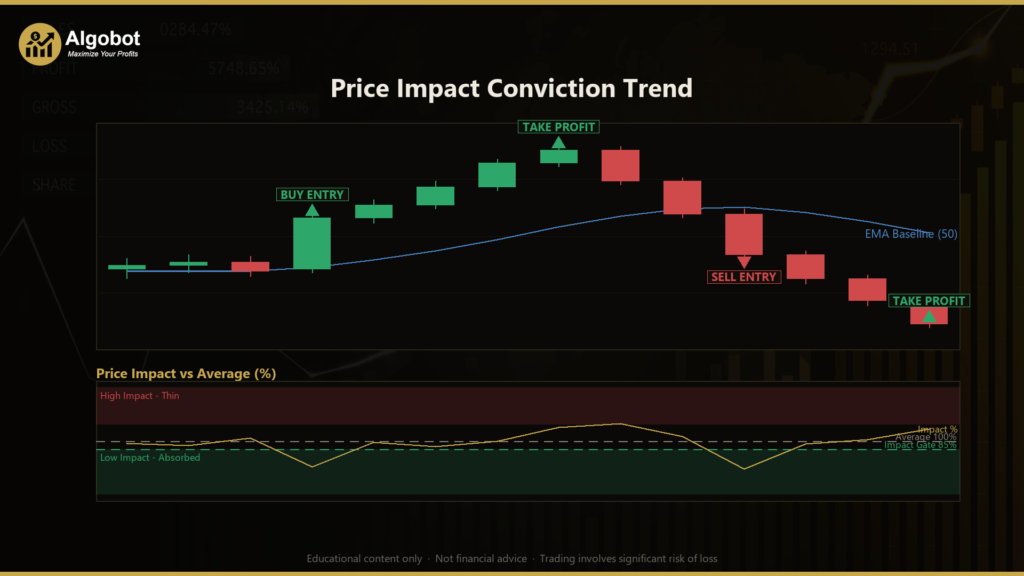
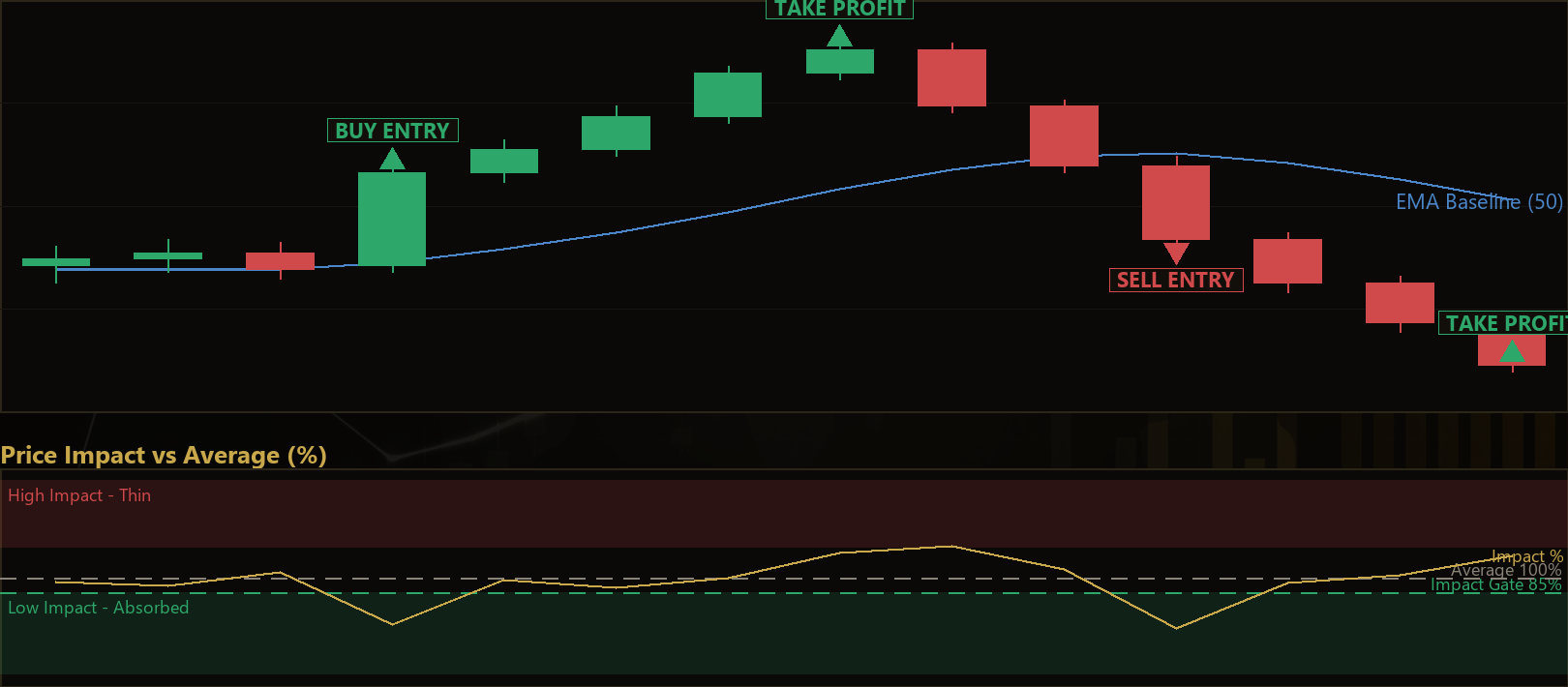
The strategy evaluates only completed bars on a single timeframe (the chart's timeframe). On each newly-closed bar it recomputes the impact ratio, the ATR, and the EMA baseline, then checks for a conviction bar. Here is what the strategy signals and how it manages a trade:
- Impact measurement: For each bar, the strategy computes
Impact = |Close − PreviousClose| / TickVolume. It maintains a rolling average of this ratio over theImpactPeriodwindow to define what "normal" impact looks like for the current market. - Long entry — the strategy signals a long when all of these align:
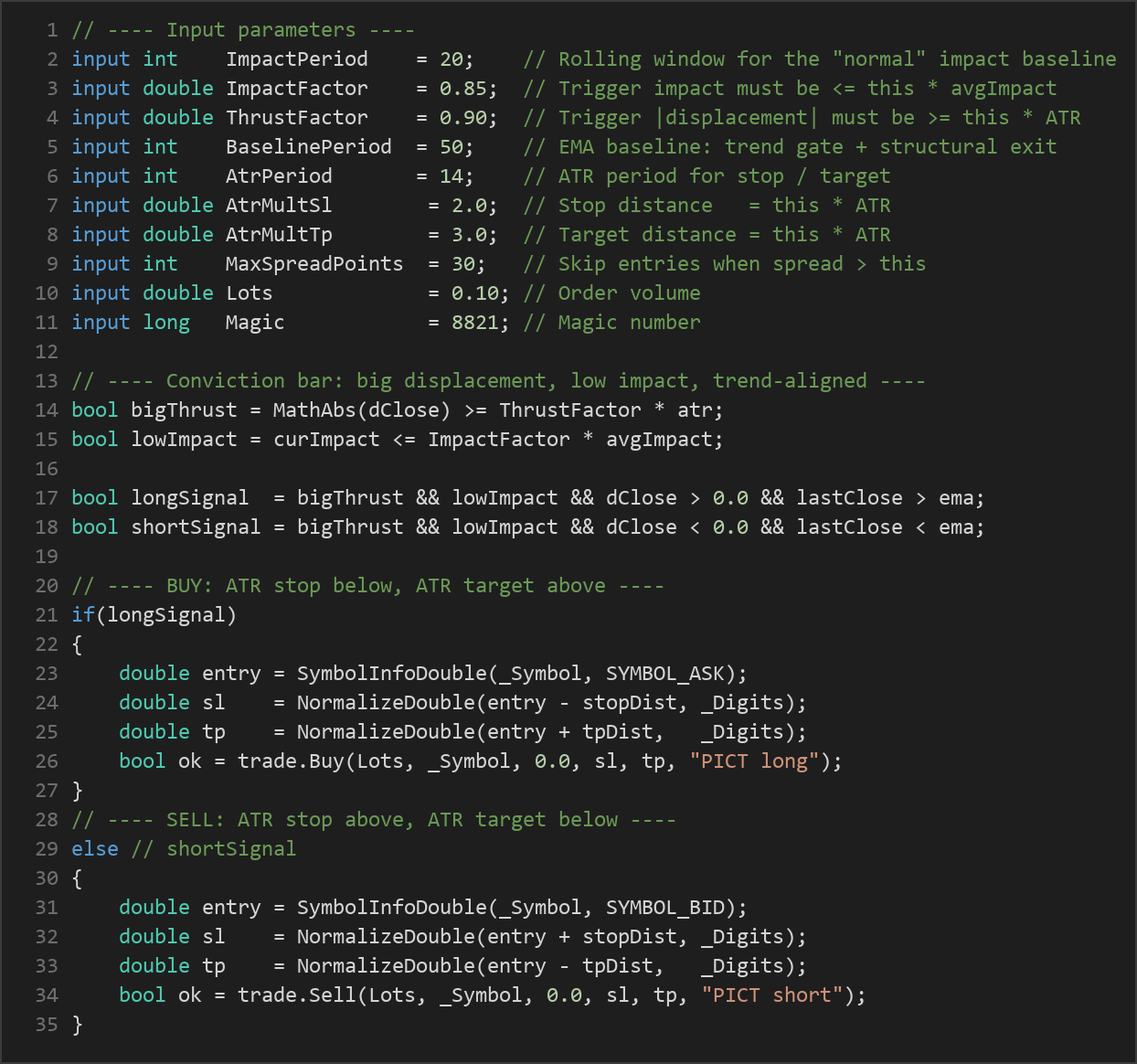
- Big thrust: the bar's directional displacement is at least
ThrustFactor × ATR(a genuine move, not baseline noise). - Low impact: the bar's impact is at or below
ImpactFactor × average impact(the move was efficiently absorbed by volume). - Upward displacement: the close is higher than the previous close (direction comes from the sign of the move).
- Trend agreement: the close is above the EMA baseline, so the strategy rides the prevailing trend rather than fading it.
- Short entry: the mirror image — a big downward thrust, low impact, a lower close, and price below the EMA baseline. The system is fully symmetric.
- Structural exit: an open long is closed the moment price loses the EMA baseline (closes back below it) or a fresh opposite conviction bar prints. Shorts exit on the same logic in reverse. This "structure broke" rule is designed to end the ride when the trend premise no longer holds.
- Stop-loss: placed at
AtrMultSl × ATRaway from entry, so the protective stop widens in volatile conditions and tightens in quiet ones. - Take-profit: placed at
AtrMultTp × ATRaway from entry as a backstop for a runaway leg. The default target is wider than the stop, giving the position room to trend. - Spread filter: fresh entries are skipped when the current spread (in points) exceeds
MaxSpreadPoints, helping avoid poor fills during thin conditions. - One position per magic: the strategy holds a single position at a time, letting the ATR stop and target manage the trade once it is open.
Strategy Parameters
| Parameter | Default | Min | Max | Description |
|---|---|---|---|---|
| ImpactPeriod | 20 | 8 | 80 | Rolling window (in bars) that defines the "normal" per-bar price-impact baseline. |
| ImpactFactor | 0.85 | 0.30 | 1.50 | Conviction gate: the trigger bar's impact must be at or below this multiple of average impact. Lower is stricter. |
| ThrustFactor | 0.90 | 0.30 | 2.50 | The trigger bar's directional displacement must be at least this multiple of ATR to count as a genuine thrust. |
| BaselinePeriod | 50 | 10 | 200 | EMA baseline period that keeps entries trend-aligned and doubles as the structural exit. |
| AtrPeriod | 14 | 5 | 40 | ATR period used for the protective stop and target. |
| AtrMultSl | 2.0 | 0.5 | 6.0 | Stop-loss distance as a multiple of ATR. |
| AtrMultTp | 3.0 | 0.5 | 10.0 | Take-profit distance as a multiple of ATR (backstop for a runaway move). |
| MaxSpreadPoints | 30 | 0 | 200 | Skip entries when the spread (points) is wider than this (0 disables the filter). |
| Lots | 0.10 | 0.01 | 1.00 | Fixed order volume in lots. |
| Magic | 8821 | 0 | 9,999,999 | Magic number identifying this EA's positions. |
Recommended Chart Settings
The Price Impact Conviction Trend strategy is timeframe-agnostic by design — every calculation uses the chart's timeframe, so it runs on whatever timeframe you attach it to. Because the trigger is volume-normalized, it adapts to instruments with very different volatility profiles. A common starting point for study is a major FX pair such as EURUSD or a volatile instrument such as XAUUSD (gold) on an intraday timeframe like M15, M30, or H1, where tick volume is meaningful and trends develop with enough room for the ATR stop and target.
Keep in mind that the strategy relies on tick volume, which is a broker-side proxy for real traded volume in the decentralized forex market. Different brokers report tick volume differently, so behavior can vary between feeds. As with any strategy, results will vary across symbols, timeframes, and market conditions, and any settings should be validated on your own broker's data before further study.
How to Install on MetaTrader 5
- Download the .ex5 file from the link below
- Copy it to your MT5
MQL5\Expertsfolder - Restart MetaTrader 5 or refresh the Navigator panel
- Drag the EA onto a chart matching the recommended symbol and timeframe
- Configure the input parameters and enable Algo Trading
What to Consider Before Using This EA
Every approach has trade-offs, and understanding them is part of learning to evaluate a strategy critically.
Strengths of this approach:
- Volume-aware momentum. By normalizing displacement by tick volume, the strategy attempts to distinguish absorbed, informed moves from thin liquidity spikes — a distinction that pure price- or volume-surge systems ignore.
- Self-scaling. The ATR- and impact-relative thresholds mean the same parameters can read quiet and volatile markets on comparable terms.
- Defined risk on every trade. An ATR-based stop, an ATR-based target, and an EMA structural exit are built in, so the exit logic is explicit rather than discretionary.
- Trend-aligned by rule. The EMA baseline gate keeps the system riding trends rather than fighting them.
Known limitations:
- Tick volume is a proxy. Forex has no centralized volume, so the impact ratio is only as reliable as your broker's tick-volume feed. This is an inherent limitation of the underlying data, not the code.
- Whipsaw in ranges. Like all trend-continuation systems, it can generate losing trades in choppy, directionless markets where price repeatedly crosses the EMA baseline.
- Parameter sensitivity. The
ImpactFactorandThrustFactorthresholds materially change how often signals fire. Overly loose settings may produce noise; overly strict settings may produce very few trades. - Single position, single timeframe. The strategy trades one position at a time on one timeframe, so it does not diversify signals or confirm across higher timeframes.
The strategy may underperform during low-volatility consolidations, around major news spikes that distort both price and volume, and during periods when tick-volume reporting is unusually noisy. Treat it as a framework to study and stress-test, not a finished product.
Risk Management Tips
Sound risk management matters more than any single indicator. As you study this strategy, keep these general principles in mind:
- Risk a small fraction per trade. A widely taught guideline is to risk no more than 1–2% of account equity on any single position. Size your lots so the ATR stop distance fits within that limit rather than using a fixed lot size blindly.
- Test on a demo account first. Run the EA on a demo or paper account across different market conditions before considering any live use, so you can observe its behavior without financial exposure.
- Understand drawdown. Every strategy experiences losing streaks. Study the maximum drawdown you would have to tolerate and ask honestly whether you could stick with the rules through it.
- Account for costs. Spread, slippage, and swap fees all erode results. The built-in spread filter helps, but real-world execution can still differ from backtested assumptions.
- Change one variable at a time. When experimenting with parameters, adjust a single input and observe the effect rather than changing many at once, so you can understand what each control actually does.
- Never over-leverage. Leverage magnifies both gains and losses. Use only what you can manage, and never trade with money you cannot afford to lose.
Risk Warning
Trading foreign exchange, CFDs, and other leveraged financial instruments involves substantial risk of loss and is not suitable for all investors. The strategies and tools discussed on this page are provided for educational purposes only and do not constitute financial advice, investment recommendations, or solicitation to trade. Always consult a qualified financial adviser before making trading decisions. Past backtest performance is not indicative of future results.
Downloads
- Expert Advisor: PriceImpactConvictionTrend.ex5 (59 downloads)
- Source Code: PriceImpactConvictionTrend.mq5 (70 downloads)
- Documentation: PriceImpactConvictionTrend.pdf (61 downloads)