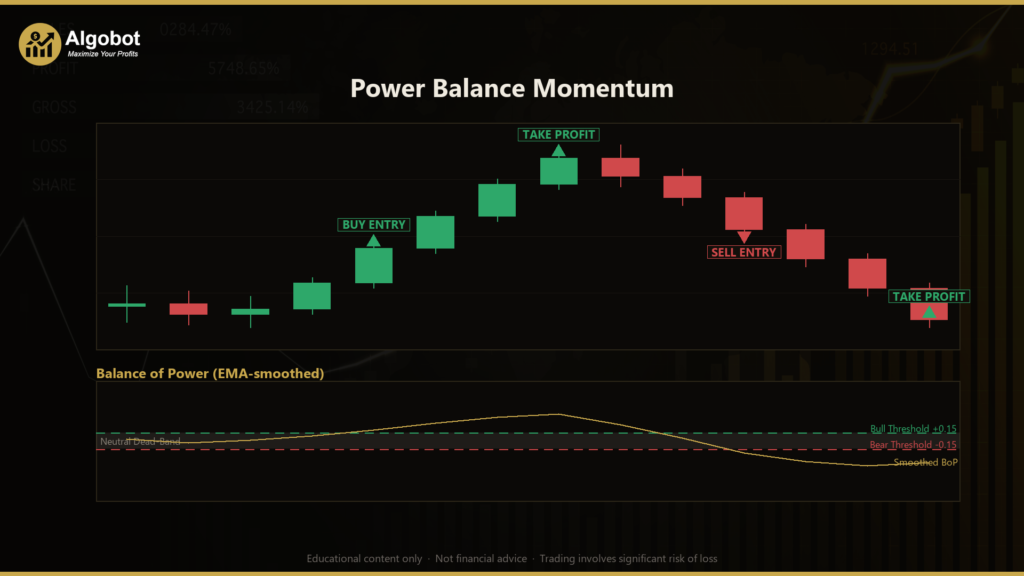
Disclaimer: This article is for educational and informational purposes only. It does not constitute financial or investment advice. Trading forex and CFDs carries significant risk of loss. Past performance of any strategy — including backtests — does not guarantee future results. Never trade with money you cannot afford to lose.
What Is This Strategy?
Power Balance Momentum is a momentum, trend-following strategy built around the Balance of Power (BoP) indicator — a pure price-action gauge that measures who won each finished candle. For every completed bar, Balance of Power is calculated as (Close − Open) / (High − Low), producing a value between −1 and +1. A reading near +1 means buyers dragged price from the session low all the way to the high (strong bullish conviction), while a reading near −1 means sellers dominated the bar. In this way, the indicator reads the internal "tug of war" of a candle rather than just its closing price.
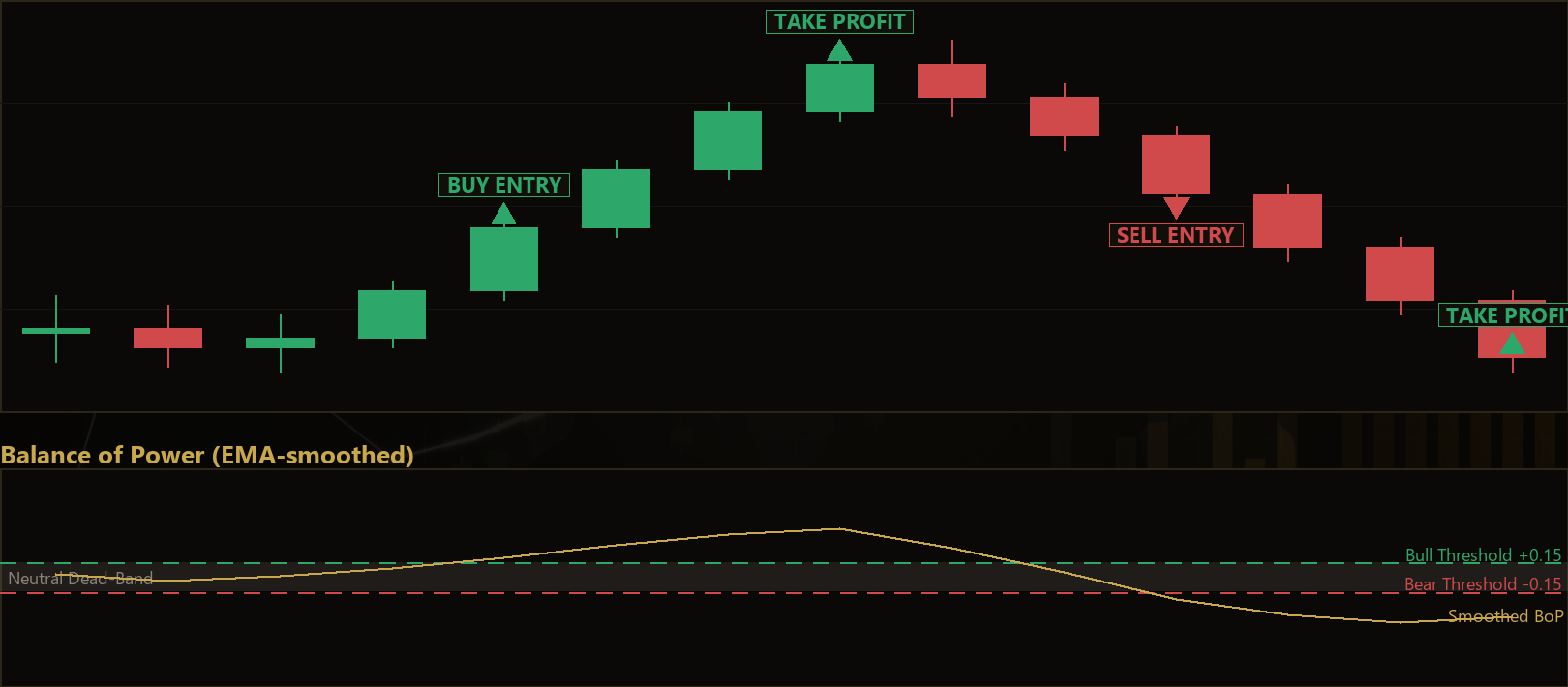
Because raw Balance of Power jumps around from bar to bar, Power Balance Momentum smooths it with an Exponential Moving Average (EMA) — a moving average that weights recent bars more heavily than older ones. The strategy then watches for the smoothed BoP line to push decisively through a positive or negative threshold. When momentum tips convincingly toward one side, the strategy signals a trade in that direction; when the reading sits near zero, a neutral "dead-band" keeps the strategy out of choppy, balanced conditions where neither buyers nor sellers are in control.
This makes Power Balance Momentum most suitable as a learning tool for traders studying momentum and trend-following behaviour, particularly on intraday forex or index charts. If you want to understand how order-flow conviction can be quantified from ordinary OHLC (open-high-low-close) data — and how a dead-band filter reduces noise — this strategy is a clean, readable example. It is a study of a trading concept, not a shortcut to returns.
How It Works
The strategy evaluates its logic once per newly-formed bar and builds every signal on the just-closed candle, so it never acts on incomplete data. Here is what happens on each finished bar:
- Measure conviction: The strategy computes Balance of Power for the closed bar:
(Close − Open) / (High − Low). If the bar has no range (high equals low), BoP is treated as zero. - Smooth the signal: It applies an EMA (length set by
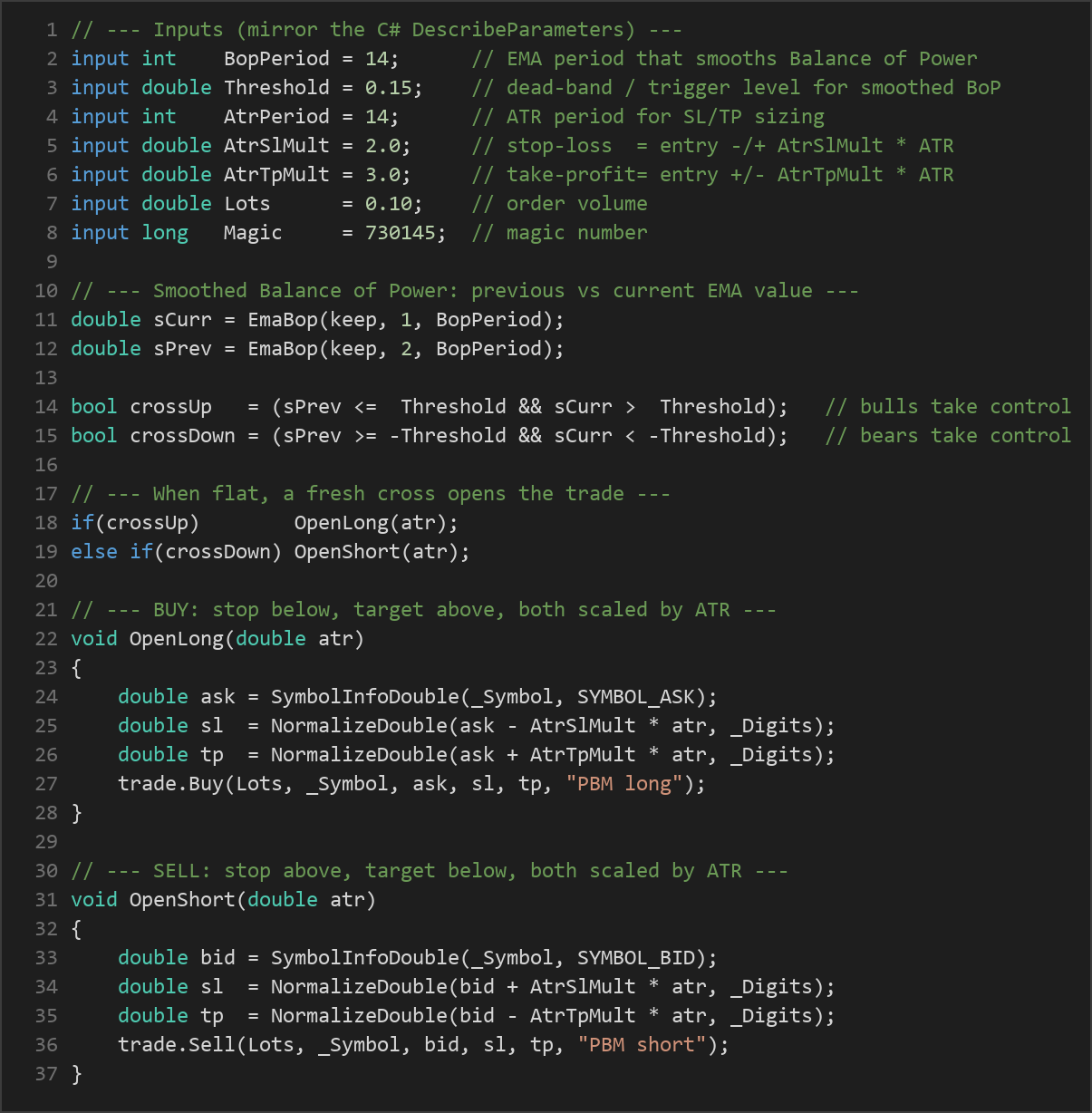
BopPeriod) over the rolling series of BoP values to produce a smoothed momentum line, tracking both its current and previous value. - Bullish entry — a cross up: When the smoothed BoP was at or below the positive
Thresholdon the prior bar and rises above it on the current bar, control has flipped decisively to the bulls. If no position is open, the strategy signals a long entry. - Bearish entry — a cross down: When the smoothed BoP was at or above the mirror-image negative
Thresholdand falls below it, sellers have taken charge. If flat, the strategy signals a short entry. - Neutral dead-band: While the smoothed BoP stays between the negative and positive thresholds, the strategy stays out. This filters balanced, indecisive bars where momentum has no clear owner.
- Position reversal: If a trade is already open, the strategy does not stack new orders. Instead, it reverses only when momentum flips to the opposite side — closing a long and opening a short on a cross down, or closing a short and opening a long on a cross up. This keeps the book aligned with the prevailing momentum.
Stop-loss and take-profit logic are sized using the Average True Range (ATR) — a volatility measure of how far price typically travels per bar:
- For a long trade, the stop-loss is placed at
entry − (AtrSlMult × ATR)and the take-profit atentry + (AtrTpMult × ATR). - For a short trade, the stop-loss is placed at
entry + (AtrSlMult × ATR)and the take-profit atentry − (AtrTpMult × ATR).
Because exits scale with ATR, the stop and target automatically widen in volatile conditions and tighten in calm ones, rather than using fixed pip distances.
Strategy Parameters
| Parameter | Default | Min | Max | Description |
|---|---|---|---|---|
| BopPeriod | 14 | 5 | 40 | EMA length used to smooth the raw Balance of Power series. Higher values produce a steadier, slower signal; lower values react faster but are noisier. |
| Threshold | 0.15 | 0.0 | 0.5 | The trigger level and neutral dead-band for the smoothed BoP. The smoothed line must cross above +Threshold (long) or below −Threshold (short) to signal. Larger values demand stronger conviction. |
| AtrPeriod | 14 | 5 | 30 | Number of bars used to calculate the Average True Range for stop-loss and take-profit sizing. |
| AtrSlMult | 2.0 | 0.5 | 5.0 | Stop-loss distance as a multiple of ATR. A larger multiple gives the trade more room but risks more per position. |
| AtrTpMult | 3.0 | 0.5 | 8.0 | Take-profit distance as a multiple of ATR. Combined with the SL multiple, this sets the reward-to-risk profile of each trade. |
| Lots | 0.10 | 0.01 | 2.0 | Fixed order volume (position size) for each trade, expressed in lots. |
Recommended Chart Settings
Power Balance Momentum was designed as a momentum / trend-following strategy for the primary chart timeframe, and it tends to be studied on intraday forex pairs or index charts — for example, a major FX pair such as EUR/USD on an intraday timeframe like M15, M30, or H1. Because the strategy reads one signal per closed bar, the chosen timeframe directly sets its trading cadence: faster timeframes generate more frequent signals and more noise, while higher timeframes produce fewer, slower signals.
There is no single "correct" symbol or timeframe. The default parameters are a reasonable starting point for study, but the character of every market differs, and results will vary considerably across instruments, sessions, and changing market conditions. Treat any chart setting as a hypothesis to be tested, not a recommendation.
How to Install on MetaTrader 5
- Download the
.ex5file from the link below. - Copy it to your MT5
MQL5\Expertsfolder. - Restart MetaTrader 5 or refresh the Navigator panel.
- Drag the EA onto a chart matching the recommended symbol and timeframe.
- Configure the input parameters and enable Algo Trading.
What to Consider Before Using This EA
Every approach has trade-offs, and Power Balance Momentum is no exception.
Strengths of the approach. Balance of Power is computed directly from OHLC data, so it requires no exotic inputs and is easy to reason about — a good property for a learning tool. The EMA smoothing and the neutral dead-band together aim to keep the strategy out of directionless chop, which is a common failure point for raw momentum signals. ATR-based exits are also adaptive, adjusting stop and target distances to current volatility instead of relying on fixed levels.
Known limitations. Like all momentum and trend-following methods, this strategy is designed for markets that actually trend. In range-bound or whipsawing conditions, the smoothed BoP can cross the threshold, trigger a trade, and then reverse — producing a string of small losing trades. The reversal-on-opposite-cross logic means the strategy is frequently in the market, which can increase exposure to spread and commission costs. It also holds a single position at a time and does not scale in or out, so its behaviour depends heavily on how well the Threshold, ATR multiples, and timeframe suit the instrument.
Where it may underperform. Expect weaker results during low-volatility consolidation, around major news spikes that gap through stops, and in markets that lack sustained directional follow-through. No fixed set of parameters performs well in every regime, so this EA should be viewed as a framework for study and experimentation rather than a finished, plug-in system.
Risk Management Tips
Sound risk management matters far more than any single entry rule. Whatever strategy you study, keep these principles in mind:
- Size positions deliberately. A common educational guideline is to risk no more than 1–2% of account equity per trade. Set your lot size so that the distance to your stop-loss keeps any single loss within that limit.
- Test on a demo account first. Run the strategy on a demo or paper account long enough to understand its behaviour across different market conditions before considering any live capital.
- Understand drawdown. Even a well-designed momentum strategy will experience losing streaks and equity drawdowns. Know in advance how much decline you are prepared to tolerate, and how you would respond.
- Account for costs. Because this strategy can trade frequently and reverse positions, spread, commission, and slippage can meaningfully affect outcomes. Include realistic costs in any testing.
- Never over-leverage. Leverage amplifies both gains and losses. Use it conservatively, and never trade with money you cannot afford to lose.
Risk Warning
Trading foreign exchange, CFDs, and other leveraged financial instruments involves substantial risk of loss and is not suitable for all investors. The strategies and tools discussed on this page are provided for educational purposes only and do not constitute financial advice, investment recommendations, or solicitation to trade. Always consult a qualified financial adviser before making trading decisions. Past backtest performance is not indicative of future results.
Downloads
- Expert Advisor: PowerBalanceMomentum.ex5 (43 downloads)
- Source Code: PowerBalanceMomentum.mq5 (46 downloads)
- Documentation: PowerBalanceMomentum.pdf (44 downloads)