Disclaimer: This article is for educational and informational purposes only. It does not constitute financial or investment advice. Trading forex and CFDs carries significant risk of loss. Past performance of any strategy — including backtests — does not guarantee future results. Never trade with money you cannot afford to lose.
What Is This Strategy?
The Pivot Momentum Breakout strategy is a breakout trading system that combines classic Pivot Points — an objective ladder of support and resistance levels used by floor traders for decades — with the Relative Strength Index (RSI), a momentum oscillator that measures the speed and strength of recent price moves. Rather than reacting to a level being touched, the strategy waits for price to close through a pivot level and only acts when momentum confirms that the move has genuine drive behind it.
The reasoning behind this design is simple: a raw breakout of a support or resistance level is a notoriously noisy signal. Many "pokes" through the first resistance (R1) or first support (S1) fail and snap straight back, trapping breakout traders. By adding RSI as a momentum gate, the Pivot Momentum Breakout strategy attempts to filter out those weak, exhausted breaks and focus only on moves where buyers (or sellers) are clearly in control. Once in a trade, it runs the position structurally — from one pivot level to the next — rather than guessing at an arbitrary profit target.
This strategy is best understood as a learning tool for traders who want to study how level-based breakout logic and momentum confirmation can be combined into a rules-based system. It suits intermediate students of technical analysis who already understand support and resistance and want to see how those ideas translate into an automated MetaTrader 5 Expert Advisor (EA). It is designed for trending or momentum-driven conditions on liquid markets, and it is not a "set and forget" money machine — it is a structured framework for analysis and education.
How It Works
The strategy rebuilds its pivot ladder on every newly-closed bar, using only the primary timeframe (no higher timeframe is read). The pivots are calculated from a rolling window of bars that ends on the bar before the breakout bar, so the level being broken was already fixed before the break happened. The formulas are the classic floor-trader pivots:
- Pivot (P) = (High + Low + Close) ÷ 3
- R1 = (2 × P) − Low, and S1 = (2 × P) − High
- R2 = P + (High − Low), and S2 = P − (High − Low)
Here, High, Low, and Close refer to the range and close of the rolling lookback window.
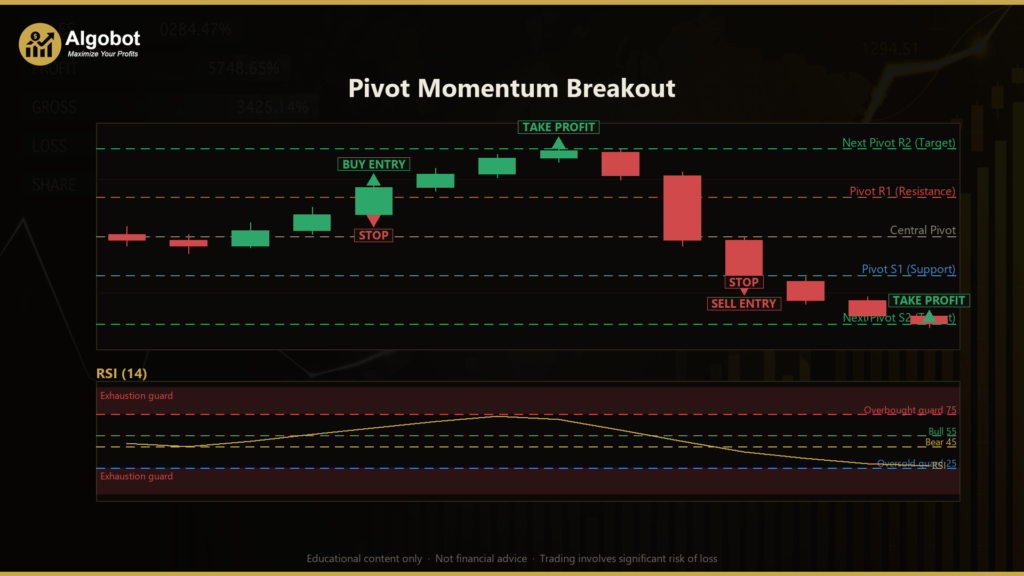
The strategy signals a long (buy) entry when all of the following are true:
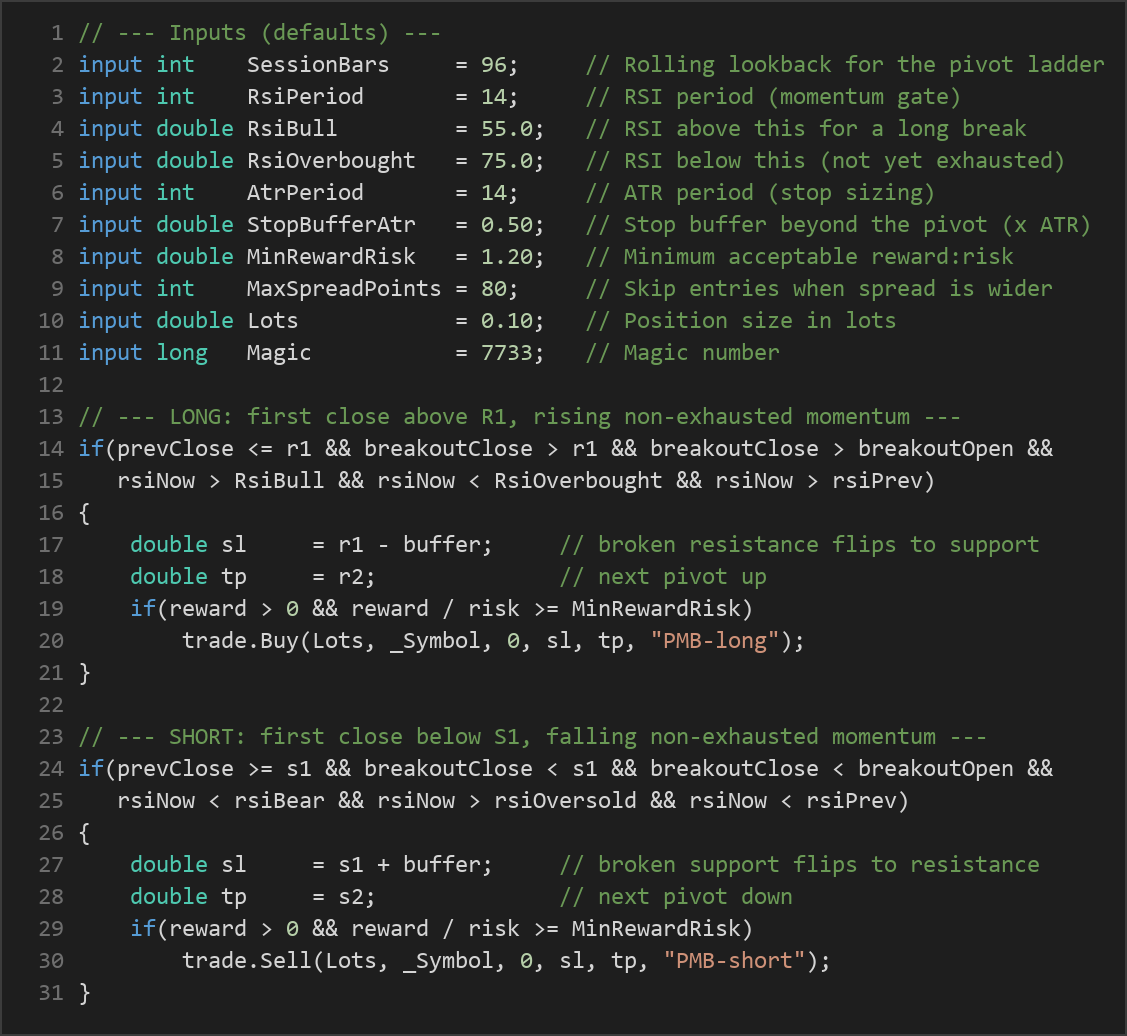
- The just-closed bar is the first to close above R1 (the prior bar's close was at or below R1) — a fresh breakout, not a continuation.
- The breakout bar is bullish (it closed above its open).
- RSI is above the bullish threshold (default 55), indicating momentum is present.
- RSI is still rising compared to the previous bar — momentum is building, not fading.
- RSI is not yet overbought (below the default 75), because an exhausted break tends to snap back.
The strategy signals a short (sell) entry as the mirror image below S1: the first close below S1, a bearish bar, RSI below the bearish threshold (100 − bullish), still falling, and not yet oversold.
Exit logic is purely structural — there is no trailing logic or time-based exit. Each trade is handed a fixed stop-loss and take-profit, and the trade is left to resolve on its own:
- Take-profit (long): the next pivot up, R2 — the natural structural target above the broken level.
- Stop-loss (long): placed just below R1, where broken resistance is expected to flip into support, buffered by a multiple of the Average True Range (ATR) — a volatility measure — so the stop adapts to current market conditions.
- For shorts, the take-profit is S2 and the stop sits above S1, again buffered by ATR.
Two protective filters complete the logic. A minimum reward-to-risk filter rejects any break where the distance to the next pivot is too small to justify the structural stop. A spread cap blocks entries when the current spread is wider than the allowed maximum, avoiding poor execution conditions. Only one position per magic number is held at a time, so the structural stop and target fully manage each trade before another can open.
Strategy Parameters
| Parameter | Default | Min | Max | Description |
|---|---|---|---|---|
| SessionBars | 96 | 20 | 240 | Number of bars in the rolling lookback window used to build the pivot ladder each bar. |
| RsiPeriod | 14 | 7 | 28 | Lookback period for the RSI momentum gate. |
| RsiBull | 55.0 | 50 | 70 | RSI must be above this value for a long break (mirrored as 100 − value for shorts) — confirms momentum is present. |
| RsiOverbought | 75.0 | 65 | 90 | RSI must be below this value for a long break (mirrored for shorts) — avoids entering an already-exhausted move. |
| AtrPeriod | 14 | 7 | 28 | Lookback period for the ATR used to size the stop-loss buffer. |
| StopBufferAtr | 0.50 | 0.10 | 2.00 | Size of the stop buffer beyond the broken pivot, expressed as a multiple of ATR. |
| MinRewardRisk | 1.20 | 0.50 | 3.00 | Minimum acceptable reward-to-risk ratio (next-pivot distance ÷ stop distance) required to take a trade. |
| MaxSpreadPoints | 80 | 5 | 300 | Entries are skipped when the current spread (in points) is wider than this value. |
| Lots | 0.10 | 0.01 | 1.00 | Fixed position size in lots. |
| Magic | 7733 | 0 | 9,999,999 | Unique identifier so the EA only manages its own trades. |
Recommended Chart Settings
The Pivot Momentum Breakout strategy was designed with a liquid FX major (such as EUR/USD or GBP/USD) or a major stock index in mind, on the M15 to H1 timeframes. These markets tend to produce cleaner pivot structure and more reliable momentum readings than thin, illiquid instruments.
The default SessionBars value of 96 builds the pivot ladder from a meaningful rolling window — for example, roughly a day of M15 bars — but you can adjust it to suit the rhythm of your chosen symbol and timeframe. Keep in mind that results will vary considerably across different symbols, timeframes, and market conditions. A setting that looks balanced on one instrument may behave very differently on another, which is why thorough testing on a demo account is essential before any live use.
How to Install on MetaTrader 5
- Download the
PivotMomentumBreakout.ex5file from the link below. - Copy it to your MT5
MQL5\Expertsfolder. - Restart MetaTrader 5 or refresh the Navigator panel.
- Drag the EA onto a chart matching the recommended symbol and timeframe.
- Configure the input parameters and enable Algo Trading.
What to Consider Before Using This EA
Like every trading approach, the Pivot Momentum Breakout strategy has both strengths and clear limitations, and understanding them is part of using it intelligently.
Strengths. Pivot points are non-repainting and fully objective — the levels are fixed by a formula, not by discretionary drawing, so the logic is reproducible and easy to study. Layering an RSI momentum gate on top filters out many of the weak, false breakouts that plague naive level-break systems. Because both the stop and the target are anchored to structure and scaled by ATR, the strategy adapts to different symbols and volatility regimes rather than relying on fixed pip distances.
Known limitations. Breakout systems, by their nature, perform best in trending or momentum-driven conditions. In choppy, range-bound markets, price may repeatedly break a pivot and reverse, producing a series of small losses — a behaviour traders call "whipsaw." The RSI filter reduces but cannot eliminate this. The strategy also takes only one position at a time and relies on a single structural stop and target with no trailing or partial-exit logic, so a trade that stalls between pivots is simply left to resolve. Finally, the fixed-lot sizing does not scale risk to account equity, and the spread cap, while helpful, cannot protect against slippage during fast or illiquid conditions.
The honest takeaway is that this is a focused, rules-based framework that may indicate higher-probability breakouts under the right conditions — but it is not a universal solution, and it will historically have periods of drawdown like any strategy.
Risk Management Tips
Sound risk management matters far more than any single entry rule. The following general principles apply to this strategy and to trading in general:
- Risk only a small fraction per trade. A common educational guideline is to risk no more than 1–2% of your account on any single position. With fixed-lot sizing, you may need to adjust the
Lotsvalue so that the ATR-based stop distance keeps your risk within that range. - Always test on a demo account first. Run the EA in a risk-free demo environment across different market conditions before considering any live deployment, so you understand how it behaves.
- Understand drawdown. Every strategy experiences losing streaks. Study the maximum historical drawdown so you know what a normal rough patch looks like and are not surprised by it.
- Use the spread and reward-to-risk filters deliberately. The
MaxSpreadPointsandMinRewardRiskparameters exist to protect trade quality — tightening or loosening them changes how selective the strategy is. - Never trade money you cannot afford to lose, and avoid over-leveraging your account, which magnifies both gains and losses.
Treat this EA as a learning instrument for studying breakout-plus-momentum logic, not as a substitute for your own analysis and judgement.
Risk Warning
Trading foreign exchange, CFDs, and other leveraged financial instruments involves substantial risk of loss and is not suitable for all investors. The strategies and tools discussed on this page are provided for educational purposes only and do not constitute financial advice, investment recommendations, or solicitation to trade. Always consult a qualified financial adviser before making trading decisions. Past backtest performance is not indicative of future results.
Downloads
- Expert Advisor: PivotMomentumBreakout.ex5 (55 downloads)
- Source Code: PivotMomentumBreakout.mq5 (58 downloads)
- Documentation: PivotMomentumBreakout.pdf (68 downloads)