Disclaimer: This article is for educational and informational purposes only. It does not constitute financial or investment advice. Trading forex and CFDs carries significant risk of loss. Past performance of any strategy — including backtests — does not guarantee future results. Never trade with money you cannot afford to lose.
What Is This Strategy?
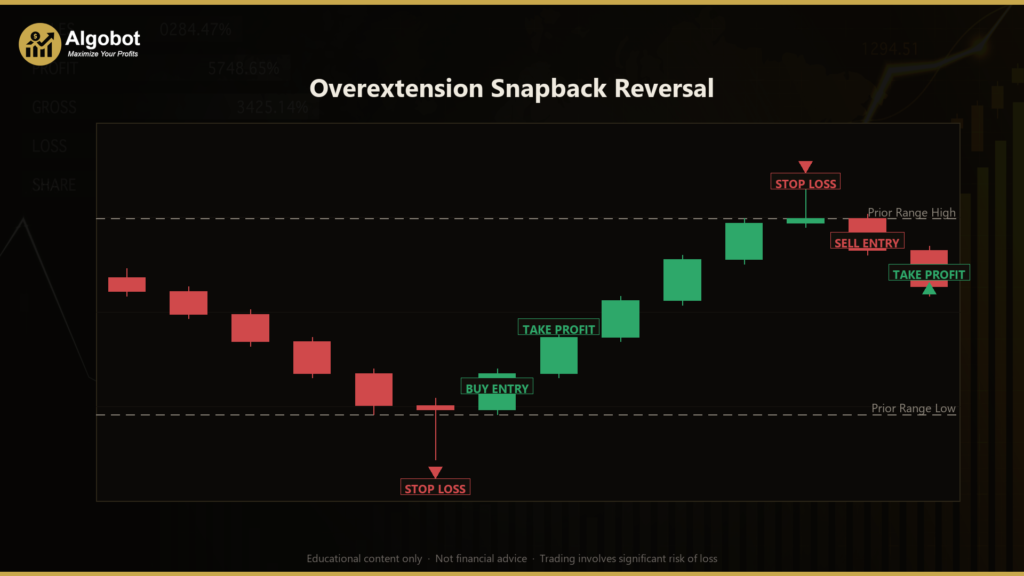
The Overextension Snapback Reversal is a pure price-action mean-reversion strategy that uses raw candle geometry — no moving averages, no oscillators, no lagging indicators of any kind. Its job is to identify the precise moment a strong directional move runs out of fuel and then fade it, betting on a "snapback" toward the recent average price (the mean). In trading, mean reversion simply means the assumption that price, after stretching unusually far from its normal rhythm, tends to spring back toward it.
The strategy works by reading two things directly off the chart. First, it measures momentum overextension: how far price has travelled over the last several bars compared with the market's own recent average candle range. When that net travel is several times larger than a typical candle, the move is statistically "stretched." Second, it waits for a candle rejection — a pin-bar-style candle with a long wick that pokes to a fresh extreme and then closes back in, the visual fingerprint of buyers or sellers being rejected. Only when both conditions line up does the strategy signal a counter-trend entry.
As a learning tool, this approach is well suited to traders who want to study exhaustion and reversal mechanics without relying on indicators. It is a counter-trend, momentum-exhaustion design, which makes it useful for understanding how overextended legs lose steam and how to define risk around a rejected swing extreme. It is not a trend-following system, and it deliberately trades against the prevailing short-term drive — a context every student of this strategy should keep front of mind.
How It Works
The Expert Advisor (EA) evaluates the chart once per freshly closed bar, never on every tick, so its decisions are based on completed candles. It also allows only one open position at a time per its magic number. Here is how the logic flows in plain English:
- Context — is the move overextended? The strategy measures the net directional travel over the last
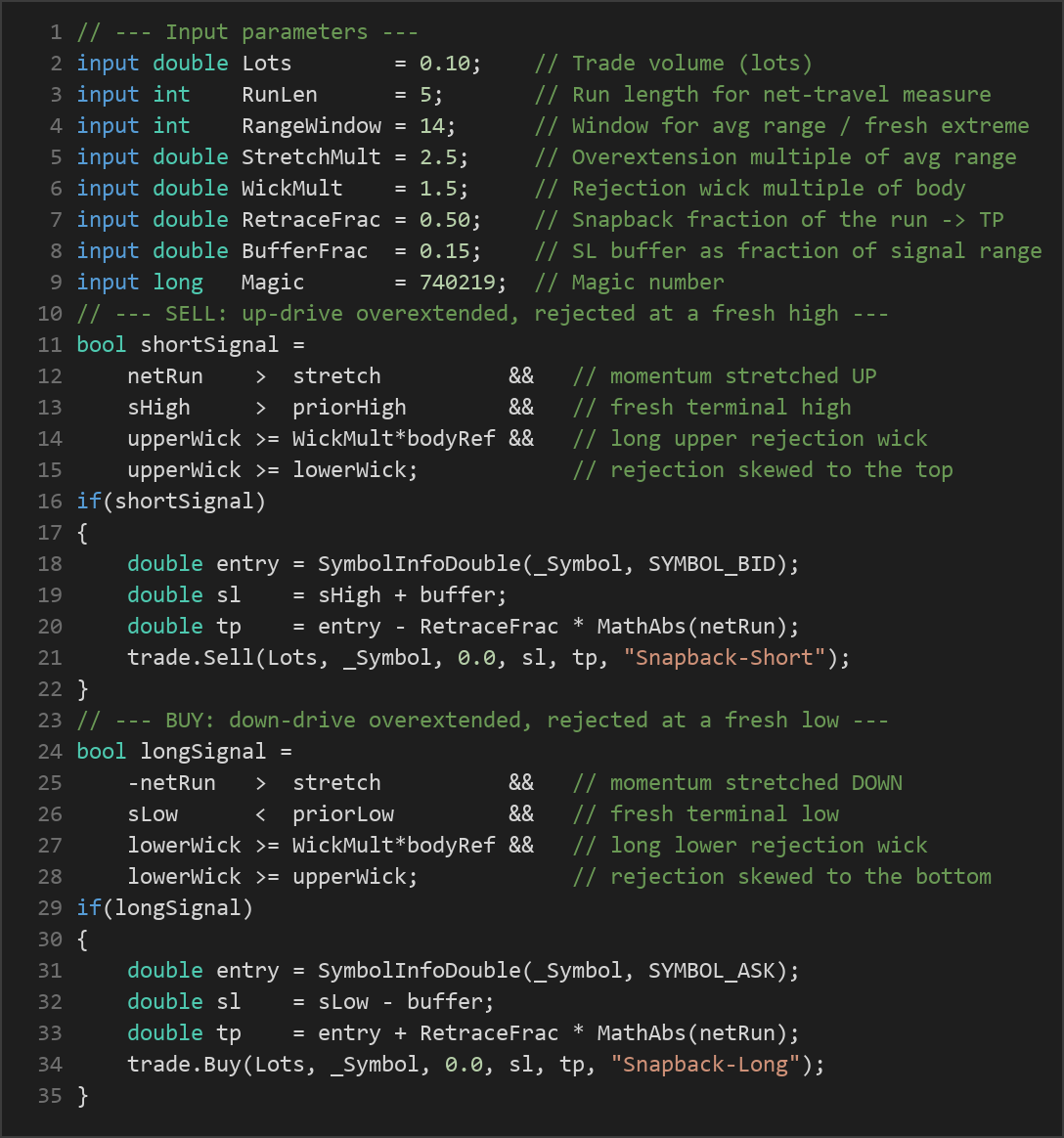
RunLenbars (the close of the most recent bar minus the closeRunLenbars earlier). It compares this to the average candle range over the lastRangeWindowbars. If net travel exceedsStretchMult× the average range, the leg is considered stretched and a snapback becomes possible. - Trigger — did the candle reject? The most-recently-closed bar must print a long rejection wick. For a short setup, the upper wick must be at least
WickMult× the candle body and longer than the lower wick. For a long setup, the lower wick must dominate by the same logic. - Fresh extreme confirmation. The signal candle must also make a new high (for shorts) or new low (for longs) beyond the preceding
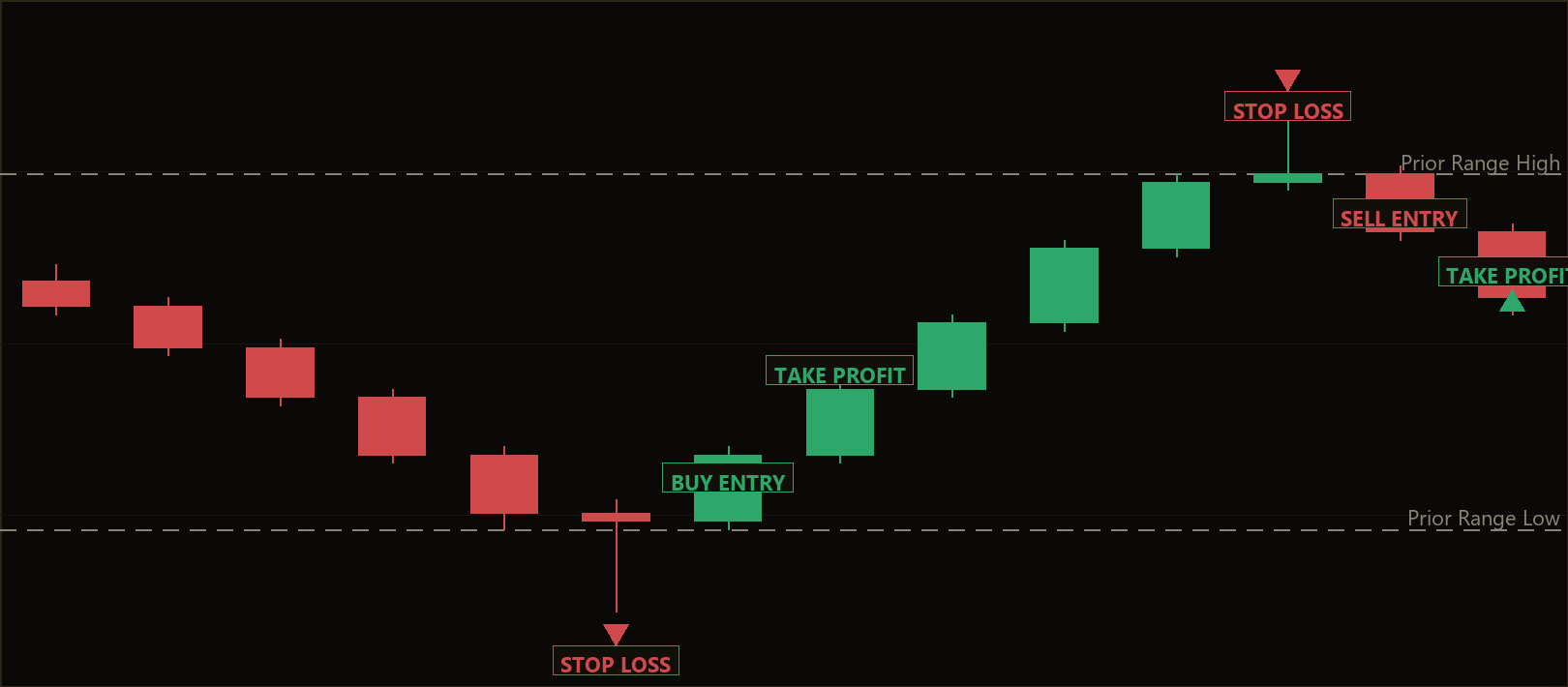
RangeWindowof bars. A long wick at a brand-new extreme means the auction probed further, found no acceptance, and snapped back. - Short entry (fading an up-drive): when price has run up sharply, prints a fresh high, and shows a long upper rejection wick, the strategy signals a sell. Entry is at the current bid.
- Long entry (fading a down-drive): the exact mirror — a sharp down-run, a fresh low, and a long lower rejection wick signals a buy at the current ask.
- Stop-loss logic. The stop is placed just beyond the rejected extreme — above the signal candle's high for shorts, below its low for longs — plus a small buffer equal to
BufferFrac× the signal candle's range. This sits where the reversal thesis would be proven wrong. - Take-profit logic. The target is a measured reversion:
RetraceFracof the stretched run's distance, projected back toward the run's origin. This is a defined, partial snapback rather than an open-ended trend bet, which keeps the trade's expectation grounded in the size of the move it is fading.
Because both the overextension context and the rejection trigger must align on the same bar, signals are relatively selective — the strategy historically stays flat through ordinary, orderly price action and only engages when a move looks exhausted.
Strategy Parameters
| Parameter | Default | Min | Max | Description |
|---|---|---|---|---|
| Lots | 0.10 | 0.01 | 1.00 | Trade volume in lots per position. Controls position size and therefore risk per trade. |
| RunLen | 5 | 3 | 20 | Number of bars used to measure the net directional run feeding into the signal bar. |
| RangeWindow | 14 | 5 | 40 | Lookback window for the average candle range and for confirming a fresh high/low extreme. |
| StretchMult | 2.5 | 1.0 | 6.0 | How many times the average candle range the net run must exceed to count as "overextended." Higher = stricter. |
| WickMult | 1.5 | 0.5 | 4.0 | Required rejection wick length as a multiple of the candle body. Higher demands a more pronounced pin. |
| RetraceFrac | 0.50 | 0.20 | 1.00 | Fraction of the stretched run targeted as the snapback take-profit. |
| BufferFrac | 0.15 | 0.00 | 1.00 | Extra stop-loss padding beyond the rejected extreme, as a fraction of the signal candle's range. |
Recommended Chart Settings
This strategy was designed with XAU/USD (gold) and GBP/JPY in mind, on the M5 and M15 timeframes, where directional bursts and sharp rejections are common enough to produce setups. That said, the logic is generic and will run on any liquid symbol or timeframe. Markets with frequent overextended legs and clean pin-bar rejections tend to suit it best, while quieter, range-bound conditions may produce fewer valid signals. Remember that results will vary considerably across different instruments, sessions, and volatility regimes — what behaves well on gold may behave very differently on a major currency pair.
How to Install on MetaTrader 5
- Download the .ex5 file from the link below
- Copy it to your MT5
MQL5\Expertsfolder - Restart MetaTrader 5 or refresh the Navigator panel
- Drag the EA onto a chart matching the recommended symbol and timeframe
- Configure the input parameters and enable Algo Trading
What to Consider Before Using This EA
The Overextension Snapback Reversal has clear conceptual strengths. It is fully transparent — every gate is raw candle geometry, so there is nothing hidden inside a black-box indicator. It defines risk precisely, anchoring the stop just beyond the rejected extreme where the idea is invalidated, and it sets a measured, logical target rather than chasing an unlimited move. The dual-confirmation design (overextension and rejection) helps filter out a large share of random noise.
However, counter-trend trading carries inherent limitations that you should understand before deploying it. Fading momentum means occasionally standing in front of a move that simply keeps going — a strong, news-driven trend can blow through a "fresh extreme" repeatedly, and each push can stop the position out. Mean-reversion logic historically struggles most during sustained directional trends and high-impact news events, precisely when extremes keep extending. Pin-bar rejections can also be ambiguous on lower timeframes, where a single tick can change a wick's shape.
Parameter sensitivity is another consideration. A low StretchMult or WickMult will generate more frequent but lower-quality signals; raising them makes the system stricter and quieter. There is no single "correct" setting — these values interact with each instrument's volatility. Treat any configuration as a hypothesis to be tested, not a finished answer, and study how the strategy behaves across many market conditions rather than judging it on a handful of trades.
Risk Management Tips
Sound risk management matters far more than any single entry signal. Consider these general principles as part of your education:
- Size positions conservatively. A common guideline is to risk no more than 1–2% of account equity per trade. Adjust the
Lotsparameter so that the distance to your stop-loss represents only a small fraction of your balance. - Test on a demo account first. Run the EA on a demo or simulated account to understand its behavior, frequency of trades, and drawdown profile before considering any live capital.
- Understand drawdown. Even a well-designed strategy will experience losing streaks. Know the maximum drawdown you are willing to tolerate and how that translates into consecutive losing trades.
- Mind correlated exposure. Avoid running the same fade logic on multiple highly correlated symbols at once, which can multiply risk unintentionally.
- Account for costs. Spreads, commissions, and slippage — especially on volatile symbols like gold around news — can meaningfully affect outcomes and should be factored into any evaluation.
Risk Warning
Trading foreign exchange, CFDs, and other leveraged financial instruments involves substantial risk of loss and is not suitable for all investors. The strategies and tools discussed on this page are provided for educational purposes only and do not constitute financial advice, investment recommendations, or solicitation to trade. Always consult a qualified financial adviser before making trading decisions. Past backtest performance is not indicative of future results.
Downloads
- Expert Advisor: OverextensionSnapbackReversal.ex5 (65 downloads)
- Source Code: OverextensionSnapbackReversal.mq5 (66 downloads)
- Documentation: OverextensionSnapbackReversal.pdf (64 downloads)