Disclaimer: This article is for educational and informational purposes only. It does not constitute financial or investment advice. Trading forex and CFDs carries significant risk of loss. Past performance of any strategy — including backtests — does not guarantee future results. Never trade with money you cannot afford to lose.
What Is This Strategy?
The Money Flow Pullback Trend strategy is a volume-aware, trend-following pullback continuation system built around the Money Flow Index (MFI) — a volume-weighted momentum oscillator that behaves like a version of the RSI (Relative Strength Index) computed from a bar's typical price and its trading volume. Because the MFI factors in volume rather than price alone, it will not turn upward on a shallow dip unless genuine buying activity flows back into the market. That single distinction is the idea the whole strategy is designed to test.
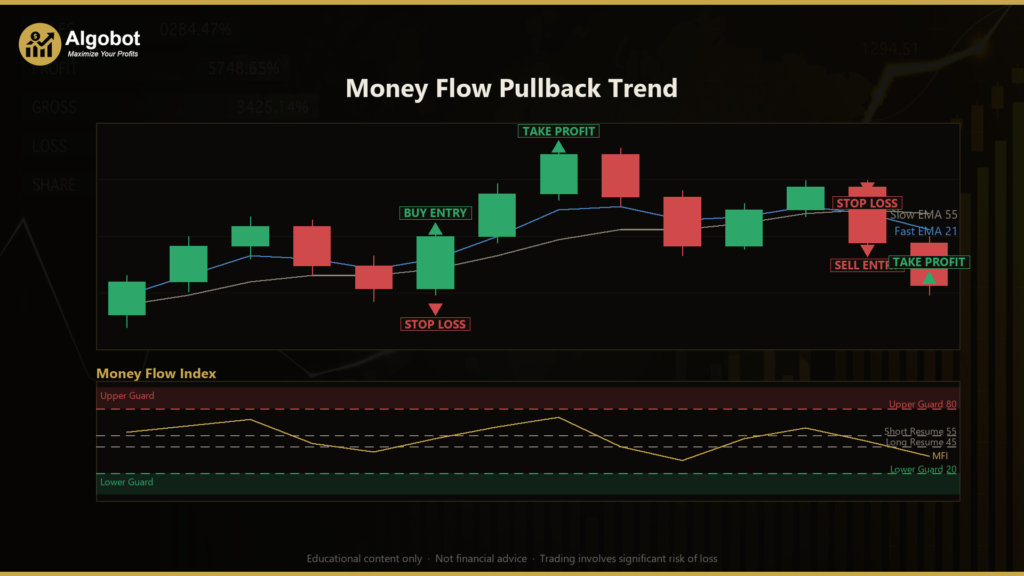
At its core, this is a "buy the dip in an uptrend, sell the rally in a downtrend" approach. It uses two Exponential Moving Averages (EMAs) to define the prevailing trend, waits for a temporary pause or pullback where money flow cools off, and then looks for money flow to resume in the trend's direction while price reclaims the fast EMA. The goal is to filter out low-conviction bounces and only participate in pullbacks that show renewed volume support. It is designed for trending market conditions, particularly on liquid instruments where volume behaves in an orderly way.
As a learning tool, the Money Flow Pullback Trend strategy is well suited to intermediate traders who already understand moving averages and oscillators and want to study how a volume filter can be layered on top of a classic trend-continuation model. It is a structured example of combining trend direction, momentum timing, and risk control into one rules-based system — useful for anyone studying how discretionary "buy the dip" logic can be expressed as objective, non-repainting code.
How It Works
The strategy evaluates its rules once per newly closed bar (no repainting) and manages open trades on every tick. All entry logic is built from closed-bar data only.
Trend definition (the context filter):
- The strategy calculates a fast EMA and a slow EMA on closing prices.
- An uptrend is recognized when the fast EMA is above the slow EMA and the last closed price is above the slow EMA.
- A downtrend is recognized when the fast EMA is below the slow EMA and the last closed price is below the slow EMA.
- Trades are only ever taken in the direction of this established trend.
Entry conditions — Long (in an uptrend):
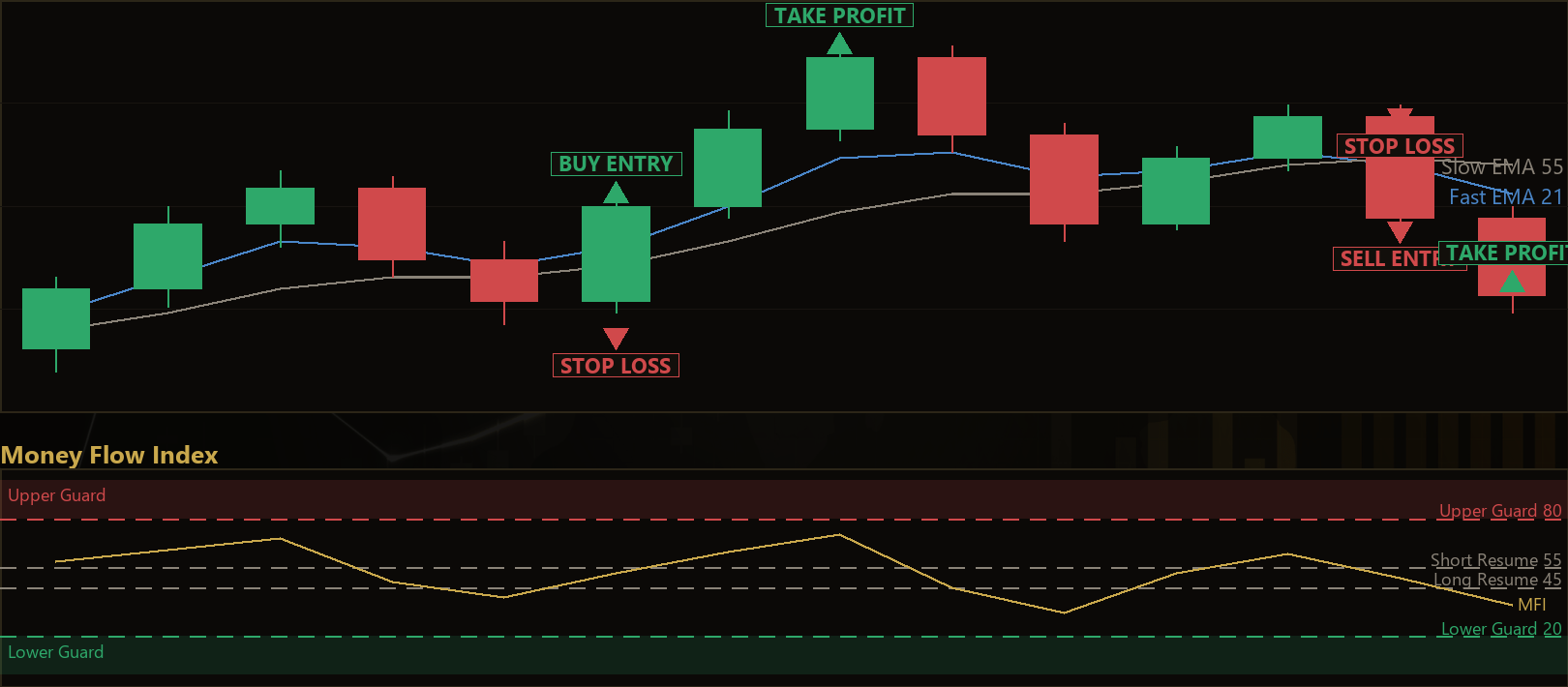
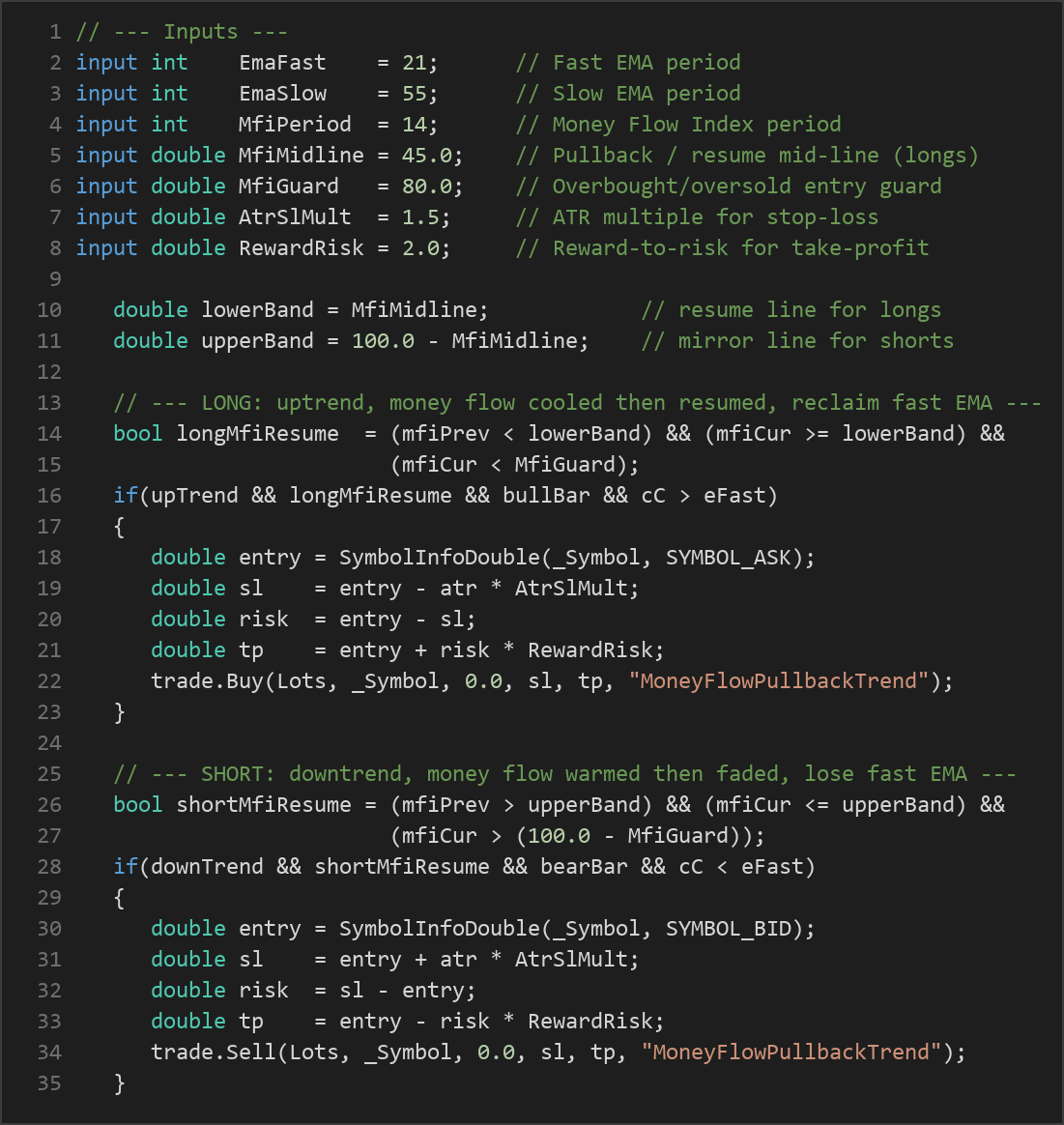
- The MFI on the previous bar was below the midline (money flow cooling off during a pullback).
- The MFI on the just-closed bar has crossed back up to or above the midline (money flow resuming).
- The MFI is still below the overbought guard, so the strategy is not chasing an already-stretched move.
- The just-closed bar is a bullish bar (it closed higher than it opened).
- Price has reclaimed the fast EMA (the close is above the fast EMA).
- When all of these align, the strategy signals a long entry at the current ask price.
Entry conditions — Short (in a downtrend):
- The MFI on the previous bar was above the mirror line (100 − midline), then crossed back down through it on the just-closed bar (money flow fading).
- The MFI is still above the oversold guard, avoiding entries into an already-exhausted decline.
- The just-closed bar is a bearish bar (it closed lower than it opened).
- Price has lost the fast EMA (the close is below the fast EMA).
- When all conditions align, the strategy signals a short entry at the current bid price.
Stop-loss logic:
- Risk is measured with the Average True Range (ATR), an indicator of recent volatility.
- The initial stop-loss is placed a multiple of ATR away from entry (
AtrSlMult). Wider volatility means a wider stop, so the stop adapts to current market conditions rather than using a fixed distance.
Take-profit logic:
- The take-profit is set using a fixed reward-to-risk ratio (
RewardRisk). With the default of 2.0, the profit target sits twice as far from entry as the stop-loss — the strategy aims to risk one unit to potentially gain two.
Trade management:
- An ATR trailing stop (
TrailAtrMult) follows the trade, but only ever tightens the stop in the trade's favour — it never loosens it. A small epsilon buffer prevents excessive stop modifications on tiny price changes. - Only one position per magic number is allowed at a time, and a spread filter blocks entries when trading costs are unusually high.
Strategy Parameters
| Parameter | Default | Min | Max | Description |
|---|---|---|---|---|
| EmaFast | 21 | 10 | 50 | Period of the fast EMA that price must reclaim on entry. |
| EmaSlow | 55 | 30 | 120 | Period of the slow EMA used to define the overall trend. |
| MfiPeriod | 14 | 7 | 28 | Lookback period for the Money Flow Index oscillator. |
| MfiMidline | 45.0 | 35.0 | 49.0 | The pullback/resume line for longs; its mirror (100 − value) is used for shorts. |
| MfiGuard | 80.0 | 65.0 | 90.0 | Overbought/oversold guard that blocks entries into already-stretched moves. |
| AtrPeriod | 14 | 7 | 28 | Lookback period for the ATR used in stop and trail calculations. |
| AtrSlMult | 1.5 | 0.8 | 3.0 | ATR multiple that sets the initial stop-loss distance. |
| RewardRisk | 2.0 | 1.0 | 4.0 | Reward-to-risk ratio that sets the take-profit relative to the stop. |
| TrailAtrMult | 2.0 | 1.0 | 4.0 | ATR multiple for the trailing stop distance. |
| MaxSpread | 30 | 0 | 100 | Maximum allowed spread in points; 0 disables the filter. |
| Lots | 0.10 | 0.01 | 1.0 | Fixed trade volume in lots. |
Recommended Chart Settings
The Money Flow Pullback Trend strategy was designed with a liquid FX pair such as GBPUSD on the H1 (1-hour) timeframe in mind. Liquid major pairs tend to produce cleaner tick-volume readings, which matters because the MFI relies on volume to confirm pullbacks.
That said, the strategy is timeframe-agnostic — it runs on whatever primary timeframe is selected — so you can study its behaviour across different symbols and timeframes. Keep in mind that results will vary considerably across different market conditions. A trend-continuation model like this historically performs differently in trending versus ranging environments, and every instrument has its own volatility and volume profile. Testing on a demo account across several settings is the best way to understand how it responds.
How to Install on MetaTrader 5
- Download the
MoneyFlowPullbackTrend.ex5file from the link below. - Copy it to your MT5
MQL5\Expertsfolder. - Restart MetaTrader 5 or refresh the Navigator panel.
- Drag the EA onto a chart matching the recommended symbol and timeframe.
- Configure the input parameters and enable Algo Trading.
What to Consider Before Using This EA
Like every trading approach, this one has strengths and limitations worth understanding before you study it in a live-market context.
Strengths of this approach:
- Volume confirmation. By requiring the MFI to resume rather than acting on price alone, the strategy is designed to ignore weak, low-conviction bounces that price-only oscillators might act on.
- Trend alignment. Trading only in the direction of the EMA trend keeps the system on the side of the prevailing move rather than fighting it.
- Objective, non-repainting rules. Signals are evaluated on closed bars only, so what you see in a backtest is what the logic actually evaluated in real time.
- Adaptive risk. ATR-based stops and trails adjust to current volatility instead of using rigid fixed distances.
Known limitations:
- Range-bound markets. Pullback-continuation systems can struggle when a market chops sideways, because EMA trend signals whipsaw and pullbacks fail to continue. This is a common weakness of trend-following logic generally.
- Tick-volume proxy. In the spot FX market there is no centralized volume, so the MFI here uses tick volume as a proxy for real traded volume. Tick volume correlates reasonably with activity but is not identical to actual contract volume.
- Lagging indicators. EMAs and the MFI are derived from past prices, so entries can arrive after a portion of a move has already occurred.
- Parameter sensitivity. Changing the EMA periods, MFI midline, or ATR multiples can meaningfully alter behaviour. Over-optimizing to past data (curve-fitting) may produce settings that historically looked strong but do not generalize.
The strategy is best viewed as a framework for studying volume-confirmed pullbacks — not as a finished, guaranteed solution. It may underperform during low-volatility ranges, around major news releases, and in thin-liquidity sessions.
Risk Management Tips
Sound risk management matters more than any single entry signal. As you study this strategy, keep these general principles in mind:
- Risk a small, fixed fraction per trade. Many educational sources suggest risking no more than 1–2% of account equity on any single position. Rather than trading a fixed lot blindly, size positions relative to your stop distance and account balance.
- Understand drawdown. Every strategy experiences losing streaks. Know the maximum peak-to-trough decline you are prepared to tolerate before you begin, and study how a strategy behaves during its worst historical periods.
- Start on a demo account. Test the EA in a risk-free simulated environment first so you understand its trade frequency, behaviour, and typical stop distances before considering any live capital.
- Account for costs. Spreads, commissions, slippage, and swap fees all affect real results. The built-in spread filter helps, but real-world trading costs still differ from idealized backtests.
- Avoid over-leveraging. Leverage amplifies both gains and losses. Conservative position sizing gives a strategy room to work through inevitable losing trades.
- Keep a trading journal. Recording your settings, observations, and outcomes turns each test into a learning exercise rather than a guess.
Risk Warning
Trading foreign exchange, CFDs, and other leveraged financial instruments involves substantial risk of loss and is not suitable for all investors. The strategies and tools discussed on this page are provided for educational purposes only and do not constitute financial advice, investment recommendations, or solicitation to trade. Always consult a qualified financial adviser before making trading decisions. Past backtest performance is not indicative of future results.
Downloads
- Expert Advisor: MoneyFlowPullbackTrend.ex5 (56 downloads)
- Source Code: MoneyFlowPullbackTrend.mq5 (59 downloads)
- Documentation: MoneyFlowPullbackTrend.pdf (60 downloads)