Disclaimer: This article is for educational and informational purposes only. It does not constitute financial or investment advice. Trading forex and CFDs carries significant risk of loss. Past performance of any strategy — including backtests — does not guarantee future results. Never trade with money you cannot afford to lose.
What Is This Strategy?
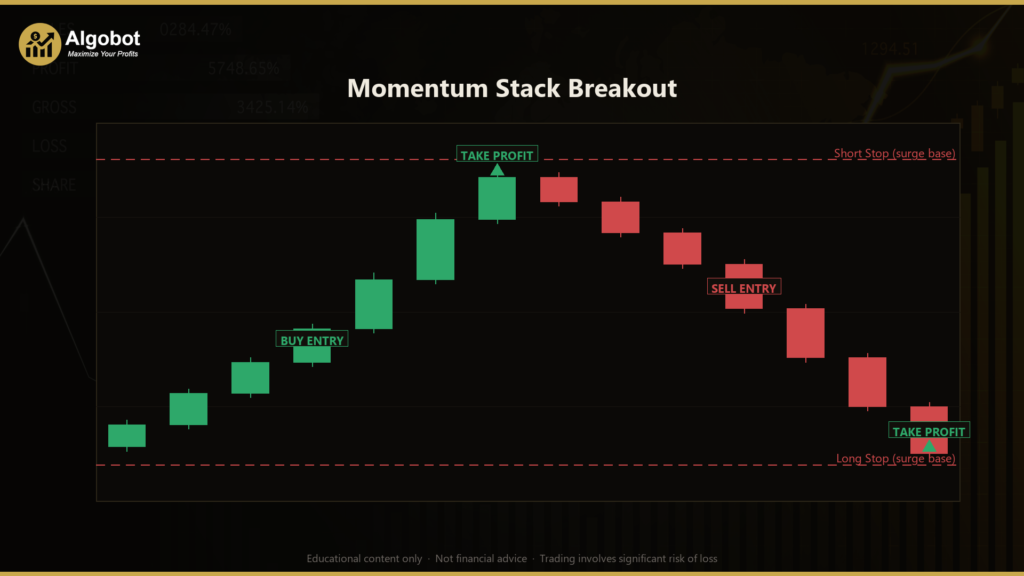
The Momentum Stack Breakout is a pure price-action, momentum-continuation strategy for MetaTrader 5 that uses no traditional indicators at all — no moving averages, no RSI, no ATR. Instead, it reads raw candlestick data (open, high, low, close) to detect a "stack": a run of consecutive same-direction candles that each show strong conviction. In plain terms, it looks for a clean staircase of strong candles marching in one direction and treats that staircase as a sign of one-way order flow worth following.
This approach is a generalization of the classic candlestick patterns "three white soldiers" (bullish) and "three black crows" (bearish), extended to any number of bars with an added strength filter. A candlestick is simply the bar that shows where price opened, closed, and how far it travelled during a given period; the body is the distance between open and close, and the wicks are the thin lines marking the extremes. The Momentum Stack Breakout only counts a candle as "strong" when its body dominates its full range — a sign that buyers or sellers controlled the bar from open to close rather than fighting over it.
As a learning tool, this strategy is well suited to traders who want to study trend-continuation logic and candlestick momentum without the lag or noise of calculated indicators. It is designed for trending market conditions where price moves decisively in one direction. It is not designed for choppy, sideways ranges, and studying when it succeeds or fails is itself a valuable exercise in understanding market structure.
How It Works
The strategy evaluates the chart once per newly closed candle. It never acts on the still-forming bar — it waits for confirmation. Here is what the strategy checks, step by step:
- Detect the stack direction. The most recently closed candle sets the intended direction: a bullish (up) candle points to a potential long, a bearish (down) candle points to a potential short.
- Validate every candle in the stack. The strategy looks back over the last
StackSizeclosed candles. Each one must pass three tests: - Correct colour — every candle in the stack must point the same way as the surge (all up for a long, all down for a short).
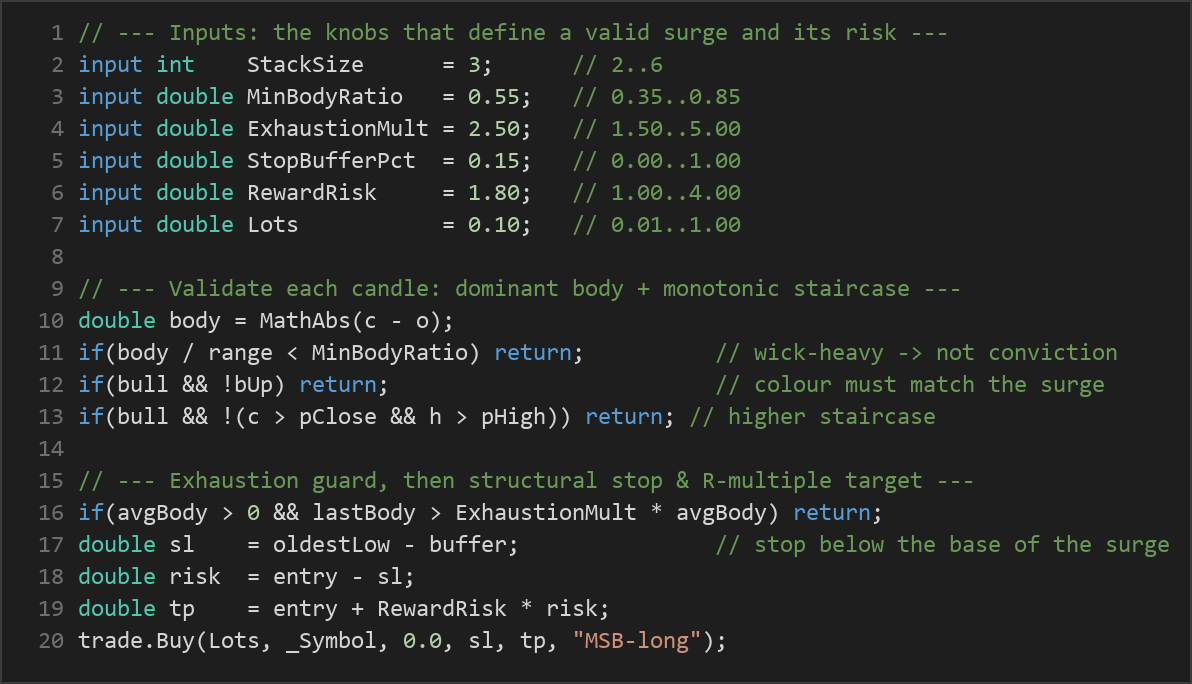
- Dominant body — each candle's body must be at least
MinBodyRatioof its full high-to-low range. Wick-heavy, indecisive candles disqualify the stack. - Monotonic staircase — each candle must close beyond the previous candle's close and print a fresh extreme (a higher high for an up-stack, a lower low for a down-stack). This confirms steady, one-way progression rather than overlapping chop.
- Apply the exhaustion guard. The strategy then compares the newest candle's body to the average body of the whole stack. If the final candle's body balloons past
ExhaustionMulttimes the average, the signal is rejected. An oversized closing candle often marks a climactic blow-off that snaps back, so the strategy refuses to chase it. - Entry. If all checks pass, the strategy signals an entry in the stack's direction — a buy at the ask price for an up-stack, a sell at the bid price for a down-stack. Only one position per symbol is held at a time; the strategy rides a single surge rather than stacking multiple trades.
- Stop-loss (structural). The stop is placed just beyond the base of the surge — below the low of the oldest stack candle for a long, or above the high of the oldest stack candle for a short. A buffer, set as
StopBufferPctof the full stack range, is added for breathing room. This ties risk to actual market structure rather than a fixed pip figure. - Take-profit (fixed reward-to-risk). The target is placed at a multiple of the measured risk. If the distance from entry to stop is the risk, the take-profit sits
RewardRisktimes that distance away in the trade's favour.
Because the stop and target are both derived from the size of the surge itself, the strategy automatically adapts its risk distance to current volatility without ever calculating an indicator like ATR.
Strategy Parameters
| Parameter | Default | Min | Max | Description |
|---|---|---|---|---|
| StackSize | 3 | 2 | 6 | Number of consecutive same-direction strong candles required to form a valid surge stack. |
| MinBodyRatio | 0.55 | 0.35 | 0.85 | Minimum fraction of a candle's full range that its body must occupy to count as "strong" (a momentum filter). |
| ExhaustionMult | 2.50 | 1.50 | 5.00 | Exhaustion guard: rejects the signal if the newest candle's body exceeds this multiple of the stack's average body. |
| StopBufferPct | 0.15 | 0.00 | 1.00 | Extra stop-loss buffer beyond the surge base, expressed as a fraction of the whole stack's range. |
| RewardRisk | 1.80 | 1.00 | 4.00 | Take-profit distance as a multiple of the entry-to-stop risk. |
| Lots | 0.10 | 0.01 | 1.00 | Position size in lots. |
A higher StackSize demands more confirmation before entering, which tends to reduce trade frequency while raising the bar for what counts as conviction. A higher MinBodyRatio insists on cleaner, more decisive candles. Adjusting these values changes how selective the strategy is, and experimenting with them on historical data is a good way to understand the trade-offs between frequency and selectivity.
Recommended Chart Settings
The Momentum Stack Breakout is a continuation strategy, so it is best studied on liquid, trending instruments. Major forex pairs such as EUR/USD or GBP/USD on intraday-to-swing timeframes like the H1 (1-hour) or H4 (4-hour) chart are a reasonable starting point, since these timeframes produce cleaner candle structures with less micro-noise than very short timeframes.
That said, no single setting is optimal everywhere. Results will vary considerably across different symbols, timeframes, and market conditions. Before committing to any configuration, you should observe how the stack-detection logic behaves on the specific instrument and timeframe you intend to study, because what forms a clean staircase on one market may not on another.
How to Install on MetaTrader 5
- Download the .ex5 file from the link below
- Copy it to your MT5
MQL5\Expertsfolder - Restart MetaTrader 5 or refresh the Navigator panel
- Drag the EA onto a chart matching the recommended symbol and timeframe
- Configure the input parameters and enable Algo Trading
What to Consider Before Using This EA
Like every approach, the Momentum Stack Breakout has clear strengths and equally clear limitations. Understanding both is the point of studying it.
Strengths:
- Transparency. Because it uses only raw OHLC data, every decision is easy to inspect and reason about. There is no hidden indicator math — you can look at any candle and verify why the strategy did or did not act.
- Structural risk. Anchoring the stop to the base of the surge ties risk to real market structure, which is often more meaningful than an arbitrary fixed distance.
- The exhaustion guard. Refusing climactic blow-off candles is a thoughtful filter that historically helps avoid buying tops and selling bottoms at the moment a move is most likely to reverse.
Limitations:
- Whipsaw in ranges. In sideways or choppy markets, false staircases can form and break down quickly. Continuation logic generally underperforms when there is no underlying trend to continue.
- Late entries. By design the strategy waits for several confirming candles, so it enters after a move is already underway. Sometimes much of the move has already happened, leaving less room to the target.
- Fixed reward-to-risk. A static target does not adapt to changing momentum; a strong run may reverse before reaching the take-profit, while an exceptional run is capped at the preset multiple.
- Parameter sensitivity. Settings that worked on historical data may not generalize. Over-tuning to past data (curve-fitting) is a common pitfall that can make results look better in testing than in live conditions.
This strategy is best viewed as a structured framework for learning how momentum and candlestick continuation work — not as a finished, hands-off system.
Risk Management Tips
Sound risk management matters more than any single entry signal. Whatever strategy you study, these principles apply:
- Risk a small, fixed fraction per trade. A common educational guideline is to risk no more than 1–2% of your account on any single trade, so that a string of losses does not threaten your capital.
- Size positions to your stop, not the other way around. Let the distance to your stop-loss determine your lot size, rather than picking a lot size first and accepting whatever risk follows.
- Test on a demo account first. Practice on a demo or simulated account until you understand how the strategy behaves across different conditions before considering any real capital.
- Understand drawdown. Every strategy experiences losing streaks. Knowing the historical depth and duration of drawdowns helps you set realistic expectations and avoid abandoning a plan at the worst moment.
- Keep a trading journal. Recording why each trade was taken and how it resolved turns every result — win or loss — into a learning opportunity.
Risk management is the discipline that allows you to keep studying and improving over time, rather than being forced out by a single bad run.
Risk Warning
Trading foreign exchange, CFDs, and other leveraged financial instruments involves substantial risk of loss and is not suitable for all investors. The strategies and tools discussed on this page are provided for educational purposes only and do not constitute financial advice, investment recommendations, or solicitation to trade. Always consult a qualified financial adviser before making trading decisions. Past backtest performance is not indicative of future results.
Downloads
- Expert Advisor: MomentumStackBreakout.ex5 (59 downloads)
- Source Code: MomentumStackBreakout.mq5 (58 downloads)
- Documentation: MomentumStackBreakout.pdf (65 downloads)