Disclaimer: This article is for educational and informational purposes only. It does not constitute financial or investment advice. Trading forex and CFDs carries significant risk of loss. Past performance of any strategy — including backtests — does not guarantee future results. Never trade with money you cannot afford to lose.
What Is This Strategy?
The Momentum Pocket Pullback is a pure price-action momentum-continuation strategy for MetaTrader 5 that uses no traditional indicators at all. Instead of relying on moving averages, oscillators, or other calculated tools, every value it measures — the size of a momentum burst, the average size of recent candles, the depth of a pause, and the placement of its stop-loss — is derived directly from raw OHLC (Open, High, Low, Close) bar data. In trading terms, this makes it a "naked chart" or price-action system that reads the structure of the candles themselves.
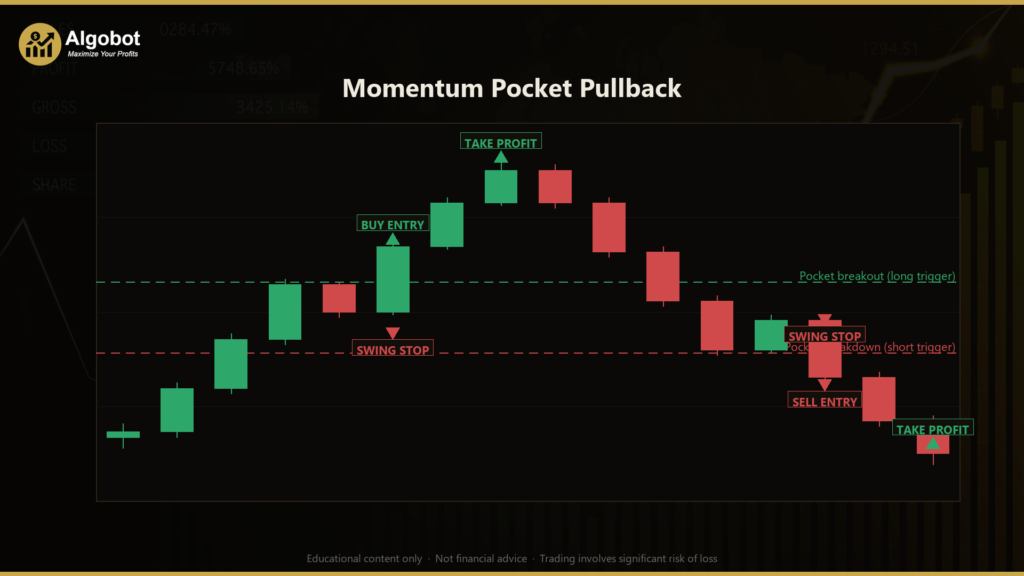
The core idea is built on a well-known market behavior: strong directional moves often resume after a brief, shallow rest. When price makes a powerful run in one direction (an "impulse leg") and then pauses with only a small counter-move (the "pocket"), momentum traders watch for that pause to end and the original trend to continue. The Momentum Pocket Pullback automates exactly this observation — it hunts for a strong impulse, confirms that the pullback was shallow enough to keep the trend intact, and then waits for a confirming candle to break out of the pocket in the original direction.
This strategy is best understood as a learning tool for traders who want to study trend continuation, breakout timing, and swing-based risk placement without the noise of lagging indicators. It is designed for trending market conditions, where directional momentum is present, and it is not built for sideways or choppy ranges. If you are studying how to quantify "momentum" and "pullback depth" in objective, rule-based terms, this strategy offers a clean, transparent example.
How It Works
The strategy evaluates the chart once per newly-closed candle, and it only looks for a new setup when no position is currently open for its magic number. Before any logic runs, it confirms that enough historical bars exist to measure the impulse, the pocket, and the average-range window.
Here is how the strategy builds and signals a trade in plain English:
- Average candle range (the yardstick): The strategy first sums the High-minus-Low range of the most recent closed candles (over the
RangeWindowperiod) and divides to get an average. This becomes the benchmark for what counts as a "big" move on the current chart. - Identifying the impulse leg: It scans back over
ImpulseBarscandles and measures their combined high, low, and net travel (the close of the newest impulse bar minus the open of the oldest). It also counts how many candles were bullish versus bearish. - Qualifying the momentum: For a long setup, the net upward travel must be at least
MinImpulseMulttimes the average range, and a majority of the impulse candles (at least 60%, rounded up) must be bullish. The mirror logic applies for shorts. - Measuring the pocket (pullback): The strategy looks at the 1 to
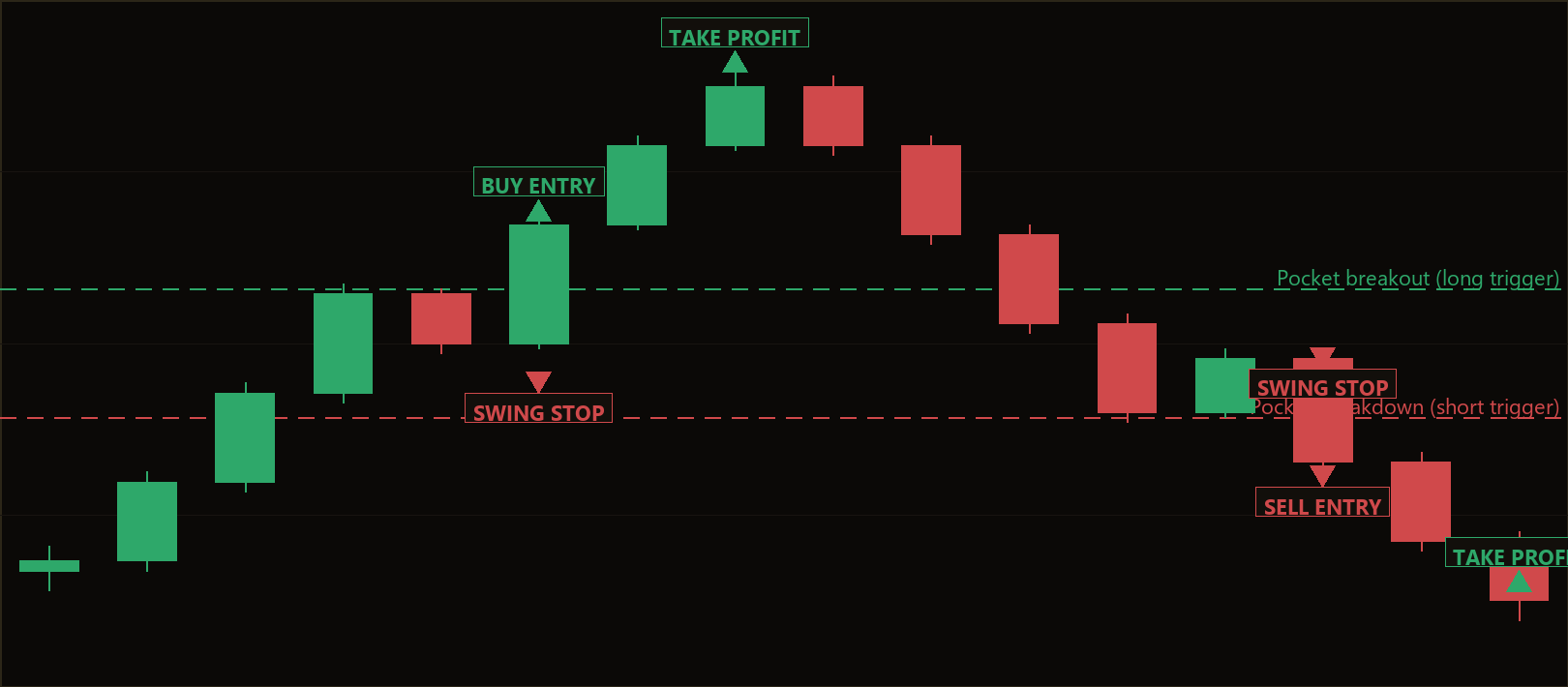
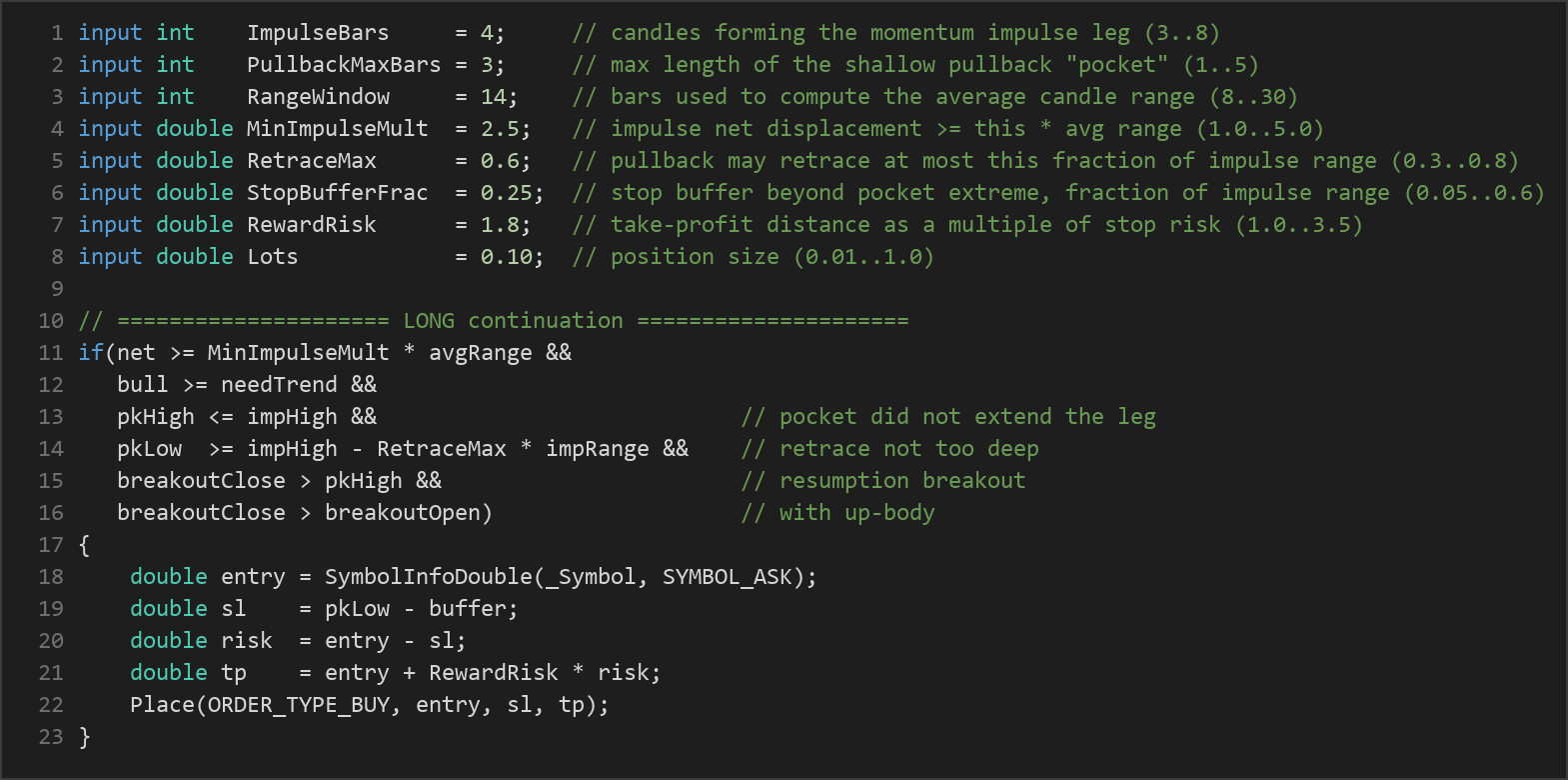
PullbackMaxBarscandles that follow the impulse. It checks that the pullback did not extend the leg (the pocket high stays at or below the impulse high for longs) and that the retracement was shallow — no deeper thanRetraceMaxof the impulse range. It tries the shortest pocket first, favoring the freshest continuation. - The entry signal (long): The strategy signals a buy when the most recently closed candle closes above the pocket high and closes higher than it opened (an up-body). This is read as the trend resuming.
- The entry signal (short): The strategy signals a sell when the most recently closed candle closes below the pocket low and closes lower than it opened (a down-body).
- Stop-loss logic: For a long, the stop is placed below the pocket low, with an extra buffer equal to
StopBufferFracof the impulse range. For a short, the stop sits above the pocket high with the same buffer. This anchors risk to the actual swing structure rather than a fixed pip value. - Take-profit logic: The distance from entry to stop defines one unit of risk (1R). The take-profit is then set at
RewardRiskmultiplied by that risk distance, producing a fixed reward-to-risk target. - Trade management: Only one position is held at a time. Once placed, the trade is left to its stop-loss or take-profit to manage the exit — there is no trailing or scaling logic.
Strategy Parameters
| Parameter | Default | Min | Max | Description |
|---|---|---|---|---|
| ImpulseBars | 4 | 3 | 8 | Number of candles that must form the momentum impulse leg. |
| PullbackMaxBars | 3 | 1 | 5 | Maximum length, in candles, of the shallow pullback "pocket." |
| RangeWindow | 14 | 8 | 30 | Number of bars used to compute the average candle range yardstick. |
| MinImpulseMult | 2.5 | 1.0 | 5.0 | The impulse's net displacement must be at least this multiple of the average range to qualify. |
| RetraceMax | 0.6 | 0.3 | 0.8 | The pullback may retrace at most this fraction of the impulse range. |
| StopBufferFrac | 0.25 | 0.05 | 0.6 | Stop-loss buffer beyond the pocket extreme, as a fraction of the impulse range. |
| RewardRisk | 1.8 | 1.0 | 3.5 | Take-profit distance expressed as a multiple of the stop risk (the R-multiple). |
| Lots | 0.10 | 0.01 | 1.0 | Position size in lots. |
Recommended Chart Settings
Because momentum-continuation patterns tend to be clearest on intraday and swing timeframes, the Momentum Pocket Pullback is typically studied on charts such as the H1 (1-hour) or M30 (30-minute) timeframe, where impulse legs and shallow pullbacks are visible without excessive micro-noise. Liquid instruments with clean trending behavior — major forex pairs like EUR/USD or GBP/USD — are sensible starting points for analysis.
That said, the strategy reads only raw candle structure, so its behavior will vary meaningfully across symbols, sessions, and volatility regimes. A setting that produces frequent signals on one pair may rarely trigger on another. Always test the strategy on the specific symbol and timeframe you intend to study, and remember that results will differ across changing market conditions.
How to Install on MetaTrader 5
- Download the .ex5 file from the link below.
- Copy it to your MT5
MQL5\Expertsfolder. - Restart MetaTrader 5 or refresh the Navigator panel.
- Drag the EA onto a chart matching the recommended symbol and timeframe.
- Configure the input parameters and enable Algo Trading.
What to Consider Before Using This EA
Like every trading approach, the Momentum Pocket Pullback has clear strengths and equally clear limitations, and understanding both is the point of studying it.
Strengths. The logic is fully transparent and indicator-free, which makes it an excellent teaching example — you can read every rule directly from the candles. Its swing-anchored stop ties risk to real market structure rather than an arbitrary distance, and its fixed reward-to-risk target enforces a consistent, pre-defined exit plan. Trying the shortest pocket first also biases the system toward the freshest, most reactive continuation signals.
Limitations. Momentum-continuation systems are inherently trend-dependent. In sideways, range-bound, or choppy conditions, impulse legs and shallow pullbacks can produce false breakouts, where price breaks the pocket only to reverse and hit the stop. Because the strategy enters on a breakout candle, it may also experience slippage or whipsaws around volatile news events. The fixed RewardRisk target means winning trades are capped even when a trend extends much further, and the one-position-at-a-time rule can keep you out of additional setups while a trade is open.
Where it may underperform. Expect weaker behavior during low-volatility consolidation, during sharp counter-trend reversals, and on instruments or sessions with erratic spreads. No fixed parameter set is optimal across all markets, so the defaults should be treated as a starting point for study, not a finished configuration. The honest takeaway: this is a structured framework for learning how momentum continuation can be measured and traded — not a finished, guaranteed system.
Risk Management Tips
Sound risk management matters far more than any single entry rule. As you study this strategy, keep these general principles in mind:
- Risk a small, fixed fraction per trade. A common educational guideline is to risk no more than 1–2% of account equity on any single position. Use the
Lotsparameter together with your stop distance to keep each trade within that limit. - Understand your drawdown. Even a well-designed strategy will have losing streaks. Study the worst-case sequence of consecutive losses you could tolerate before adjusting or pausing.
- Use a demo account first. Before risking real capital, run the EA on a demo or paper account to observe how it behaves across different sessions and market conditions.
- Size positions deliberately. Larger lot sizes amplify both gains and losses. Match your position size to your account, not to your expectations.
- Respect the stop-loss. The swing-anchored stop is part of the strategy's design; overriding it manually defeats the purpose of the structured risk model.
- Review and journal. Track which market conditions produce clean continuations and which produce false breakouts, and use that to inform whether and how you adjust the parameters.
By treating the Momentum Pocket Pullback as a study in disciplined, rule-based trading, you will learn far more about momentum, structure, and risk than any single setup could teach you.
Risk Warning
Trading foreign exchange, CFDs, and other leveraged financial instruments involves substantial risk of loss and is not suitable for all investors. The strategies and tools discussed on this page are provided for educational purposes only and do not constitute financial advice, investment recommendations, or solicitation to trade. Always consult a qualified financial adviser before making trading decisions. Past backtest performance is not indicative of future results.
Downloads
- Expert Advisor: MomentumPocketPullback.ex5 (59 downloads)
- Source Code: MomentumPocketPullback.mq5 (60 downloads)
- Documentation: MomentumPocketPullback.pdf (66 downloads)