Disclaimer: This article is for educational and informational purposes only. It does not constitute financial or investment advice. Trading forex and CFDs carries significant risk of loss. Past performance of any strategy — including backtests — does not guarantee future results. Never trade with money you cannot afford to lose.
What Is This Strategy?
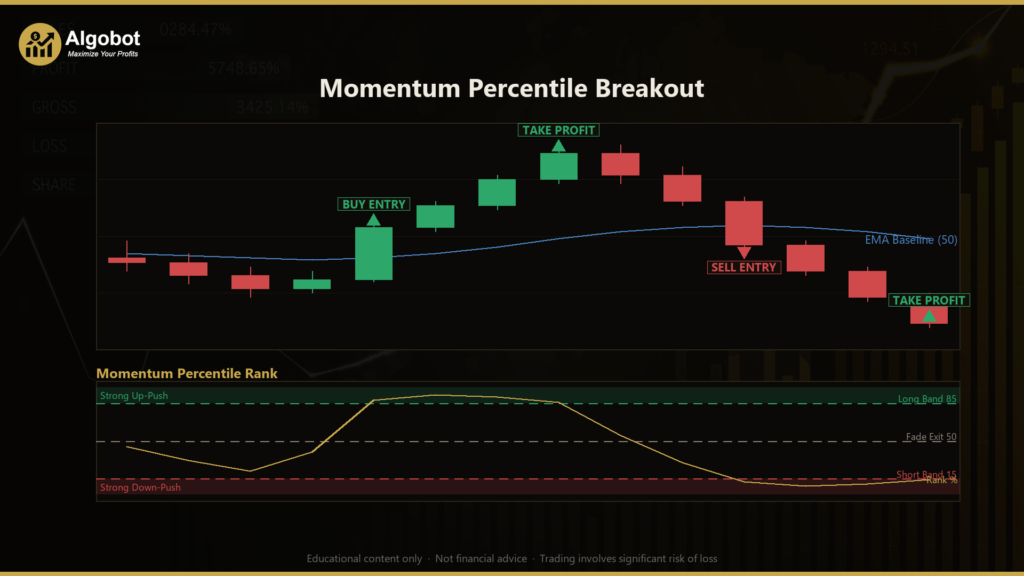
The Momentum Percentile Breakout strategy is an adaptive momentum-breakout system for MetaTrader 5 that judges the strength of a price push using a percentile rank rather than a fixed indicator level. In plain terms, "momentum" here is simply the net distance price has travelled over a set number of bars (the current close minus the close a fixed number of bars ago). Instead of comparing that raw distance to a static threshold — the way a classic Relative Strength Index (RSI) reading of 70 or a fixed rate-of-change level would — the strategy ranks the latest momentum against its own recent history and expresses it as a number between 0 and 1.
This design solves a common problem in fixed-threshold momentum systems: a "strong" move on a quiet pair like EUR/USD looks nothing like a "strong" move on a volatile instrument like gold (XAU/USD). By measuring where today's push sits within the recent distribution of pushes — for example, "stronger than 90% of the last 100 readings" — the signal becomes self-calibrating and scale-free. The same parameter set can therefore travel across different symbols and timeframes without constant re-tuning. To keep signals aligned with the larger trend, the strategy also uses an Exponential Moving Average (EMA) baseline as a directional filter, and an Average True Range (ATR) measure to size protective stops and targets.
As a learning tool, this strategy suits traders who want to study how relative momentum measurement differs from absolute thresholds, and who are interested in trend-following and breakout mechanics. It is designed for trending, liquid markets and is best explored on a demo account. It is not a shortcut of any kind — it is a structured framework for understanding adaptive signal generation.
How It Works
The strategy evaluates one reading per closed bar and is fully symmetric, meaning it can trade both long and short. Here is the logic in plain English:
- Measuring momentum: For each closed bar, the strategy calculates momentum as the current close minus the close
MomentumPeriodbars earlier. This is the net displacement over that window. - Ranking momentum: It keeps a rolling history of these momentum values and computes a percentile rank — the fraction of the previous
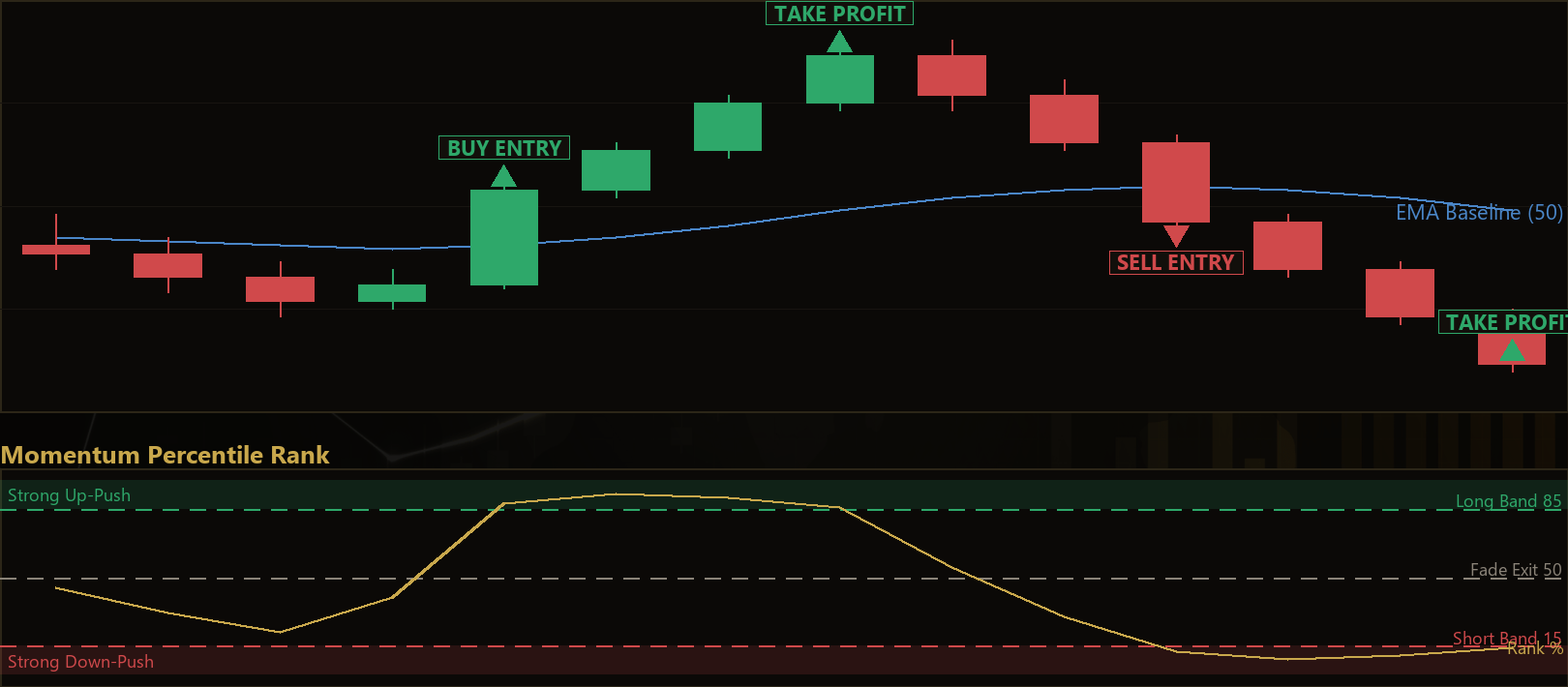
RankWindowreadings that are less than or equal to the current one. A rank of 0.90 means the current up-push is stronger than 90% of the recent past; a rank of 0.05 means it is more negative than 95% of it. - Long entry signal: The strategy signals a long when the percentile rank freshly crosses up through the
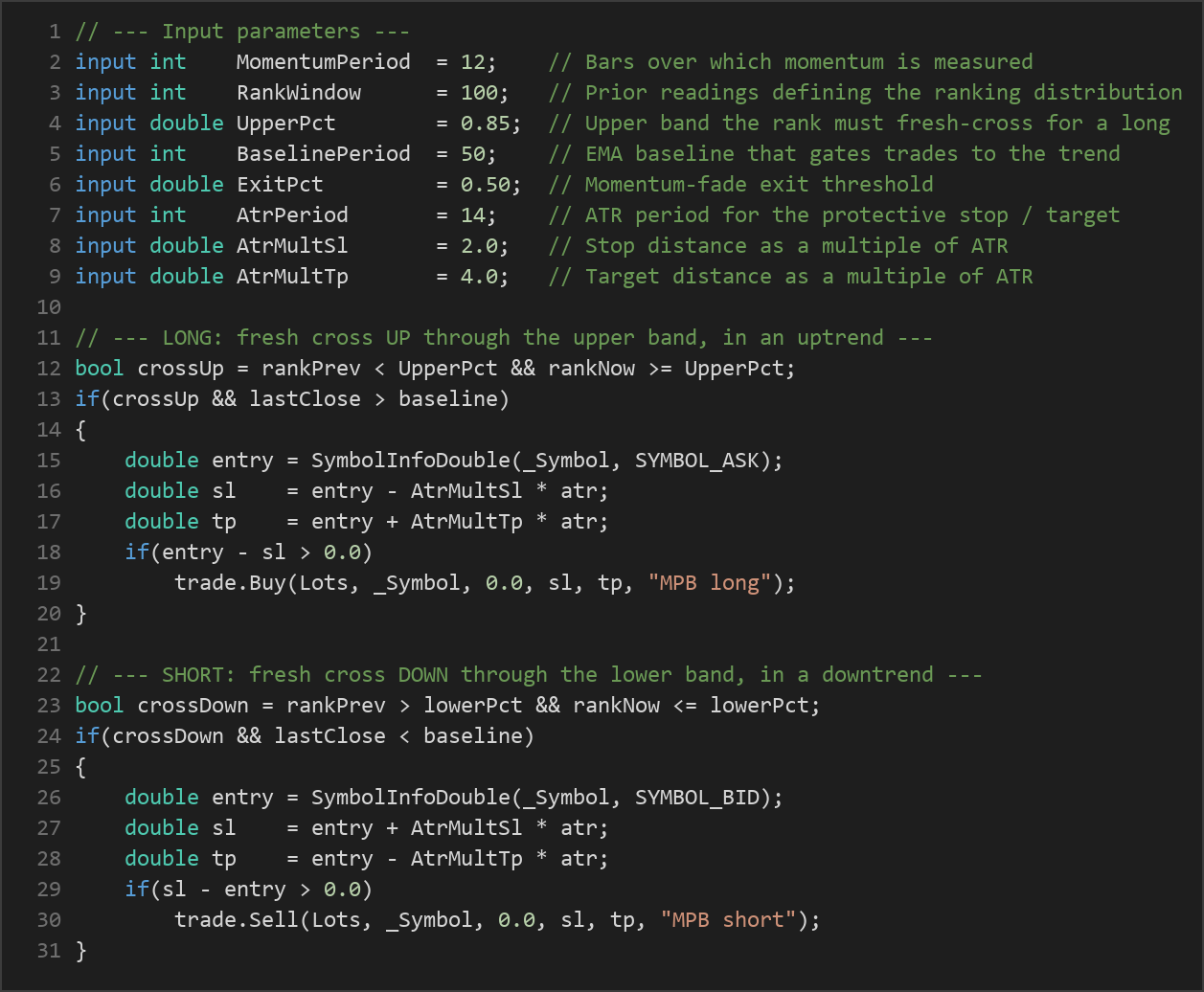
UpperPctband (the previous bar was below it, the current bar is at or above it) and the closing price sits above the EMA baseline. Requiring a fresh cross avoids entering an already-extended move; requiring price above the EMA keeps the trade on the trend's side. - Short entry signal: The mirror image applies. The strategy signals a short when the rank freshly crosses down through the lower band (calculated automatically as 1 −
UpperPct) and the close is below the EMA baseline. - Momentum-fade exit: Because momentum tends to fade, an open long is closed the moment its rank drops back below the
ExitPctmidline; an open short is closed once its rank rises back above 1 −ExitPct. The idea is to bank the impulse and step aside rather than round-trip the move. - Stop-loss logic: Each trade is protected by a stop placed
AtrMultSlmultiples of ATR away from entry. This caps the loss if the push reverses sharply, and it adapts to current volatility because ATR expands and contracts with the market. - Take-profit logic: A wider target is placed
AtrMultTpmultiples of ATR from entry. This acts as a backstop for a runaway move that never triggers the fade exit. - Trade management: The strategy holds only one position per magic number at a time, and it skips new entries when the spread is wider than
MaxSpreadPoints(unless that filter is switched off).
Together, these rules aim to isolate rare, genuine shifts in momentum from the constant low-grade noise that fixed-threshold systems often mistake for signals.
Strategy Parameters
| Parameter | Default | Min | Max | Description |
|---|---|---|---|---|
| MomentumPeriod | 12 | 4 | 40 | Number of bars over which net displacement (momentum) is measured. |
| RankWindow | 100 | 30 | 300 | How many prior momentum readings define the distribution the current reading is ranked against. |
| UpperPct | 0.85 | 0.60 | 0.95 | Upper percentile band the rank must freshly cross to fire a long (the short band is automatically 1 − UpperPct). |
| BaselinePeriod | 50 | 10 | 200 | Period of the EMA baseline that gates trades to the prevailing trend side. |
| ExitPct | 0.50 | 0.30 | 0.65 | Momentum-fade exit threshold; a long closes once rank falls below this (short: above 1 − ExitPct). |
| AtrPeriod | 14 | 5 | 40 | ATR period used for the protective stop and target. |
| AtrMultSl | 2.0 | 0.5 | 6.0 | Stop-loss distance as a multiple of ATR. |
| AtrMultTp | 4.0 | 0.5 | 10.0 | Take-profit distance as a multiple of ATR (backstop for runaway moves). |
| MaxSpreadPoints | 30 | 0 | 200 | Skip entries when the spread in points exceeds this value (0 disables the filter). |
| Lots | 0.10 | 0.01 | 1.00 | Trade volume in lots. |
| Magic | 7731 | 0 | 9,999,999 | Magic number used to identify and manage this EA's positions. |
Recommended Chart Settings
The Momentum Percentile Breakout was designed with liquid, trending instruments in mind — for example GBP/USD or XAU/USD (gold) — on intraday timeframes such as M15 to H1. These conditions give the percentile-ranking logic a steady stream of momentum readings to calibrate against while avoiding the thinnest, noisiest parts of the trading day.
That said, because the ranking mechanism is scale-free, part of the educational value of this strategy is testing how it behaves across other symbols and timeframes. Results will vary considerably with different market conditions, spreads, and volatility regimes, so treat any single chart configuration as a starting point for study rather than a fixed recommendation.
How to Install on MetaTrader 5
- Download the
MomentumPercentileBreakout.ex5file from the link below. - Copy it to your MT5
MQL5\Expertsfolder. - Restart MetaTrader 5 or refresh the Navigator panel.
- Drag the EA onto a chart matching the recommended symbol and timeframe.
- Configure the input parameters and enable Algo Trading.
What to Consider Before Using This EA
Like every trading approach, this one has clear strengths and equally clear limitations that are worth understanding before you study it.
Strengths. The percentile-ranking core is genuinely adaptive: because it grades momentum against its own recent distribution, it does not need constant re-tuning when you move between a calm major pair and a volatile metal. The fresh-cross requirement helps avoid chasing moves that are already stretched, the EMA baseline keeps signals aligned with the broader trend, and the ATR-based stop and target adjust automatically as volatility changes. The momentum-fade exit is a disciplined way to release a trade once the impulse it was built on weakens.
Limitations. This is fundamentally a trend-and-breakout strategy, and such systems historically struggle in choppy, range-bound markets where fresh percentile crosses can appear and reverse quickly, producing a string of small losses often called "whipsaws." The percentile rank also needs a warm-up period — a full ranking window plus momentum, EMA, and ATR history — before it produces valid signals. A large ATR-based stop can mean the loss on a bad trade is meaningfully larger than the typical gain banked by the fade exit, so the balance between win rate and average trade size deserves careful study. Finally, the strategy holds only one position per magic number, so it will not pyramid into a strong trend.
The purpose here is to understand why the strategy behaves the way it does, not to assume it will perform well in any given market. No indicator or ranking method removes the inherent uncertainty of trading.
Risk Management Tips
Sound risk management matters far more than any single entry rule. Consider these general principles as you study this or any strategy:
- Position sizing: Size trades so that a single loss represents only a small slice of your account. A widely taught guideline is to risk no more than 1–2% of account equity per trade.
- Use a demo account first: Test the strategy thoroughly in a risk-free demo environment before ever considering live capital, so you can observe its behaviour across different conditions.
- Understand drawdown: Every strategy experiences losing streaks. Study the historical depth and duration of drawdowns so that a normal losing run does not push you into abandoning your plan at the worst moment.
- Respect the stop-loss: The ATR-based stop exists for a reason — avoid the temptation to widen or remove it mid-trade.
- Account for costs: Spreads, commissions, and slippage all erode results, especially on lower timeframes. The built-in spread filter helps, but real-world costs still deserve attention.
- Diversify your study: Do not rely on a single strategy or a single instrument to form your understanding of the markets.
Risk Warning
Trading foreign exchange, CFDs, and other leveraged financial instruments involves substantial risk of loss and is not suitable for all investors. The strategies and tools discussed on this page are provided for educational purposes only and do not constitute financial advice, investment recommendations, or solicitation to trade. Always consult a qualified financial adviser before making trading decisions. Past backtest performance is not indicative of future results.
Downloads
- Expert Advisor: MomentumPercentileBreakout.ex5 (53 downloads)
- Source Code: MomentumPercentileBreakout.mq5 (55 downloads)
- Documentation: MomentumPercentileBreakout.pdf (59 downloads)