Disclaimer: This article is for educational and informational purposes only. It does not constitute financial or investment advice. Trading forex and CFDs carries significant risk of loss. Past performance of any strategy — including backtests — does not guarantee future results. Never trade with money you cannot afford to lose.
What Is This Strategy?
The Mass Index Bulge Institutional Reversal is a counter-trend, mean-reversion expert advisor built around the Mass Index, a volatility indicator developed by Donald Dorsey that measures the expansion and contraction of the high-low trading range. Rather than following momentum, this strategy is designed to identify moments when a stretched directional move is likely running out of fuel, and it positions for a potential reversal back toward the mean.
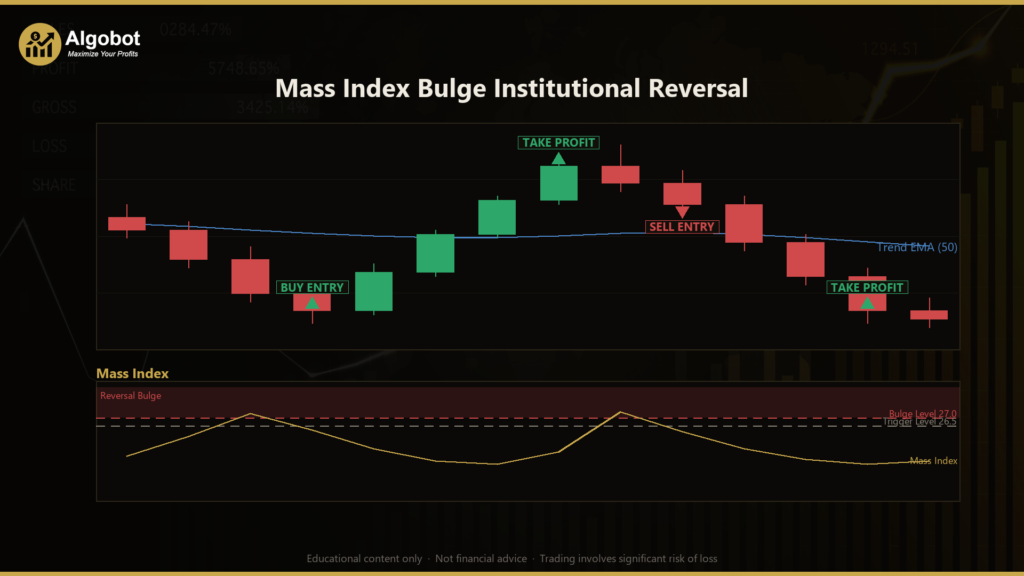
The Mass Index works by comparing a single exponential moving average (EMA) of the daily range to a double-smoothed EMA of that same range, then summing the resulting ratio over a lookback window. When the range widens sharply, the index "bulges" upward. Dorsey observed that a bulge followed by a fall-back — often called a reversal bulge — frequently precedes a change in trend direction. This EA automates the detection of that pattern and combines it with a trend filter to decide which side of the market to trade.
This strategy is intended as a learning tool for traders who want to study volatility-based reversal logic on index CFDs. It was designed for the US30 (Dow Jones 30) index on the H1 (one-hour) timeframe, a market known for sharp intraday expansions and reversions. It is best suited to those who already understand basic order mechanics and want to explore how a range-expansion signal can be paired with a directional filter and structured risk controls. It is not a shortcut to results, and no reversal signal is correct every time.
How It Works
The strategy processes each newly closed H1 bar, updates the Mass Index, and watches for a completed reversal bulge. Here is the full logic in plain English:
- Building the Mass Index: For every closed bar, the strategy measures the high-low range. It smooths that range with a single EMA, then smooths the result again with a second EMA (a double EMA). The ratio of the single EMA to the double EMA is calculated, and the last
SumPeriodratios are summed to produce the current Mass Index value. - Detecting the bulge: When the Mass Index rises above the
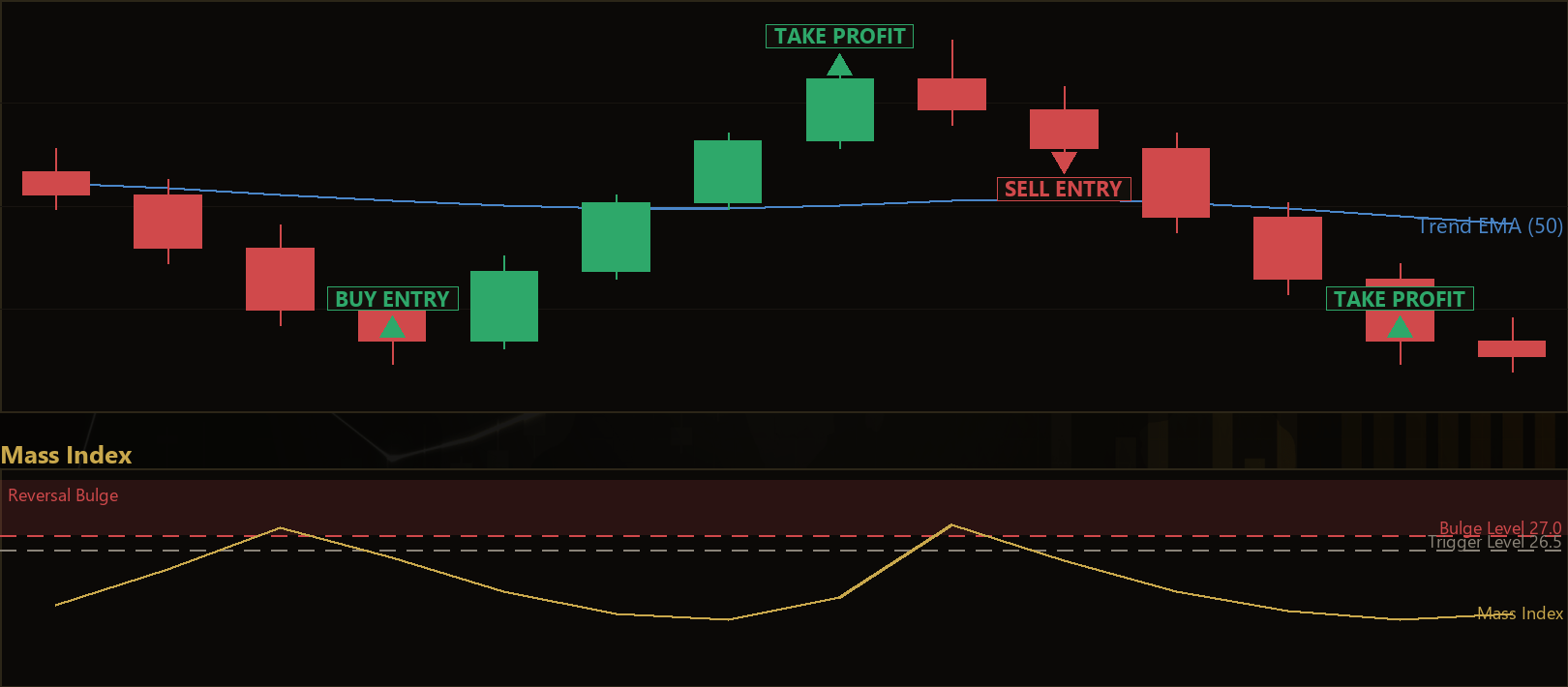
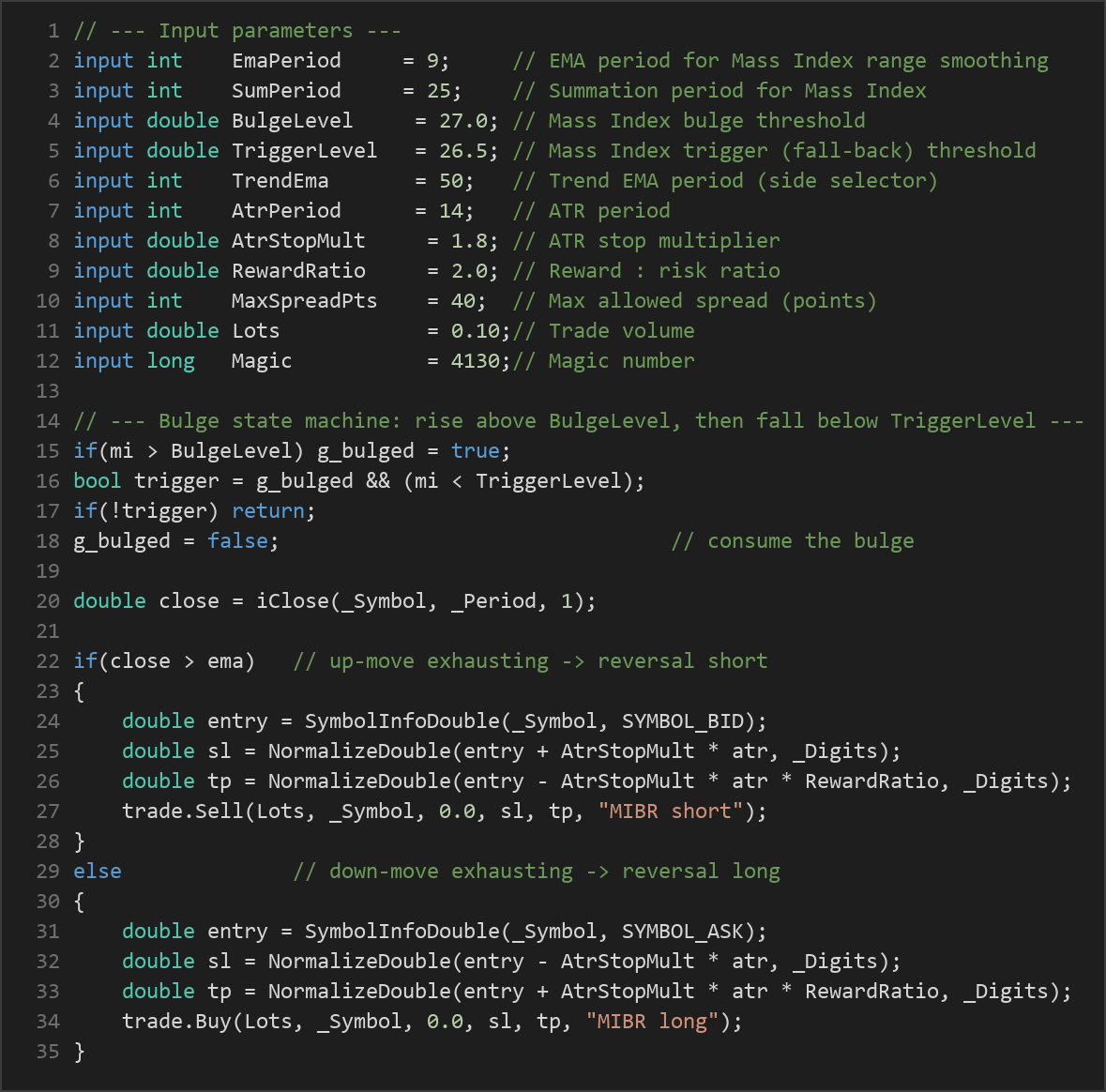
BulgeLevelthreshold, the strategy flags that a bulge has formed (range expansion is under way). - Detecting the trigger: Once a bulge exists, the strategy waits for the Mass Index to fall back below the
TriggerLevel. This fall-back — the completed reversal bulge — is the entry trigger. The bulge flag is then consumed so the same event cannot fire twice. - Choosing the side (trend filter): The strategy compares the latest close to a longer
TrendEma. Because this is a fade strategy, it trades against the prevailing move: - Short signal — the bulge completes while price is above its trend EMA, suggesting an up-move is exhausting and may reverse down.
- Long signal — the bulge completes while price is below its trend EMA, suggesting a down-move is exhausting and may reverse up.
- Entry filters: Before any order is sent, the strategy confirms there is no open position for its magic number and that the current spread is at or below
MaxSpreadPts. If either check fails, the signal is skipped. - Stop-loss logic: Risk is sized from the Average True Range (ATR), a measure of recent volatility. The stop is placed
AtrStopMult × ATRaway from entry — above entry for shorts, below entry for longs. - Take-profit logic: The take-profit distance is the stop distance multiplied by the
RewardRatio. With the defaults (1.8 ATR stop and a 2.0 reward ratio), the target sits roughly twice as far from entry as the stop, defining the intended risk-to-reward profile of each trade.
Because entries are evaluated only on a closed bar, the strategy avoids reacting to unfinished, noisy price action within the hour.
Strategy Parameters
| Parameter | Default | Min | Max | Description |
|---|---|---|---|---|
| EmaPeriod | 9 | 5 | 20 | EMA length used to smooth the high-low range inside the Mass Index. |
| SumPeriod | 25 | 15 | 40 | Number of ratio values summed to form the Mass Index reading. |
| BulgeLevel | 27.0 | 25.0 | 30.0 | Mass Index threshold that must be exceeded to register a bulge. |
| TriggerLevel | 26.5 | 24.0 | 29.0 | Fall-back threshold the Mass Index must drop below to trigger a trade. |
| TrendEma | 50 | 20 | 150 | Trend EMA period that selects the trade side (fade above vs. below). |
| AtrPeriod | 14 | 5 | 30 | Lookback period for the ATR used to size stops and targets. |
| AtrStopMult | 1.8 | 1.0 | 4.0 | ATR multiple that sets the stop-loss distance from entry. |
| RewardRatio | 2.0 | 1.0 | 4.0 | Reward-to-risk multiple applied to the stop distance for the take-profit. |
| MaxSpreadPts | 40 | 5 | 300 | Maximum allowed spread (in points) for a trade to be taken. |
| Lots | 0.10 | 0.01 | 1.0 | Fixed trade volume in lots. |
| Magic | 4130 | 0 | 9,999,999 | Magic number identifying this EA's positions. |
Recommended Chart Settings
This strategy was designed and tuned for the US30 (Dow Jones 30) index on the H1 timeframe. The Mass Index thresholds, trend EMA, and ATR-based risk parameters are all calibrated for the volatility profile of an hourly index chart. You can attach the EA to other symbols or timeframes for study, but the default thresholds may behave very differently, and results will vary across different market conditions. If you experiment, treat any new symbol or timeframe as a fresh study that requires its own testing rather than assuming the defaults transfer.
How to Install on MetaTrader 5
- Download the
.ex5file from the link below. - Copy it to your MT5
MQL5\Expertsfolder. - Restart MetaTrader 5 or refresh the Navigator panel.
- Drag the EA onto a chart matching the recommended symbol and timeframe.
- Configure the input parameters and enable Algo Trading.
What to Consider Before Using This EA
Every reversal approach carries trade-offs, and it is important to understand them before committing capital.
Strengths. The Mass Index is a genuine, well-documented attempt to anticipate reversals from volatility structure rather than lagging price alone. Pairing the bulge signal with a trend EMA gives the strategy a clear rule for which side to take, and the ATR-based stops adapt position risk to current volatility rather than using a fixed distance. The spread filter and one-position-at-a-time rule add basic discipline that many manual traders overlook.
Limitations. Counter-trend strategies fade the prevailing move, which means that in a strong, sustained trend the signals may repeatedly position against momentum and get stopped out. The reversal bulge is a probabilistic pattern; a bulge and fall-back can occur without any meaningful reversal following. Fixed-lot sizing does not scale risk to account equity, and the strategy trades only one instrument and timeframe by design. Index CFDs can also gap around news, session opens, and macro releases, where ATR-based stops may fill at worse prices than intended.
Where it may underperform. Expect the approach to struggle during trending, low-volatility grinds where range expansions are shallow, and during erratic, headline-driven sessions where the bulge signal fires but price does not revert. As with any single-pattern system, no set of defaults performs equally across all regimes.
Risk Management Tips
Sound risk management matters more than any single indicator setting. Consider these general principles as you study this EA:
- Position sizing: Size positions so that a full stop-loss represents only a small, predefined slice of your account — many educators suggest risking no more than 1–2% of equity per trade. Adjust the
Lotsinput to fit your own account size rather than leaving it at the default. - Test on a demo account first: Run the EA on a demo account to observe how it behaves across different sessions before considering any live use.
- Understand drawdown: Reversal strategies can experience losing streaks during strong trends. Study the depth and duration of drawdown so its behavior does not surprise you.
- Respect the spread and costs: Keep the
MaxSpreadPtsfilter realistic for your broker, and factor spreads, commissions, and swaps into your expectations. - Never over-leverage: Only allocate capital you can afford to lose, and avoid stacking excessive leverage on a single directional idea.
Risk Warning
Trading foreign exchange, CFDs, and other leveraged financial instruments involves substantial risk of loss and is not suitable for all investors. The strategies and tools discussed on this page are provided for educational purposes only and do not constitute financial advice, investment recommendations, or solicitation to trade. Always consult a qualified financial adviser before making trading decisions. Past backtest performance is not indicative of future results.
Downloads
- Expert Advisor: MassIndexBulgeInstitutionalReversal.ex5 (83 downloads)
- Source Code: MassIndexBulgeInstitutionalReversal.mq5 (77 downloads)
- Documentation: MassIndexBulgeInstitutionalReversal.pdf (223 downloads)