
Disclaimer: This article is for educational and informational purposes only. It does not constitute financial or investment advice. Trading forex and CFDs carries significant risk of loss. Past performance of any strategy — including backtests — does not guarantee future results. Never trade with money you cannot afford to lose.
What Is This Strategy?
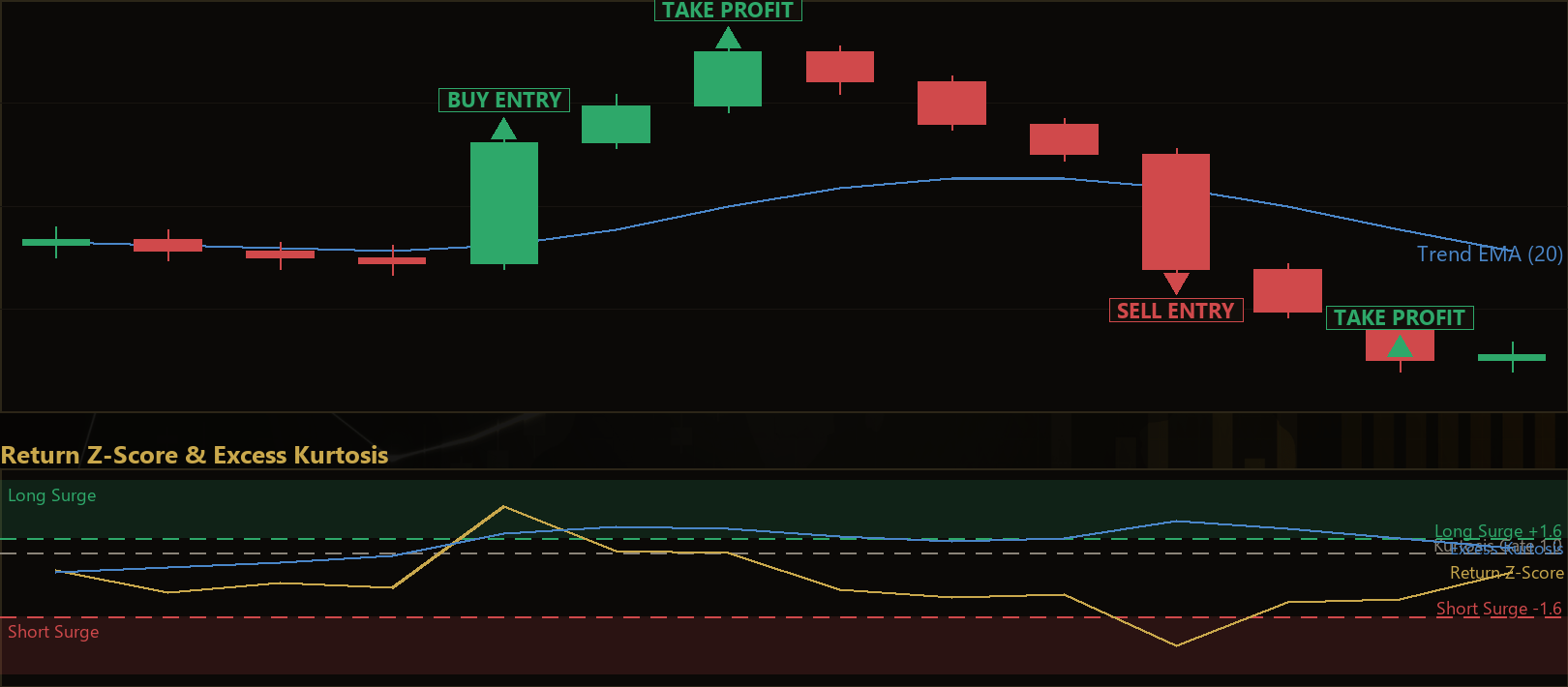
Kurtosis Surge Momentum is a statistical momentum-continuation strategy that combines a kurtosis filter (a measure of how "fat-tailed" recent price returns have been) with a Z-score surge trigger and a short EMA (Exponential Moving Average) slope confirmation. In plain terms, it tries to detect when a market has entered a phase of outsized, impulsive moves, then joins a fresh breakout in the direction that impulse is already pointing. It is a trend-continuation approach rather than a mean-reversion one.
The strategy is built on two well-documented properties of financial returns. The first is leptokurtosis — real-world returns produce more extreme moves than a normal (bell-curve) distribution would predict, giving the distribution "fat tails." The second is volatility clustering — the observation that large moves tend to be followed by more large moves. Kurtosis Surge Momentum measures both conditions over a rolling window, and only looks for entries when the recent regime has been genuinely fat-tailed and the latest bar delivered a statistical outlier.
As a learning tool, this strategy is well suited to traders who want to study how statistical descriptions of returns — mean, standard deviation, kurtosis, and Z-scores — can be translated into concrete, rule-based entry logic. It is designed for liquid, momentum-prone instruments such as major forex pairs and stock indices, on intraday timeframes where volatility clustering is most pronounced. It is best viewed as a framework for understanding regime-aware momentum entries, not as a shortcut to any particular outcome.
How It Works
The strategy processes one completed bar at a time on the timeframe of the chart it is attached to. On each newly closed bar, it recalculates its rolling statistics and checks whether a symmetric long or short condition is met. Only one position is held at a time, and exits are handled entirely by the stop-loss and take-profit bracket.
- Rolling return window: Over the last
ReturnLookbackbars, the strategy computes close-to-close log returns (the natural log of each close divided by the prior close). From this window it derives the mean return, the standard deviation, and the excess kurtosis (kurtosis minus 3, so that a normal distribution scores 0). - Fat-tailed regime gate: The strategy signals a valid regime only when excess kurtosis is greater than or equal to
KurtThreshold. A higher reading historically indicates the market has been producing impulsive, outsized moves rather than smooth drift — the environment where a fresh impulse may be more likely to extend than to fade. - Surge trigger (Z-score): The return of the bar that just completed is converted to a Z-score — how many standard deviations it sits from the window mean. The strategy treats the bar as a genuine "tail event" only when the Z-score reaches the
ZThresholdmagnitude. - Trend agreement (EMA slope): A short EMA of the closes is maintained, and its slope (current value minus previous value) must point the same way as the surge. This helps the strategy ride an impulse that is already moving with the short-term trend rather than fighting a fading one.
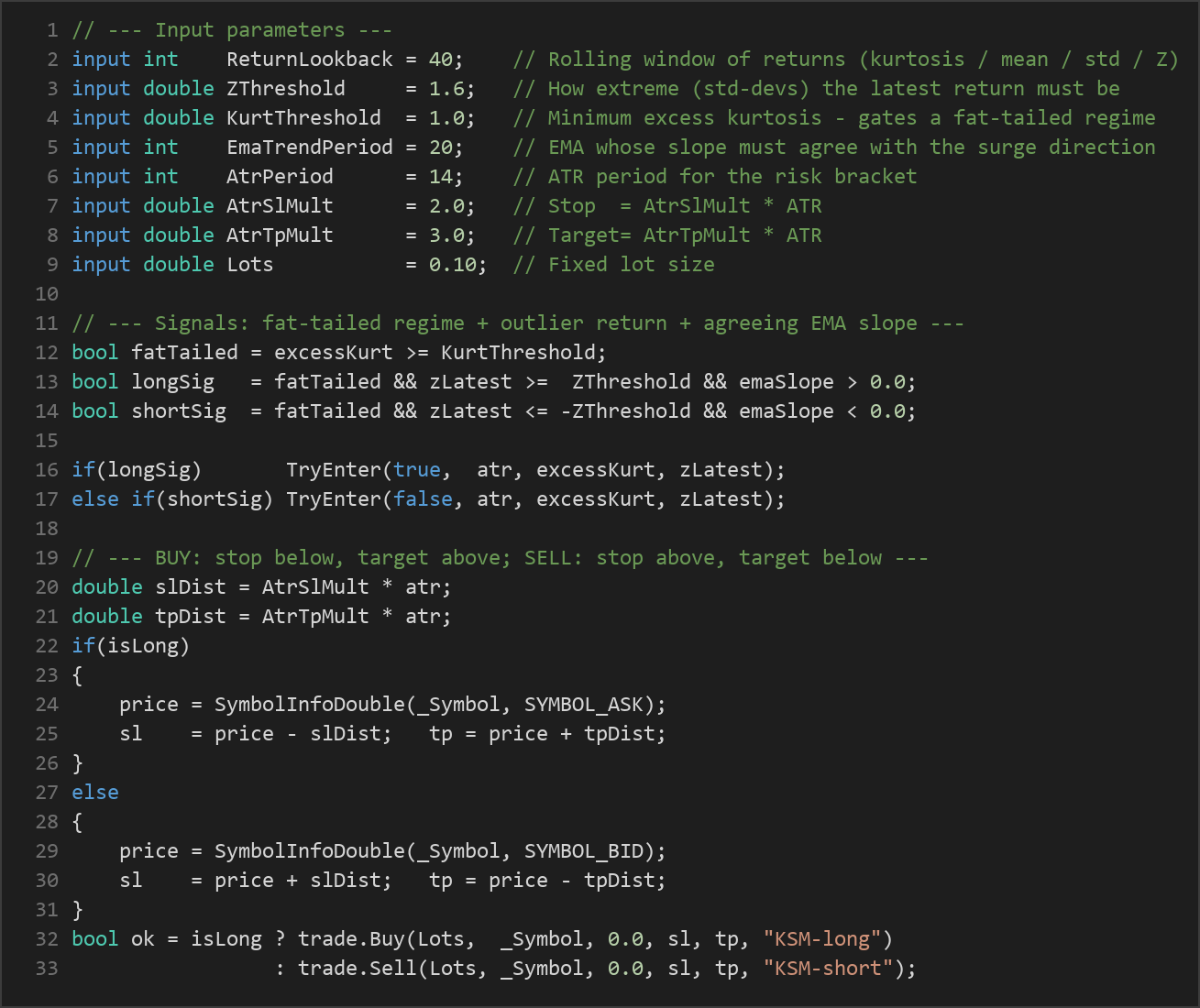
- Long entry: The strategy signals a long when the Z-score is at or above
+ZThreshold, excess kurtosis is at or aboveKurtThreshold, and the EMA slope is positive. - Short entry: The strategy signals a short when the Z-score is at or below
−ZThreshold, excess kurtosis is at or aboveKurtThreshold, and the EMA slope is negative. - Stop-loss logic: Risk is ATR-based (Average True Range, a volatility measure). The stop is placed
AtrSlMult × ATRaway from entry, so the protective distance scales with the very volatility that produced the surge. - Take-profit logic: The target is placed
AtrTpMult × ATRaway from entry. With the default multipliers, the target distance is larger than the stop distance, giving a reward-to-risk ratio above 1:1 on each bracket. - Position management: The strategy allows only one open position per magic number at a time. Once a trade is open, no new entries are taken until the existing stop or target closes it.
Strategy Parameters
| Parameter | Default | Min | Max | Description |
|---|---|---|---|---|
| ReturnLookback | 40 | 20 | 100 | Number of bars in the rolling window used to compute kurtosis, mean, standard deviation, and the Z-score. |
| ZThreshold | 1.6 | 0.8 | 3.0 | How extreme (in standard deviations) the latest return must be to count as a surge. Higher values demand rarer, more extreme moves. |
| KurtThreshold | 1.0 | -1.0 | 6.0 | Minimum excess kurtosis of the window; gates entries to fat-tailed regimes. Higher values require a more strongly leptokurtic regime. |
| EmaTrendPeriod | 20 | 5 | 60 | Period of the EMA whose slope must agree with the surge direction. |
| AtrPeriod | 14 | 5 | 30 | Number of bars used to calculate the ATR that sizes the risk bracket. |
| AtrSlMult | 2.0 | 0.5 | 5.0 | Stop-loss distance as a multiple of ATR. |
| AtrTpMult | 3.0 | 0.5 | 8.0 | Take-profit distance as a multiple of ATR. |
| Lots | 0.10 | 0.01 | 1.0 | Fixed trade volume in lots. |
Recommended Chart Settings
Kurtosis Surge Momentum is a single-timeframe strategy: it runs on whatever chart period it is attached to, and every calculation uses that one timeframe. It was designed with liquid, momentum-prone markets in mind — major forex pairs (for example EUR/USD or GBP/USD) and major stock indices — on intraday timeframes such as M15, M30, or H1, where volatility clustering tends to be most visible.
Because the entry logic depends on statistical properties of returns, the strategy's behavior can change meaningfully between instruments and timeframes. A window length and Z-threshold that produce reasonable signals on one pair may be too loose or too strict on another. Results will vary across different market conditions, so treat any single configuration as a starting point for study rather than a finished setting, and always test on historical data and a demo account before drawing conclusions.
How to Install on MetaTrader 5
- Download the .ex5 file from the link below
- Copy it to your MT5
MQL5\Expertsfolder - Restart MetaTrader 5 or refresh the Navigator panel
- Drag the EA onto a chart matching the recommended symbol and timeframe
- Configure the input parameters and enable Algo Trading
What to Consider Before Using This EA
The main strength of this approach is that it is explicitly regime-aware. Rather than acting on every crossover, it waits for two conditions to line up — a fat-tailed regime and a genuine outlier bar — before it even considers a trade, and then it demands trend agreement from the EMA slope. This layered filtering is designed to keep the strategy out of quiet, low-conviction conditions and to align entries with momentum that is already in motion. The ATR-based bracket is another sensible feature, because it adapts stop and target distances to current volatility instead of using fixed pip values.
There are also real limitations to understand. Kurtosis and Z-scores are backward-looking: they describe what returns have just done, not what they will do next. A surge that looks like the start of a trend can just as easily be a one-bar spike that reverses, and the strategy has no way to distinguish the two in advance. Because entries are triggered by outlier bars, the strategy may enter after a large move has already occurred, which can mean buying near a short-term high or selling near a short-term low. In choppy or range-bound markets, or during low-volatility regimes where the kurtosis gate rarely opens, the strategy may take very few trades or produce a series of small losses as brackets get whipsawed. News-driven spikes can also trip the Z-score trigger in ways that do not lead to sustained follow-through. None of these behaviors are flaws to be "fixed" — they are inherent trade-offs of a statistical momentum-continuation design, and understanding them is part of using the tool responsibly.
Risk Management Tips
Sound risk management matters more than any single parameter setting. Consider these general principles as you study the strategy:
- Position sizing: Keep individual trade sizes small relative to your account. Many educational sources suggest risking no more than 1–2% of account equity on any single trade.
- Understand the bracket: With the default multipliers, the stop is
2 × ATRand the target is3 × ATR. Make sure you know, in account-currency terms, what that stop distance means for your chosen lot size before trading. - Use a demo account first: Run the strategy on a demo account across a range of market conditions to understand how often it trades and how it behaves during quiet and volatile periods.
- Study drawdown: Every strategy experiences losing streaks. Review the depth and duration of historical drawdowns so you understand the emotional and financial tolerance the approach would require.
- Avoid over-optimization: Tuning parameters until backtest results look ideal often produces settings that fail on new data. Prefer robust, stable configurations over ones that only shine on a narrow slice of history.
- Only risk capital you can afford to lose: Leveraged trading can result in losses that exceed expectations. Treat this EA as a learning instrument first.
Risk Warning
Trading foreign exchange, CFDs, and other leveraged financial instruments involves substantial risk of loss and is not suitable for all investors. The strategies and tools discussed on this page are provided for educational purposes only and do not constitute financial advice, investment recommendations, or solicitation to trade. Always consult a qualified financial adviser before making trading decisions. Past backtest performance is not indicative of future results.
Downloads
- Expert Advisor: KurtosisSurgeMomentum.ex5 (1 downloads)
- Source Code: KurtosisSurgeMomentum.mq5 (1 downloads)
- Documentation: KurtosisSurgeMomentum.pdf (1 downloads)