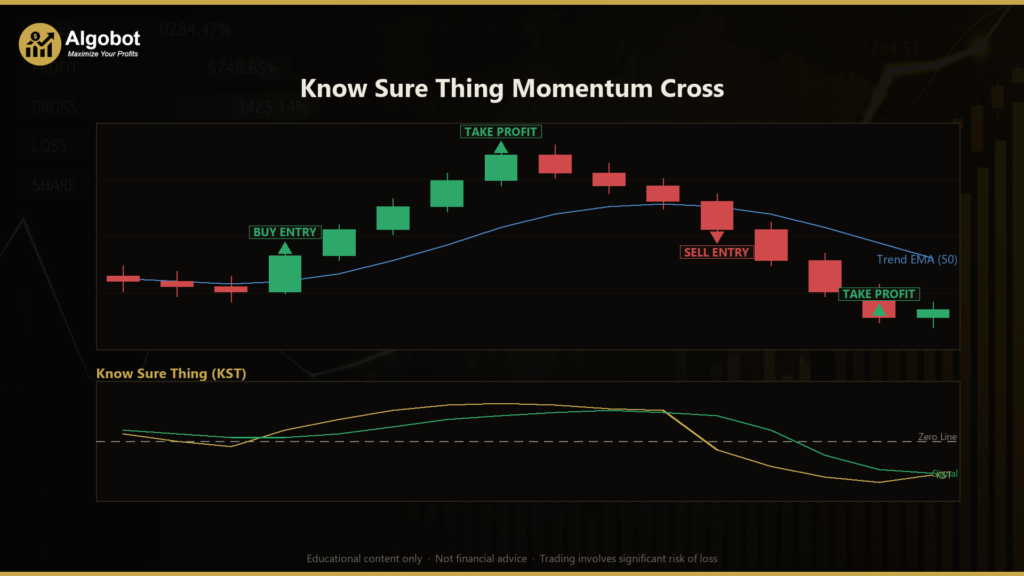
Disclaimer: This article is for educational and informational purposes only. It does not constitute financial or investment advice. Trading forex and CFDs carries significant risk of loss. Past performance of any strategy — including backtests — does not guarantee future results. Never trade with money you cannot afford to lose.
What Is This Strategy?
The Know Sure Thing Momentum Cross is a momentum-following trading strategy built around Martin Pring's Know Sure Thing (KST) oscillator — a smoothed, weighted momentum indicator — combined with a signal-line crossover, a zero-line regime check, and a sloping EMA (Exponential Moving Average) trend filter. Rather than reacting to a single measure of price momentum, it fuses four different Rate-of-Change readings into one consensus signal, which is what gives the KST its distinctive character.
The core idea is straightforward. A standard momentum study such as a single Rate-of-Change (ROC) — the percentage change in price over a fixed look-back — can flip direction on the smallest wiggle. The KST addresses this by measuring momentum over four progressively longer windows (short, medium, and long cycles), smoothing each one, and then weighting them so the slower, more reliable cycles carry the most influence. The strategy only acts when short-, medium-, and long-cycle momentum broadly agree, which is designed to filter out the whipsaw that troubles raw single-period oscillators like ROC or MACD.
This makes the strategy most at home in trending markets, where sustained directional momentum can develop and persist. As a learning tool, it is well suited to traders who already understand basic indicators and want to study how multi-timeframe momentum consensus, regime filtering, and trend confirmation can be layered together into a single rules-based system. It is not designed for scalping or for choppy, range-bound conditions, and this article treats it strictly as a strategy analysis rather than a profit opportunity.
How It Works
The strategy evaluates its rules only on closed bars, meaning it never acts on the still-forming candle. This "non-repainting" design ensures that a signal you see on a completed bar will not change afterward. Here is how the logic unfolds:
Building the KST oscillator:
- For each of four look-back periods, the strategy computes a Rate-of-Change:
ROC(n) = 100 × (Close − Close[n]) / Close[n]. - Each ROC is smoothed with a Simple Moving Average (SMA) over the
SmoothPeriod. - The four smoothed legs are combined with Pring's classic weights:
KST = 1×leg1 + 2×leg2 + 3×leg3 + 4×leg4, so the longer cycles dominate. - A signal line is formed by taking an SMA of the KST over the
SignalPeriod.
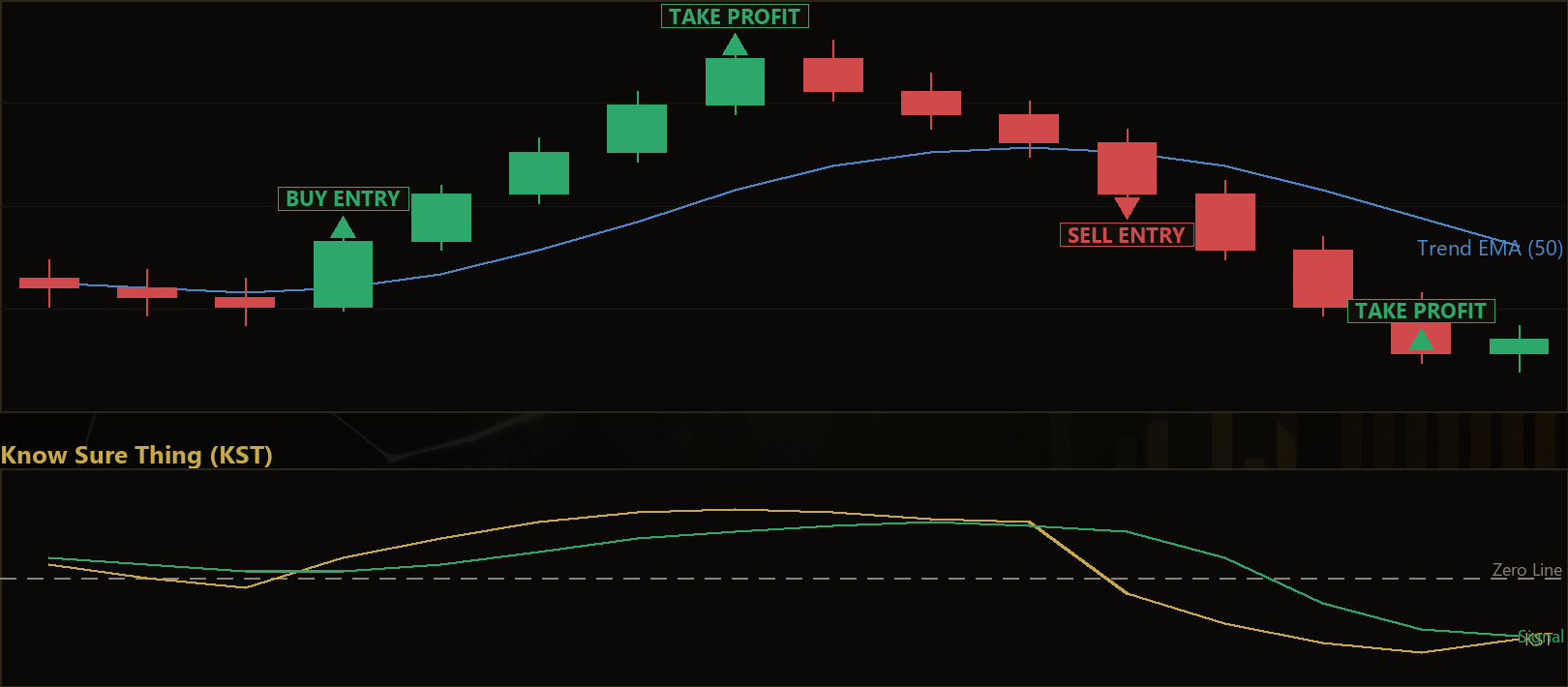
Entry conditions (all three must align):
- Cross — The KST crosses its own signal line. A cross upward points to a potential long; a cross downward points to a potential short.
- Regime — The KST must be on the correct side of the zero line. For a long, KST must be positive (aggregate momentum genuinely bullish); for a short, negative. This avoids buying on a brief up-tick inside an overall down phase.
- Trend — Price must be on the correct side of a sloping EMA. For a long, price sits above the EMA and the EMA is rising; for a short, price sits below a falling EMA. This confirms the higher-level drift agrees with the momentum signal.
When all three conditions align, the strategy signals a long (buy) or short (sell) entry.
Stop-loss logic:
- The initial stop is placed at
AtrStopMult × ATRaway from the entry price. ATR (Average True Range) measures recent volatility, so the stop automatically widens in fast markets and tightens in calm ones.
Take-profit logic:
- The take-profit is set at a fixed reward-to-risk multiple of the stop distance, controlled by
RewardRiskRatio. A ratio of 1.8, for example, targets 1.8 units of reward for every 1 unit of risk.
Trade management:
- An optional chandelier ATR trailing stop (
TrailAtrMult) trails behind price at a set number of ATRs. It only ever ratchets in the trade's favour — it never loosens — which is designed to protect open profit if a trend extends. - Only one position per magic number is held at a time, so the strategy manages an existing trade before it considers a new one.
- A spread filter (
MaxSpreadPoints) skips new entries when the broker spread is unusually wide, helping avoid poor fills.
Strategy Parameters
| Parameter | Default | Min | Max | Description |
|---|---|---|---|---|
| Roc1Period | 10 | 5 | 20 | Look-back for the first (shortest cycle) Rate-of-Change leg. |
| Roc2Period | 15 | 8 | 30 | Look-back for the second Rate-of-Change leg. |
| Roc3Period | 20 | 12 | 45 | Look-back for the third Rate-of-Change leg. |
| Roc4Period | 30 | 18 | 70 | Look-back for the fourth (longest cycle) Rate-of-Change leg. |
| SmoothPeriod | 10 | 3 | 25 | SMA smoothing applied to each ROC before weighting. |
| SignalPeriod | 9 | 3 | 20 | SMA period of the KST used as the signal line. |
| TrendPeriod | 50 | 20 | 200 | EMA period for the trend filter; price must sit on the correct side and slope with it. |
| AtrPeriod | 14 | 7 | 30 | ATR window used for stop, target, and trailing distances. |
| AtrStopMult | 1.8 | 0.5 | 4.0 | Initial stop distance in ATR multiples from entry. |
| RewardRiskRatio | 1.8 | 0.8 | 5.0 | Take-profit distance as a reward:risk multiple of the stop distance. |
| TrailAtrMult | 1.2 | 0.0 | 3.0 | Chandelier trailing-stop distance in ATRs (0 disables trailing). |
| RiskPercent | 1.0 | 0.0 | 5.0 | Percentage of equity risked per trade (0 uses flat BaseLots). |
| BaseLots | 0.10 | 0.01 | 1.0 | Base/flat lot size and the fallback sizing unit. |
| MaxLots | 2.0 | 0.01 | 10.0 | Hard cap on the size of any single position. |
| MaxSpreadPoints | 40 | 0 | 200 | Skip entries when spread (in points) exceeds this value (0 disables the filter). |

Recommended Chart Settings
Because the KST blends look-backs measured in dozens of bars and pairs them with a 50-period EMA trend filter, the strategy is designed for higher timeframes where trends have room to develop — the H1 (1-hour) or H4 (4-hour) charts are sensible starting points for study. Major, liquid forex pairs such as EUR/USD tend to suit trend-and-momentum systems because they trend cleanly and carry tight spreads.
The default parameters are a general baseline, not an optimized configuration for any specific market. Results will vary considerably across different symbols, timeframes, and market conditions, and any parameter set that looks appealing on one instrument may behave very differently on another. Always test on the exact symbol and timeframe you intend to study.
How to Install on MetaTrader 5
- Download the .ex5 file from the link below
- Copy it to your MT5
MQL5\Expertsfolder - Restart MetaTrader 5 or refresh the Navigator panel
- Drag the EA onto a chart matching the recommended symbol and timeframe
- Configure the input parameters and enable Algo Trading
What to Consider Before Using This EA
Strengths of the approach. The KST's four-cycle consensus design is genuinely different from a single-period oscillator: by requiring short, medium, and long momentum to broadly agree, it historically tends to produce fewer false crossovers than a raw ROC or a plain MACD. Layering the zero-line regime check and the sloping-EMA trend filter on top means three independent conditions must align before an entry, which can reduce the count of low-quality signals. The ATR-based stops and reward-to-risk take profit also give the system a defined, volatility-adaptive risk structure rather than fixed pip distances.
Known limitations. Every one of those strengths is also a source of lag. Smoothed, weighted momentum reacts slowly, so entries often arrive after a move is already underway, and exits can give back open profit. Requiring three conditions to align means the strategy trades relatively infrequently and will sit out many moves entirely. In range-bound or choppy markets, the signal line can cross back and forth around zero, producing whipsaw entries that get stopped out — the trend filter helps here but does not eliminate the problem.
Where it may underperform. Sharp reversals, news-driven spikes, and low-volatility drift are difficult for a lagging momentum system. The strategy holds only one position at a time, so it cannot pyramid into a strong trend, and a poorly chosen RewardRiskRatio relative to the win rate can quietly erode results. Treat the defaults as a research starting point, not a finished configuration.
Risk Management Tips
Sound risk management matters far more than any single indicator setting. Consider these general principles as part of your education:
- Risk a small, fixed fraction per trade. Many educational sources suggest risking no more than 1–2% of account equity on any one position. The
RiskPercentparameter is designed to support this kind of fixed-fractional sizing. - Understand drawdown. Even a well-designed strategy will experience losing streaks. Study the maximum peak-to-trough decline a configuration produces so you know what a normal rough patch looks like before committing real capital.
- Always demo first. Run the strategy on a demo account across varied market conditions until you understand its behaviour, signal frequency, and typical trade duration.
- Mind position size limits. Use
MaxLotsas a hard ceiling and keep leverage modest so a single adverse move cannot cause outsized damage. - Account for costs. Spreads, commissions, and slippage all eat into results; the
MaxSpreadPointsfilter helps, but real trading conditions differ from idealized backtests.
Risk Warning
Trading foreign exchange, CFDs, and other leveraged financial instruments involves substantial risk of loss and is not suitable for all investors. The strategies and tools discussed on this page are provided for educational purposes only and do not constitute financial advice, investment recommendations, or solicitation to trade. Always consult a qualified financial adviser before making trading decisions. Past backtest performance is not indicative of future results.
Downloads
- Expert Advisor: KnowSureThingMomentumCross.ex5 (54 downloads)
- Source Code: KnowSureThingMomentumCross.mq5 (52 downloads)
- Documentation: KnowSureThingMomentumCross.pdf (54 downloads)