Disclaimer: This article is for educational and informational purposes only. It does not constitute financial or investment advice. Trading forex and CFDs carries significant risk of loss. Past performance of any strategy — including backtests — does not guarantee future results. Never trade with money you cannot afford to lose.
What Is This Strategy?
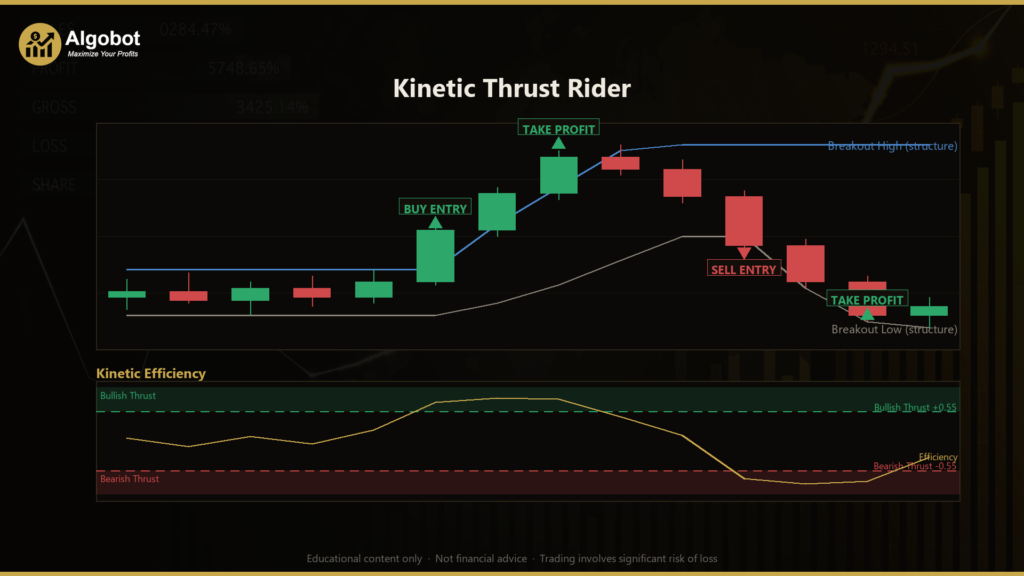
Kinetic Thrust Rider is a pure price-action momentum-continuation strategy that uses a self-computed kinetic efficiency ratio — not a traditional indicator like RSI or moving averages — to decide when a market is moving with genuine intent. The core insight is simple: a strong move is not just a big move, it is an efficient one. Price that travels in a straight line with little back-and-forth shows real momentum, while price that lurches around to reach the same point is just chop wearing a costume. This makes it a trend-following, breakout-confirmation style of trading rather than a mean-reversion or scalping approach.
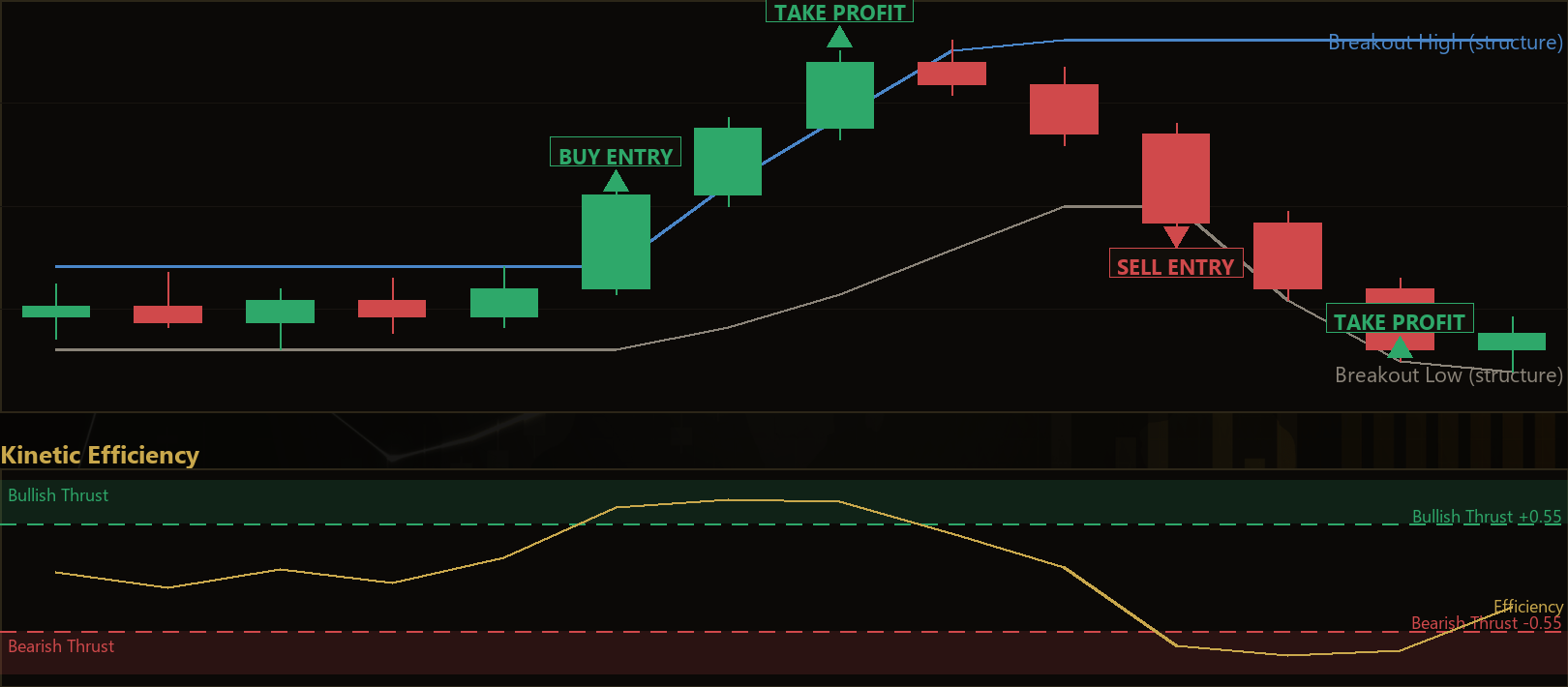
The strategy measures efficiency over a short window of closing prices by dividing the net distance price travelled by the total path it walked to get there. That signed ratio lives roughly between -1 and +1. A value near +1 means an almost perfectly clean bullish thrust; near -1 means a clean bearish thrust; and a value near 0 means the market is undecided and choppy. Crucially, Kinetic Thrust Rider does not act on efficiency alone — it also requires a break of recent price structure and a confirming candle before it commits, so momentum, structure, and the candle all have to agree.
As a learning tool, this strategy is well suited to traders who want to understand momentum and breakout mechanics without leaning on packaged indicators. Because every calculation is built from raw open, high, low, and close data, studying it teaches you how price efficiency, structure breaks, and volatility-based stops fit together. It is best treated as an educational case study in disciplined trend continuation, not as a turnkey solution.
How It Works
Kinetic Thrust Rider evaluates the market only once per closed bar (it ignores the still-forming current bar) and will hold only one position at a time per magic number, letting the stop-loss and take-profit manage each trade to completion. Here is how the strategy builds a signal:
- Momentum (kinetic efficiency): Over the last
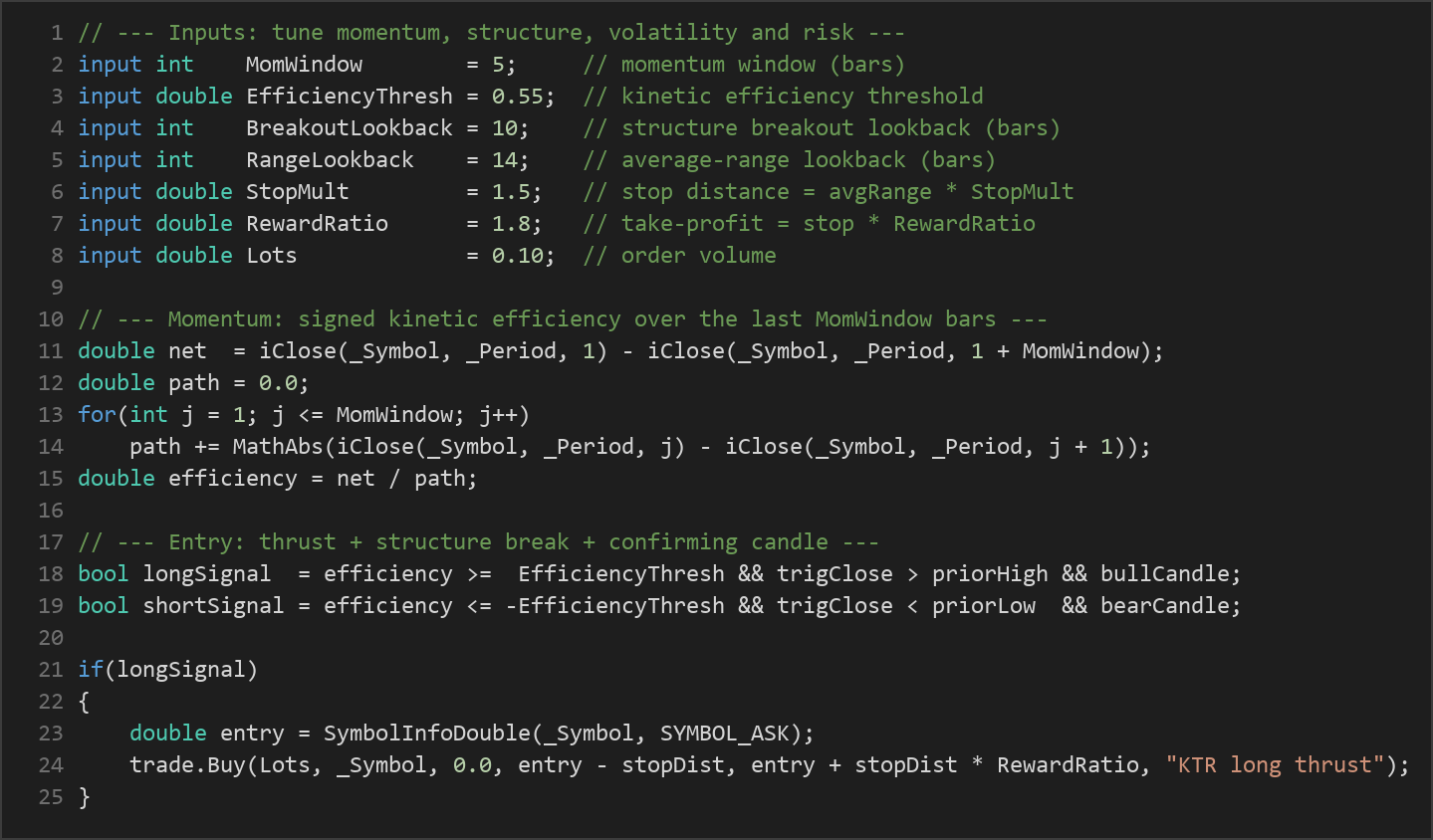
MomWindowbars, the strategy calculatesefficiency = (net price change) / (sum of absolute bar-to-bar changes). This produces a signed number between roughly -1 and +1. A reading at or above theEfficiencyThreshvalue flags a clean bullish thrust; a reading at or below the negative of that threshold flags a clean bearish thrust. - Structure (breakout confirmation): The strategy scans the prior
BreakoutLookbackbars (excluding the trigger bar) to find the highest high and lowest low. For a long, the trigger bar's close must break above that prior high; for a short, it must close below the prior low. This confirms the move is breaking recent structure, not just drifting inside a range. - Confirming candle: The trigger bar itself must agree with the direction. A long requires a bullish candle (close above open); a short requires a bearish candle (close below open). This filters out signals where momentum and structure line up but the final candle stalls or reverses.
- Volatility measurement: The strategy averages the high-to-low range of the last
RangeLookbackbars. This price-action volatility figure — again, no indicator — scales the stop distance to current market conditions so a quiet market gets a tighter stop and a volatile one gets more room.
When all three conditions agree, the strategy signals an entry:
- Long entry: efficiency ≥
EfficiencyThreshand trigger close above prior high and bullish candle. The order is sent at the current ask. - Short entry: efficiency ≤ –
EfficiencyThreshand trigger close below prior low and bearish candle. The order is sent at the current bid. - Stop-loss: placed at
avgRange × StopMultaway from entry (below entry for longs, above for shorts). The stop is therefore tied to live volatility rather than a fixed pip count. - Take-profit: placed at
stop distance × RewardRatioin the direction of the trade, giving a fixed, pre-defined risk-to-reward target on every position.
Once a trade is live, the strategy steps back and lets the stop-loss or take-profit close it; no new position is opened until the current one is resolved.
Strategy Parameters
| Parameter | Default | Min | Max | Description |
|---|---|---|---|---|
| MomWindow | 5 | 3 | 20 | Number of bars used to measure kinetic efficiency. Shorter windows react faster but are noisier; longer windows smooth the reading. |
| EfficiencyThresh | 0.55 | 0.30 | 0.90 | Minimum efficiency (0–1) required to qualify as a clean thrust. Higher values demand straighter, more decisive moves and produce fewer signals. |
| BreakoutLookback | 10 | 3 | 40 | How many prior bars define the recent high/low that the trigger bar must break to confirm a structure breakout. |
| RangeLookback | 14 | 5 | 50 | Number of bars averaged to measure typical bar range (volatility), which scales the stop distance. |
| StopMult | 1.5 | 0.5 | 4.0 | Multiplier applied to the average range to set the stop-loss distance. Larger values give wider stops. |
| RewardRatio | 1.8 | 0.5 | 5.0 | Take-profit distance as a multiple of the stop distance. A value of 1.8 targets 1.8× the risked distance. |
| Lots | 0.10 | 0.01 | 1.0 | Fixed order volume in lots for each trade. |
Recommended Chart Settings
Kinetic Thrust Rider operates on a single timeframe — always the chart's primary timeframe — and trades the chart's primary symbol. Because it relies on clean directional thrusts breaking recent structure, it tends to be studied on liquid instruments such as major forex pairs, and on intraday-to-swing timeframes (for example M15 through H1) where breakouts have room to develop without excessive noise. There is no single "correct" symbol or timeframe baked into the code, so treat these as starting points for your own testing. Results will vary considerably across different instruments, sessions, and market conditions, and any setting that performed well in one regime may behave very differently in another.
How to Install on MetaTrader 5
- Download the .ex5 file from the link below
- Copy it to your MT5
MQL5\Expertsfolder - Restart MetaTrader 5 or refresh the Navigator panel
- Drag the EA onto a chart matching the recommended symbol and timeframe
- Configure the input parameters and enable Algo Trading
What to Consider Before Using This EA
The main strength of Kinetic Thrust Rider is its triple-confirmation logic. By requiring momentum efficiency, a structure break, and a confirming candle to all agree, it is designed to avoid acting on weak or ambiguous moves. Its volatility-scaled stop is another thoughtful feature: tying risk to the market's actual range is generally more adaptive than a fixed stop, and the fixed reward ratio enforces a consistent, pre-planned trade structure.
That said, every approach has limitations, and momentum-continuation systems share a well-known one: they can struggle in ranging, sideways, or whipsawing markets. When a market repeatedly fakes breakouts, the strategy may enter on a thrust that immediately reverses, taking the stop. Efficiency readings can also spike during fast, news-driven moves that then snap back. Because the strategy trades only one position at a time and waits for closed bars, it is deliberately selective — which can mean long stretches with no signals, followed by clustered activity during trending phases. Slippage on breakouts, spread widening around news, and the gap between backtested fills and live fills can all affect real-world behaviour. None of these are reasons to dismiss the strategy; they are reasons to study it carefully and test it thoroughly before risking capital.
Risk Management Tips
Sound risk management matters far more than any single entry rule. As an educational starting point, consider these widely taught principles:
- Risk a small, fixed fraction per trade. Many educators suggest risking no more than 1–2% of account equity on any single position. Set your
Lotsso that the stop distance translates to that fraction, rather than choosing volume arbitrarily. - Demo first. Run the strategy on a demo account across different market conditions before considering real funds, so you understand how it behaves in trends, ranges, and volatile sessions.
- Understand drawdown. Even a well-designed strategy will have losing streaks. Know the maximum peak-to-trough decline you are willing to tolerate, and how that maps to your position size.
- Mind correlation and exposure. Running the EA on several correlated pairs can multiply your effective risk beyond what the per-trade size suggests.
- Review and adjust. Markets evolve; parameters that suited one period may need re-evaluation. Treat tuning as ongoing study, not a one-time setup.
Risk Warning
Trading foreign exchange, CFDs, and other leveraged financial instruments involves substantial risk of loss and is not suitable for all investors. The strategies and tools discussed on this page are provided for educational purposes only and do not constitute financial advice, investment recommendations, or solicitation to trade. Always consult a qualified financial adviser before making trading decisions. Past backtest performance is not indicative of future results.
Downloads
- Expert Advisor: KineticThrustRider.ex5 (61 downloads)
- Source Code: KineticThrustRider.mq5 (53 downloads)
- Documentation: KineticThrustRider.pdf (64 downloads)