Disclaimer: This article is for educational and informational purposes only. It does not constitute financial or investment advice. Trading forex and CFDs carries significant risk of loss. Past performance of any strategy — including backtests — does not guarantee future results. Never trade with money you cannot afford to lose.
What Is This Strategy?
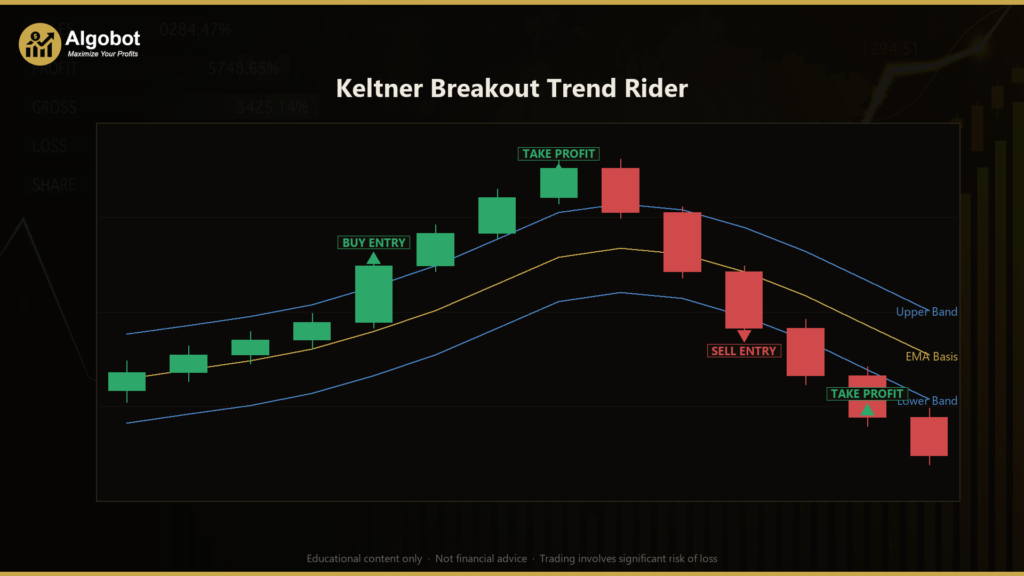
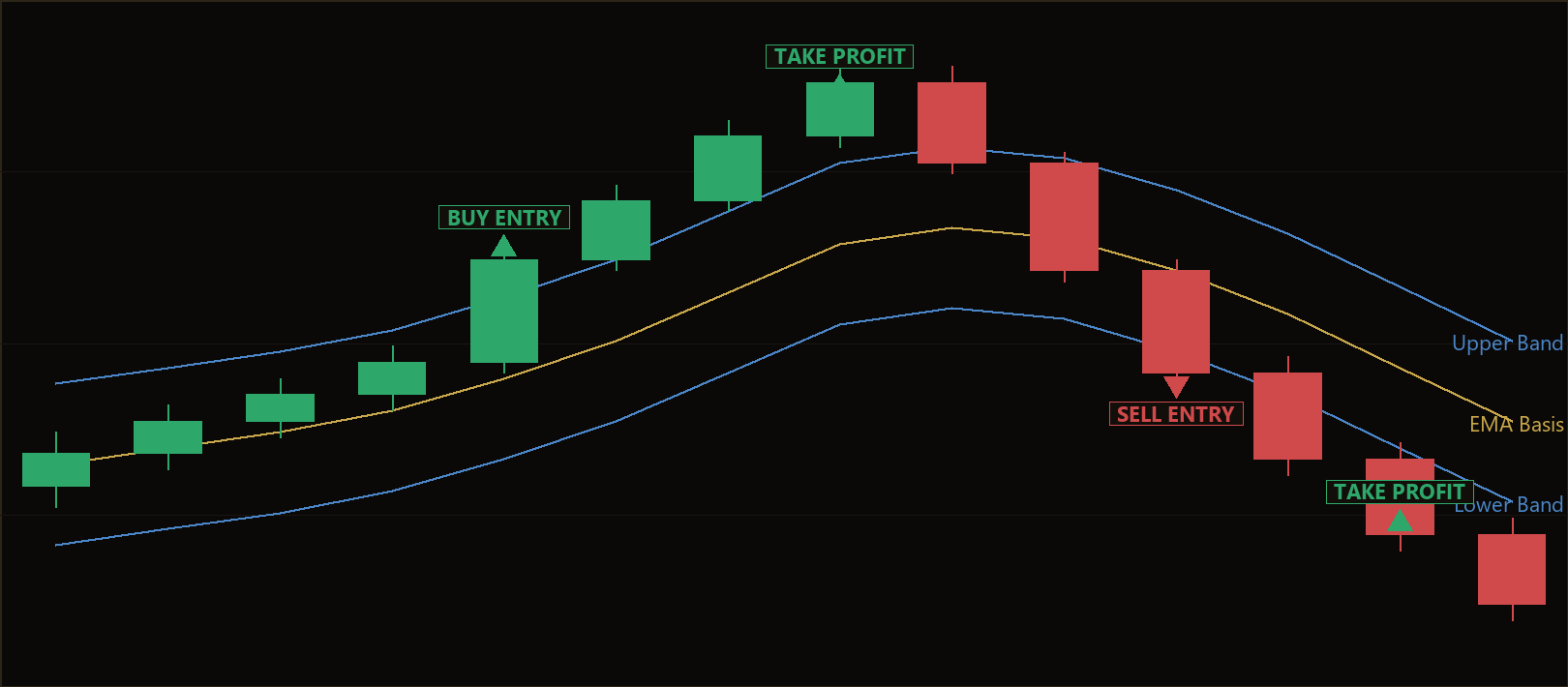
The Keltner Breakout Trend Rider is a volatility-channel, trend-following breakout strategy built around the Keltner Channel — a set of bands drawn a fixed number of Average True Range (ATR) units above and below an Exponential Moving Average (EMA). The EMA acts as the channel's centre line (the "basis"), while ATR — a measure of how much price typically moves in a given period — sets how wide the bands sit around it. When price pushes decisively through a band, the strategy interprets that as a momentum thrust and looks to ride the emerging trend.
This is a classic trend-following approach, and it is designed for trending, directional market conditions rather than quiet, sideways ranges. A built-in regime filter checks that the EMA is sloping in the same direction as the breakout before any trade is signalled, which is intended to keep the strategy out of choppy, non-trending periods where breakouts tend to fail. Long and short logic are fully symmetric, so the strategy treats upside and downside opportunities the same way.
As a learning tool, the Keltner Breakout Trend Rider is well suited to traders who want to study how channel breakouts, moving-average slope filters, and ATR-based risk controls fit together in a single, rules-based system. It deliberately uses only a small handful of economically meaningful parameters, which makes it a clean example for understanding trend-following mechanics without a maze of settings to tune. Treat it as a framework for analysis and study, not as a shortcut of any kind.
How It Works
The strategy is a bar-close system: it evaluates its rules only once per completed candle, using the values of the just-closed bar rather than reacting to every tick. This reduces noise and avoids acting on incomplete price information.
Entry conditions — the strategy signals a long trade when:
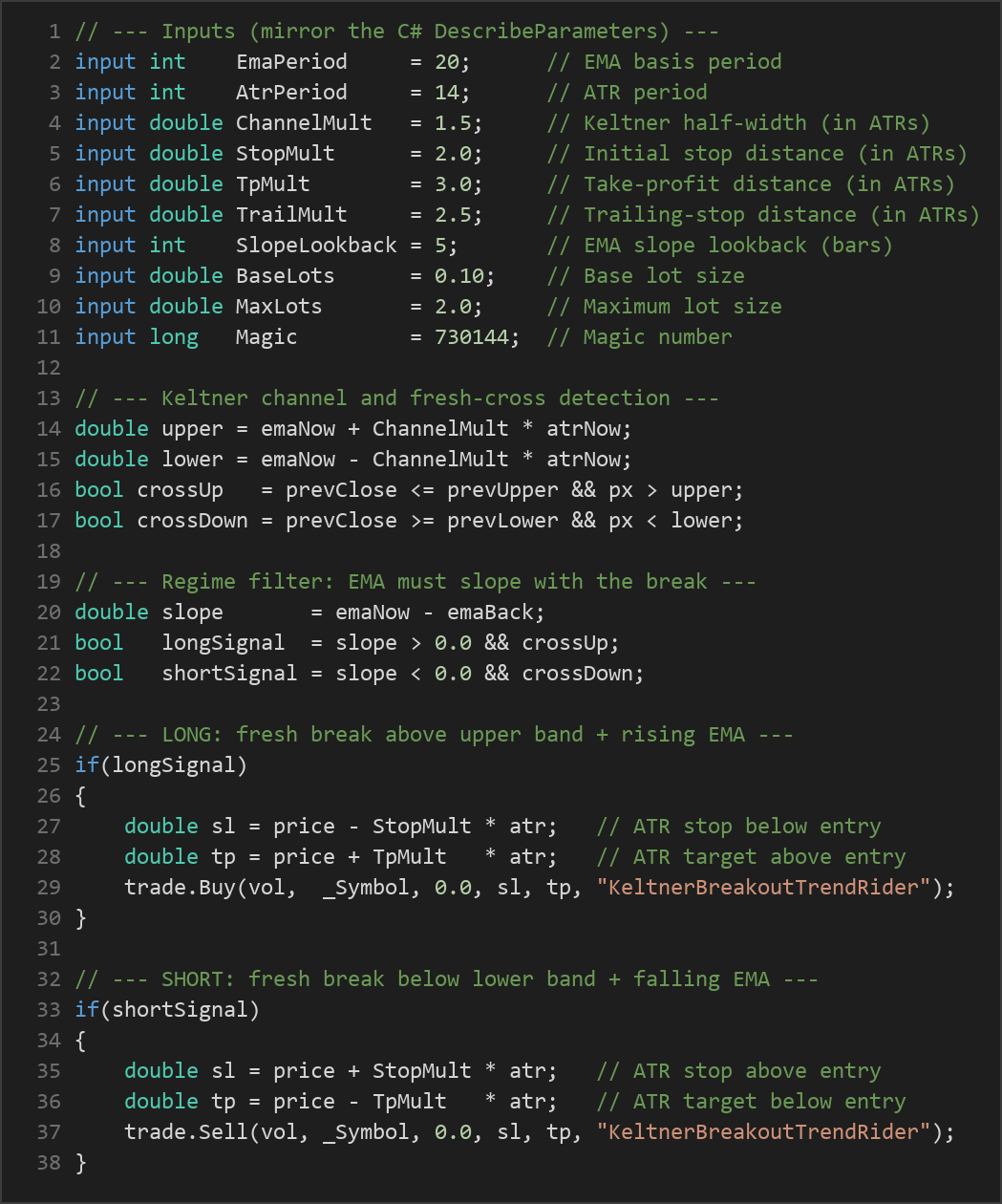
- Price closes above the upper Keltner band for the first time (a "fresh cross"). The previous bar's close was inside or below the band, and the current close is beyond it — this filters out bars that are already extended outside the channel.
- The EMA slope is positive, measured by comparing the current EMA to its value a set number of bars earlier (the
SlopeLookbackwindow). A rising EMA suggests an established uptrend.
The strategy signals a short trade when the mirror image occurs:
- Price closes below the lower Keltner band for the first time (a fresh downward cross).
- The EMA slope is negative, indicating a downtrend.
Exit and risk logic on every position:
- Initial stop-loss: placed
StopMult × ATRaway from the entry price. Because it is ATR-based, the stop automatically widens in volatile conditions and tightens in calm ones. - Take-profit: set
TpMult × ATRaway from entry. With the default settings, the take-profit sits farther from entry than the stop, giving a reward-to-risk structure greater than 1:1. - Chandelier-style ATR trailing stop: as price moves in the trade's favour, the stop ratchets to
TrailMult × ATRbehind the current price. Critically, it only ever moves in the trade's favour — it never loosens — helping to protect open gains as a trend extends. - Opposite-band early exit: if a fresh breakout signal appears in the opposite direction while a position is open, the strategy closes that position early. A long is exited on a fresh downside breakout, and a short on a fresh upside breakout.
Position discipline: only one position per magic number is allowed at a time. There is no averaging, no grid, and no adding to losers — a design choice intended to keep drawdown bounded. Trade volume is scaled fixed-fractionally with account balance (growing as the account grows, relative to a reference balance) and is clamped to a maximum lot ceiling.
Strategy Parameters
| Parameter | Default | Min | Max | Description |
|---|---|---|---|---|
| EmaPeriod | 20 | 10 | 60 | Period of the EMA that forms the Keltner Channel's centre line (basis). |
| AtrPeriod | 14 | 7 | 30 | Period of the ATR used to measure volatility and set band width. |
| ChannelMult | 1.5 | 1.0 | 3.0 | Channel half-width in ATRs — how far the bands sit from the EMA. |
| StopMult | 2.0 | 1.0 | 4.0 | Initial stop-loss distance from entry, in ATRs. |
| TpMult | 3.0 | 1.5 | 6.0 | Take-profit distance from entry, in ATRs. |
| TrailMult | 2.5 | 1.0 | 5.0 | Trailing-stop distance behind current price, in ATRs. |
| SlopeLookback | 5 | 2 | 20 | Number of bars used to measure EMA slope for the trend filter. |
| BaseLots | 0.10 | 0.01 | 1.0 | Base lot size at the reference account balance. |
| MaxLots | 2.0 | 0.10 | 10.0 | Maximum lot size cap after fixed-fractional scaling. |
Recommended Chart Settings
The Keltner Breakout Trend Rider is designed to be symbol- and timeframe-agnostic — it contains no hardcoded symbol, session, or time-of-day rules. It runs on whatever symbol and single timeframe you attach it to, which makes it a flexible framework for study across different markets.
Trend-following breakout logic generally behaves most consistently on higher timeframes (for example H1, H4, or D1), where individual bars carry more information and breakouts are less prone to intrabar noise. Liquid instruments with clean, sustained trends — such as major forex pairs or index CFDs — are natural candidates for study. That said, results will vary significantly across different symbols, timeframes, and market conditions. Always test any configuration on historical data and a demo account before considering live use, and remember that a setting that suited one market period may behave very differently in another.
How to Install on MetaTrader 5
- Download the
KeltnerBreakoutTrendRider.ex5file from the link below. - Copy it to your MT5
MQL5\Expertsfolder. - Restart MetaTrader 5 or refresh the Navigator panel.
- Drag the EA onto a chart matching the recommended symbol and timeframe.
- Configure the input parameters and enable Algo Trading.
What to Consider Before Using This EA
Strengths of this approach. Trend-following breakout systems like this one are designed to capture sustained directional moves, and the ATR-based sizing of stops, targets, and trailing stops means the strategy adapts to changing volatility automatically rather than using fixed pip distances. The EMA slope filter is a sensible attempt to avoid trading breakouts against the prevailing trend, and the one-position, no-averaging rule keeps the risk profile straightforward and bounded. The small parameter count reduces the temptation to over-optimise the strategy to past data.
Known limitations. The biggest challenge for any breakout strategy is the whipsaw: in ranging or choppy markets, price frequently pokes beyond a band only to reverse, triggering an entry that is quickly stopped out. The slope filter reduces but cannot eliminate this. Trend-following systems also characteristically have a lower win rate, relying on a smaller number of large winning trends to offset many small losing trades — this can be psychologically difficult and can produce extended losing streaks during range-bound periods. Because entries occur after price has already broken out, a portion of the initial move is given up before the position opens, and volatile breakouts can produce slippage.
Where it may underperform. Sideways, low-volatility, or mean-reverting markets are the most difficult environment for this design. News-driven spikes that immediately reverse, and periods of erratic price action without a clear direction, can generate a cluster of losing signals. No parameter set performs equally well across all market regimes, and a configuration optimised on one historical period should not be assumed to carry over to the future.
Risk Management Tips
Sound risk management matters far more than any single indicator setting. Consider these general principles as part of your education:
- Risk a small, fixed fraction per trade. A common guideline is to risk no more than 1–2% of account equity on any single position. Size your lots so that the distance to your stop-loss represents only that fraction of your balance.
- Understand drawdown. Every strategy experiences losing streaks. Study the maximum drawdown of any configuration on historical data and honestly ask whether you could tolerate that decline in real money without abandoning the plan.
- Start on a demo account. Run the strategy in a risk-free simulated environment first to understand its behaviour, trade frequency, and how it reacts to different market conditions before committing any capital.
- Use appropriate leverage. Higher leverage magnifies both gains and losses. Conservative leverage gives your account room to survive normal drawdown.
- Diversify and avoid over-concentration. Relying on a single strategy, symbol, or market regime increases fragility. Treat this EA as one component of a broader, well-considered approach.
- Review regularly. Markets evolve. Periodically re-examine whether the strategy's assumptions still hold, and never treat any automated system as "set and forget."
Risk Warning
Trading foreign exchange, CFDs, and other leveraged financial instruments involves substantial risk of loss and is not suitable for all investors. The strategies and tools discussed on this page are provided for educational purposes only and do not constitute financial advice, investment recommendations, or solicitation to trade. Always consult a qualified financial adviser before making trading decisions. Past backtest performance is not indicative of future results.
Downloads
- Expert Advisor: KeltnerBreakoutTrendRider.ex5 (68 downloads)
- Source Code: KeltnerBreakoutTrendRider.mq5 (69 downloads)
- Documentation: KeltnerBreakoutTrendRider.pdf (64 downloads)