
Disclaimer: This article is for educational and informational purposes only. It does not constitute financial or investment advice. Trading forex and CFDs carries significant risk of loss. Past performance of any strategy — including backtests — does not guarantee future results. Never trade with money you cannot afford to lose.
What Is This Strategy?
The Fractal Expansion Channel Reversion strategy is a mean-reversion system built around a custom volatility-channel structure and confirmed by the Relative Strength Index (RSI) — a momentum oscillator that measures how overextended recent price movement has become. Rather than following a trend, this strategy is designed to do the opposite: it waits for a stretched market to reach an apparent point of exhaustion and then trades a snapback toward the long-term average price.
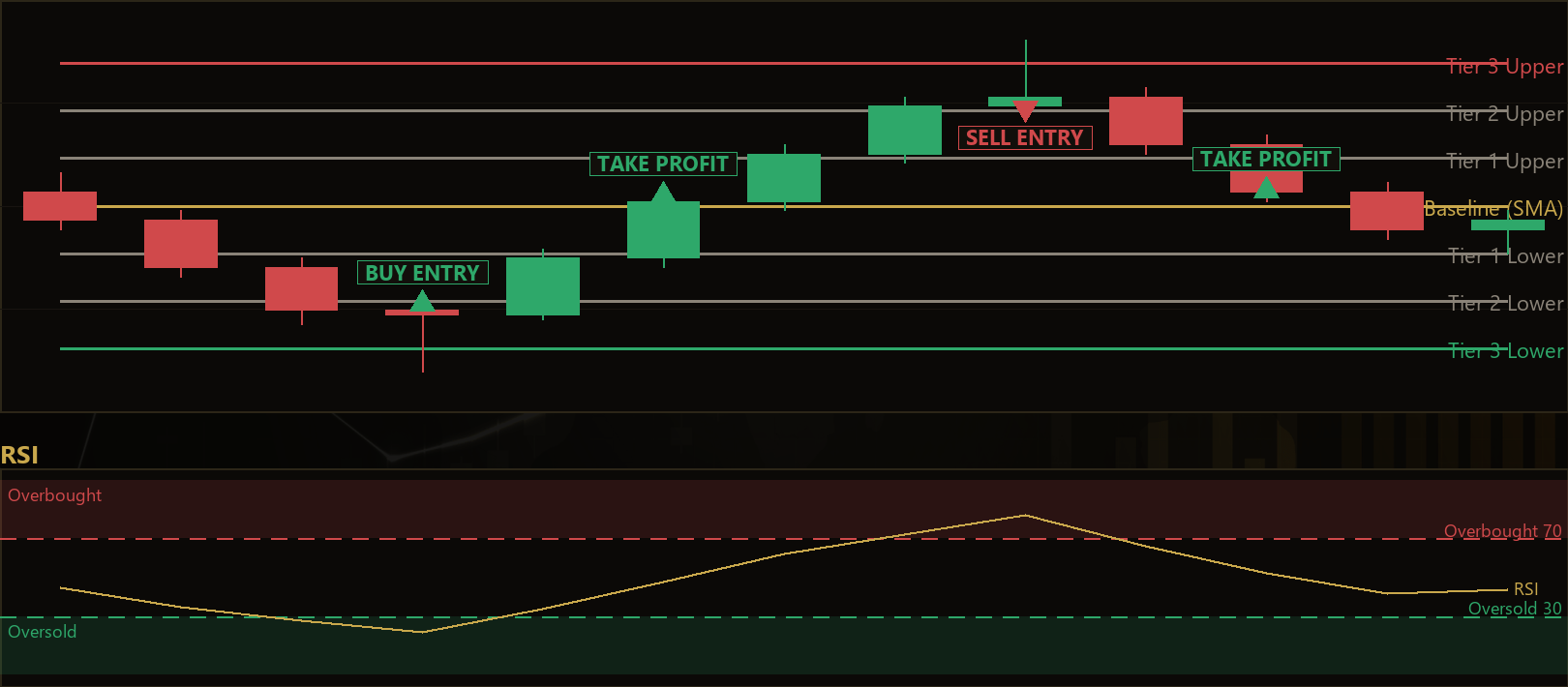
At its core, the strategy plots a long-term mean (a Simple Moving Average, or SMA, of closing prices) and surrounds it with three nested, self-similar "fractal expansion channel" tiers. Each tier sits a further multiple of one volatility unit — the rolling standard deviation of price — away from that central mean. Because volatility naturally widens as a trend accelerates, these channels physically expand during a strong move, and the outermost third tier marks the zone where price has become statistically extreme.
This is a strategy analysis intended as a learning tool for traders who want to study how mean-reversion logic, volatility banding, and momentum confirmation can be combined into a single rules-based system. It is best suited to intermediate learners who already understand basic indicators and want to see how a counter-trend "fade" is structured with defined risk. It is not a shortcut, and it is not designed for every market condition — mean-reversion approaches face particular challenges in strongly trending environments, as discussed later.
How It Works
The strategy evaluates the market only once per completed bar (candle), so signals are based on finished price action rather than a still-forming candle. On each new bar it recalculates its channels and checks whether the just-completed candle qualifies as a "blow-off" — a sharp thrust that overshoots and then rejects.
The channel construction:
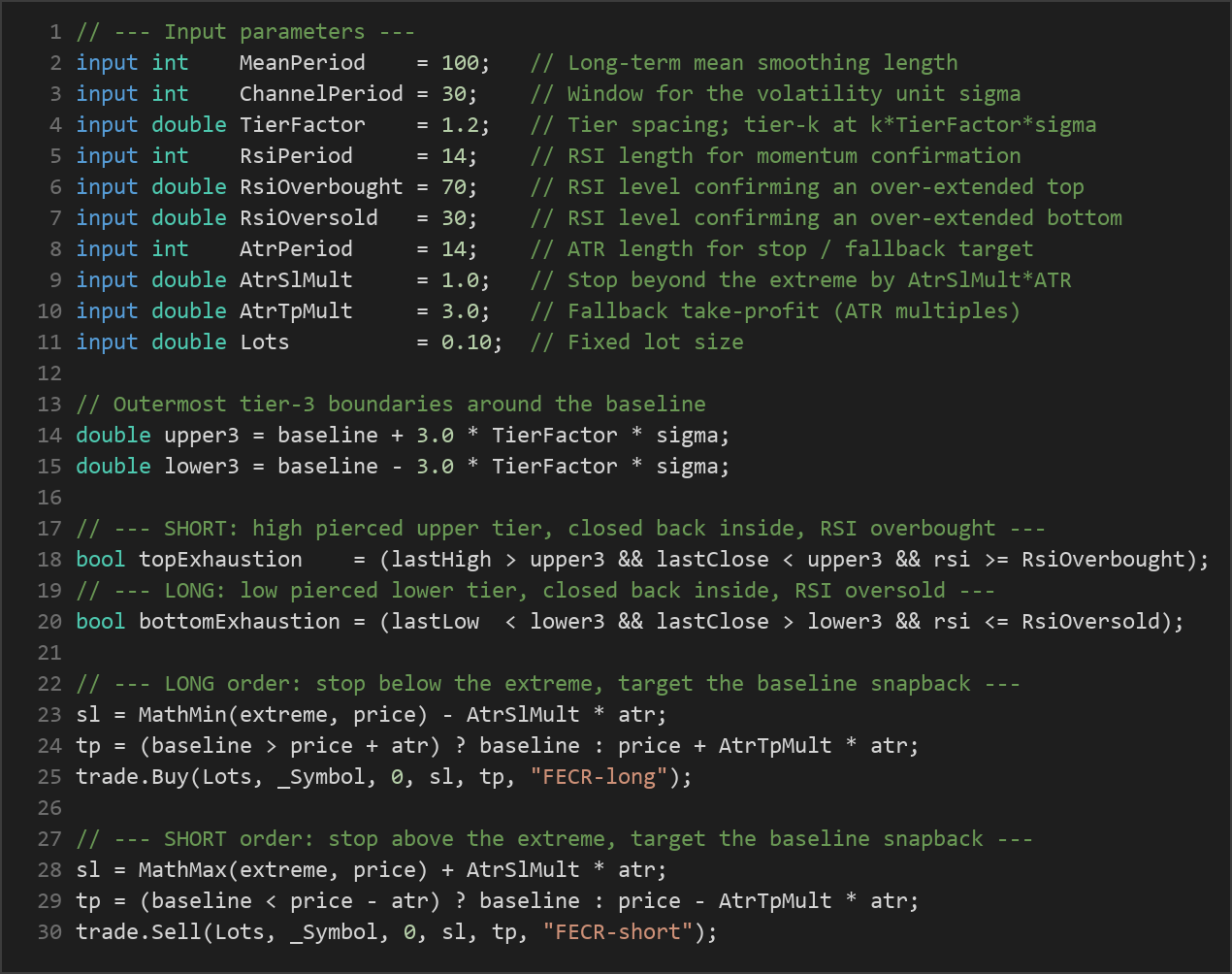
- The baseline is an SMA of closing prices over
MeanPeriodbars — this represents the long-term mean the strategy expects price to revert toward. - Sigma is the population standard deviation of the most recent
ChannelPeriodcloses, measured about that baseline. This is the "volatility unit" that spaces the tiers. - Three tiers are placed at
baseline ± k × TierFactor × sigma, for k = 1, 2, 3. The third tier (Upper3 / Lower3) is the outermost expansion boundary and the only one used for entries.
The strategy signals a SHORT (fade a blow-off top) when all of these are true:
- The completed candle's high pierces above Upper3 (the wick breaches the outer channel).
- The candle closes back below Upper3 (the breach is rejected — price could not hold the extreme).
- RSI is at or above
RsiOverbought, confirming the thrust was genuinely overextended rather than an ordinary poke.
The strategy signals a LONG (fade a blow-off bottom) when the symmetric conditions hold:
- The completed candle's low pierces below Lower3.
- The candle closes back above Lower3.
- RSI is at or below
RsiOversold.
Stop-loss logic:
- The stop is placed just beyond the blow-off extreme (the candle's high for a short, its low for a long) by
AtrSlMult × ATR, where ATR (Average True Range) measures recent volatility. This positions the stop past the rejection wick, so the trade is invalidated only if price pushes back through the extreme.
Take-profit logic:
- The primary target is the snapback to the baseline (the long-term mean) — the whole premise of the trade.
- If the baseline is too close to the entry (less than one ATR away), the strategy instead uses an ATR-multiple fallback target of
AtrTpMult × ATR, so the reward is never trivially small. - Any trade whose stop or target would sit on the wrong side of the entry price (degenerate risk) is rejected before submission.
Only one position per magic number is allowed at a time, and position sizing is a fixed lot value, keeping the logic simple and easy to study.
Strategy Parameters
| Parameter | Default | Min | Max | Description |
|---|---|---|---|---|
| MeanPeriod | 100 | 40 | 200 | Number of bars in the SMA that defines the long-term mean (channel centre). |
| ChannelPeriod | 30 | 10 | 80 | Rolling window for the standard-deviation volatility unit (sigma) that spaces the tiers. |
| TierFactor | 1.2 | 0.5 | 3.0 | Base tier spacing in sigma units; tier-k sits at k × TierFactor × sigma from the baseline. |
| RsiPeriod | 14 | 7 | 30 | Number of bars used to calculate the RSI momentum-exhaustion confirmation. |
| RsiOverbought | 70 | 60 | 85 | RSI level that confirms an over-extended top for a short entry. |
| RsiOversold | 30 | 15 | 40 | RSI level that confirms an over-extended bottom for a long entry. |
| AtrPeriod | 14 | 7 | 30 | Number of bars used to calculate the ATR for stop and fallback-target distances. |
| AtrSlMult | 1.0 | 0.5 | 3.0 | Stop distance beyond the blow-off extreme, in ATR multiples. |
| AtrTpMult | 3.0 | 1.0 | 6.0 | Fallback take-profit distance in ATR multiples, used when the baseline is too near. |
| Lots | 0.10 | 0.01 | 1.0 | Fixed lot size used for each position. |
Recommended Chart Settings
The Fractal Expansion Channel Reversion strategy is designed as a single-timeframe system — every calculation uses whatever chart timeframe you attach it to, so the same logic can be studied across many timeframes. As a starting point for analysis, a liquid major forex pair such as EUR/USD on the H1 (1-hour) or H4 (4-hour) timeframe provides enough bars to populate the 100-period baseline and gives the channels room to expand and contract meaningfully.
Because the defaults require a long baseline history, avoid very low timeframes where noise dominates and the mean becomes unstable. Whichever market you choose, remember that results will vary considerably across different instruments and market conditions. A pair or timeframe that ranges cleanly will behave very differently from one locked in a persistent trend, so treat any single configuration as a study case rather than a universal setting.
How to Install on MetaTrader 5
- Download the
.ex5file from the link below. - Copy it to your MT5
MQL5\Expertsfolder. - Restart MetaTrader 5 or refresh the Navigator panel.
- Drag the EA onto a chart matching the recommended symbol and timeframe.
- Configure the input parameters and enable Algo Trading.
What to Consider Before Using This EA
Strengths of the approach. Mean-reversion systems like this one target a well-documented market behaviour: price extremes are often followed by pullbacks toward an average. The strategy is disciplined about where it acts — it requires both a structural signal (a wick through the outer channel that fails to hold) and an independent momentum signal (RSI at an extreme). Requiring two unrelated confirmations helps filter out ordinary volatility. Risk is also defined on every trade, with a stop anchored beyond the rejection extreme and a logical target at the mean.
Known limitations. The single biggest challenge for any fading strategy is a strong, sustained trend. When a market genuinely breaks out, price can push through the third tier and simply keep going — repeatedly triggering counter-trend entries that get stopped out. The RSI filter reduces but does not eliminate this, because momentum can stay "overbought" or "oversold" for a long time during powerful moves. Standard-deviation channels also react to recent volatility, so during a sudden regime change the bands may widen or narrow faster than the logic anticipates.
Where it may underperform. Expect weaker behaviour in trending or news-driven markets, during low-liquidity sessions where wicks are erratic, and on instruments with frequent gaps. The strategy historically fits ranging or mean-reverting conditions best, and it may indicate signals that look valid in hindsight but occur mid-trend in real time. Treat it as one analytical framework among many, not a complete system.
Risk Management Tips
Sound risk management matters more than any single entry rule. Consider these general principles as you study this or any strategy:
- Risk a small, fixed fraction per trade. Many educational sources suggest never risking more than 1–2% of account equity on a single position. Adjust the
Lotsvalue so your stop distance translates into that fraction, rather than trading a fixed lot blindly. - Test on a demo account first. Run the EA on a demo or simulated account for an extended period across varied conditions before considering any live use, so you understand how it behaves in both ranging and trending markets.
- Understand drawdown. Even a well-designed strategy will endure losing streaks. Study the maximum drawdown you would have tolerated historically and ask whether you could stay disciplined through it.
- Account for costs. Spreads, commissions, and slippage all erode counter-trend trades that target modest snapbacks; factor them into any evaluation.
- Never over-leverage. Leverage amplifies both gains and losses. Use position sizes that let you survive a string of stop-outs without material harm to your capital.
Risk management is about survival and consistency, not prediction. No indicator combination removes uncertainty, and this strategy is best used to deepen your understanding of how volatility channels and momentum confirmation interact.
Risk Warning
Trading foreign exchange, CFDs, and other leveraged financial instruments involves substantial risk of loss and is not suitable for all investors. The strategies and tools discussed on this page are provided for educational purposes only and do not constitute financial advice, investment recommendations, or solicitation to trade. Always consult a qualified financial adviser before making trading decisions. Past backtest performance is not indicative of future results.
Downloads
- Expert Advisor: FractalExpansionChannelReversion.ex5 (48 downloads)
- Source Code: FractalExpansionChannelReversion.mq5 (55 downloads)
- Documentation: FractalExpansionChannelReversion.pdf (53 downloads)