
Disclaimer: This article is for educational and informational purposes only. It does not constitute financial or investment advice. Trading forex and CFDs carries significant risk of loss. Past performance of any strategy — including backtests — does not guarantee future results. Never trade with money you cannot afford to lose.
What Is This Strategy?
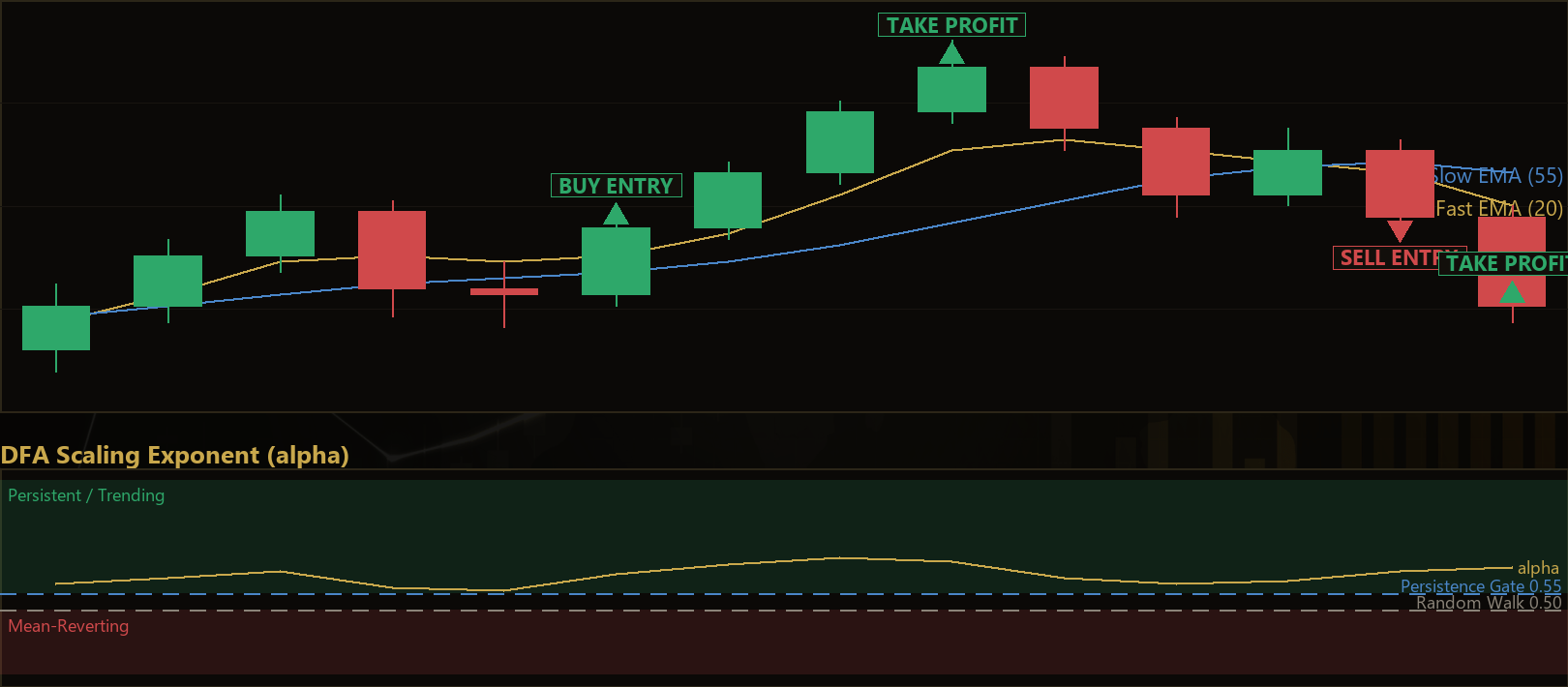
The Fluctuation Scaling Trend Regime strategy is an educational MetaTrader 5 expert advisor built around Detrended Fluctuation Analysis (DFA), a statistical technique borrowed from physics that measures how "self-similar" a price series is across different time scales. Its trading style is regime-gated trend following: it only allows trend trades when a mathematical test suggests the market is genuinely trending rather than wandering randomly. In plain terms, DFA produces a single number — the scaling exponent, usually written as alpha — that describes whether recent price movement is persistent (momentum tends to continue), random (no exploitable structure), or mean-reverting (moves tend to snap back).
The core idea is that most technical trend systems fire signals all the time, including during choppy, directionless conditions where those signals fail repeatedly. Fluctuation Scaling Trend Regime tries to address that by adding a statistical "permission gate" in front of a conventional moving-average trend engine. Only when DFA confirms the series is persistent does the strategy look for an entry, and it then rides the direction defined by a fast and slow Exponential Moving Average (EMA) — a moving average that weights recent prices more heavily than older ones.
This EA is best understood as a learning tool for traders who want to study how regime detection and self-affine scaling concepts can be combined with classic moving-average and Average True Range (ATR)-based risk logic. It is well suited to students of quantitative trading, hobbyist algo developers, and anyone curious about applying fractal-scaling statistics to price data. It is not a shortcut and it is not a finished product — treat it as a framework for experimentation and study.
How It Works
The strategy evaluates its logic once per completed bar on the chart's primary timeframe, so signals are based on closed candles rather than the flickering current price. Here is what happens on each new bar:
- Measure the regime with DFA. The strategy takes the most recent block of closing prices (set by
DfaWindow), converts them into a return series, builds the cumulative "profile," splits it into boxes of several sizes, removes a straight-line trend inside each box, and measures the leftover fluctuation. The slope of log-fluctuation versus log-box-size gives the scaling exponent alpha. - alpha ≈ 0.5 suggests a random walk with no exploitable structure.
- alpha > 0.5 suggests a persistent, trending series where momentum may continue.
- alpha < 0.5 suggests an anti-persistent, mean-reverting series.
- Apply the persistence gate. The series is treated as trending only when alpha is above
TrendThreshold. If the market does not pass this test, no new trade is opened — this is the strategy's main filter against choppy conditions. - Define trend direction with two EMAs. A fast EMA (
FastEma) and a slow EMA (SlowEma) establish drift. When the fast EMA sits above the slow EMA the drift is up; when it sits below, the drift is down. - Time the entry with a fresh close-cross. The strategy signals a long only when the close crosses from below to above the fast EMA on that bar, and a short only when the close crosses from above to below it. This ensures entries are triggered by a fresh event rather than a stale condition.
Entry conditions:
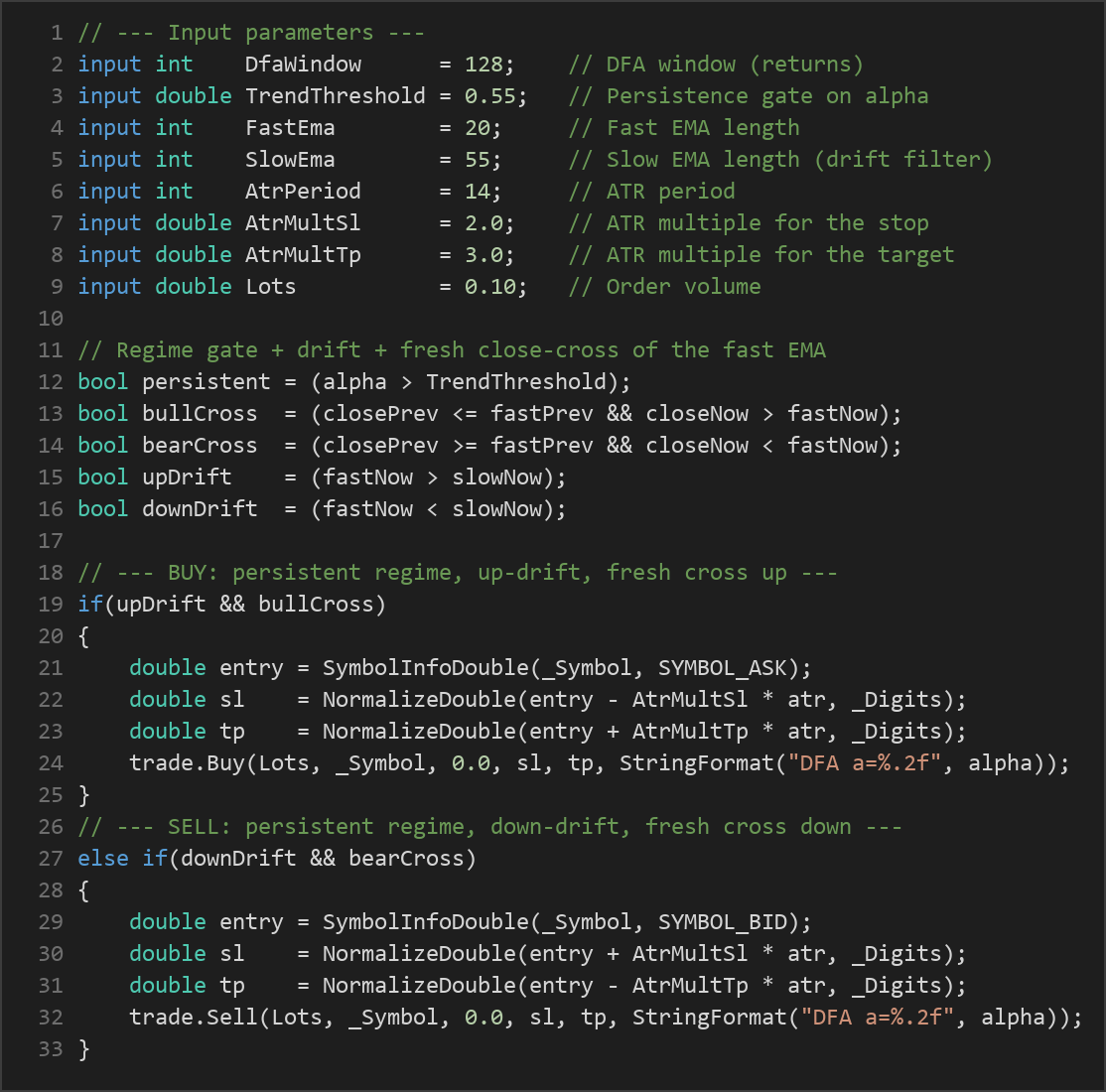
- Long: DFA reports persistence (alpha above threshold), the fast EMA is above the slow EMA (up-drift), and the close makes a fresh bullish cross above the fast EMA.
- Short: DFA reports persistence, the fast EMA is below the slow EMA (down-drift), and the close makes a fresh bearish cross below the fast EMA.
Exit, stop-loss, and take-profit logic:
- Opposite-cross exit: An open long is closed if a bearish fast-EMA cross appears; an open short is closed if a bullish fast-EMA cross appears. This lets the trade exit when the short-term structure flips against it.
- Stop-loss: Placed a distance of
AtrMultSl× ATR away from entry, so the stop automatically widens in volatile markets and tightens in calm ones. - Take-profit: Placed
AtrMultTp× ATR away from entry in the trade's favour, giving a volatility-scaled target. - One position at a time per magic number, so the EA does not stack multiple trades on the same symbol.
Strategy Parameters
| Parameter | Default | Min | Max | Description |
|---|---|---|---|---|
| DfaWindow | 128 | 64 | 256 | Number of returns used to compute the DFA scaling exponent. Larger windows give a smoother, slower-reacting regime estimate. |
| TrendThreshold | 0.55 | 0.50 | 0.70 | Persistence gate on alpha. The market must score above this value to be treated as trending. Higher values demand stronger persistence. |
| FastEma | 20 | 5 | 60 | Length of the fast EMA used for the entry cross and direction. Shorter values react faster and produce more signals. |
| SlowEma | 55 | 20 | 150 | Length of the slow EMA used as the drift/direction filter. |
| AtrPeriod | 14 | 7 | 40 | Lookback period for the ATR used to size the stop and target. |
| AtrMultSl | 2.0 | 1.0 | 5.0 | ATR multiple that sets the stop-loss distance from entry. |
| AtrMultTp | 3.0 | 1.0 | 8.0 | ATR multiple that sets the take-profit distance from entry. |
| Lots | 0.10 | 0.01 | 1.0 | Fixed order volume in lots for each trade. |
Recommended Chart Settings
Fluctuation Scaling Trend Regime was designed as a general-purpose trend-following framework and is most naturally studied on liquid instruments such as major forex pairs (for example, EUR/USD or GBP/USD) on intermediate timeframes like H1 or H4. These timeframes give the DFA window enough bars to produce a stable scaling exponent while still generating a workable number of signals for study.
Because the strategy relies on a statistical estimate of persistence, it needs a healthy amount of price history loaded on the chart — at least the DFA window plus the slow EMA and ATR periods. Keep in mind that behaviour will vary considerably across symbols, timeframes, and market conditions. Always test any configuration on your own broker's data before drawing conclusions, since spreads, session liquidity, and volatility differ between instruments.
How to Install on MetaTrader 5
- Download the .ex5 file from the link below
- Copy it to your MT5
MQL5\Expertsfolder - Restart MetaTrader 5 or refresh the Navigator panel
- Drag the EA onto a chart matching the recommended symbol and timeframe
- Configure the input parameters and enable Algo Trading
What to Consider Before Using This EA
Strengths of the approach. The most interesting feature of Fluctuation Scaling Trend Regime is that it does not simply trade every moving-average cross. By requiring DFA to confirm persistence first, it attempts to sit out the random, choppy phases that punish naive trend systems. The ATR-based stop and target adapt to volatility automatically, and the opposite-cross exit gives the strategy a clear, rule-based way to leave a trade when momentum flips. As a study piece, it neatly demonstrates how a statistical regime filter can be layered on top of familiar indicators.
Known limitations. DFA is a lagging, window-based estimate: by the time alpha rises above the threshold, part of the trend may already have unfolded, and by the time it falls back, the regime may have changed again. The scaling exponent can also be noisy on shorter windows, producing borderline readings that flip in and out of "persistent." Like all trend-following logic, this strategy is vulnerable to whipsaws when a market that recently trended stalls, and the opposite-cross exit can close trades early during normal pullbacks. Fixed lot sizing means position risk does not scale with account equity.
Where it may underperform. Expect weaker behaviour in tight ranges, low-volatility consolidations, and news-driven spikes that violate the smooth-scaling assumptions behind DFA. During strong mean-reverting regimes — precisely where alpha is low — the persistence gate should keep the EA on the sidelines, but no filter is perfect, and borderline readings can still allow poorly timed entries. This is a tool for learning about regime detection, not a guarantee of favourable outcomes.
Risk Management Tips
- Risk a small, fixed fraction per trade. A common educational guideline is to risk no more than 1–2% of account equity on any single position. Size your lots so that the ATR-based stop distance corresponds to that fraction, rather than leaving the volume at a default value.
- Start on a demo account. Run the EA on a demo or simulation environment first so you can observe how often the DFA gate opens trades and how the exits behave in live conditions, without financial exposure.
- Understand drawdown. Every trend strategy endures losing streaks during range-bound periods. Study the depth and duration of drawdowns in testing so you know what to expect emotionally and financially.
- Diversify and avoid overfitting. Resist the temptation to tune parameters until a backtest looks perfect on one symbol — such settings rarely generalize. Test across multiple instruments and time periods.
- Mind costs and leverage. Spreads, commissions, and slippage erode results, and leverage magnifies both gains and losses. Factor these realities into any evaluation.
Risk Warning
Trading foreign exchange, CFDs, and other leveraged financial instruments involves substantial risk of loss and is not suitable for all investors. The strategies and tools discussed on this page are provided for educational purposes only and do not constitute financial advice, investment recommendations, or solicitation to trade. Always consult a qualified financial adviser before making trading decisions. Past backtest performance is not indicative of future results.
Downloads
- Expert Advisor: FluctuationScalingTrendRegime.ex5 (46 downloads)
- Source Code: FluctuationScalingTrendRegime.mq5 (50 downloads)
- Documentation: FluctuationScalingTrendRegime.pdf (56 downloads)