Disclaimer: This article is for educational and informational purposes only. It does not constitute financial or investment advice. Trading forex and CFDs carries significant risk of loss. Past performance of any strategy — including backtests — does not guarantee future results. Never trade with money you cannot afford to lose.
What Is This Strategy?
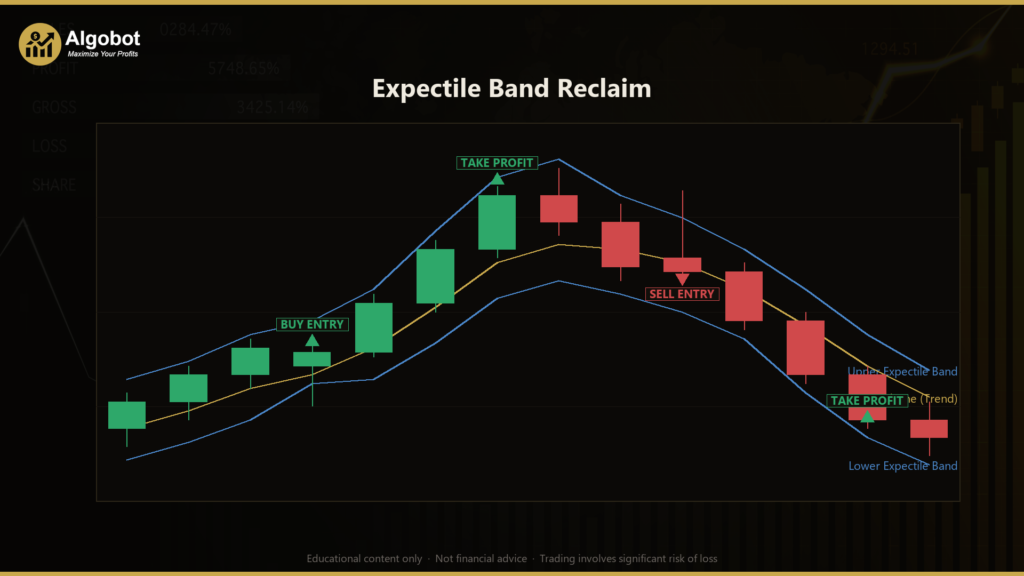
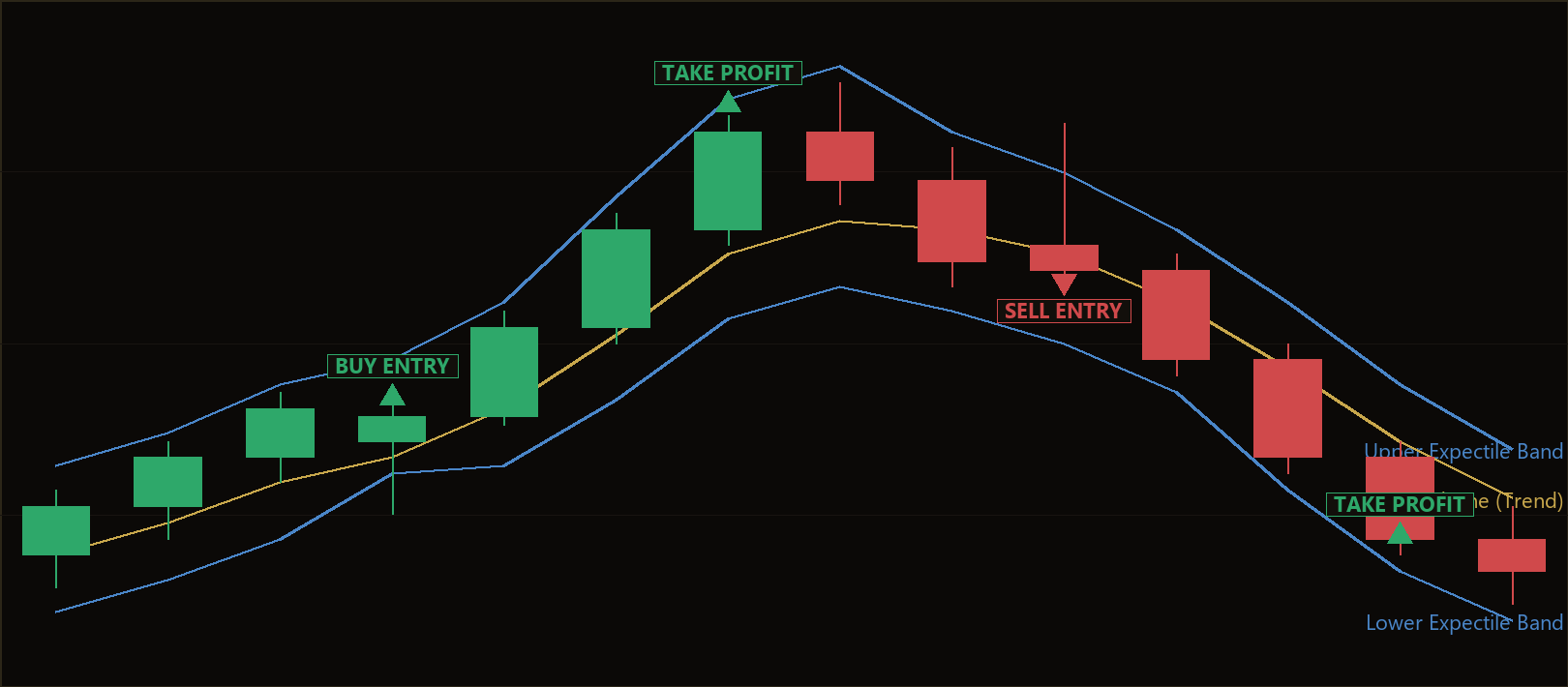
The Expectile Band Reclaim strategy is a trend-pullback trading system built around an expectile envelope — a statistical band that most traders have never encountered. It is designed as an educational study of how asymmetric statistics behave in a trending market, and how a shallow dip inside a trend can be distinguished from a genuine trend break. The trading style is trend continuation: it looks to re-enter in the direction of an existing move after price briefly pulls back and then recovers.
To understand the core idea, it helps to know what an expectile is. An expectile is to the mean what a quantile (percentile) is to the median. The 0.5-expectile is simply the ordinary average of a window of prices. As you push the expectile level (called tau) toward the tails, the band responds not just to how often price visits each side, but to how far price travels on each side — because it weights squared distances asymmetrically. Symmetric tools like Bollinger Bands (standard deviation) and ordinary percentile bands treat both tails identically. Expectile bands do not: in a real uptrend, upside excursions are larger and more frequent, so the upper band floats well above price while the lower band hugs it closely.
That asymmetry is the whole point. Because the lower band sits tight to price during an uptrend, a dip that actually pierces the lower expectile is — by construction — a shallow, high-probability pullback rather than the start of a reversal. This makes the strategy a useful learning tool for anyone studying volatility bands, mean-reversion-within-trend behavior, or the difference between symmetric and asymmetric statistical measures. It is not a shortcut to results, and it is best treated as a framework for understanding market structure on a demo account.
How It Works
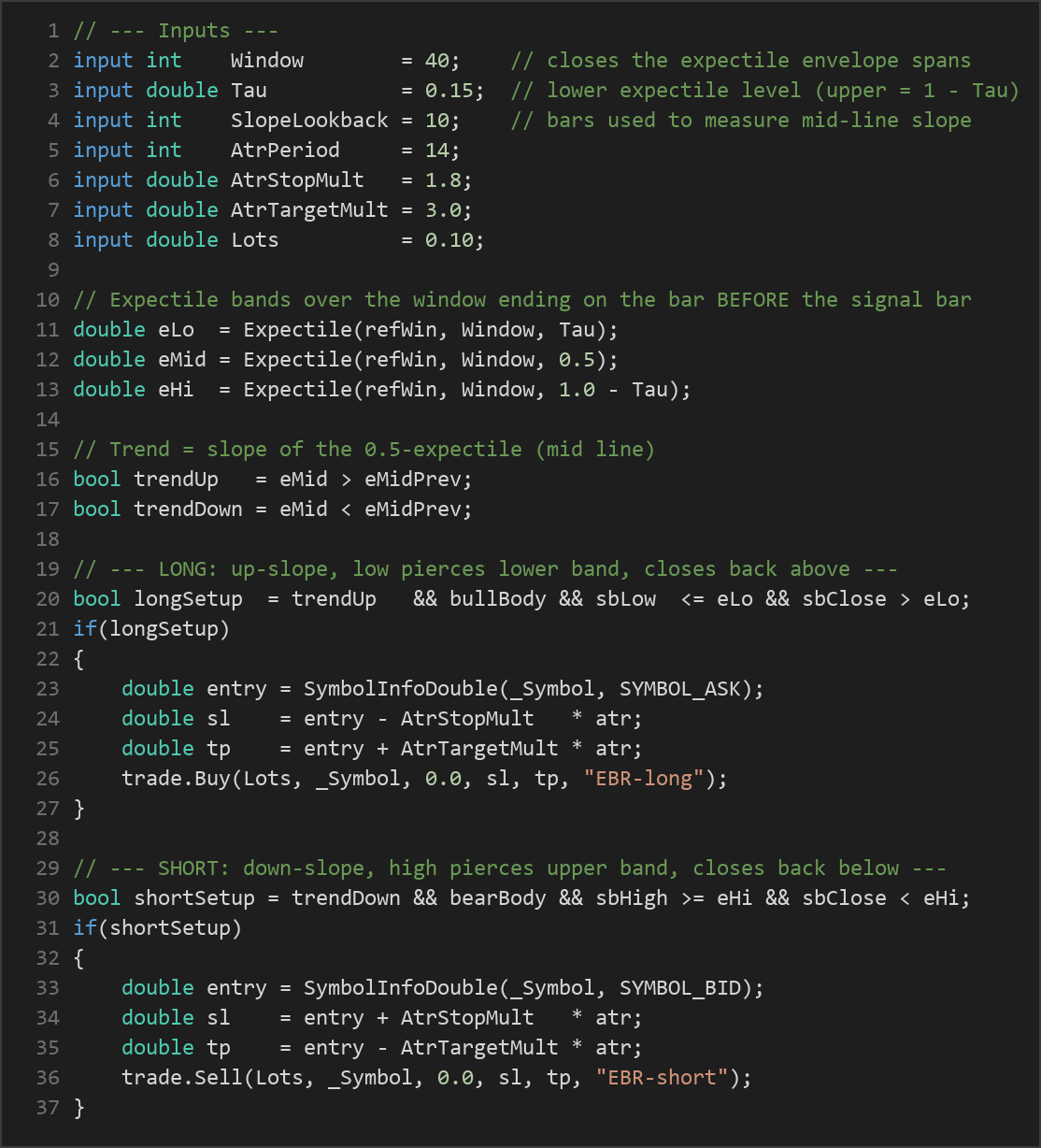
The strategy evaluates one signal per newly-closed bar. It measures the expectile envelope over a window of closing prices that ends on the bar before the signal candle, so the signal bar interacts with a band it did not itself help define. Trend direction comes from the slope of the mid line (the 0.5-expectile, which equals the window mean).
Trend definition:
- The strategy computes the mid line (0.5-expectile) over the current window and over the same window shifted back by
SlopeLookbackbars. - If the current mid line is higher than the earlier one, the trend is considered up.
- If it is lower, the trend is considered down.
Long entry — the strategy signals a buy when all of the following are true:
- The trend is up (rising mid line).
- The just-closed bar has a bullish body (close above open).
- The bar's low pierces the lower expectile band (the
Taulevel) — price dipped into the band. - The bar closes back above the lower band — the "reclaim" that gives the strategy its name.
Short entry — the strategy signals a sell when the mirror conditions hold:
- The trend is down (falling mid line).
- The just-closed bar has a bearish body (close below open).
- The bar's high pierces the upper expectile band (the
1 − Taulevel). - The bar closes back below the upper band.
Stop-loss logic:
- Both stops are volatility-based, using the Average True Range (ATR) — a measure of how much price typically moves per bar.
- A long stop is placed
AtrStopMult × ATRbelow entry; a short stop is placed the same distance above entry.
Take-profit logic:
- The target is also ATR-based:
AtrTargetMult × ATRin the direction of the trade. - With the default multipliers (1.8 stop, 3.0 target), the target distance is larger than the stop distance, giving a reward-to-risk ratio of roughly 1.67-to-1 on each signal.
Position management:
- Only one position per magic number is allowed on the symbol at a time, so the strategy will not stack trades. A new signal is ignored while a position is already open.
Strategy Parameters
| Parameter | Default | Min | Max | Description |
|---|---|---|---|---|
| Window | 40 | 15 | 120 | Number of closing prices the expectile envelope is measured over. Larger values produce a smoother, slower-moving band. |
| Tau | 0.15 | 0.05 | 0.40 | Lower expectile level (the upper band uses 1 − Tau). Smaller values push the bands wider apart. |
| SlopeLookback | 10 | 3 | 40 | Number of bars used to measure the slope of the 0.5-expectile mid line, which defines trend direction. |
| AtrPeriod | 14 | 5 | 30 | Number of bars used to calculate the ATR that sizes the stop and target. |
| AtrStopMult | 1.8 | 0.5 | 4.0 | Multiplier applied to ATR to set the stop-loss distance from entry. |
| AtrTargetMult | 3.0 | 1.0 | 8.0 | Multiplier applied to ATR to set the take-profit distance from entry. |
| Lots | 0.10 | 0.01 | 1.0 | Fixed trade size in lots for each position. |
Recommended Chart Settings
The Expectile Band Reclaim EA is single-timeframe only — every calculation runs on whatever timeframe the chart is set to when the strategy loads. This makes it flexible, but it also means the character of the signals changes with your chosen timeframe.
As a starting point for study, many pullback-continuation strategies of this type are examined on major forex pairs (such as EUR/USD or GBP/USD) on the H1 (1-hour) or H4 (4-hour) timeframes, where trends are more persistent and the ATR-based stops have room to breathe. Lower timeframes generate more signals but also more noise, while higher timeframes generate fewer, slower signals.
Because the strategy depends on a window of at least Window + SlopeLookback + 1 completed bars before it will act, allow the chart enough history to load. Remember that results will vary substantially across different symbols, timeframes, and market conditions — a setting that behaves one way in a trending market may behave very differently in a ranging one. Always test any configuration on a demo account first.
How to Install on MetaTrader 5
- Download the .ex5 file from the link below
- Copy it to your MT5
MQL5\Expertsfolder - Restart MetaTrader 5 or refresh the Navigator panel
- Drag the EA onto a chart matching the recommended symbol and timeframe
- Configure the input parameters and enable Algo Trading
What to Consider Before Using This EA
The strength of the Expectile Band Reclaim approach is conceptual clarity. By using an asymmetric band, it targets a specific, well-defined event: a shallow dip within an established trend that immediately recovers. The "close back above/below the band" reclaim requirement filters out bars that merely poke into the band and keep going, which are more often signs of a breakdown than a pullback. The trend filter (mid-line slope) adds a second layer of confirmation, and ATR-based exits automatically adapt to changing volatility.
The limitations are equally important to understand. Like all trend-continuation systems, this strategy assumes a trend exists. In choppy, sideways, or range-bound markets, the mid-line slope can flip back and forth, producing conflicting long and short signals and a series of small losing trades — a common weakness of pullback methods. Expectile bands, while elegant, are still a statistical estimate of recent history; they do not predict the future and can be whipsawed by news-driven spikes or gaps. The fixed reward-to-risk profile also means that a market with many small pullbacks that fail to continue can erode results even if the "big" moves are captured.
This EA is best viewed as a learning framework for studying asymmetric volatility bands and pullback structure — not as a finished, hands-off system. Historically, no single set of parameters performs well across all instruments and regimes, so ongoing observation and testing matter.
Risk Management Tips
Sound risk management matters more than any single entry signal. As you study this strategy, keep these general principles in mind:
- Risk a small fraction per trade. A widely taught guideline is to risk no more than 1–2% of your account on any single position. Adjust the
Lotsparameter so the ATR-based stop distance stays within that limit. - Understand drawdown. Even a well-designed strategy will experience losing streaks. Know the maximum drawdown you are willing to tolerate before you begin, and size positions accordingly.
- Use a demo account first. Test the EA on a demo or paper-trading account across different market conditions before considering any live capital. This lets you observe how it behaves in trends, ranges, and volatile news periods.
- Diversify and avoid over-leverage. Concentrating risk in a single symbol or using excessive leverage can turn a normal drawdown into a serious loss.
- Review regularly. Markets evolve. Periodically re-examine whether the parameters still suit current conditions rather than assuming past behavior will persist.
Risk Warning
Trading foreign exchange, CFDs, and other leveraged financial instruments involves substantial risk of loss and is not suitable for all investors. The strategies and tools discussed on this page are provided for educational purposes only and do not constitute financial advice, investment recommendations, or solicitation to trade. Always consult a qualified financial adviser before making trading decisions. Past backtest performance is not indicative of future results.
Downloads
- Expert Advisor: ExpectileBandReclaim.ex5 (26 downloads)
- Source Code: ExpectileBandReclaim.mq5 (30 downloads)
- Documentation: ExpectileBandReclaim.pdf (40 downloads)