Disclaimer: This article is for educational and informational purposes only. It does not constitute financial or investment advice. Trading forex and CFDs carries significant risk of loss. Past performance of any strategy — including backtests — does not guarantee future results. Never trade with money you cannot afford to lose.
What Is This Strategy?
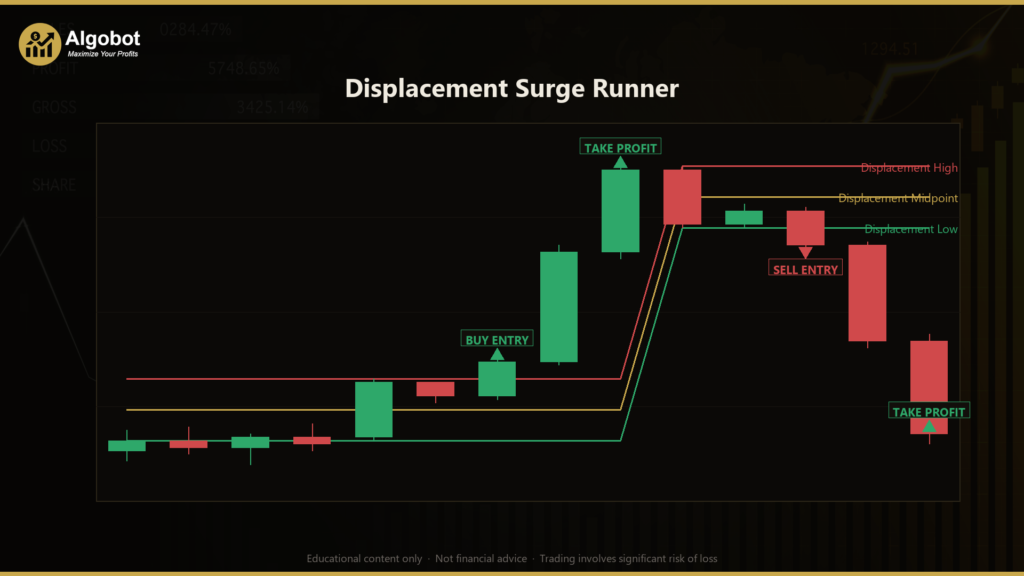
Displacement Surge Runner is a pure price-action momentum-continuation strategy that uses no traditional indicators at all — no moving averages, no RSI, no ATR. Its single "indicator" is the candle itself: the strategy reads raw open, high, low, and close (OHLC) data to detect a displacement candle, a bar whose real body is dramatically larger than the recent average and that closes near its own extreme. In price-action trading, a displacement candle is widely interpreted as a footprint of strong directional conviction — the kind of decisive push that often comes from institutional order flow rather than ordinary market noise.
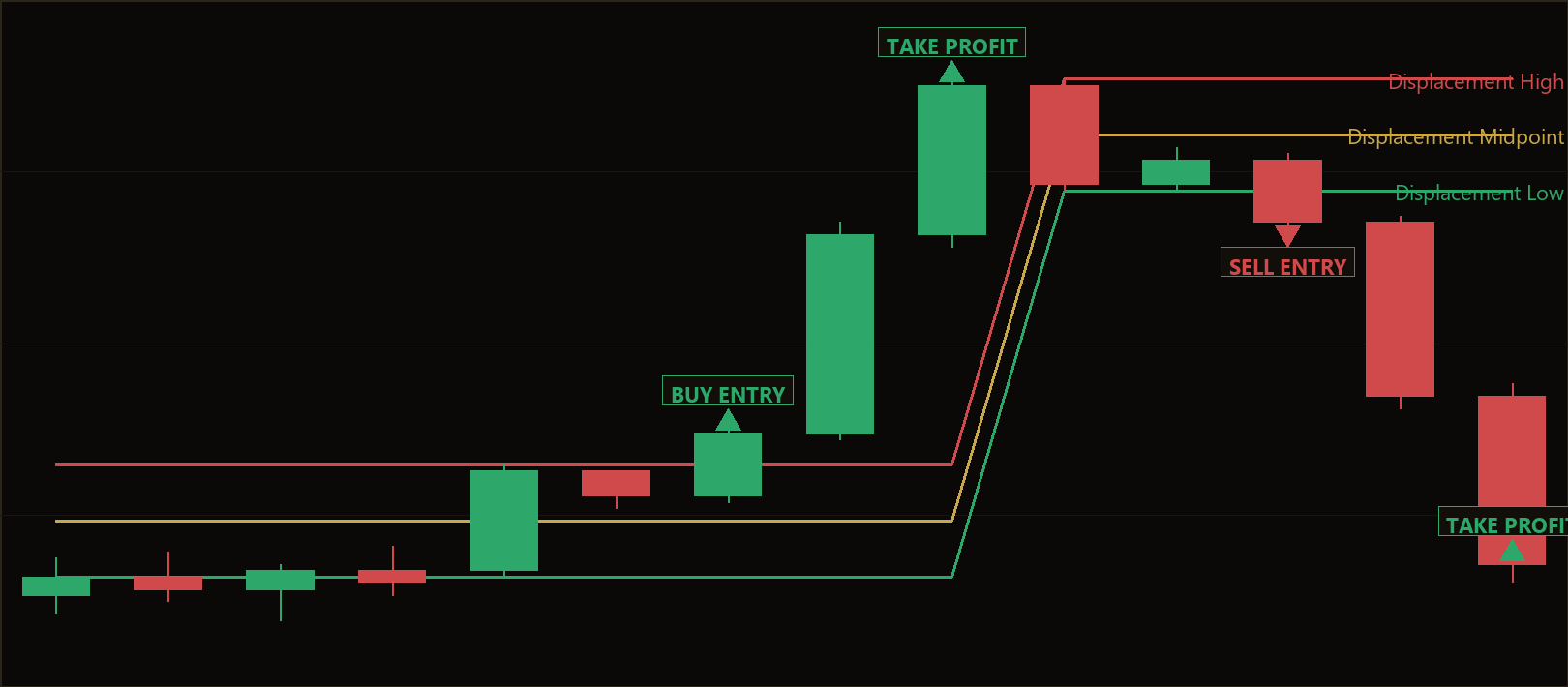
The strategy is designed for trending or impulsive market conditions, where momentum tends to arrive in waves: a strong push, a brief pause, and then a second push in the same direction. Rather than chasing the first surge — which can be a trap — Displacement Surge Runner waits patiently. It arms a setup after spotting the displacement bar, then looks for a shallow pullback followed by a clear continuation before committing to a trade. This "push, pause, push again" logic is what gives the strategy its name.
As a learning tool, this strategy suits traders who want to understand market structure and momentum without relying on lagging indicators. Because every decision is derived from candle geometry, studying it can sharpen your eye for reading raw price behavior. It is framed here as a strategy analysis for educational study, not as a profit opportunity.
How It Works
The strategy operates on fully-closed bars only — it evaluates the most recently completed candle once per new bar, never acting on the still-forming candle. The logic moves through three stages: arming, watching the pullback, and entering on continuation.
Arming a setup (detecting displacement):
- The strategy signals a potential setup when the just-closed candle's body is at least
BodyExpansiontimes larger than the average body of the precedingAvgBodyPeriodcandles. This identifies a sudden expansion in momentum. - The candle must also show conviction: its close must sit near the extreme it pushed toward. For a bullish bar, the close-to-low distance must be at least
CloseStrengthof the total range; for a bearish bar, the high-to-close distance must clear the same threshold. A big body with a long wick is rejected. - A qualifying bullish candle arms a long setup; a qualifying bearish candle arms a short setup. The strategy records the displacement bar's high, low, and midpoint as reference levels.
Watching the pullback:
- Once armed, the strategy watches subsequent candles for a shallow pullback that respects the displacement. For a long, price must hold above the displacement candle's midpoint; for a short, it must stay below the midpoint.
- If the pullback goes too deep — a long setup's candle dips its low below the midpoint, or a short setup's candle pokes its high above the midpoint — the strategy interprets momentum as failed and disarms the setup with no trade taken.
Entering on continuation:
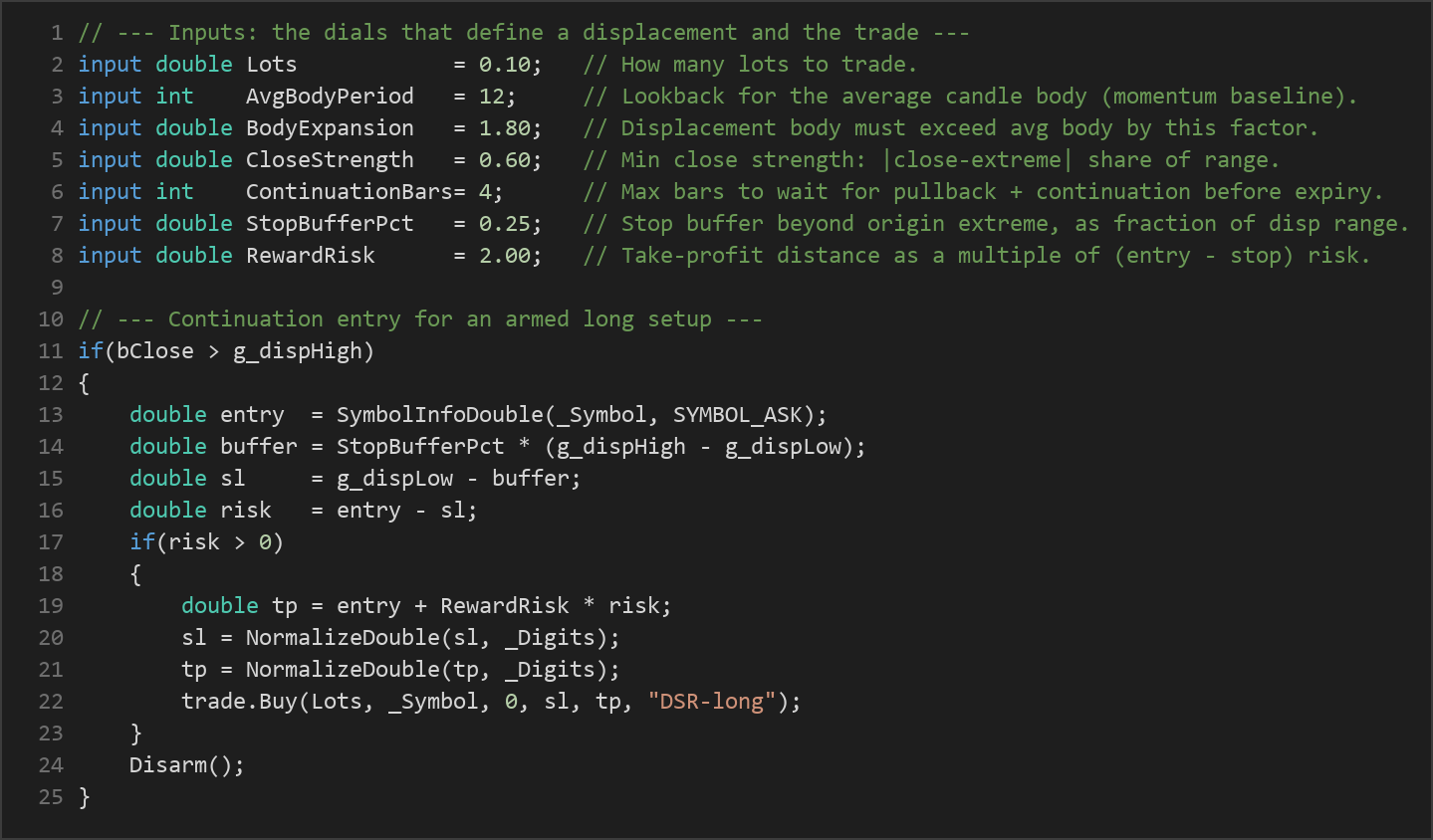
- The trade only triggers on proof that the surge resumed. For a long, a later candle must close above the displacement candle's high; for a short, a candle must close below the displacement candle's low.
- If neither continuation nor failure occurs within
ContinuationBarscandles, the armed setup simply expires.
Stop-loss logic:
- Risk is defined by the displacement candle itself. For a long, the stop is placed just below the displacement low, with an extra buffer of
StopBufferPctof the candle's range. For a short, the stop sits just above the displacement high plus the same buffer.
Take-profit logic:
- The take-profit is set at a fixed reward-to-risk multiple. The distance from entry to stop defines one unit of risk, and the target is placed
RewardRisktimes that distance away from entry. With the default of 2.0, the target sits twice as far as the stop.
Only one position per symbol and magic number is held at a time, and the strategy never arms a new setup on the same bar it just managed an existing one.
Strategy Parameters
| Parameter | Default | Min | Max | Description |
|---|---|---|---|---|
| Lots | 0.10 | 0.01 | 1.00 | Trade size in lots. Should be matched to your account size and risk tolerance. |
| AvgBodyPeriod | 12 | 5 | 30 | Number of prior candles used to compute the average body — the momentum baseline the displacement bar is measured against. |
| BodyExpansion | 1.80 | 1.20 | 3.50 | How many times larger than the average body the displacement candle must be to qualify as a surge. Higher values demand more extreme candles. |
| CloseStrength | 0.60 | 0.40 | 0.85 | Minimum close strength — the share of the candle's range between the close and the extreme it pushed toward. Higher values require closes nearer the high/low. |
| ContinuationBars | 4 | 1 | 8 | Maximum number of bars to wait for the pullback plus continuation before an armed setup expires. |
| StopBufferPct | 0.25 | 0.00 | 1.00 | Extra stop-loss buffer beyond the displacement candle's origin extreme, expressed as a fraction of its range. |
| RewardRisk | 2.00 | 1.00 | 4.00 | Take-profit distance as a multiple of the entry-to-stop risk. A value of 2.0 targets twice the risk distance. |
Recommended Chart Settings
Displacement Surge Runner was designed as a momentum-continuation system, so it tends to be most coherent on intraday timeframes such as M15, M30, or H1, where displacement candles map cleanly to genuine bursts of order flow rather than tick noise. Liquid instruments with clean trending behavior — major forex pairs like EUR/USD or GBP/USD, or major indices — are natural candidates for study.
Because the logic is built entirely on candle geometry, its behavior changes with the volatility character of each symbol and session. There is no single "correct" chart; results will vary considerably across different market conditions, instruments, and timeframes. Always study the strategy on your chosen market in a backtest and on a demo account before drawing conclusions.
How to Install on MetaTrader 5
- Download the .ex5 file from the link below
- Copy it to your MT5
MQL5\Expertsfolder - Restart MetaTrader 5 or refresh the Navigator panel
- Drag the EA onto a chart matching the recommended symbol and timeframe
- Configure the input parameters and enable Algo Trading
What to Consider Before Using This EA
Strengths of this approach. By using raw OHLC instead of lagging indicators, the strategy reacts to price the moment a candle closes, with no smoothing delay. Its insistence on a shallow pullback and a confirmed continuation filters out many one-candle traps, and because risk is anchored to the displacement candle's own range, every trade carries a clearly defined, structurally meaningful stop. The fixed reward-to-risk target also enforces discipline around exits.
Known limitations. Momentum-continuation logic is built for trending and impulsive markets. In choppy, range-bound conditions, displacement candles can appear and then immediately reverse, producing setups that arm and expire — or trigger and stop out — without follow-through. The strategy also has no news filter, so a displacement candle caused by a one-off data spike may not behave like a true momentum surge. Slippage and spread can meaningfully affect entries that fire on a close beyond an extreme, particularly on fast-moving bars.
Where it may underperform. Expect more failed setups during low-volatility consolidations, around major news releases, and in markets that gap frequently. The BodyExpansion and CloseStrength filters can be tightened to demand cleaner candles, but stricter filters also reduce the number of setups. This is a balance to study, not a setting to optimize blindly.
Risk Management Tips
Sound risk management matters far more than any single entry rule. A few general principles to study:
- Risk a small, fixed fraction per trade. Many educational sources suggest never risking more than 1–2% of account equity on any single position. Size your
Lotsso that the distance from entry to stop represents that fraction, not a round number that feels comfortable. - Understand drawdown. Even a strategy with a positive expectancy will experience losing streaks. Knowing how a sequence of losses would affect your account helps you size positions you can hold through rough patches.
- Test on a demo account first. Run the strategy in a simulated environment across varied market conditions before risking real capital, and compare its live behavior to your backtest assumptions.
- Account for costs. Spread, commission, and slippage all erode results, especially for a strategy that enters on closes beyond recent extremes. Factor realistic costs into any evaluation.
- Never trade with money you cannot afford to lose, and treat automated systems as tools that require ongoing supervision, not set-and-forget solutions.
Risk Warning
Trading foreign exchange, CFDs, and other leveraged financial instruments involves substantial risk of loss and is not suitable for all investors. The strategies and tools discussed on this page are provided for educational purposes only and do not constitute financial advice, investment recommendations, or solicitation to trade. Always consult a qualified financial adviser before making trading decisions. Past backtest performance is not indicative of future results.
Downloads
- Expert Advisor: DisplacementSurgeRunner.ex5 (40 downloads)
- Source Code: DisplacementSurgeRunner.mq5 (43 downloads)
- Documentation: DisplacementSurgeRunner.pdf (46 downloads)