
Disclaimer: This article is for educational and informational purposes only. It does not constitute financial or investment advice. Trading forex and CFDs carries significant risk of loss. Past performance of any strategy — including backtests — does not guarantee future results. Never trade with money you cannot afford to lose.
What Is This Strategy?
The Daily Open Gravity Fade is a mean-reversion trading strategy that anchors every decision to a single, fixed reference point: the current trading day's opening price. Instead of a moving average or a VWAP (Volume Weighted Average Price) that drifts with each new bar, it uses the day open as a static line — a price level that every intraday participant can see and remember. The strategy also uses the Average True Range (ATR), a classic volatility indicator that measures the typical size of a bar's price movement, to decide how far is "far" and where to place its protective stop.
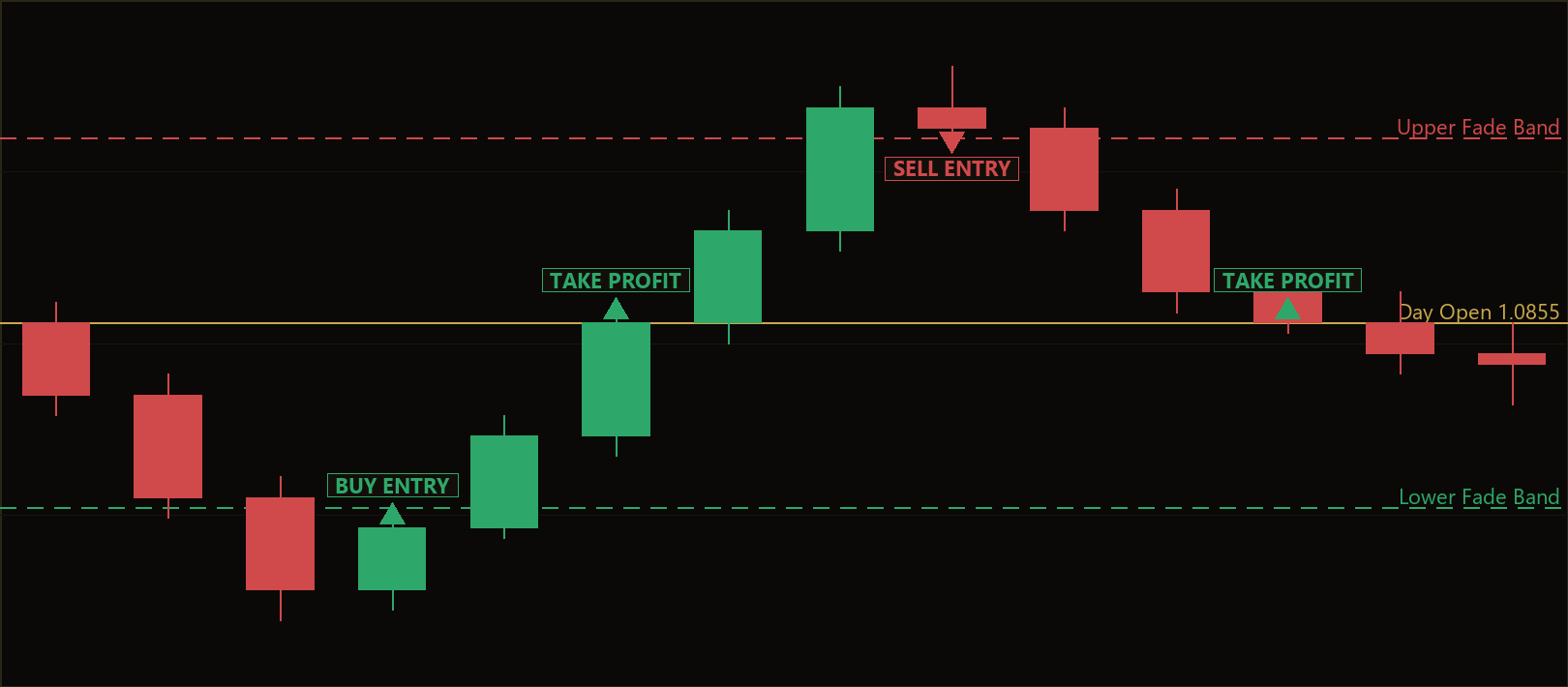
The core idea is "gravity." In balanced or ranging foreign-exchange (FX) sessions, price is repeatedly tugged back toward the opening level after it stretches away from it. When the just-closed bar sits several ATR units above or below the day open, the strategy treats that stretch as an overextension and fades it — meaning it trades against the recent move, betting on a snap-back toward the open. The open itself becomes the profit target, or "magnet," while ATR governs the stop distance. Because a runaway trend can keep stretching indefinitely, the strategy wraps the whole idea in an outer guard band so it does not try to catch a falling knife.
As a learning tool, the Daily Open Gravity Fade is well suited to traders who want to study session-anchored mean reversion, volatility-scaled position management, and reward-to-risk filtering in a single, readable framework. It is designed for liquid FX majors on intraday timeframes, where daily-open reversion is a familiar behavior. Treat it as a study of how a structural anchor can be combined with volatility measurement — not as a shortcut to any particular outcome.
How It Works
The strategy acts once per newly-closed bar on your chosen (primary) timeframe. Each time a bar closes, it evaluates the setup using the bar that just finished forming. Here is the logic in plain English:
- Rebuild the day open. On the first closed bar of each new calendar day (measured in UTC), the strategy records that bar's open as the day-open anchor. This value stays fixed for the rest of the day and is rebuilt fresh the next day. No higher timeframe is read — everything is aggregated from primary-timeframe bars.
- Measure the stretch. It calculates a signed distance in ATR units:
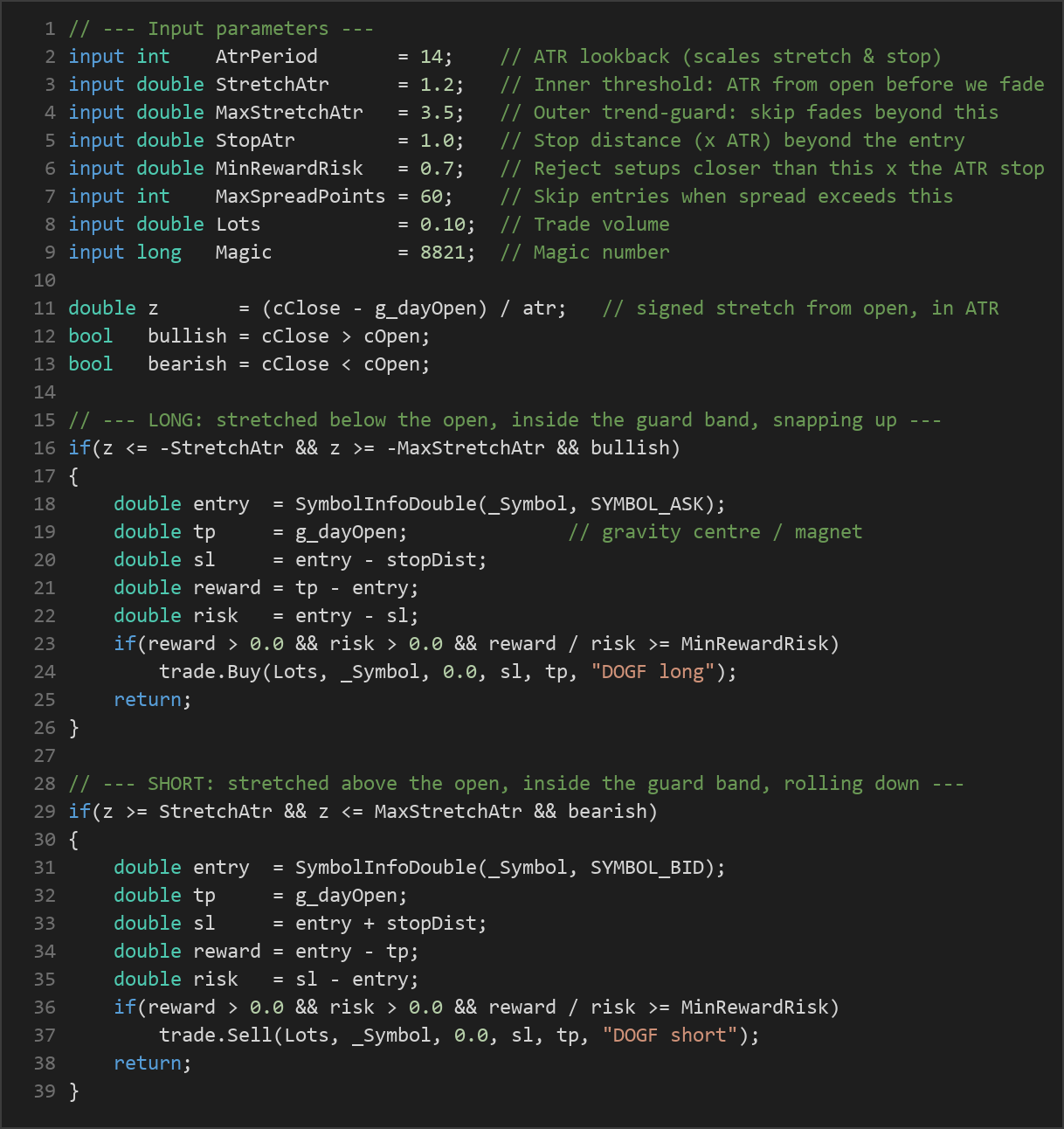
z = (close − dayOpen) / ATR. A positivezmeans price closed above the open; a negativezmeans it closed below. Expressing the stretch in ATR units keeps the threshold consistent across symbols and volatility regimes. - Long (buy) signal. The strategy signals a long when the just-closed bar is stretched below the open (
z ≤ −StretchAtr), is not beyond the outer guard (z ≥ −MaxStretchAtr), and the signal bar is bullish (its close is above its open, suggesting the snap-back has begun). The entry is at the ask price, the take-profit is the day open, and the stop-loss is placedStopAtr × ATRbelow the entry. - Short (sell) signal. The mirror image: price is stretched above the open (
z ≥ StretchAtr), still inside the guard (z ≤ MaxStretchAtr), and the signal bar is bearish. The entry is at the bid, the take-profit is the day open, and the stop isStopAtr × ATRabove the entry. - Take-profit logic. The target is always the day open — a real structural level that acts as the reversion magnet — rather than a fixed pip amount.
- Stop-loss logic. The stop scales with volatility. When ATR is large the stop is wider; when the market is quiet the stop tightens automatically. This keeps the protective distance proportional to current conditions.
- Reward-to-risk filter. Before sending any order, the strategy compares the potential reward (distance to the open) against the risk (the ATR stop distance). If price has already drifted too close to the open to justify the stop — that is, if the reward-to-risk ratio falls below
MinRewardRisk— the setup is rejected. - Spread and position filters. New entries are skipped when the current spread (in points) exceeds
MaxSpreadPoints, and only one position per Magic number is allowed at a time, so the structural stop and open target manage the exit without stacking trades.
Together these rules mean the strategy only fades stretches that sit inside a defined band, that show an early sign of turning back, and that still offer enough room to the open to be worth the risk.
Strategy Parameters
| Parameter | Default | Min | Max | Description |
|---|---|---|---|---|
| AtrPeriod | 14 | 5 | 40 | ATR lookback used to scale the stretch distance and the stop. |
| StretchAtr | 1.2 | 0.4 | 4.0 | Inner threshold — how many ATR away from the day open before the strategy fades. |
| MaxStretchAtr | 3.5 | 1.5 | 8.0 | Outer trend-guard — fades are skipped once price is beyond this many ATR (runaway protection). |
| StopAtr | 1.0 | 0.3 | 3.0 | Stop distance in multiples of ATR, placed beyond the entry. |
| MinRewardRisk | 0.7 | 0.3 | 3.0 | Rejects setups whose open target is closer than this multiple of the ATR stop distance. |
| MaxSpreadPoints | 60 | 5 | 300 | Skips new entries when the current spread (points) is wider than this. |
| Lots | 0.10 | 0.01 | 1.0 | Trade volume in lots. |
| Magic | 8821 | 0 | 9,999,999 | Unique identifier so the EA manages only its own positions. |
Recommended Chart Settings
The Daily Open Gravity Fade was designed for liquid FX majors on intraday timeframes — for example EURUSD or USDJPY on the M15 to H1 charts. These pairs and frames are the natural habitat of daily-open reversion, where balanced sessions repeatedly pull price back toward the opening level. The strategy runs on whatever timeframe is selected at backtest time, so you can experiment, but the intraday majors are the intended study environment.
Keep in mind that market behavior changes. A range-friendly environment where price oscillates around the open looks very different from a strong trending day where the open is left behind early. Results will vary across symbols, sessions, and market conditions, so any settings you study should be validated across a wide range of historical periods rather than a single favorable window.
How to Install on MetaTrader 5
- Download the .ex5 file from the link below
- Copy it to your MT5
MQL5\Expertsfolder - Restart MetaTrader 5 or refresh the Navigator panel
- Drag the EA onto a chart matching the recommended symbol and timeframe
- Configure the input parameters and enable Algo Trading
What to Consider Before Using This EA
Strengths of the approach. The Daily Open Gravity Fade is built around a genuinely structural reference. The day open is a level that many participants watch, which gives the anchor an intuitive rationale rather than a purely statistical one. Expressing the stretch in ATR units makes the threshold adapt to volatility, and the ATR-scaled stop keeps risk proportional to current conditions. The outer guard band (MaxStretchAtr) is an important design choice: it acknowledges that not every stretch reverts, and it refuses to fade the strongest, most extended moves. The reward-to-risk filter adds a further layer of selectivity by discarding setups that have already drifted too close to the target.
Known limitations. Mean-reversion strategies share a well-documented weakness: they tend to underperform during strong, sustained trends. On a decisively trending day, price may push away from the open and never look back, and while the guard band is designed to keep the strategy out of the most extreme runaways, borderline trends inside the band can still produce a run of stops. Because the take-profit is the open rather than a fixed distance, the reward on any single trade shrinks as price nears the open — the reward-to-risk filter is what keeps those low-reward setups out, but it also reduces the number of qualifying signals. The strategy holds only one position at a time per Magic number, so it is deliberately conservative in exposure.
Where it may struggle. Thin-liquidity sessions, news-driven volatility spikes, and instruments that trend persistently (rather than oscillate around a session anchor) are challenging conditions for this style. The spread filter helps avoid the worst execution windows, but no filter removes trend risk entirely. Study the strategy as an illustration of session-anchored reversion, and observe carefully how it behaves in both ranging and trending historical data before drawing any conclusions.
Risk Management Tips
Sound risk management matters more than any single indicator setting. The following are general educational principles, not recommendations tailored to your circumstances:
- Size positions conservatively. A common guideline is to risk no more than 1–2% of account equity on any single trade. Because this strategy's stop is
StopAtr × ATR, your actual monetary risk changes with volatility — recalculate your lot size accordingly rather than leavingLotsfixed. - Test on a demo account first. Run the EA on a demo or paper-trading account long enough to understand its trade frequency, its typical stop behavior, and how it responds to trending versus ranging days before considering any live use.
- Understand drawdown. Mean-reversion systems can experience clusters of losing trades during trends. Study the worst historical stretches, not just the average, so you know what a difficult period can look like.
- Account for costs. Spreads, commissions, and slippage all erode results, especially for a strategy whose target (the day open) can be a modest distance away. The
MaxSpreadPointsfilter helps, but real-world execution still differs from a backtest. - Never over-leverage. Leverage magnifies both gains and losses. Keep total exposure well within what your account can absorb during an adverse run.
Approach this EA as a way to learn how a structural anchor, a volatility measure, and a reward-to-risk filter interact — not as a set-and-forget solution.
Risk Warning
Trading foreign exchange, CFDs, and other leveraged financial instruments involves substantial risk of loss and is not suitable for all investors. The strategies and tools discussed on this page are provided for educational purposes only and do not constitute financial advice, investment recommendations, or solicitation to trade. Always consult a qualified financial adviser before making trading decisions. Past backtest performance is not indicative of future results.
Downloads
- Expert Advisor: DailyOpenGravityFade.ex5 (35 downloads)
- Source Code: DailyOpenGravityFade.mq5 (34 downloads)
- Documentation: DailyOpenGravityFade.pdf (37 downloads)